Fill out DWC forms
with AI.
Division of Workers' Compensation (DWC) forms are the essential documents used to manage the claims process following a workplace injury or illness. These forms facilitate critical communication between employers, employees, medical providers, and insurance carriers to ensure that injured workers receive the benefits they are entitled to while maintaining legal compliance. From documenting the initial report of an injury to calculating wage statements for compensation, these documents serve as the official record for the entire lifecycle of a workers' compensation claim.
By continuing, you acknowledge Instafill's Privacy Policy and agree to get occasional product update and promotional emails.
About DWC forms
Typically, these forms are handled by human resources professionals, safety officers, and healthcare providers who must navigate specific state regulations in regions like Texas, California, and Florida. For example, an employer might use the Employer’s First Report of Injury to meet strict filing deadlines, while a physician might submit a Request for Authorization to secure medical treatment for a patient. Because these situations often involve urgent medical needs and legal timelines, completing the paperwork accurately is vital to avoid delays in care or reimbursement.
Managing this volume of paperwork manually can be a significant administrative burden during a stressful time. Tools like Instafill.ai use AI to fill these DWC forms in under 30 seconds, ensuring that data is handled accurately and securely so you can focus on recovery and workplace safety rather than manual data entry.
Every form on this page can be completed without typing. Instafill is form filling software that reads a PDF and fills it for you — including flat and scanned documents that carry no fillable fields at all.
Forms in This Category
The forms in this category have a median Form Complexity Index of 59/100 (Moderate), measured across 5 forms by field count, input difficulty, length, conditional logic and structure. See how it is calculated.
| Form Name | Pages | FCI | |
|---|---|---|---|
| 1. | DWC Form-001, Employer’s first report of injury or illness | 2 | Moderate 59 |
| 2. | DWC Form RFA, Request for Authorization | 1 | Moderate 62 |
| 3. | DWC001S, Employer’s first report of injury or illness | 2 | Moderate 58 |
| 4. | DWC002, Employer’s report for reimbursement of voluntary payment | 2 | Basic 39 |
| 5. | Form DFS-F2-DWC-1a, Wage Statement | 1 | Complex 70 |
- Enterprise-grade security & data encryption
- 99%+ accuracy powered by AI
- 1,000+ forms from all industries
- Complete forms in under 60 seconds
How to Choose the Right Form
Navigating workers' compensation requirements can be complex, as forms vary significantly by state and specific administrative needs. To select the correct document, first identify the state jurisdiction and your role in the claims process.
Reporting a New Injury in Texas
If you are an employer in Texas and need to report a workplace injury, illness, or fatality, choose your form based on the recipient:
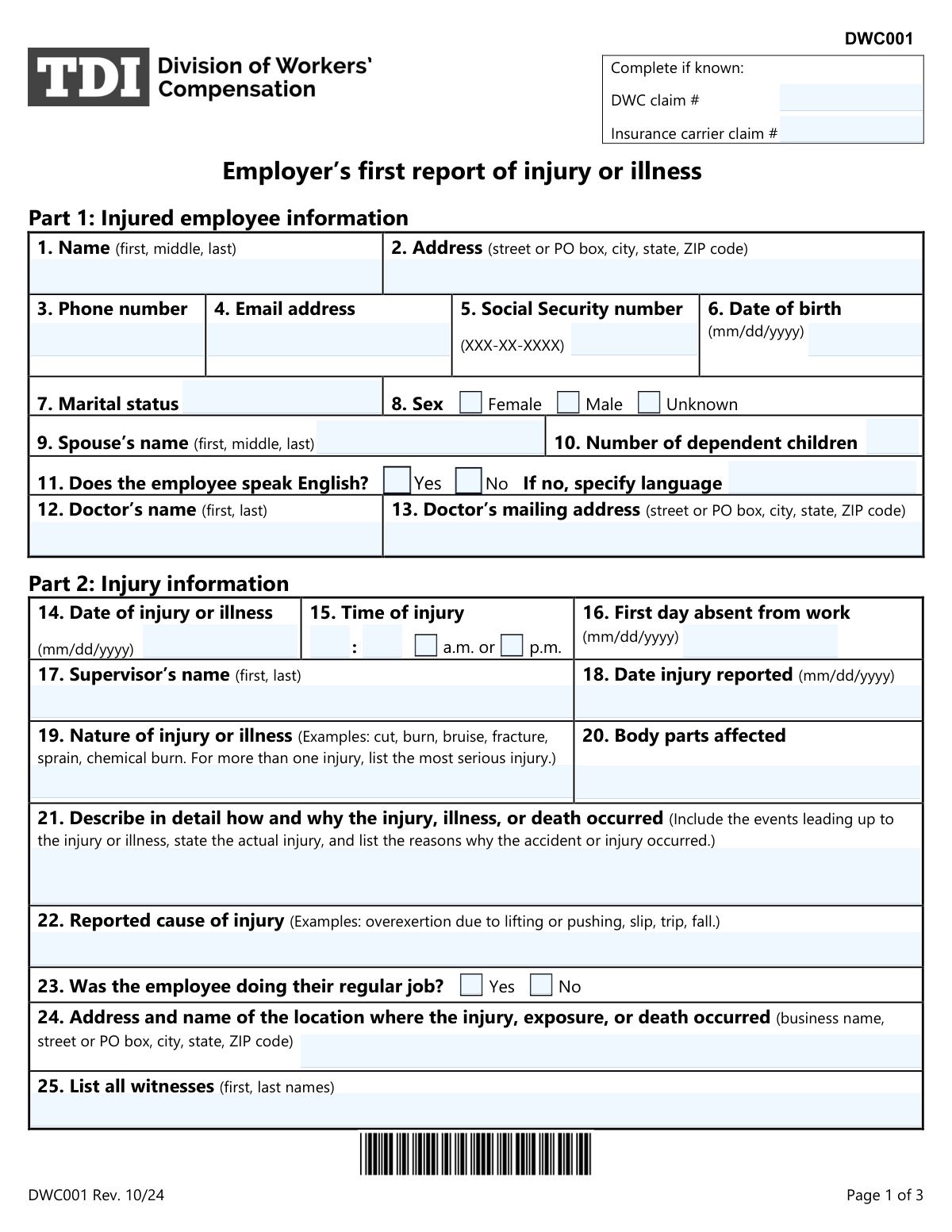
- DWC Form-001 (Employer’s First Report of Injury or Illness): This is the standard form for most Texas employers to report an incident to their private insurance carrier. It must be filed within eight days of the incident.
- DWC001S (Employer’s First Report of Injury or Illness - SORM): Use this specific version if you are a state agency or entity reporting to the State Office of Risk Management (SORM) rather than a private carrier.
Managing Payments and Reimbursements
Once a claim is active, employers and carriers use specific forms to finalize financial details:
- DWC002 (Employer’s Report for Reimbursement of Voluntary Payment): Use this form if you are a Texas employer seeking to recover costs from your insurance carrier for payments you voluntarily made to an injured employee before the claim was officially processed.
- Form DFS-F2-DWC-1a (Wage Statement): For claims in Florida, employers must use this form to report the employee's gross wages and benefits for the 13 weeks prior to the accident. This is essential for calculating the correct compensation rate.
Medical Authorizations in California
- DWC Form RFA (Request for Authorization): This form is used specifically in the California workers' compensation system. Unlike the other forms in this list, this is typically completed by a treating physician to request prior authorization for medical services from a claims administrator.
By identifying whether you are reporting an injury, calculating wages, or requesting medical treatment, you can ensure you submit the correct paperwork to the appropriate state agency.
Form Comparison
| Form | Primary Purpose | Submitting Party | Jurisdiction | Filing Trigger |
|---|---|---|---|---|
| DWC Form-001, Employer’s first report of injury or illness | Reports initial workplace injury or illness to the insurance carrier. | Texas employers | Texas | Within eight days of injury or employee absence. |
| DWC Form RFA, Request for Authorization | Requests prior authorization for medical treatment from a claims administrator. | Treating physicians | California | Before providing medical services to an injured worker. |
| DWC001S, Employer’s first report of injury or illness | Reports initial workplace injury to the State Office of Risk Management. | Texas state agency employers | Texas (SORM) | First step in initiating state employee workers' compensation claims. |
| DWC002, Employer’s report for reimbursement of voluntary payment | Requests reimbursement for voluntary payments made directly to employees. | Texas employers | Texas | After paying initial medical costs or supplemental income. |
| Form DFS-F2-DWC-1a, Wage Statement | Reports 13-week wage history to calculate compensation rates. | Florida employers | Florida | Following a workplace accident to determine average weekly wage. |
Tips for DWC forms
Workers' compensation regulations are strictly governed by state law, meaning a Texas DWC-001 is not interchangeable with forms from other states. Always double-check that you are using the specific version required by your state’s Division of Workers' Compensation to avoid administrative rejection.
Always cross-reference the exact date and time of the incident with your internal incident reports before filing. Inaccurate timing on a First Report of Injury can lead to significant delays or discrepancies when the insurance carrier reviews the corresponding medical records.
For wage statements like the Florida DFS-F2-DWC-1a, ensure you include all gross wages, tips, and fringe benefits for the exact 13-week lookback period. Small errors in these calculations can result in incorrect compensation rates and potential disputes with the claimant.
Managing high volumes of DWC forms is a major administrative burden for HR departments. AI-powered tools like Instafill.ai can complete these forms in under 30 seconds with high accuracy, ensuring your data stays secure throughout the entire process.
Ensure that the description of the injury or illness is consistent across the initial report and any subsequent reimbursement requests like the DWC002. Discrepancies between different filings can trigger unnecessary audits or investigations by the insurance carrier.
Many DWC forms have mandatory submission windows, such as the eight-day requirement for initial reports in Texas. Establishing a standardized internal workflow for these forms ensures you meet legal requirements and avoid costly late-filing penalties.
Frequently Asked Questions
DWC forms are standardized documents used by state Divisions of Workers' Compensation to manage the claims process for workplace injuries and illnesses. They facilitate communication between employers, injured workers, insurance carriers, and medical providers to ensure legal compliance and the timely delivery of benefits.
In most jurisdictions, the employer is responsible for filing this report after being notified of a workplace injury, illness, or death. For instance, Texas employers use DWC Form-001 to notify their insurance carrier, while state agencies use DWC001S to report to the State Office of Risk Management.
The choice depends on the type of employer and the insurance entity involved. DWC Form-001 is generally used by private employers reporting to their insurance carrier, whereas DWC001S is specifically for Texas state agencies reporting to the State Office of Risk Management (SORM).
The Request for Authorization (RFA) is a mandatory form used by treating physicians in California to request medical services for an injured worker. It initiates the utilization review process, allowing the claims administrator to determine if the requested treatment is medically necessary under state guidelines.
Florida employers must complete this form to report an employee's gross wages and benefits for the 13 weeks prior to a workplace accident. This data is essential for the insurance carrier to calculate the Average Weekly Wage (AWW), which determines the rate of compensation the injured worker will receive.
Yes, in Texas, employers can use Form DWC002 to request reimbursement from their insurance carrier for voluntary payments made to an injured employee. This allows employers to provide immediate financial support or cover medical costs while the official workers' compensation claim is being reviewed.
Yes, AI tools like Instafill.ai can automatically fill out DWC forms in under 30 seconds by accurately extracting data from your source documents and placing it into the correct fields. This technology helps ensure that complex reporting requirements are met without manual data entry errors.
While manual entry for detailed payroll or medical forms can take significant time, using AI-powered platforms like Instafill.ai allows you to complete these documents in seconds. The AI quickly maps information from your records directly into the PDF, streamlining the entire filing process.
No, DWC forms are specific to the state's regulatory body governing workers' compensation. While many states have similar requirements for reporting injuries or requesting medical authorization, the specific form numbers, layouts, and submission timelines vary significantly between states like Texas, California, and Florida.
Failing to submit required forms within state-mandated deadlines can result in administrative fines and legal penalties for employers. Additionally, late filings can delay the approval of medical treatments for employees and stall the distribution of necessary income benefits.
Submission targets vary by form; they are usually sent to the employer's workers' compensation insurance carrier, a state-specific risk management office, or the state's Division of Workers' Compensation. It is important to review the specific instructions for each form to ensure it reaches the correct claims administrator or government agency.
Glossary
- Form Complexity Index
- Instafill’s 0–100 measure of how much effort a form takes to complete, calculated deterministically from the form’s own structure rather than estimated. It combines the number of fillable fields (the largest factor), how difficult those fields are to complete based on their type, the number of pages that contain fields, the amount of conditional “fill-only-if” logic, and how many sections the form is divided into, then adds modifiers for tables and repeating lists, bundled instruction pages, and dense page layouts. A higher score means the form is harder to fill out by hand. The forms in this category have a median Form Complexity Index of 59/100 (Moderate). See exactly how it is calculated.
- Division of Workers' Compensation (DWC)
- The state-level government agency responsible for overseeing the administration of workers' compensation claims and resolving disputes between injured workers and employers.
- Average Weekly Wage (AWW)
- A calculation of an employee's gross earnings over a specific period before their injury, used to determine the amount of disability or indemnity benefits they will receive.
- Utilization Review (UR)
- A formal process used by insurance claims administrators to evaluate whether a requested medical treatment is medically necessary and appropriate for the specific injury.
- Occupational Disease
- A chronic ailment or illness that arises specifically out of the nature of an employee's work or environment, such as long-term exposure to toxic chemicals.
- Claims Administrator
- The entity, such as an insurance carrier or third-party administrator, that manages the workers' compensation claim and pays for medical treatment and lost wages.
- Wage Statement
- A mandatory report filed by an employer that details an employee's earnings, including overtime and fringe benefits, to ensure accurate benefit calculations.
- State Office of Risk Management (SORM)
- The specific agency in Texas that acts as the workers' compensation insurer for state employees and state-funded entities.
- Request for Authorization (RFA)
- A formal document submitted by a physician to a claims administrator to obtain prior approval for medical procedures, tests, or specialist consultations.