Fill out employment tax forms
with AI.
Employment tax forms are essential documents used by the IRS to manage tax obligations related to the workforce. They ensure that businesses and workers are correctly classified and that the appropriate amount of federal income tax, Social Security, and Medicare taxes are withheld and reported. Accurate completion of these documents is vital for maintaining compliance with federal labor and tax laws, as errors can lead to significant penalties or disputes regarding worker benefits and tax liabilities.
By continuing, you acknowledge Instafill's Privacy Policy and agree to get occasional product update and promotional emails.
About employment tax forms
These forms are typically used by business owners, HR professionals, and individual workers who need to clarify their professional relationship with a firm. For instance, when there is uncertainty about whether a worker should be classified as an independent contractor or a formal employee, specific filings like Form SS-8 are used to request a formal determination from the IRS. This process involves a detailed analysis of behavioral and financial control, making it a critical step during the onboarding process or when restructuring a company's labor model.
Managing these complex documents can be time-consuming, but tools like Instafill.ai use AI to accurately and securely populate these forms in under 30 seconds. By automating the data entry process, you can ensure that all relevant facts regarding financial and behavioral control are captured correctly, allowing you to focus on managing your business or career while maintaining full tax compliance.
Every form on this page can be completed without typing. Instafill is form filling software that reads a PDF and fills it for you — including flat and scanned documents that carry no fillable fields at all.
Forms in This Category
The forms in this category have a median Form Complexity Index of 76/100 (Complex), measured across 2 forms by field count, input difficulty, length, conditional logic and structure. See how it is calculated.
| Form Name | Pages | FCI | |
|---|---|---|---|
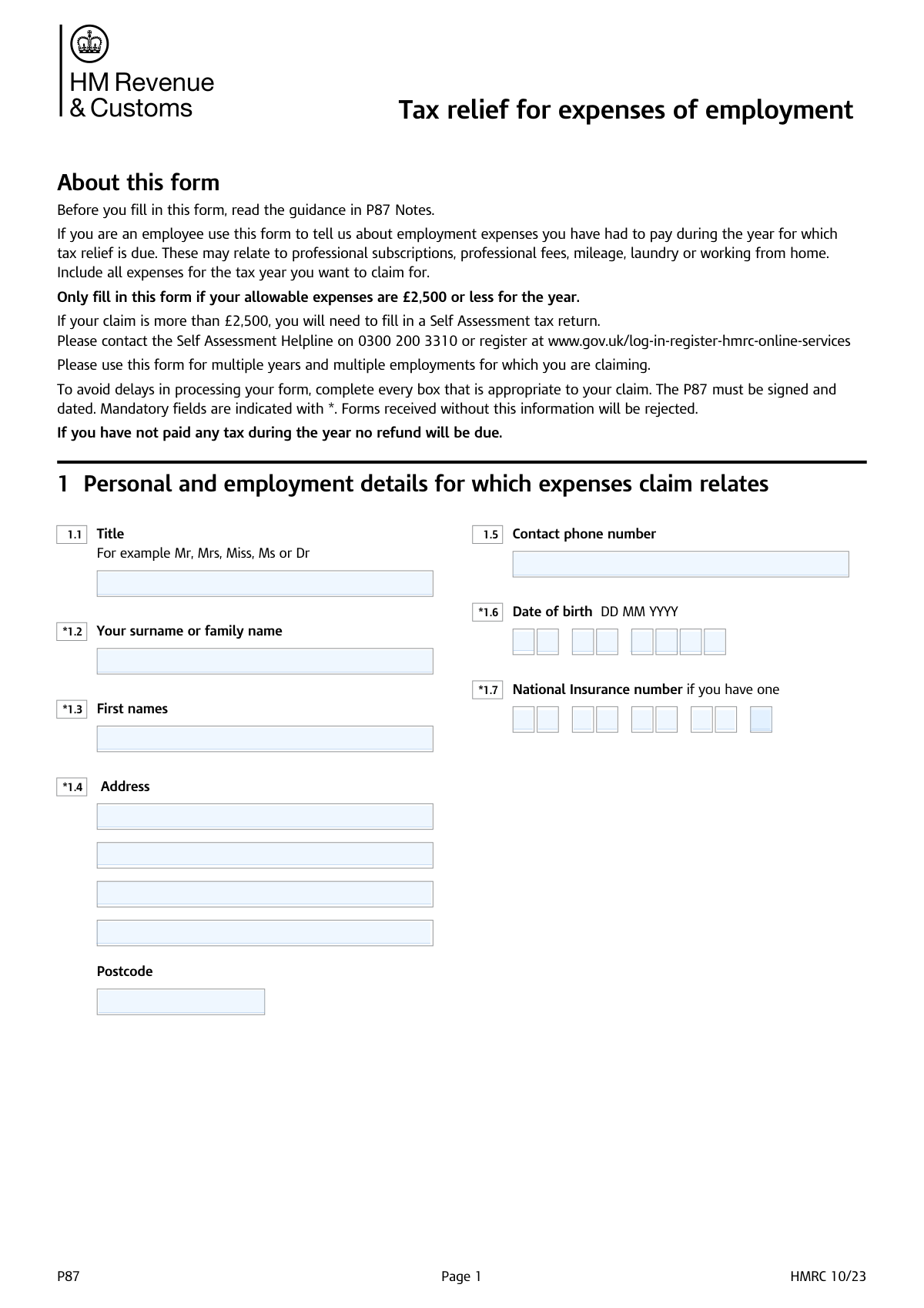
| 1. | P87: Tax relief for expenses of employment | 8 | Complex 73 |
| 2. | Form SS-8, Determination of Worker Status | 5 | Complex 76 |
- Enterprise-grade security & data encryption
- 99%+ accuracy powered by AI
- 1,000+ forms from all industries
- Complete forms in under 60 seconds
How to Choose the Right Form
Determining Worker Status
The primary form in this category is Form SS-8 (Determination of Worker Status for Purposes of Federal Employment Taxes and Income Tax Withholding). This form is essential when there is uncertainty or a dispute regarding whether a worker should be classified as an independent contractor or an employee for federal tax purposes.
When to Use Form SS-8
You should select this form if you need a formal determination from the IRS regarding tax obligations. It is typically used in the following scenarios:
- For Firms: If your business is unsure how to classify a new role and wants to avoid potential penalties for misclassification, filing Form SS-8 provides a definitive answer based on common-law rules.
- For Workers: If you believe you are being treated as an independent contractor (receiving a 1099) but your working conditions mirror those of an employee (receiving a W-2), you can use this form to request a status review to ensure your payroll taxes and withholdings are handled correctly.
Key Factors for Classification
When filling out Form SS-8, the IRS evaluates three main categories of evidence to make their determination:
- Behavioral Control: Does the business direct or control how the worker performs the specific task? This includes instructions and training provided by the firm.
- Financial Control: Does the business control the economic aspects of the worker’s job, such as how the worker is paid, whether expenses are reimbursed, or who provides tools and supplies?
- Relationship Type: Are there written contracts or employee-type benefits (such as insurance, pension plans, or vacation pay)?
What You Will Need
To complete Form SS-8 effectively, have your supporting documentation ready. This includes copies of contracts, job descriptions, and any previous tax forms like Form W-2 or Form 1099. Providing a detailed factual account of the working relationship is necessary for the IRS to process your request accurately. Note that because this form requires a detailed review by the IRS, it is often used for long-term classification clarity rather than immediate payroll processing.
Form Comparison
| Form | Purpose | Who Files It | Key Factors Evaluated |
|---|---|---|---|
| Form SS-8 (Rev. December 2023), Determination of Worker Status for Purposes of Federal Employment Taxes and Income Tax Withholding | Determines federal tax status as either an employee or an independent contractor. | Submitted by either the worker or the firm to obtain an IRS determination. | Evaluates behavioral control, financial control, and the specific nature of the relationship. |
Tips for employment tax forms
When filling out employment status forms, clearly describe who directs when, where, and how the work is performed. Detailed explanations of the training and instructions provided to the worker help the IRS make an accurate determination regarding their status.
Clearly state who provides the equipment and whether the worker incurs significant unreimbursed business expenses. These financial details are critical in distinguishing between an independent contractor and a traditional employee for payroll tax purposes.
Always include copies of written agreements, contracts, and previous tax statements like W-2s or 1099s. Providing these documents upfront prevents processing delays and gives the IRS a complete picture of the working relationship.
AI-powered tools like Instafill.ai can complete these complex employment tax forms in under 30 seconds with high accuracy. Your data stays secure during the process, making it a major time-saver when managing multiple filings or worker determinations.
Double-check that the information provided in the behavioral, financial, and relationship sections does not contradict itself. Consistent messaging ensures the IRS can process your request without needing additional clarification or follow-up.
Maintain a dedicated file for each worker status determination request, including a copy of the submitted form and all supporting evidence. This organization is essential for payroll tax compliance and simplifies the process if you need to reference the determination during a future audit.
Explain whether the relationship is intended to be indefinite or for a specific project with a set end date. Mentioning the presence or absence of benefits like insurance or vacation pay can further clarify the intended status of the worker.
Frequently Asked Questions
Employment tax forms are used by businesses and workers to document income, calculate tax withholdings, and determine the legal status of the working relationship. These documents ensure that Social Security, Medicare, and federal income taxes are correctly reported and paid to the Internal Revenue Service (IRS).
Worker classification is based on the level of behavioral and financial control a firm has over a worker. If you are uncertain about a worker's status, you can file a determination form with the IRS, which reviews the specific facts of the relationship to provide an official ruling.
Both the firm and the worker have the right to request a determination of federal tax status. This is often done when there is a disagreement or lack of clarity regarding whether the worker should receive a Form W-2 as an employee or a Form 1099 as an independent contractor.
Yes, you can use AI-powered tools like Instafill.ai to complete these documents. The AI can accurately extract relevant data from your source documents, such as contracts or payroll records, and place it into the correct fields in under 30 seconds.
While manual completion of complex tax forms can take significant time, using an AI tool like Instafill.ai allows you to fill them out in less than 30 seconds. The software automates the data entry process, ensuring high accuracy and saving you from repetitive typing.
Misclassifying an employee as an independent contractor can lead to significant financial penalties, including liability for unpaid employer shares of Social Security and Medicare taxes. It can also affect the worker's eligibility for unemployment insurance and workers' compensation benefits.
These forms are typically mailed to specific IRS addresses designated for worker status determinations, which vary depending on your location. It is important to check the most recent IRS instructions to ensure your documentation is sent to the correct processing center.
You should be prepared to provide copies of written contracts, job descriptions, and any evidence of how work is directed and performed. The IRS may also request copies of previous tax filings, such as Forms W-2 or 1099, to understand the historical context of the relationship.
The distinction determines who is responsible for withholding and paying federal taxes. For employees, the firm must handle tax withholding, while independent contractors are generally responsible for paying their own self-employment taxes directly to the IRS.
Standard employment tax forms like the W-4 or I-9 are required for every new employee, but determination forms are only used when there is a specific question about a worker's status. They are not part of the routine onboarding process unless the classification is in doubt.
Glossary
- Form Complexity Index
- Instafill’s 0–100 measure of how much effort a form takes to complete, calculated deterministically from the form’s own structure rather than estimated. It combines the number of fillable fields (the largest factor), how difficult those fields are to complete based on their type, the number of pages that contain fields, the amount of conditional “fill-only-if” logic, and how many sections the form is divided into, then adds modifiers for tables and repeating lists, bundled instruction pages, and dense page layouts. A higher score means the form is harder to fill out by hand. The forms in this category have a median Form Complexity Index of 76/100 (Complex). See exactly how it is calculated.
- Independent Contractor
- A person or business that provides services to another entity under a contract where the payer only controls the result of the work, not the specific methods used to achieve it.
- Withholding
- The portion of an employee's wages that an employer sends directly to the government as partial payment of the worker's income and payroll tax liabilities.
- Behavioral Control
- A category of evidence used by the IRS to determine worker status based on whether the business has the right to direct and control how the worker performs the specific tasks of the job.
- Financial Control
- A set of factors that determine whether a business has the right to direct the business aspects of a worker's job, such as how the worker is paid or if expenses are reimbursed.
- Common-Law Rules
- The legal standards and guidelines used by the IRS to evaluate the relationship between a worker and a business to determine if an employer-employee relationship exists.
- FICA Taxes
- Social Security and Medicare taxes paid by both employees and employers under the Federal Insurance Contributions Act.
- Firm
- The entity or individual for whom a worker performs services; in the context of Form SS-8, it refers to the business whose tax status is being evaluated.
- Worker Classification
- The formal determination of whether a person providing services is an employee or an independent contractor, which dictates how taxes are reported and paid.