Fill out heirship forms
with AI.
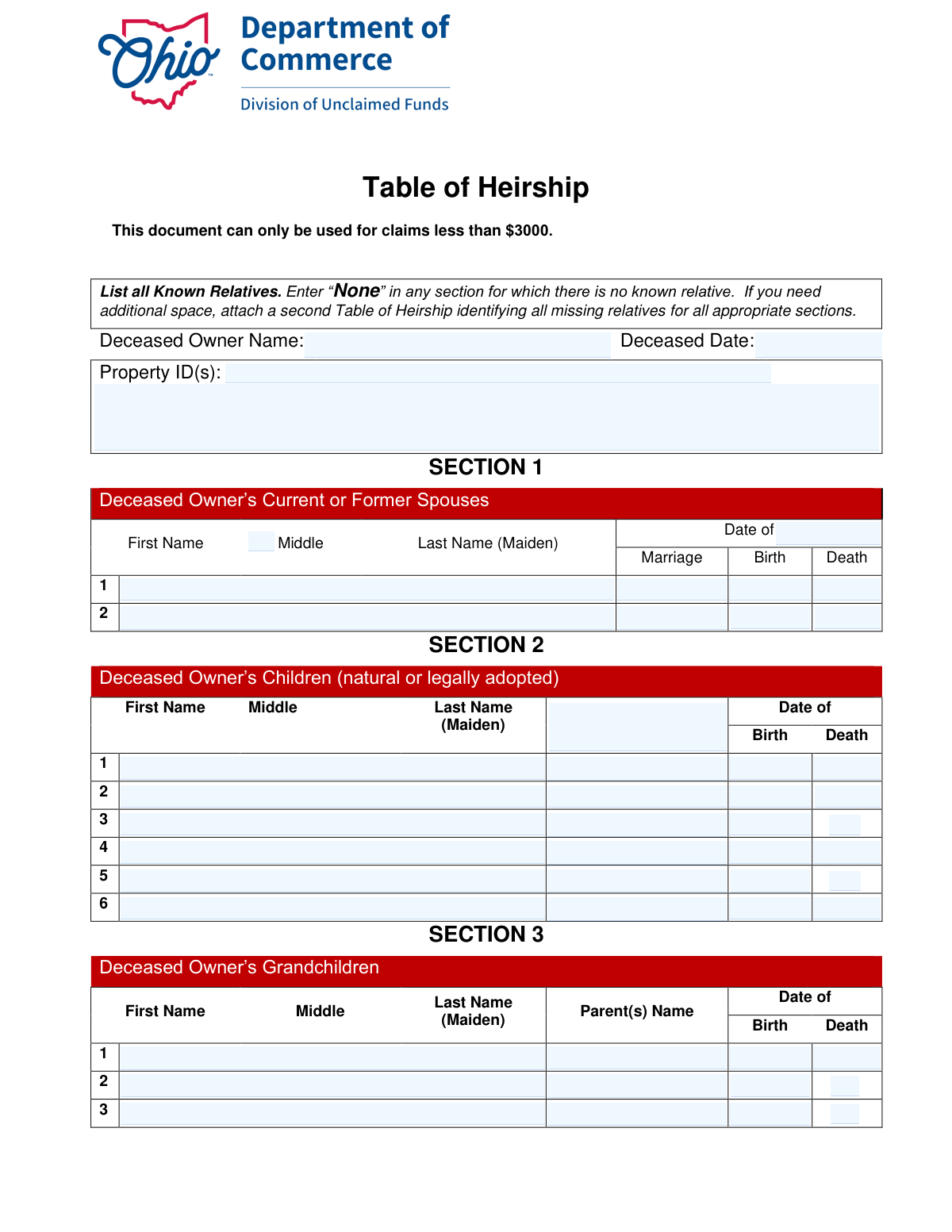
Heirship forms are legal documents used to establish the rightful heirs of a deceased person's assets, particularly when those assets have gone unclaimed. In Ohio, these forms play a critical role in the state's unclaimed funds process, allowing surviving family members to formally document their relationship to a deceased owner and submit a claim for property that may be held by the Ohio Department of Commerce's Division of Unclaimed Funds. Because these forms are signed under penalty of perjury, accuracy and completeness are essential — every known relative, whether living or deceased, must be listed.
By continuing, you acknowledge Instafill's Privacy Policy and agree to get occasional product update and promotional emails.
About heirship forms
These forms are typically needed by spouses, children, grandchildren, parents, or siblings of a deceased person who left behind unclaimed property such as forgotten bank accounts, insurance proceeds, or other financial assets. The Ohio Table of Heirship, for example, is specifically designed for unclaimed property claims under $3,000 and must be accompanied by a certified, unredacted death certificate. Anyone navigating this process after a loved one's passing will find that gathering the right documentation and filling out the forms correctly can make or break a successful claim.
Tools like Instafill.ai use AI to fill these forms in under 30 seconds, handling the details accurately and securely — a practical time-saver when you're already managing the complexities of settling a loved one's estate.
Every form on this page can be completed without typing. Instafill is form filling software that reads a PDF and fills it for you — including flat and scanned documents that carry no fillable fields at all.
Forms in This Category
The forms in this category have a median Form Complexity Index of 63/100 (Complex), measured across 2 forms by field count, input difficulty, length, conditional logic and structure. See how it is calculated.
| Form Name | Pages | FCI | |
|---|---|---|---|
| 1. | Ohio Department of Commerce Table of Heirship (Division of Unclaimed Funds) | 1 | – |
| 2. | Ohio Department of Commerce – Table of Heirship (Unclaimed Funds Claim, Claims Less Than $3,000) | 3 | Complex 63 |
- Enterprise-grade security & data encryption
- 99%+ accuracy powered by AI
- 1,000+ forms from all industries
- Complete forms in under 60 seconds
How to Choose the Right Form
Both forms in this category serve the same core purpose — helping heirs claim unclaimed funds from the Ohio Department of Commerce when the original owner has passed away. Here's how to navigate your options:
What These Forms Are For
Both the Ohio Department of Commerce Table of Heirship (Division of Unclaimed Funds) and the Ohio Department of Commerce – Table of Heirship (Unclaimed Funds Claim, Claims Less Than $3,000) are sworn statements used to:
- Document the deceased owner's family relationships (spouses, children, grandchildren, parents, and siblings)
- Help the state identify and verify rightful heirs
- Support unclaimed property claims valued at less than $3,000
How to Choose Between the Two
These forms are functionally identical in purpose and requirements. However, there are a few practical distinctions to consider:
- If you were directed here by the Ohio Division of Unclaimed Funds as part of an active claim, use whichever version matches the paperwork or instructions provided by the state agency.
- If you are starting a new claim, either form will work — both require the same information and carry the same legal weight under Ohio law.
- Both forms require the deceased owner's certified, unredacted death certificate and complete information for all known relatives, living or deceased.
Important Reminders
- These forms apply only to claims under $3,000 — larger claims require a different process.
- Both are signed under penalty of perjury, so accuracy is essential.
- Additional documentation may be requested after the state reviews your submission.
If you're unsure which version to use, start with the form that matches your claim paperwork. Both can be completed quickly using AI-powered tools on Instafill.ai, including non-fillable PDF versions.
Form Comparison
| Form | Purpose | Who Files It | When to Use |
|---|---|---|---|
| Ohio Department of Commerce Table of Heirship (Division of Unclaimed Funds) | Documents deceased owner's family relationships to identify rightful heirs | Claimants seeking unclaimed funds of a deceased owner | Claims under $3,000; submitted with certified death certificate |
| Ohio Department of Commerce – Table of Heirship (Unclaimed Funds Claim, Claims Less Than $3,000) | Sworn statement listing all known relatives to determine proper heirs | Heirs or representatives claiming deceased owner's unclaimed property | Claims strictly under $3,000; requires all known relatives listed |
Tips for heirship forms
The Ohio Table of Heirship is specifically designed for unclaimed funds claims under $3,000. If the value of the unclaimed property exceeds this threshold, you will likely need to pursue a different claims process, such as probate. Always verify the claim amount before submitting this form to avoid delays.
The form requires complete information for all family members in each category — spouses, children, grandchildren, parents, and siblings — regardless of whether they are living or deceased. Leaving any known relatives off the form can cause your claim to be rejected or investigated. Gather family records before you begin filling out the form.
A certified and unredacted death certificate for the deceased owner is typically required alongside the Table of Heirship. Redacted or unofficial copies are not accepted, so request the correct version from the vital records office in the state where the owner passed away. Having this document ready before you start will prevent unnecessary delays.
The Table of Heirship is signed under penalty of perjury under Ohio law, meaning inaccurate or incomplete information can have legal consequences. Double-check every name, relationship, and date before signing. The Ohio Division of Unclaimed Funds may investigate the information provided.
AI-powered tools like Instafill.ai can complete heirship forms in under 30 seconds with high accuracy, saving you significant time — especially when dealing with multiple family members to document. Your data stays secure throughout the process. Instafill.ai can also convert non-fillable PDF versions of these forms into interactive fillable forms.
After submitting your claim and Table of Heirship, the Ohio Division of Unclaimed Funds may request additional supporting documents before approving the claim. Keep copies of everything you submit and stay responsive to any correspondence from the state. Organizing your documents upfront can speed up this process significantly.
Before mailing or submitting your completed Table of Heirship and supporting documents, make copies for your own records. If questions arise during the review process, having your own copies allows you to quickly reference what was submitted. This is especially important since the form is a legal sworn statement.
Frequently Asked Questions
A Table of Heirship is a sworn legal statement that documents a deceased person's family relationships, including spouses, children, grandchildren, parents, and siblings. It is used by government agencies — such as Ohio's Division of Unclaimed Funds — to identify and verify the rightful heirs when someone files a claim on behalf of a deceased owner.
You need to complete a Table of Heirship if you are claiming unclaimed funds or property that belonged to a deceased person in Ohio. It is required when the original owner has passed away and the state needs to determine who the legal heirs are before releasing the funds.
This category contains two Ohio Department of Commerce Table of Heirship forms used by the Division of Unclaimed Funds. Both forms serve the same core purpose — documenting a deceased owner's family relationships — and are specifically designated for unclaimed property claims valued at less than $3,000.
No. The Ohio Table of Heirship forms in this category are specifically noted for use with claims less than $3,000. For larger claims, the Ohio Division of Unclaimed Funds may require different documentation or a more formal legal process, such as probate proceedings.
You will need complete information about all known relatives of the deceased owner, including living and deceased spouses, children, grandchildren, parents, and siblings. Having names, dates, and relationship details ready before you start will help you fill out the form accurately.
Claimants are generally required to submit the deceased owner's certified, unredacted death certificate along with the completed Table of Heirship. The Ohio Division of Unclaimed Funds may also request additional documentation after reviewing your initial submission.
The Table of Heirship is signed under penalty of perjury under Ohio law, meaning all information provided must be truthful and accurate. The state may investigate the information submitted, so it is important to include complete and correct details for all known relatives.
Completed Table of Heirship forms are submitted to the Ohio Department of Commerce, Division of Unclaimed Funds, along with any required supporting documents. You can check the Ohio Division of Unclaimed Funds website for current submission instructions, whether by mail or online.
Yes. AI-powered tools like Instafill.ai can fill out Ohio Table of Heirship forms in under 30 seconds by accurately extracting and placing data from your source documents. Instafill.ai can also convert non-fillable PDF versions of these forms into interactive, fillable formats.
Manually completing a Table of Heirship can take time, especially when gathering details about all known relatives. However, using an AI service like Instafill.ai, the form can be filled out in under 30 seconds once your source documents are ready.
An attorney is not always required to complete a Table of Heirship for smaller unclaimed funds claims in Ohio. However, because the form is signed under penalty of perjury and involves legal determinations about heirship, consulting a legal professional may be advisable if your situation is complex.
After submission, the Ohio Division of Unclaimed Funds will review your claim and the supporting documentation to verify the heirship information. They may contact you to request additional documents before approving and disbursing the unclaimed funds to the rightful heirs.
Glossary
- Form Complexity Index
- Instafill’s 0–100 measure of how much effort a form takes to complete, calculated deterministically from the form’s own structure rather than estimated. It combines the number of fillable fields (the largest factor), how difficult those fields are to complete based on their type, the number of pages that contain fields, the amount of conditional “fill-only-if” logic, and how many sections the form is divided into, then adds modifiers for tables and repeating lists, bundled instruction pages, and dense page layouts. A higher score means the form is harder to fill out by hand. The forms in this category have a median Form Complexity Index of 63/100 (Complex). See exactly how it is calculated.
- Heirship
- The legal right to inherit property or assets from a deceased person. Establishing heirship means proving your relationship to the deceased and your entitlement to their unclaimed property.
- Table of Heirship
- A sworn document that lists all known relatives of a deceased property owner, used by the state to determine who is legally entitled to claim unclaimed funds on behalf of the deceased.
- Unclaimed Funds
- Money or property that has been turned over to the state because the original owner could not be located, such as forgotten bank accounts, uncashed checks, or insurance proceeds.
- Division of Unclaimed Funds
- The Ohio Department of Commerce division responsible for holding and returning unclaimed property to its rightful owners or their heirs.
- Deceased Owner
- The original owner of the unclaimed property who has died, on whose behalf an heir or family member is submitting a claim to recover the funds.
- Certified Unredacted Death Certificate
- An official, government-issued death certificate that has not had any information removed or blacked out, typically required to verify the death of the original property owner when filing a claim.
- Signed Under Penalty of Perjury
- A legal declaration that the information provided in the form is true and accurate, meaning that knowingly providing false information can result in criminal charges.
- Claimant
- The person submitting a request to recover unclaimed funds, typically a surviving relative or legal representative of the deceased property owner.
- Intestate Succession
- The legal process that determines how a deceased person's assets are distributed among relatives when there is no will, which guides who qualifies as a rightful heir on heirship forms.