Fill out immigrant petition forms
with AI.
Immigrant petition forms are the foundational documents used by individuals and employers to establish eligibility for various immigration statuses in the United States. These forms are critical because they serve as the formal request to U.S. Citizenship and Immigration Services (USCIS) to grant a specific benefit, such as permanent residency or the ability to work. Whether you are an employer sponsoring a highly skilled specialist or an individual applying for special immigrant status, these documents are the first step in a complex legal journey. They ensure that the applicant meets the specific criteria set by federal law, providing the necessary evidence for the government to adjudicate the case.
By continuing, you acknowledge Instafill's Privacy Policy and agree to get occasional product update and promotional emails.
About immigrant petition forms
This category typically serves business owners, HR professionals, and foreign nationals seeking employment or residency. For instance, employers use the Form I-129 to hire nonimmigrant workers for specialized roles, while the Form I-140 is essential for those transitioning to a permanent green card. Additionally, these forms cover unique circumstances, such as the I-360 for special immigrants like religious workers or the I-526 for international investors. Because these petitions often involve significant legal and financial stakes, providing precise information is vital to avoid processing delays or denials.
Navigating the intricate requirements of these documents can be time-consuming, but tools like Instafill.ai use AI to fill these forms in under 30 seconds while ensuring data is handled accurately and securely. This allows petitioners to focus on the broader aspects of their application rather than the tedious manual entry of repetitive personal and professional details.
Every form on this page can be completed without typing. Instafill is form filling software that reads a PDF and fills it for you — including flat and scanned documents that carry no fillable fields at all.
Forms in This Category
The forms in this category have a median Form Complexity Index of 70/100 (Complex), measured across 12 forms by field count, input difficulty, length, conditional logic and structure. See how it is calculated.
| Form Name | Pages | FCI | |
|---|---|---|---|
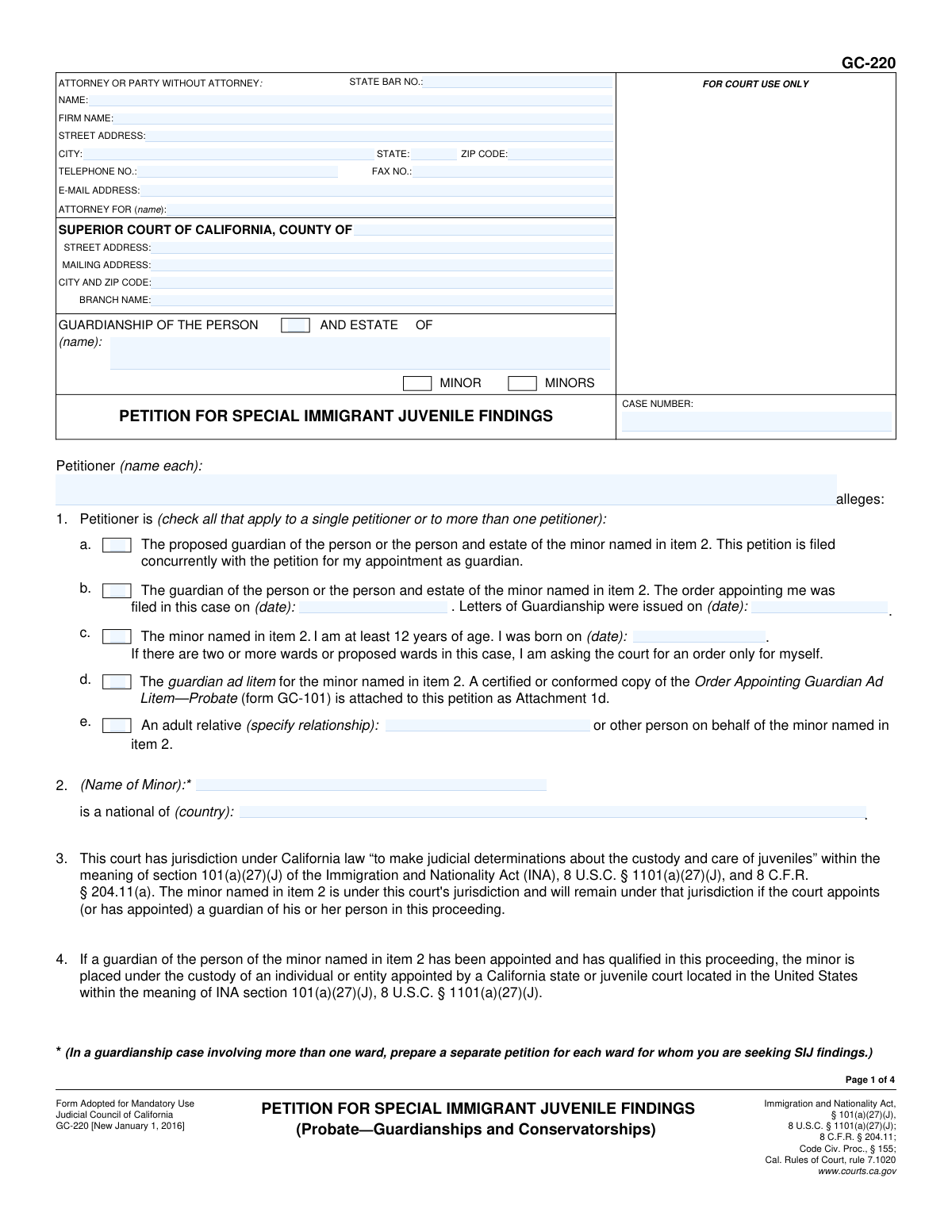
| 1. | Form GC-220, Petition for Special Immigrant Juvenile Findings (Probate—Guardianships and Conservatorships) | 4 | Moderate 54 |
| 2. | Form I-129, Petition for a Nonimmigrant Worker | 8 | Complex 63 |
| 3. | Form I-129, Petition for a Nonimmigrant Worker | 38 | Very Complex 92 |
| 4. | Form I-129, Petition for a Nonimmigrant Worker | 38 | Very Complex 91 |
| 5. | Form I-140, Immigrant Petition for Alien Workers | 8 | Complex 69 |
| 6. | Form I-918, Petition for U Nonimmigrant Status | 11 | Complex 74 |
| 7. | Forms I-526/I-526E, Immigrant Petition by Standalone Investor / Regional Center Investor | 1 | Simple 23 |
| 8. | Form I-129, Petition for a Nonimmigrant Worker | 38 | Complex 70 |
| 9. | Form I-129CW, Petition for a CNMI-Only Nonimmigrant Transitional Worker | 12 | – |
| 10. | Form I-129S, Nonimmigrant Petition Based on Blanket L | 8 | Complex 72 |
| 11. | Form I-140, Immigrant Petition for Alien Workers | 8 | Complex 76 |
| 12. | Form I-360, Petition for Amerasian, Widow(er), or Special Immigrant | 19 | Complex 70 |
- Enterprise-grade security & data encryption
- 99%+ accuracy powered by AI
- 1,000+ forms from all industries
- Complete forms in under 60 seconds
How to Choose the Right Form
Navigating the U.S. immigration system starts with identifying whether you are seeking temporary status or permanent residency. Use the following breakdown to find the correct petition for your specific situation.
Temporary (Nonimmigrant) Employment
If an employer is petitioning for a worker to enter the U.S. for a fixed period to perform labor or receive training, you will likely need a variation of the I-129 series:
- Form I-129, Petition for a Nonimmigrant Worker: This is the standard form for most temporary classifications, including H-1B, L-1 (individual), and O-1 visas. It is used for new employment, extensions, or changes of status.
- Form I-129S, Nonimmigrant Petition Based on Blanket L: Use this specifically for employees being transferred within a multinational company under a previously approved "Blanket L" petition.
- Form I-129CW, Petition for a CNMI-Only Nonimmigrant Transitional Worker: This is reserved exclusively for employers located in the Commonwealth of the Northern Mariana Islands to meet local labor needs.
Permanent Residency (Green Card) Petitions
For individuals seeking to live and work in the U.S. indefinitely, the focus shifts to immigrant petitions that lead to a Green Card:
- Form I-140, Immigrant Petition for Alien Workers: This is the primary form for employment-based green cards (EB-1, EB-2, and EB-3). It is used for individuals with extraordinary abilities, outstanding researchers, multinational managers, or skilled workers.
- Forms I-526/I-526E, Immigrant Petition by Standalone Investor / Regional Center Investor: Choose these forms if you are applying for the EB-5 investment program. Use I-526 for independent investments and I-526E for those investing through a designated Regional Center.
Special Immigrant Categories
Certain individuals qualify for residency based on unique humanitarian, family, or professional circumstances:
- Form I-360, Petition for Amerasian, Widow(er), or Special Immigrant: This versatile form covers a wide range of specific groups, including religious workers, special immigrant juveniles, and self-petitioning abused spouses or children under the Violence Against Women Act (VAWA).
Instafill.ai helps you navigate these complex documents by converting non-fillable PDFs into interactive, AI-assisted forms to ensure your petition is completed accurately.
Form Comparison
| Form | Main Purpose | Target Beneficiary | Immigration Status |
|---|---|---|---|
| Form I-129, Petition for a Nonimmigrant Worker | Requests temporary work authorization for foreign nationals in specific labor categories. | H-1B, L-1, O-1, and other temporary skilled workers. | Nonimmigrant (Temporary) |
| Forms I-526/I-526E, Immigrant Petition by Standalone Investor / Regional Center Investor | Initiates the EB-5 process for investors funding U.S. commercial enterprises. | Foreign investors providing capital that creates at least ten jobs. | Immigrant (Permanent) |
| Form I-129CW, Petition for a CNMI-Only Nonimmigrant Transitional Worker | Petitions for transitional workers specifically within the Northern Mariana Islands. | Employers and workers operating exclusively in the CNMI territory. | Nonimmigrant (Temporary) |
| Form I-129S, Nonimmigrant Petition Based on Blanket L | Transfers employees to the U.S. under a pre-approved blanket L-1 petition. | Managers, executives, or specialized knowledge staff of multinational companies. | Nonimmigrant (Temporary) |
| Form I-140, Immigrant Petition for Alien Workers | Petitions for an alien worker to become a permanent U.S. resident. | Extraordinary ability workers, professors, researchers, and multinational executives. | Immigrant (Permanent) |
| Form I-360, Petition for Amerasian, Widow(er), or Special Immigrant | Petitions for residency under specific humanitarian or religious categories. | Religious workers, special immigrant juveniles, and abused spouses or children. | Immigrant (Permanent) |
Tips for immigrant petition forms
Ensure that the name, date of birth, and passport number exactly match the beneficiary's official travel documents. Even small typographical errors can lead to significant delays or requests for evidence (RFEs) from immigration authorities.
AI-powered tools like Instafill.ai can complete these complex immigrant petition forms in under 30 seconds with high accuracy. This is a major time-saver for those handling multiple filings, and your sensitive data remains completely secure throughout the automated process.
If you are filing multiple forms for the same worker or investor, ensure that job titles, salary figures, and company descriptions are identical across all documents. Inconsistent data between different forms can trigger unnecessary scrutiny or administrative rejections.
Immigration agencies frequently update form editions and may reject petitions submitted on outdated versions. Always check that you are using the most recent edition of forms like the I-129 or I-140 before you begin the data entry process.
When preparing petitions such as the I-360 or I-526, group your supporting evidence to correspond with specific form sections. This systematic approach ensures you haven't missed a required attachment and makes the package easier for officers to navigate.
Many immigrant petitions require specific signatures from the employer or petitioner rather than the beneficiary. Review the signature blocks carefully to ensure the authorized representative signs in the correct field to prevent the form from being returned as incomplete.
Always save a digital copy of the final, signed version of every form and all accompanying evidence. Having these records easily accessible is vital for responding to future inquiries or when filing for extensions and status changes later in the process.
Frequently Asked Questions
Immigrant petition forms are used to request that a foreign national be granted permission to work or live in the United States, either on a temporary or permanent basis. These forms are typically submitted to U.S. Citizenship and Immigration Services (USCIS) to establish that the person meets the eligibility requirements for a specific visa or residency category.
Nonimmigrant petitions, such as Form I-129, are intended for individuals coming to the U.S. temporarily for a specific job or period. Immigrant petitions, such as Form I-140 or I-526, are for those seeking lawful permanent residency (a Green Card) to live and work in the U.S. indefinitely.
In most employment-based cases, the U.S. employer acts as the petitioner and must file the form on behalf of the foreign worker. However, certain special categories, such as some I-360 applicants or specific high-ability workers using Form I-140, may be eligible to self-petition without a sponsoring employer.
Yes, AI tools can be used to significantly simplify the process of completing these complex documents. AI services like Instafill.ai can fill out immigrant petition forms in under 30 seconds by accurately extracting data from your source documents and placing it into the correct fields.
Form I-360 is a versatile petition used by several specialized groups, including religious workers, special immigrant juveniles, and certain widow(er)s of U.S. citizens. It is also the primary form used by individuals seeking status under the Violence Against Women Act (VAWA).
Manually filling out these forms can take several hours due to their technical nature, but AI-powered tools provide a much faster alternative. Using Instafill.ai, you can complete these forms in less than 30 seconds, ensuring high accuracy by pulling data directly from your existing records.
Completed petitions are generally mailed to a USCIS Lockbox or Service Center, though the specific address depends on the form type and your geographic location. It is essential to check the official USCIS 'Where to File' page for the most current mailing instructions before sending your documents.
Most petitions require evidence of the petitioner's legal status, the beneficiary's educational or professional qualifications, and proof of the job offer or investment. You may also need to provide financial statements, organizational charts, or legal records depending on the specific visa category.
Yes, foreign investors can start the process for permanent residency by filing Form I-526 or I-526E under the EB-5 program. These petitions require detailed evidence that the investment capital was obtained lawfully and will result in the creation of at least ten full-time jobs for U.S. workers.
Yes, many of these forms, particularly Form I-129, allow an employer to request a change of status for a worker who is already legally in the U.S. under a different classification. This process enables the worker to transition to a new visa type without necessarily having to depart and re-enter the country.
Glossary
- Form Complexity Index
- Instafill’s 0–100 measure of how much effort a form takes to complete, calculated deterministically from the form’s own structure rather than estimated. It combines the number of fillable fields (the largest factor), how difficult those fields are to complete based on their type, the number of pages that contain fields, the amount of conditional “fill-only-if” logic, and how many sections the form is divided into, then adds modifiers for tables and repeating lists, bundled instruction pages, and dense page layouts. A higher score means the form is harder to fill out by hand. The forms in this category have a median Form Complexity Index of 70/100 (Complex). See exactly how it is calculated.
- Beneficiary
- The foreign national on whose behalf the petition is being filed to receive a specific immigration status or work authorization.
- Petitioner
- The individual or U.S. organization, such as an employer, that is officially filing the form to sponsor a foreign national.
- Nonimmigrant
- A temporary immigration status for individuals who intend to stay in the U.S. for a specific period and purpose, such as work or training, rather than permanent residency.
- Adjustment of Status
- The process of applying for lawful permanent resident status (a Green Card) while the applicant is already physically present in the United States.
- Blanket L Petition
- A pre-approved status for large multinational companies that allows them to transfer multiple employees to the U.S. more quickly without filing separate petitions for each individual.
- EB-5 Investor
- A foreign national who qualifies for permanent residency by investing a required amount of capital in a new commercial enterprise that creates jobs for U.S. workers.
- Priority Date
- The date that determines an individual’s place in line for an immigrant visa, typically based on when their initial petition was successfully filed with USCIS.
- CNMI
- The Commonwealth of the Northern Mariana Islands, a U.S. territory that has specific transitional worker programs and specialized immigration forms like the I-129CW.