Fill out industrial accident forms
with AI.
Industrial accident forms are the official documents used to report workplace injuries, initiate compensation claims, and navigate the legal processes that follow on-the-job incidents. These forms serve a critical function: they create a formal record of what happened, who was affected, and what benefits or remedies are being sought. Whether the situation involves a sudden injury, an occupational illness developed over time, or a workplace fatality, completing the right paperwork accurately and on time is essential to protecting workers' rights and ensuring claims move forward without unnecessary delays.
By continuing, you acknowledge Instafill's Privacy Policy and agree to get occasional product update and promotional emails.
About industrial accident forms
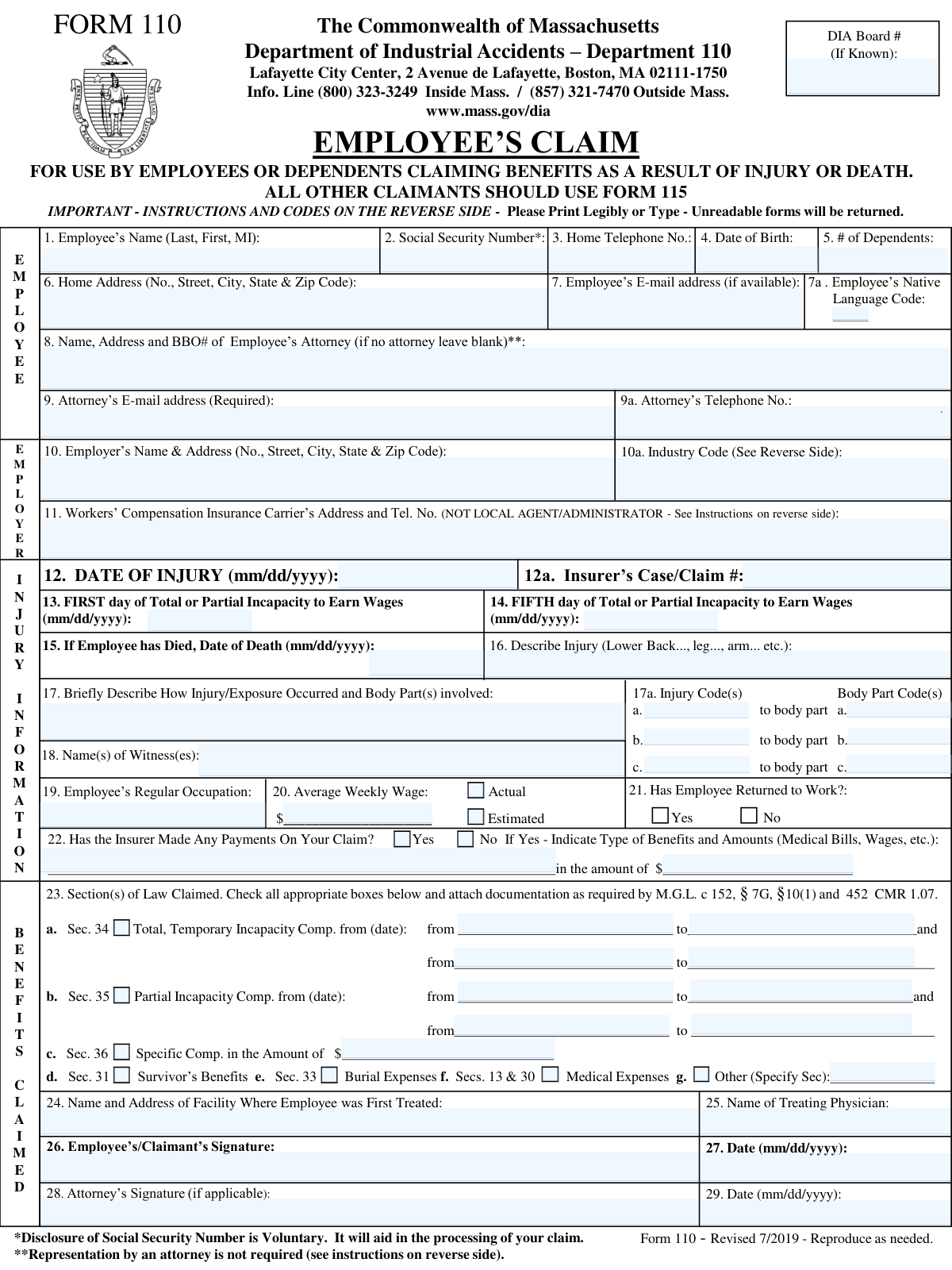
The forms in this category are primarily used by employees, their dependents, or legal representatives who need to formally dispute or initiate a workers' compensation claim. A key example is the Massachusetts Department of Industrial Accidents (DIA) Form 110, Employee's Claim, which workers in Massachusetts must file to begin the official dispute process with the DIA. These documents require detailed information — injury specifics, wage data, insurer details, and the particular benefits being claimed — so accuracy matters enormously, as errors or missing information can result in rejection or processing delays.
For anyone navigating this process, tools like Instafill.ai use AI to fill these forms in under 30 seconds, handling the data accurately and securely, which can be a genuine time-saver during an already stressful situation.
Every form on this page can be completed without typing. Instafill is form filling software that reads a PDF and fills it for you — including flat and scanned documents that carry no fillable fields at all.
Forms in This Category
The forms in this category have a median Form Complexity Index of 64/100 (Complex), measured across 2 forms by field count, input difficulty, length, conditional logic and structure. See how it is calculated.
| Form Name | Pages | FCI | |
|---|---|---|---|
| 1. | Commonwealth of Massachusetts Department of Industrial Accidents (DIA) Form 110, Employee’s Claim | 1 | Moderate 57 |
| 2. | Commonwealth of Massachusetts Department of Industrial Accidents Form 110, Employee’s Claim | 1 | Complex 64 |
- Enterprise-grade security & data encryption
- 99%+ accuracy powered by AI
- 1,000+ forms from all industries
- Complete forms in under 60 seconds
How to Choose the Right Form
Both forms in this category are versions of the same official document — Massachusetts DIA Form 110, Employee's Claim — used to file a disputed workers' compensation claim with the Commonwealth of Massachusetts Department of Industrial Accidents.
What Both Forms Do
- Initiate a formal dispute for workers' compensation benefits
- Cover workplace injuries, occupational exposures, and work-related deaths
- Capture employee, employer, and insurer details, injury information, wage data, and specific benefits claimed under M.G.L. c. 152
- Formally start the DIA dispute process when an employer or insurer has denied or disputed your claim
How to Choose Between the Two
The two listings represent slightly different versions of DIA Form 110:
- Form 1 (Commonwealth of Massachusetts Department of Industrial Accidents Form 110) is a general version suitable for most standard workplace injury or death claims, including temporary total/partial incapacity and survivor benefits.
- Form 2 (Commonwealth of Massachusetts Department of Industrial Accidents (DIA) Form 110) includes more explicit references to specific Massachusetts General Law citations (e.g., §§ 34, 35, 36, 31, 33, 13 & 30) and mentions occupational exposure claims — making it a better fit if your claim involves a specific statutory benefit or an occupational disease/exposure scenario.
Quick Decision Guide
- Standard workplace injury or death claim? → Either version works; start with Form 1.
- Occupational disease, chemical exposure, or need to cite a specific MGL section? → Use Form 2 for its more detailed statutory references.
- Unsure which applies? → Form 2's additional detail makes it the safer, more comprehensive choice in most situations.
Both forms can be filled out quickly and accurately on Instafill.ai, including converting non-fillable PDF versions into interactive forms.
Form Comparison
| Form | Purpose | Who Files It | When to Use |
|---|---|---|---|
| Commonwealth of Massachusetts Department of Industrial Accidents Form 110, Employee's Claim | Initiate disputed workers' compensation claim for workplace injury or death | Employee or eligible dependents of injured/deceased worker | When employer or insurer disputes a workers' compensation claim |
| Commonwealth of Massachusetts Department of Industrial Accidents (DIA) Form 110, Employee's Claim | Initiate disputed claim for workplace injury, occupational exposure, or death | Employee or eligible dependents of injured/deceased worker | When filing under M.G.L. c. 152 for incapacity, medical, or survivor benefits |
Tips for industrial accident forms
Errors in your name, Social Security number, employer details, or insurer information are among the most common reasons claims get delayed or rejected. Before submitting Form 110, carefully verify every identifying field matches your official documents and pay stubs exactly.
The DIA requires specific dates for when the injury occurred, when incapacity began, and when medical treatment was sought. Vague or inconsistent dates can complicate your claim, so gather medical records, incident reports, and employer notices before filling out the form.
Form 110 requires you to specify which Massachusetts General Law sections apply to your situation — such as §34 for temporary total incapacity or §31 for survivor benefits. Selecting the wrong benefit type can misdirect your claim, so review your situation carefully or consult a workers' compensation attorney if unsure.
An unsigned Form 110 or one missing required attachments will not be accepted by the DIA and will delay the start of your dispute process. Make sure the form is signed where required and that you attach any supporting documentation, such as medical records or wage statements, before filing.
AI-powered tools like Instafill.ai can complete industrial accident forms like DIA Form 110 in under 30 seconds with high accuracy, reducing the risk of errors that cause delays. Your data stays secure throughout the process, making it a practical time-saver — especially if you're managing multiple forms or dealing with a non-fillable PDF version.
Always retain a complete copy of your filed Form 110 and any supporting documents for your personal records. If questions arise during the DIA dispute process, having your own copies allows you to quickly reference what was submitted and when.
If your workers' compensation claim has been denied or disputed by your employer or insurer, filing Form 110 initiates the formal DIA dispute process — waiting too long can affect your ability to recover benefits. Act as soon as you know a dispute exists rather than hoping the issue resolves informally.
Frequently Asked Questions
Industrial accident forms are official documents used to report workplace injuries, occupational illnesses, or work-related deaths and to initiate claims for workers' compensation benefits. In Massachusetts, the primary form in this category is the DIA Form 110, which formally starts the dispute resolution process with the Department of Industrial Accidents.
Employees who have suffered a workplace injury, occupational exposure, or illness and whose workers' compensation claim is being disputed by their employer or insurer need to file a DIA Form 110. Eligible dependents or survivors may also file this form in cases involving a work-related death.
Both forms in this category are versions of the Massachusetts DIA Form 110, 'Employee's Claim,' used to initiate a disputed workers' compensation claim. They capture the same core information — employee, employer, insurer details, injury information, and benefits claimed — and may represent different editions or formats of the same official form.
You should file DIA Form 110 when your workers' compensation claim has been disputed or denied by your employer or their insurer and you wish to formally pursue benefits through the Massachusetts Department of Industrial Accidents. It is important to file as soon as possible, as workers' compensation claims are subject to statutory deadlines under Massachusetts law.
Completed DIA Form 110 submissions are directed to the Massachusetts Department of Industrial Accidents. You should ensure all required documentation and signatures are included before submitting, as incomplete forms can cause delays or rejection in the dispute process.
Using DIA Form 110, you can claim a range of workers' compensation benefits under Massachusetts General Laws Chapter 152, including temporary total incapacity, temporary partial incapacity, permanent and serious disability, medical expenses, and survivor or death benefits for eligible dependents.
You will generally need identifying information for yourself, your employer, and the workers' compensation insurer, along with details about the date, nature, and location of the injury or illness. You should also have wage information, medical treatment records, and incapacity dates available to complete the form accurately.
Yes, AI-powered tools like Instafill.ai can fill out industrial accident forms such as DIA Form 110 in under 30 seconds by accurately extracting and placing data from your source documents. Instafill.ai can also convert non-fillable PDF versions of these forms into interactive fillable formats, making the process faster and reducing the risk of errors.
Filling out industrial accident forms manually can take significant time, especially when gathering and organizing all required details. Using AI tools like Instafill.ai, the process can be completed in under 30 seconds, with data accurately extracted and placed into the correct fields from your supporting documents.
After submission, the Massachusetts Department of Industrial Accidents will process your claim and formally initiate the dispute resolution process, which may involve conciliation, conference, or hearing steps. Ensuring your form is complete, legible, and accompanied by required documentation helps avoid delays in processing.
You are not required to have an attorney to file a DIA Form 110, but many employees choose to consult with a workers' compensation attorney given the legal complexity of disputed claims. An attorney can help ensure the form is filed correctly and that you are claiming all benefits you may be entitled to under Massachusetts law.
Glossary
- Form Complexity Index
- Instafill’s 0–100 measure of how much effort a form takes to complete, calculated deterministically from the form’s own structure rather than estimated. It combines the number of fillable fields (the largest factor), how difficult those fields are to complete based on their type, the number of pages that contain fields, the amount of conditional “fill-only-if” logic, and how many sections the form is divided into, then adds modifiers for tables and repeating lists, bundled instruction pages, and dense page layouts. A higher score means the form is harder to fill out by hand. The forms in this category have a median Form Complexity Index of 64/100 (Complex). See exactly how it is calculated.
- DIA (Department of Industrial Accidents)
- The Massachusetts state agency that oversees the workers' compensation system, resolves disputed claims between injured employees and insurers, and enforces compliance with workers' compensation laws.
- Workers' Compensation
- A state-mandated insurance program that provides wage replacement and medical benefits to employees injured or made ill in the course of employment, in exchange for giving up the right to sue the employer.
- Disputed Claim
- A workers' compensation claim in which the insurer or employer has denied or stopped benefits, requiring the employee to formally file with the DIA to have the dispute resolved through a hearing process.
- Temporary Total Incapacity (§ 34)
- A type of workers' compensation benefit under M.G.L. c. 152 § 34 that provides weekly wage replacement when an injured employee is completely unable to work due to their workplace injury.
- Temporary Partial Incapacity (§ 35)
- A benefit under M.G.L. c. 152 § 35 that provides partial wage replacement when an injured employee can return to work in a limited capacity but earns less than their pre-injury wages.
- M.G.L. c. 152
- Massachusetts General Laws Chapter 152, the state statute that governs the entire workers' compensation system, defining employee rights, employer obligations, benefit types, and the DIA dispute process.
- Occupational Exposure
- A work-related illness or injury caused by repeated or prolonged contact with hazardous substances, conditions, or activities on the job, such as chemical exposure or repetitive strain, rather than a single accident.
- Survivor Benefits (§ 31)
- Compensation paid under M.G.L. c. 152 § 31 to eligible dependents of an employee who died as a result of a work-related injury or illness, covering ongoing financial support and funeral expenses.
- Average Weekly Wage (AWW)
- The calculated average of an employee's earnings per week prior to the injury, used as the baseline figure to determine the amount of wage-replacement benefits they are entitled to receive.
- Insurer
- In the context of these forms, the insurance company or self-insured employer responsible for paying workers' compensation benefits; the party typically named alongside the employer on a disputed claim.