Fill out inherited IRA forms
with AI.
Inherited IRA forms are essential documents used to manage retirement assets after the original account owner passes away. These forms facilitate the legal transfer of funds from the decedent’s account into a new Inherited IRA, ensuring that the transition complies with IRS regulations and financial institution policies. Proper documentation is critical because it determines how the assets are titled and how future distributions—including Required Minimum Distributions (RMDs)—will be handled to avoid significant tax penalties.
By continuing, you acknowledge Instafill's Privacy Policy and agree to get occasional product update and promotional emails.
About inherited IRA forms
These forms are typically required by individual beneficiaries, including spouses and non-spouses, who have been named as heirs to a traditional or Roth IRA. Whether you are opening a new account via an Inherited IRA Application or moving assets from one custodian to another using a Transfer of Assets form, these documents serve as the primary link between the decedent’s legacy and the beneficiary's financial future. Notable examples include applications from major institutions like Fidelity or Schwab, which collect vital information about the deceased and the inheritor to establish clear legal ownership.
Navigating the paperwork during a time of loss can be overwhelming, especially when dealing with complex multi-page applications and transfer instructions. Tools like Instafill.ai use AI to fill these forms in under 30 seconds, handling sensitive data accurately and securely to streamline the administrative process. This allows beneficiaries to focus on their financial planning rather than the nuances of manual form completion.
Every form on this page can be completed without typing. Instafill is form filling software that reads a PDF and fills it for you — including flat and scanned documents that carry no fillable fields at all.
Forms in This Category
The forms in this category have a median Form Complexity Index of 57/100 (Moderate), measured across 7 forms by field count, input difficulty, length, conditional logic and structure. See how it is calculated.
| Form Name | Pages | FCI | |
|---|---|---|---|
| 1. | Automatic Withdrawals — Inherited IRA - Fidelity Investments | 1 | Moderate 55 |
| 2. | Inherited IRA Application | 1 | Complex 69 |
| 3. | Inherited IRA Application for Individual Beneficiaries | 1 | – |
| 4. | Inherited IRA Transfer of Assets/ Direct Rollover Form | 1 | Basic 40 |
| 5. | Inherited IRA Transfer of Assets/Direct Rollover | 1 | Basic 45 |
| 6. | Merrill Inherited IRA Transfer Instruction Form | 1 | Complex 68 |
| 7. | New Fidelity Account® — Inherited IRA for a Non-Spouse Individual | 1 | Moderate 57 |
- Enterprise-grade security & data encryption
- 99%+ accuracy powered by AI
- 1,000+ forms from all industries
- Complete forms in under 60 seconds
How to Choose the Right Form
Navigating the paperwork for an inherited IRA depends on whether you are just starting the process, moving funds between institutions, or setting up a distribution schedule. Use the categories below to identify the correct document for your specific financial institution.
Opening a New Inherited IRA Account
If you have recently inherited retirement assets and need to establish a new account in your name, you will need an application form specific to the custodian:
- Charles Schwab: Use the Inherited IRA Application for Individual Beneficiaries to open a new account and capture decedent details.
- Fidelity: Non-spouse beneficiaries should use the New Fidelity Account® — Inherited IRA for a Non-Spouse Individual to manage their received assets.
- Pershing: The Inherited IRA Application is the legal document required to establish a new account and designate future beneficiaries.
Transferring Assets or Direct Rollovers
If you already have an inherited IRA or need to move funds from the deceased person’s employer plan into a trustee-to-trustee account, choose a transfer form based on the destination firm:
- Merrill: The Merrill Inherited IRA Transfer Instruction Form is required to move assets from an external IRA or Roth IRA into a Merrill account. Note that this usually requires a death certificate.
- Voya: Select the Inherited IRA Transfer of Assets/ Direct Rollover Form to move funds from a retirement plan into a Voya-managed Inherited IRA.
- Impax: Use the Inherited IRA Transfer of Assets/Direct Rollover to facilitate the movement of inherited funds into an Impax account.
Managing Distributions and RMDs
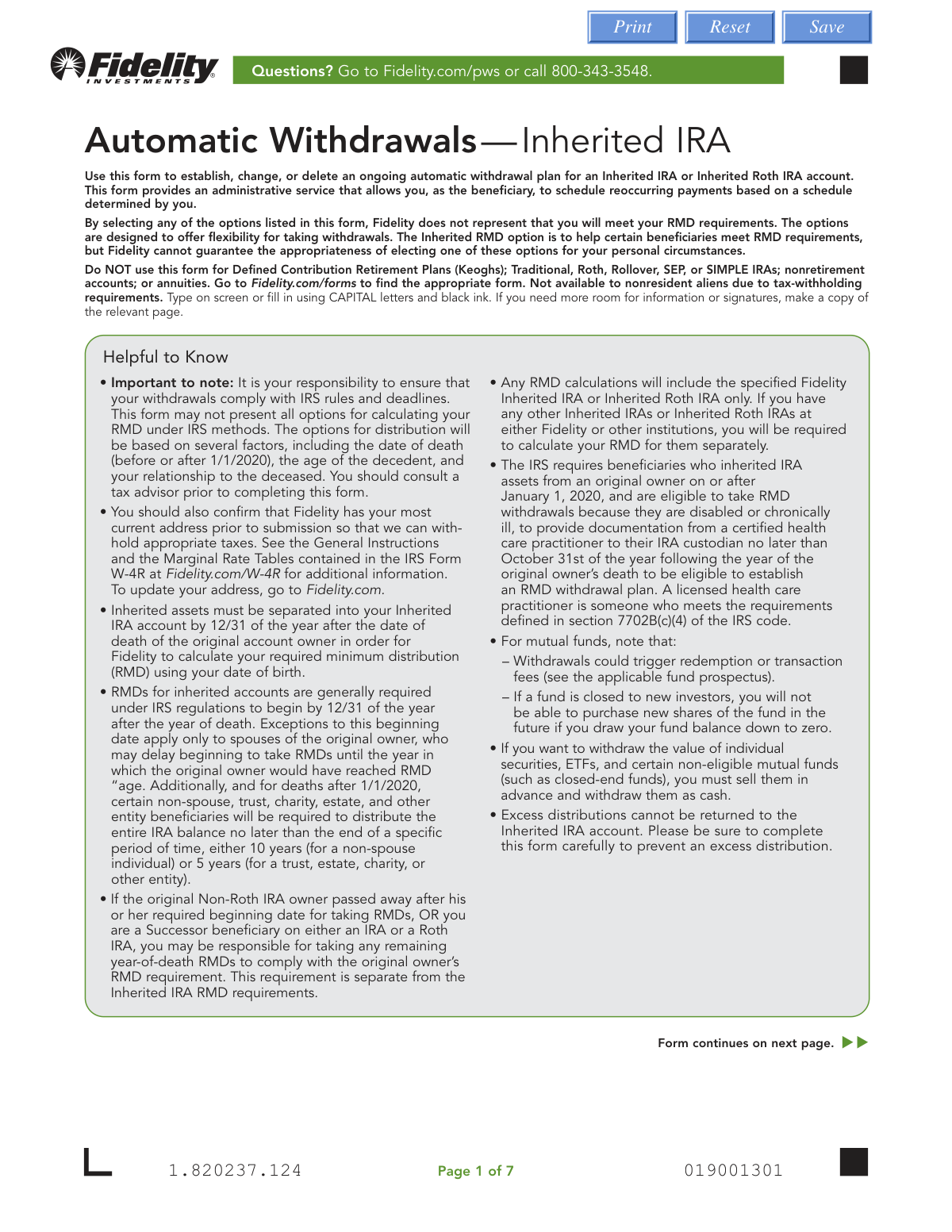
Once the account is established, you must manage withdrawals to comply with tax laws or meet personal financial needs. The Automatic Withdrawals — Inherited IRA - Fidelity Investments form is specifically designed for Fidelity beneficiaries to establish, change, or delete a recurring payment plan, which is often used to automate Required Minimum Distributions (RMDs).
Form Comparison
| Form | Primary Purpose | Target User | Key Requirement |
|---|---|---|---|
| Automatic Withdrawals — Inherited IRA - Fidelity Investments | Manage recurring distributions and RMD requirements for existing accounts. | Existing Fidelity Inherited IRA or Roth IRA owners. | Bank information and chosen payment frequency/schedule. |
| Inherited IRA Application | Establish a new Inherited IRA account to receive assets. | Beneficiaries receiving Individual Retirement Account assets from a decedent. | Decedent's personal details and beneficiary designation instructions. |
| Inherited IRA Application for Individual Beneficiaries | Open a Schwab Inherited IRA to receive transferred assets. | Individual heirs inheriting retirement funds from a deceased owner. | Information about the decedent and instructions for asset transfer. |
| Inherited IRA Transfer of Assets/ Direct Rollover Form | Move funds from a retirement plan to a Voya Inherited IRA. | Beneficiaries of deceased participants in employer-sponsored retirement plans. | Current custodian details and specific asset transfer instructions. |
| Inherited IRA Transfer of Assets/Direct Rollover | Facilitate movement of assets to an Impax Inherited IRA. | Beneficiaries consolidating inherited retirement funds into a single account. | Documentation of the original account and transfer authorization. |
| Merrill Inherited IRA Transfer Instruction Form | Direct the transfer of assets into a Merrill Inherited IRA. | Beneficiaries of IRA, Roth IRA, SEP, or SRA accounts. | A copy of the death certificate and decedent's account information. |
| New Fidelity Account® — Inherited IRA for a Non-Spouse Individual | Create a new Inherited IRA specifically for non-spouse heirs. | Children, siblings, or other non-spouse beneficiaries of retirement plans. | Detailed personal identification and information regarding the deceased owner. |
Tips for inherited IRA forms
Double-check the deceased person’s full name, social security number, and date of death before starting the application. Any discrepancy between your form and the financial institution's records can cause significant delays in the asset transfer process.
When moving assets to a new Inherited IRA, use a direct transfer or rollover form to avoid receiving a physical check. This method prevents unnecessary tax withholding and ensures the funds maintain their tax-advantaged status during the transition.
While these forms focus on transferring assets to you, most applications include a section for naming your own beneficiaries. Completing this section now ensures that the assets will be distributed according to your wishes in the future.
Inherited IRAs must follow strict IRS titling rules, usually including both the decedent's name and your name as the beneficiary. Failing to title the account correctly on your application can lead to the IRS treating the transfer as a taxable distribution.
Many inherited IRAs require annual distributions that vary based on your relationship to the decedent and their date of passing. Establishing an automatic withdrawal plan early helps you stay compliant with regulations and avoids the steep penalties associated with missed distributions.
AI-powered tools like Instafill.ai can complete these complex inherited IRA forms in under 30 seconds with high accuracy. This technology significantly reduces the time spent on manual data entry while ensuring your sensitive financial data stays secure during the process.
Most custodians require a certified copy of the death certificate to process an inherited IRA application or transfer request. Having a digital scan ready to upload alongside your filled forms will prevent administrative back-and-forth with the bank or brokerage.
Frequently Asked Questions
These forms are used to transfer retirement assets from a deceased account owner to their designated beneficiaries. They ensure the new account is legally established and titled correctly to maintain tax-advantaged status according to IRS regulations.
Any individual, trust, or entity named as a beneficiary of a retirement account must complete an application to claim the assets. This process establishes a new 'Beneficiary IRA' or 'Inherited IRA' in the name of the recipient.
In most cases, you will need both. The application is used to open the new account at a financial institution like Fidelity or Schwab, while the Transfer of Assets or Direct Rollover form provides the specific instructions to move funds from the decedent's original account to your new one.
Yes, many institutions provide specific applications for non-spouse beneficiaries because they have different distribution requirements than surviving spouses. Spouses often have the unique option to roll the assets into their own existing IRA, whereas non-spouses must generally use an Inherited IRA account.
Most custodians require a certified copy of the original account holder's death certificate to process the inheritance. You may also need to provide valid government-issued identification and, if the beneficiary is an estate or trust, relevant legal appointment documents.
Yes, AI tools like Instafill.ai can be used to fill out these forms in under 30 seconds. The AI accurately extracts necessary data from your source documents and places it into the correct fields, ensuring the complex information required is handled precisely.
While manually completing these multi-page documents can take 20 minutes or more, using an AI-powered service like Instafill.ai reduces the time to less than 30 seconds. This is particularly helpful for forms requiring detailed information about both the decedent and the beneficiary.
This form allows a beneficiary to set up a recurring payment schedule for their distributions. This is a practical way to ensure you meet IRS Required Minimum Distribution (RMD) obligations without having to manually request a withdrawal every year.
Completed and signed forms should be submitted to the financial institution where you are opening the new account. Depending on the firm's policies, you may be able to upload them through a secure portal, mail them, or hand-deliver them to a local branch office.
Proper titling is a legal requirement that identifies the account as an inheritance rather than a personal contribution. If the account is not titled correctly—typically including the name of the deceased and the name of the beneficiary—it could result in the entire balance being treated as a taxable distribution.
Yes, you can use a Transfer of Assets or Direct Rollover form to move funds from an employer-sponsored plan like a 401(k) into a Beneficiary IRA. This allows you to consolidate inherited assets into a single brokerage account for easier management.
Most Inherited IRA applications include a section for 'Successor Beneficiaries.' This allows you to designate who should receive the remaining assets in the account if you pass away before the funds are fully distributed.
Glossary
- Form Complexity Index
- Instafill’s 0–100 measure of how much effort a form takes to complete, calculated deterministically from the form’s own structure rather than estimated. It combines the number of fillable fields (the largest factor), how difficult those fields are to complete based on their type, the number of pages that contain fields, the amount of conditional “fill-only-if” logic, and how many sections the form is divided into, then adds modifiers for tables and repeating lists, bundled instruction pages, and dense page layouts. A higher score means the form is harder to fill out by hand. The forms in this category have a median Form Complexity Index of 57/100 (Moderate). See exactly how it is calculated.
- RMD (Required Minimum Distribution)
- The minimum amount the IRS requires an account holder or beneficiary to withdraw from a retirement account each year to ensure tax revenue is collected.
- Decedent
- The original owner of the IRA who has passed away and whose assets are being transferred to a beneficiary.
- Trustee-to-Trustee Transfer
- A method of moving retirement assets directly from one financial institution to another, ensuring the funds are never personally held by the beneficiary to avoid tax penalties.
- Non-Spouse Beneficiary
- An individual, such as a child, grandchild, or friend, who inherits an IRA from someone other than their legal spouse, often subject to stricter withdrawal timelines.
- Custodian
- The financial institution, such as a bank or brokerage firm, responsible for holding the account assets and reporting transactions to the IRS.
- Direct Rollover
- The process of moving funds from an employer-sponsored plan, like a 401(k), directly into an Inherited IRA to maintain the tax-deferred status of the assets.
- Successor Beneficiary
- A person named by the current beneficiary to receive any remaining assets in the Inherited IRA should the current beneficiary pass away before the account is empty.
- 10-Year Rule
- An IRS regulation requiring most non-spouse beneficiaries to fully distribute all assets from an inherited account by the end of the tenth year following the original owner's death.