Fill out insurance beneficiary forms
with AI.
Insurance beneficiary forms are essential legal documents used to specify who will receive policy proceeds after an insured person passes away. Whether you are setting up a new policy or updating an existing one, these forms ensure that death benefits are distributed exactly as intended, bypassing the often lengthy and public probate process. Without an updated beneficiary designation, assets may be distributed according to state law or default policy terms, which might not align with your current family situation or financial goals.
By continuing, you acknowledge Instafill's Privacy Policy and agree to get occasional product update and promotional emails.
About insurance beneficiary forms
These forms are typically required by policyholders during major life milestones, such as marriage, the birth of a child, or a divorce. They are also necessary when an individual changes employers and enrolls in group life insurance plans. For example, individuals with policies through providers like TIAA, Principal Life, or Transamerica need to submit specific designation forms to name primary and contingent beneficiaries. Keeping these records current is a vital part of estate planning, ensuring that loved ones are provided for without unnecessary legal hurdles.
Dealing with complex paperwork can be tedious, but modern tools like Instafill.ai use AI to accurately and securely fill these forms in under 30 seconds. This technology helps ensure that all required fields are completed correctly, reducing the risk of administrative errors that could delay the processing of a claim. By automating the data entry process, you can maintain your records with minimal effort while keeping your sensitive information protected.
Every form on this page can be completed without typing. Instafill is form filling software that reads a PDF and fills it for you — including flat and scanned documents that carry no fillable fields at all.
Forms in This Category
The forms in this category have a median Form Complexity Index of 61/100 (Moderate), measured across 5 forms by field count, input difficulty, length, conditional logic and structure. See how it is calculated.
- Enterprise-grade security & data encryption
- 99%+ accuracy powered by AI
- 1,000+ forms from all industries
- Complete forms in under 60 seconds
How to Choose the Right Form
Choosing the correct beneficiary form is essential to ensure your assets are distributed according to your wishes without legal delays. To find the right document, identify your insurance provider and the specific policy type you are updating.
Provider-Specific Designation Forms
Most insurance carriers require their own proprietary forms to process a change or designation.
- Principal Life Insurance Company: If you have group term, voluntary term, or accident coverage, use the Beneficiary Designation/Change - Principal Life Insurance Company. If your policy requires specific provisions for minor beneficiaries under the Uniform Transfers to Minors Act (UTMA), the Principal Life Insurance Company Beneficiary Designation/Change Form (GP34795-14) includes the necessary custodian sections.
- TIAA: Policyholders with Teachers Insurance and Annuity Association or TIAA-CREF should use the TIAA Life Insurance Beneficiary Designation Form to manage their death benefits.
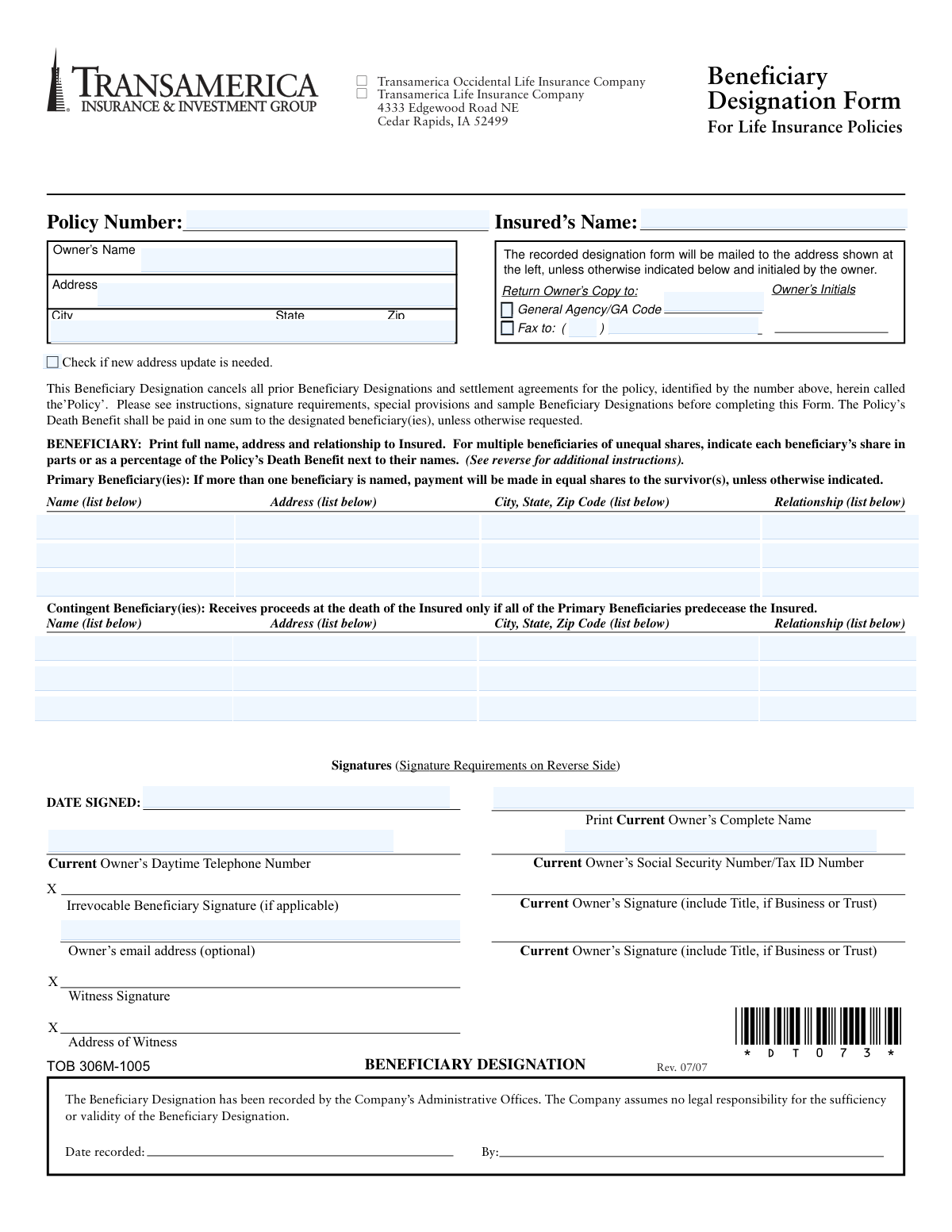
- Transamerica: For Transamerica policies, you can choose the standard Transamerica Life Insurance Company Beneficiary Designation Form. If your specific policy documentation or employer references a particular version code, use the Transamerica Life Insurance Company Beneficiary Designation Form (TOB 306M-0809).
General Life Insurance Needs
If you are looking for a standard template or your carrier accepts general legal documents, the Beneficiary Designation Form For Life Insurance Policies serves as a universal tool to name primary and contingent beneficiaries. This is often the best starting point if you are unsure of the specific carrier requirements but need to document your intent.
Key Considerations for Selection
- Primary vs. Contingent: All these forms allow you to name a primary beneficiary (first in line) and a contingent beneficiary (backup).
- Minor Beneficiaries: If you are naming a child, look for forms like the Principal GP34795-14 that include specific language for appointing a custodian.
- Superseding Old Forms: Remember that submitting a new form, such as the TIAA Life Insurance Beneficiary Designation Form, will typically supersede any previous designations on file for that specific policy.
Form Comparison
| Form | Provider | Coverage Scope | Key Features |
|---|---|---|---|
| Beneficiary Designation Form For Life Insurance Policies | General / Various | Standard Life Insurance | A universal template for designating primary and contingent death benefit recipients. |
| Beneficiary Designation/Change - Principal Life Insurance Company | Principal Life | Group Term, Voluntary Term, and Accident | Allows policyholders to update beneficiaries for multiple insurance types at once. |
| Principal Life Insurance Company Beneficiary Designation/Change Form (GP34795-14) | Principal Life | Employee Group Term Life | Includes specific sections for appointing minor custodians under the UTMA. |
| TIAA Life Insurance Beneficiary Designation Form | TIAA / TIAA-CREF | TIAA Life Insurance Policies | The official legal document for TIAA policy owners to designate beneficiaries. |
| Transamerica Life Insurance Company Beneficiary Designation Form | Transamerica | General Life Insurance | Standardized form to officially designate primary and contingent policy beneficiaries. |
| Transamerica Life Insurance Company Beneficiary Designation Form (TOB 306M-0809) | Transamerica | Specified Life Policies | Legal document that explicitly supersedes all previously filed beneficiary designations. |
Tips for insurance beneficiary forms
Always clearly define who receives the benefit first and who acts as the backup if the primary beneficiary is deceased. Failing to name a contingent beneficiary can lead to policy proceeds being tied up in probate court rather than going directly to your loved ones.
Avoid using nicknames or vague terms like 'my children' when filling out forms for providers like TIAA or Transamerica. Providing full legal names, dates of birth, and Social Security numbers ensures the insurance company can accurately identify and locate your beneficiaries without delay.
When dividing benefits among multiple people, double-check that the percentages for each group (Primary and Contingent) add up to exactly 100%. Even a 1% discrepancy can cause the insurance company to reject the form, requiring you to restart the entire process.
AI-powered tools like Instafill.ai can complete these complex insurance forms in under 30 seconds with high accuracy. Your sensitive data stays secure during the process, making it a highly efficient way to handle multiple designations for different providers like Principal or TIAA.
Most insurance companies cannot pay death benefits directly to minors. If you are naming a child, use the specific section of the form to appoint a legal guardian or custodian under the Uniform Transfers to Minors Act (UTMA) to prevent legal complications.
Update your beneficiary forms immediately following life events like marriage, divorce, or the birth of a child. It is vital to remember that a beneficiary designation on a life insurance policy typically supersedes instructions left in a will.
Before submitting a change of beneficiary form, ensure the policy number and owner information exactly match your current records. Small typos in policy numbers are one of the most common reasons for processing delays in the insurance industry.
Frequently Asked Questions
These forms are legal documents used by policyholders to specify which individuals or entities will receive the death benefit from a life insurance policy. By clearly naming beneficiaries, you ensure your assets are distributed according to your specific wishes, often bypassing the lengthy and expensive probate process.
You should review and update your forms after significant life events such as marriage, divorce, the birth of a child, or the death of a previously named beneficiary. It is also a good practice to review these designations every few years to ensure they still align with your current estate planning goals.
A primary beneficiary is the first person or entity designated to receive the policy proceeds. A contingent beneficiary serves as a backup and only receives the benefit if all primary beneficiaries have passed away before the insured individual.
Yes, but because insurance companies generally cannot pay funds directly to minors, you may need to designate a legal guardian or set up a trust. Some documents, such as the Principal Life Insurance Company forms, provide specific sections for appointing a custodian under the Uniform Transfers to Minors Act (UTMA).
If your life insurance is an individual policy, you typically submit the form directly to the carrier, such as TIAA or Transamerica. If the policy is part of an employer-sponsored group plan, you may need to submit the completed document to your company's Human Resources or benefits department.
Generally, no. In most jurisdictions, the beneficiary named on the life insurance form takes legal precedence over instructions left in a will. This is why it is vital to keep your insurance designations updated independently of other legal documents.
You will typically need the full legal names, Social Security numbers, dates of birth, and current contact information for all beneficiaries you intend to list. Having these details ready ensures the form is processed correctly and helps the insurance company locate your beneficiaries when the time comes.
Yes, you can use AI tools like Instafill.ai to fill out insurance beneficiary forms. The AI can accurately extract data from your source documents and place it into the appropriate fields on the PDF, reducing the risk of manual entry errors.
Using AI-powered services like Instafill.ai, you can complete most beneficiary designation forms in under 30 seconds. The tool can also convert non-fillable PDF versions of forms from companies like TIAA or Transamerica into interactive, fillable documents instantly.
Most forms allow you to assign a specific percentage of the total benefit to each person, such as 50% to a spouse and 25% to each of two children. It is important to ensure that the total percentages for your primary beneficiaries add up to exactly 100% to avoid administrative delays.
Glossary
- Form Complexity Index
- Instafill’s 0–100 measure of how much effort a form takes to complete, calculated deterministically from the form’s own structure rather than estimated. It combines the number of fillable fields (the largest factor), how difficult those fields are to complete based on their type, the number of pages that contain fields, the amount of conditional “fill-only-if” logic, and how many sections the form is divided into, then adds modifiers for tables and repeating lists, bundled instruction pages, and dense page layouts. A higher score means the form is harder to fill out by hand. The forms in this category have a median Form Complexity Index of 61/100 (Moderate). See exactly how it is calculated.
- Primary Beneficiary
- The first person or entity designated to receive the life insurance death benefit upon the passing of the insured.
- Contingent Beneficiary
- Also known as a secondary beneficiary, this person receives the policy proceeds only if all primary beneficiaries are deceased at the time of the insured's death.
- Death Benefit
- The total amount of money the insurance company pays out to the designated beneficiaries when the insured person passes away.
- UTMA (Uniform Transfers to Minors Act)
- A law allowing an adult to manage insurance proceeds on behalf of a minor beneficiary until that minor reaches the legal age of majority.
- Per Stirpes
- A legal term meaning 'by branch,' ensuring that if a beneficiary dies before the insured, their share of the benefit passes to their own children or heirs.
- Per Capita
- A distribution method where the death benefit is divided equally among the named beneficiaries who are still living at the time of the insured's death.
- Irrevocable Beneficiary
- A beneficiary designation that cannot be changed or removed by the policy owner without the written consent of that beneficiary.
- Group Term Life Insurance
- Life insurance coverage provided by an employer or organization to a group of people, typically requiring specific designation forms for workplace benefits.