Fill out investment authorization forms
with AI.
Investment authorization forms are essential legal documents that grant financial institutions or custodians the formal permission to execute specific transactions on an investor's behalf. These forms serve as a critical bridge between an account holder’s intent and a broker's action, ensuring that every move—from simple fund transfers to complex asset acquisitions—is documented and legally compliant. By providing clear instructions, these documents protect both the investor and the institution while maintaining a transparent record of all financial activity.
By continuing, you acknowledge Instafill's Privacy Policy and agree to get occasional product update and promotional emails.
About investment authorization forms
This category of forms is primarily used by individual investors, financial advisors, and account holders managing diverse portfolios. For example, you might need a Private Equity Investment Authorization when diversifying a self-directed IRA into non-traditional assets, or an Electronic Funds Transfer (EFT) form to automate recurring movements between your brokerage and personal bank accounts. They are also vital for specialized tax-advantaged maneuvers, such as a 1035 Exchange when transferring annuity balances between different investment companies. Because these documents often involve sensitive financial data and complex instructions, accuracy is paramount to avoid processing delays.
Managing this paperwork manually can be time-consuming, but tools like Instafill.ai use AI to fill these forms in under 30 seconds while handling your data accurately and securely. This practical solution simplifies the administrative side of wealth management, allowing you to finalize your investment authorizations quickly and move forward with your financial goals.
Every form on this page can be completed without typing. Instafill is form filling software that reads a PDF and fills it for you — including flat and scanned documents that carry no fillable fields at all.
Forms in This Category
The forms in this category have a median Form Complexity Index of 45/100 (Basic), measured across 5 forms by field count, input difficulty, length, conditional logic and structure. See how it is calculated.
| Form Name | Pages | FCI | |
|---|---|---|---|
| 1. | Alternative Investment Letter of Authorization | 1 | Basic 45 |
| 2. | Electronic Funds Transfer (EFT) Authorization | 4 | Basic 41 |
| 3. | Form AOB-03, Private Equity Investment Authorization | 1 | – |
| 4. | IRA-5054 Private Equity Investment Authorization | 1 | – |
| 5. | TIAA 1035 Exchange Authorization to Alternate Investment Company Transfer Payout Annuity for ATRA | 1 | – |
- Enterprise-grade security & data encryption
- 99%+ accuracy powered by AI
- 1,000+ forms from all industries
- Complete forms in under 60 seconds
How to Choose the Right Form
Choosing the right investment authorization form depends primarily on your financial institution and the specific action you want to take—whether that’s funding a private equity deal, moving cash, or transferring an annuity.
Private Equity & Alternative Assets
If you are looking to authorize a custodian to hold or purchase non-traditional assets like private equity, choose the form that corresponds to your specific account provider:
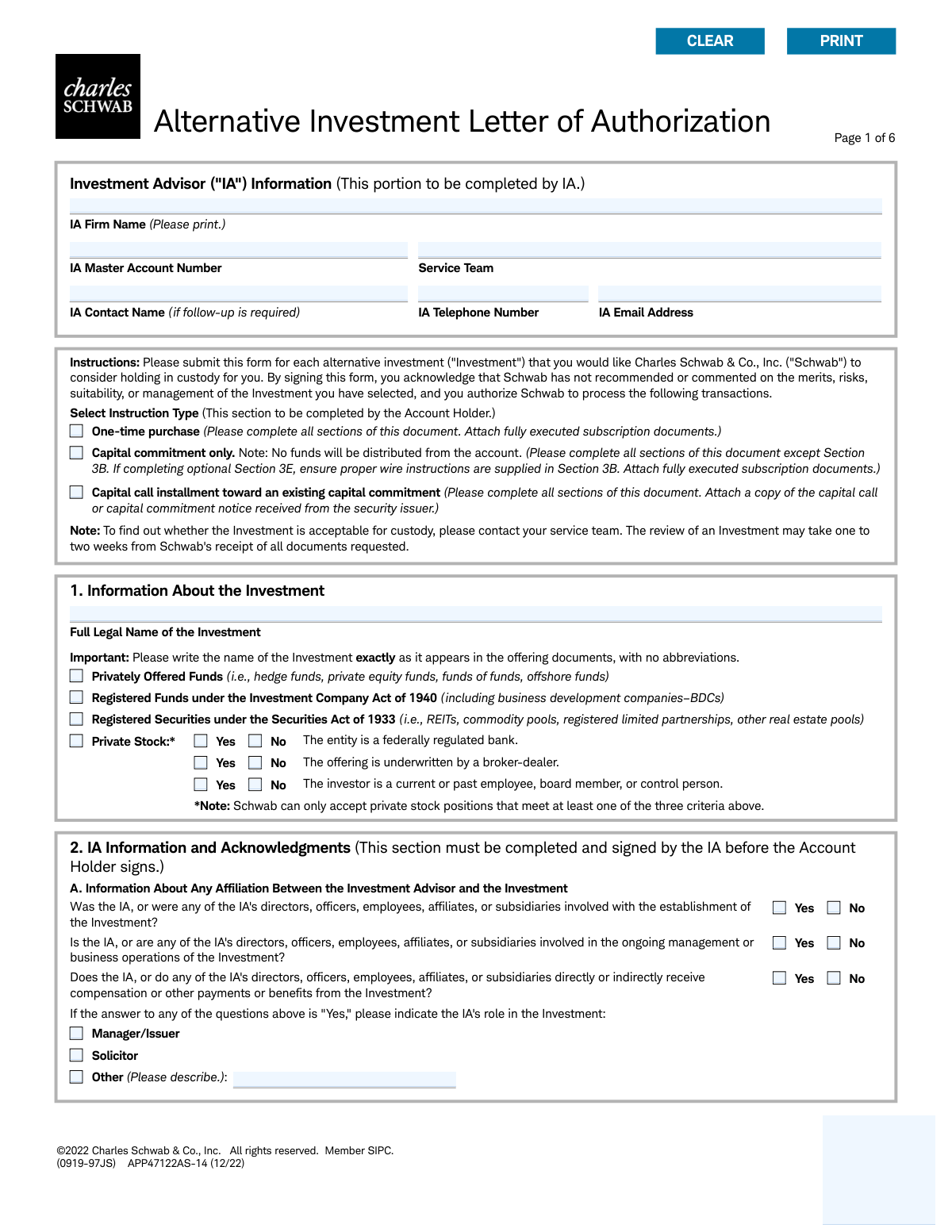
- For Charles Schwab & Co. accounts: Use the Alternative Investment Letter of Authorization to formally request that the firm hold alternative investments in custody for you. This form outlines advisor responsibilities and risk acknowledgments.
- For Columbia Private Trust: Select Form AOB-03, Private Equity Investment Authorization to provide specific funding and investment instructions for private equity assets.
- For Self-Directed IRAs via Pacific Premier Trust: Use the IRA-5054 Private Equity Investment Authorization to execute a private equity purchase specifically within a retirement account structure.
Cash Transfers & Electronic Funds
If your goal is to manage the movement of liquid cash rather than specific asset purchases, look for forms focused on banking connectivity:
- Fidelity Investments Electronic Funds Transfer (EFT) Authorization Form: Use this if you need to establish a standing link between your Fidelity account and an external bank. This is the correct choice for automating routine deposits or withdrawals for both personal and retirement accounts.
Annuity Transfers & Tax-Free Exchanges
For those looking to move retirement funds between providers without triggering a tax event, specific tax-code forms are required:
- TIAA 1035 Exchange Authorization (Form F10926): Choose this form specifically for transferring TIAA Traditional account balances to an alternate investment company. This is designed for 1035 exchanges involving After-Tax Retirement Annuities (ATRA), allowing for a tax-free transfer structured over a specific payout period.
Before filling out these forms, ensure you have your account numbers and, in some cases, your bank's routing information ready. Using Instafill.ai, you can quickly complete these PDFs and ensure all required legal acknowledgments are addressed accurately.
Form Comparison
| Form | Primary Purpose | Asset/Transaction Type | Key Requirement |
|---|---|---|---|
| Alternative Investment Letter of Authorization | Authorizes Schwab to hold alternative investments in custody for a client. | Alternative assets such as hedge funds or private equity. | Acknowledgments of risk and Investment Advisor responsibilities. |
| Fidelity Investments Electronic Funds Transfer (EFT) Authorization Form | Establishes standing instructions for electronic money movement between accounts. | Cash transfers to/from external banks or third parties. | Bank routing details and potential Medallion signature guarantee. |
| Form AOB-03, Private Equity Investment Authorization | Instructs Columbia Private Trust to execute a private equity investment. | Private equity shares or interests. | Detailed funding methods and legal risk acknowledgments. |
| IRA-5054 Private Equity Investment Authorization | Directs Pacific Premier Trust to purchase private equity for an IRA. | Private equity assets within a self-directed retirement account. | Formal direction of purchase and non-traditional asset risk disclosure. |
| TIAA 1035 Exchange Authorization to Alternate Investment Company Transfer Payout Annuity for ATRA | Authorizes tax-free transfer of annuity funds to a different company. | After-Tax Retirement Annuity (ATRA) balances. | Structured payout agreement of 10 payments over 9 years. |
Tips for investment authorization forms
Incorrect banking details are the leading cause of transfer delays or rejected authorizations. Always verify your routing number and account type against an official bank statement or voided check before submitting your form to ensure funds reach the correct destination.
Some high-value authorizations, particularly for EFTs or third-party transfers, require a Medallion Signature Guarantee rather than a standard notary seal. Check the specific requirements of your custodian early, as obtaining this guarantee often requires a physical visit to a participating financial institution.
AI-powered tools like Instafill.ai can complete these complex investment forms in under 30 seconds with high accuracy. Your data stays secure during the process, and the technology can even convert non-fillable PDF versions into interactive forms, saving you significant manual effort.
The name and registration on your authorization form must perfectly match the existing account records held by the custodian. Discrepancies, such as missing middle initials or mismatched trust titles, can lead to the form being flagged and returned for correction, delaying your investment.
For 1035 exchanges or annuity transfers, maintaining tax-deferred status depends on the funds moving directly between institutions. Ensure your form specifies the correct successor custodian information to prevent the transaction from being accidentally classified as a taxable distribution.
When authorizing alternative or private equity investments, remember that custodians like Schwab or Pacific Premier Trust act as administrative record-keepers. They do not vet the quality of the investment, so ensure you have performed your own due diligence before signing the authorization.
Once an authorization is submitted, keep a dated copy of the completed form and any confirmation receipts. This is essential for tracking the progress of private equity funding or multi-year annuity transfers, which can sometimes take several weeks to finalize.
Frequently Asked Questions
These forms serve as a formal legal instruction from an account holder to a financial custodian, such as Schwab or Fidelity, authorizing specific actions like purchasing alternative assets or transferring funds. They ensure that the custodian has documented permission to execute transactions on the client's behalf while clearly outlining the risks and responsibilities of each party.
The correct form depends on your specific financial institution and the type of transaction you wish to perform. For example, if you are moving annuity funds tax-free, you would need a 1035 Exchange Authorization, whereas setting up a recurring bank transfer would require an Electronic Funds Transfer (EFT) form.
Yes, investment authorization forms can be completed efficiently using AI tools like Instafill.ai. These tools can accurately extract data from your existing financial documents and place it into the correct fields of the form, ensuring that complex information like routing numbers and account identifiers are entered correctly.
Using AI-powered services, most investment authorization forms can be filled in under 30 seconds. This process is much faster than manual entry and helps prevent common errors that could lead to the financial institution rejecting your request.
This form is specifically used for the tax-free transfer of funds from one annuity or life insurance contract to another. It allows the policyholder to move their balance to a different investment company without incurring immediate tax liabilities, provided the transfer follows specific IRS guidelines.
A Medallion Signature Guarantee is often required for forms involving significant fund transfers or when linking a third-party bank account, such as with certain Fidelity EFT authorizations. This is a special certification provided by a financial institution that verifies the legitimacy of your signature and protects against fraud.
Yes, custodians like Pacific Premier Trust and Columbia Private Trust require specific authorization forms, such as the IRA-5054 or AOB-03, for private equity investments. These forms are necessary because self-directed IRAs involve non-traditional assets that require explicit direction from the account owner regarding funding and risk acknowledgment.
You will generally need to provide your investment account number, your external bank's routing number, and your bank account number. Some institutions also require you to specify whether the account is a checking or savings account and may ask for a voided check to verify the details.
Completed and signed forms should be submitted directly to the custodian or financial institution managing your account. Many companies allow for digital uploads through their secure portals, though some may still require you to mail the original document if a physical signature guarantee is required.
Alternative investments, such as private placements or hedge funds, carry different risks than standard stocks and bonds. A Letter of Authorization protects the custodian by documenting that the investor and their advisor have performed due diligence and understand that the custodian is only providing administrative services, not investment advice.
Yes, some forms, like the Fidelity EFT Authorization, allow you to set up standing instructions to move money to a bank account owned by someone else. This usually requires additional verification steps to ensure the security of the transaction and to prevent unauthorized withdrawals.
Errors in account numbers, routing information, or signatures can cause the financial institution to reject the form, leading to delays in your investment or transfer. Using automated tools to fill these forms helps ensure that the data matches your source documents exactly, reducing the likelihood of processing errors.
Glossary
- Form Complexity Index
- Instafill’s 0–100 measure of how much effort a form takes to complete, calculated deterministically from the form’s own structure rather than estimated. It combines the number of fillable fields (the largest factor), how difficult those fields are to complete based on their type, the number of pages that contain fields, the amount of conditional “fill-only-if” logic, and how many sections the form is divided into, then adds modifiers for tables and repeating lists, bundled instruction pages, and dense page layouts. A higher score means the form is harder to fill out by hand. The forms in this category have a median Form Complexity Index of 45/100 (Basic). See exactly how it is calculated.
- Custodian
- A financial institution that holds a customer's securities for safekeeping to minimize the risk of theft or loss. In the context of these forms, the custodian executes trades and transfers based on your written authorization but typically does not provide investment advice.
- Medallion Signature Guarantee
- A special certification stamp used by financial institutions to verify that a signature is genuine and that the signer has the legal capacity to sign. It is a higher level of security than a standard notary and is frequently required for high-value transfers or account changes.
- 1035 Exchange
- A provision in the tax code that allows for the tax-free transfer of an existing annuity or life insurance policy for a new one. This process enables investors to change providers or products without triggering immediate tax liabilities on accumulated gains.
- Alternative Investment
- A financial asset that does not fall into traditional categories like stocks, bonds, or cash. These often include private equity, real estate, or hedge funds and typically require specialized authorization forms due to their unique risks and regulatory requirements.
- Electronic Funds Transfer (EFT)
- The digital movement of money from one bank account to another via computer systems. These forms use EFT authorizations to automate the process of moving cash between your personal bank account and your investment or retirement accounts.
- Self-Directed IRA (SDIRA)
- A type of individual retirement account that allows the owner to make all investment decisions and permits a broader range of assets, such as private equity. Because the owner has full control, they must provide specific written authorization for the custodian to execute any transaction.
- Private Equity
- Investment capital that is placed in companies that are not publicly traded on a stock exchange. These investments are often less liquid than stocks and require formal authorization forms to acknowledge the specific risks involved.
- Letter of Authorization (LOA)
- A legal document that grants a third party, such as a brokerage firm or investment advisor, the permission to perform specific tasks or move funds on behalf of the account owner.