Fill out legal answer forms
with AI.
Legal answer forms are the formal documents used by a defendant to respond to a civil lawsuit. When a plaintiff files a complaint, the defendant must provide a point-by-point response to every allegation made against them. These forms are a fundamental part of the judicial process, as they allow the court to understand which facts are in dispute and which are agreed upon. Filing an answer is a time-sensitive requirement; failing to do so within the court's deadline can result in a default judgment, which often means losing the case automatically.
By continuing, you acknowledge Instafill's Privacy Policy and agree to get occasional product update and promotional emails.
About legal answer forms
This category typically serves individuals, business owners, and legal professionals who need to respond to summons and complaints in civil court. Whether the case involves a contract dispute, a property matter, or a general civil action, these forms provide the structure needed to admit or deny claims and assert affirmative defenses. For example, documents like the Michigan Answer (Civil) form are standard requirements for those navigating specific state court systems. Having the correct form ensures that your legal arguments are presented in a format the court recognizes and accepts.
Completing these documents accurately is essential for a proper defense, though the process can be tedious when dealing with complex PDF layouts. Tools like Instafill.ai use AI to fill these forms in under 30 seconds, handling your data accurately and securely to streamline the preparation process. This allows you to meet strict filing deadlines with confidence, ensuring your response is professional and complete without the manual effort of traditional document editing.
Every form on this page can be completed without typing. Instafill is form filling software that reads a PDF and fills it for you — including flat and scanned documents that carry no fillable fields at all.
Forms in This Category
The forms in this category have a median Form Complexity Index of 73/100 (Complex), measured across 1 forms by field count, input difficulty, length, conditional logic and structure. See how it is calculated.
| Form Name | Pages | FCI | |
|---|---|---|---|
| 1. | Form MC 03, Answer, Civil | 1 | Complex 73 |
- Enterprise-grade security & data encryption
- 99%+ accuracy powered by AI
- 1,000+ forms from all industries
- Complete forms in under 60 seconds
How to Choose the Right Form
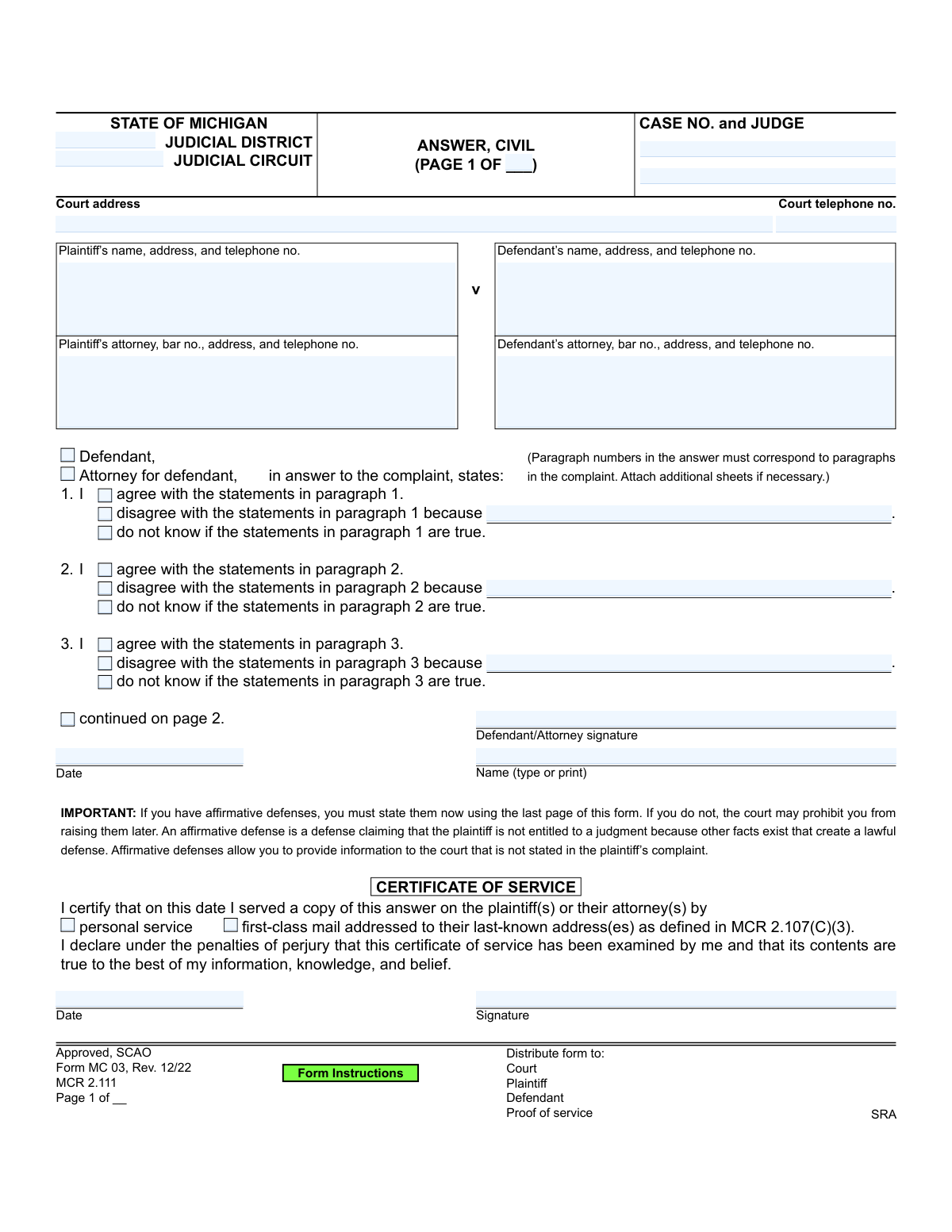
Navigating a civil lawsuit begins with a formal response. If you have been served with a summons and complaint in the state of Michigan, the Form MC 03, Answer (Civil) is the standard document required to protect your rights and present your side of the case to the court.
When to Use Form MC 03
This form is specifically designed for defendants in general civil litigation. You should choose this form if:
- You are the defendant: You have been named in a lawsuit and need to respond to a plaintiff's allegations within the required timeframe.
- The case is Civil: This form is used for standard civil matters rather than criminal cases or specialized family court proceedings.
- The jurisdiction is Michigan: Form MC 03 is the official statewide form recognized by Michigan courts.
Key Components of the Answer (Civil) Form
The Form MC 03 is structured to help you address the complaint point-by-point. When filling it out, you will need to address three main areas:
- Respond to Allegations: For every numbered paragraph in the plaintiff's complaint, you must admit the statement, deny it, or state that you lack sufficient information to form a belief.
- Assert Affirmative Defenses: This form provides the necessary space to list legal reasons why the plaintiff should not win, even if their allegations are true (such as the statute of limitations, contributory negligence, or prior payment of a debt).
- Request for Relief: This is where you formally ask the court to dismiss the case or rule in your favor.
Streamlining Your Legal Response with AI
Legal documents can be intimidating due to their precise requirements. Using Form MC 03 on Instafill.ai simplifies the process by converting the standard PDF into an interactive, AI-assisted experience. This ensures that your responses are legible, correctly formatted, and that you don't miss any critical sections required by the Michigan court system. By utilizing AI-powered tools, you can focus on the substance of your legal defense rather than the technicalities of the paperwork.
Form Comparison
| Form | Purpose | Jurisdiction | Key Response Options |
|---|---|---|---|
| Form MC 03, Answer (Civil) | Formally respond to allegations and affirmative defenses in civil lawsuits. | Michigan State Courts (Civil Division). | Admit, deny, or state lack of knowledge for each allegation. |
Tips for legal answer forms
When completing a legal answer form, ensure you respond to every numbered paragraph in the plaintiff's complaint. Failing to address a specific allegation can sometimes be interpreted by the court as an admission of that fact, so clearly state whether you admit, deny, or lack sufficient knowledge for each point.
Don't just deny the plaintiff's claims; use the designated sections to list any affirmative defenses that could legally defeat the claim. These are specific reasons why the plaintiff should not win even if their facts are true, such as the statute of limitations or contributory negligence.
Civil answers must be filed within a strict timeframe after you are served with the summons and complaint. Missing this deadline could result in a default judgment against you, so it is critical to confirm the specific response window required by your local jurisdiction.
Managing multiple legal documents is easier when you use AI-powered tools like Instafill.ai, which can complete these forms in under 30 seconds with high accuracy. This technology ensures your data stays secure during the process, providing a reliable way to handle time-sensitive legal responses.
After filing your answer with the court, you are typically required to provide a copy to the plaintiff or their attorney. Be sure to complete the proof of service section of the form to document that the other party was properly notified, as failing to do so can stall your case.
Your answer should mirror the structure of the plaintiff's complaint to make it easy for the judge to follow. Using the same paragraph numbers ensures that each of your admissions or denials clearly corresponds to the correct allegation, preventing confusion during court proceedings.
Frequently Asked Questions
A legal answer form is a formal written response filed by a defendant after being served with a civil complaint. It allows the defendant to address each allegation made by the plaintiff, admit or deny specific facts, and present legal defenses to the court.
Form MC 03 is specifically used in Michigan civil courts when a defendant needs to respond to a summons and complaint. It serves as the standard template for ensuring that your response meets the court's formatting and procedural requirements.
For each numbered paragraph in the plaintiff's complaint, you must state whether you admit the allegation, deny it, or lack enough information to form a belief. If you deny an allegation, it signals to the court that the fact is in dispute and must be proven at trial.
Affirmative defenses are legal justifications that can defeat the plaintiff's claim even if their allegations are true. Common examples include the statute of limitations, prior payment of a debt, or a lack of jurisdiction by the court.
Once the form is completed, it must be filed with the clerk of the court where the lawsuit was originally filed. You are also required to serve a copy of the filed answer to the plaintiff or their attorney to ensure they are aware of your response.
Yes, AI tools like Instafill.ai can be used to fill out legal answer forms in under 30 seconds. These systems accurately extract data from your source documents and place it directly into the correct fields on the PDF form.
While manual entry can take a significant amount of time, using an AI-powered service allows you to complete complex legal forms almost instantly. The AI automates the data mapping process, generating a ready-to-print document in less than a minute.
If you do not file an answer within the specified timeframe, the court may enter a default judgment against you. This allows the plaintiff to win the case automatically and can lead to wage garnishments or property liens.
You have the right to file an answer on your own, which is known as appearing 'pro se.' However, because legal language can be complex and deadlines are strict, many people choose to consult with an attorney to ensure their rights are fully protected.
You will need the case number, the name of the court, and the full names of all parties involved in the lawsuit. It is also essential to have the original complaint in front of you so you can respond to each allegation paragraph by paragraph.
In most jurisdictions, there is no fee for a defendant to file a standard answer to a civil complaint. However, if you choose to include a counterclaim against the plaintiff, the court may require a filing fee similar to starting a new lawsuit.
Yes, if you believe the plaintiff is actually the one at fault or owes you damages related to the same incident, you can include a counterclaim. This allows both the original claim and your counter-claim to be heard in a single legal proceeding.
Glossary
- Form Complexity Index
- Instafill’s 0–100 measure of how much effort a form takes to complete, calculated deterministically from the form’s own structure rather than estimated. It combines the number of fillable fields (the largest factor), how difficult those fields are to complete based on their type, the number of pages that contain fields, the amount of conditional “fill-only-if” logic, and how many sections the form is divided into, then adds modifiers for tables and repeating lists, bundled instruction pages, and dense page layouts. A higher score means the form is harder to fill out by hand. The forms in this category have a median Form Complexity Index of 73/100 (Complex). See exactly how it is calculated.
- Answer
- A formal written response filed by a defendant to address the specific allegations and claims made in a plaintiff's complaint.
- Defendant
- The individual, company, or institution being sued or accused in a court of law; the party responsible for filling out the Answer form.
- Plaintiff
- The person or entity who initiated the lawsuit by filing a complaint against the defendant.
- Allegation
- A statement of fact or claim in a legal document that has not yet been proven but which the defendant must admit, deny, or claim lack of knowledge about in their Answer.
- Affirmative Defense
- A legal argument raised by the defendant that, if proven, can defeat or mitigate the plaintiff's claim even if the allegations in the complaint are true.
- Proof of Service
- A formal document or section of a form that provides evidence to the court that the legal Answer was properly delivered to the plaintiff or their attorney.
- Default Judgment
- A ruling granted by the court in favor of the plaintiff when a defendant fails to file an Answer or respond to a summons within the legal deadline.
- Summons
- An official court notice delivered to the defendant that announces a lawsuit has been filed and provides the deadline for filing a formal Answer.