Fill out Medicaid therapy forms
with AI.
Medicaid therapy forms are clinical and administrative documents required to request, authorize, and document therapeutic services covered under Medicaid programs. These forms serve a critical function: they establish medical necessity, capture detailed patient information, and provide the clinical evidence that Medicaid reviewers need to approve services. For specialized therapies like Applied Behavioral Analysis (ABA) for Autism Spectrum Disorder, the documentation requirements are particularly thorough — covering diagnostic criteria, behavioral baselines, measurable treatment goals, and recommended service hours. Incomplete or generic submissions are a common reason for delays and denials, making accuracy essential.
By continuing, you acknowledge Instafill's Privacy Policy and agree to get occasional product update and promotional emails.
About Medicaid therapy forms
These forms are typically completed by licensed clinicians and credentialed specialists — such as Board-Certified Behavior Analysts (BCBAs) — on behalf of patients who rely on Medicaid coverage to access therapy services. Parents and caregivers of children with developmental conditions like autism often encounter these forms when seeking prior authorization for treatment. The stakes are high: a missing detail or unclear clinical justification can stall a child's access to care for weeks.
Because these forms require precise, patient-specific information and must meet strict formatting standards, filling them out correctly the first time matters. Tools like Instafill.ai use AI to help providers complete these forms accurately in under 30 seconds, and can even convert non-fillable PDF versions into interactive forms — reducing administrative burden without sacrificing the detail Medicaid reviewers require.
Every form on this page can be completed without typing. Instafill is form filling software that reads a PDF and fills it for you — including flat and scanned documents that carry no fillable fields at all.
Forms in This Category
The forms in this category have a median Form Complexity Index of 57/100 (Moderate), measured across 2 forms by field count, input difficulty, length, conditional logic and structure. See how it is calculated.
- Enterprise-grade security & data encryption
- 99%+ accuracy powered by AI
- 1,000+ forms from all industries
- Complete forms in under 60 seconds
How to Choose the Right Form
Identifying Your Medicaid Therapy Documentation Needs
Navigating Medicaid requirements for therapy services often depends on the specific state, the type of therapy, and the billing codes involved. In this category, the focus is on specialized behavioral health services within the state of Alabama. To determine if the available form is right for your clinical needs, consider the following criteria:
Applied Behavioral Analysis (ABA) in Alabama
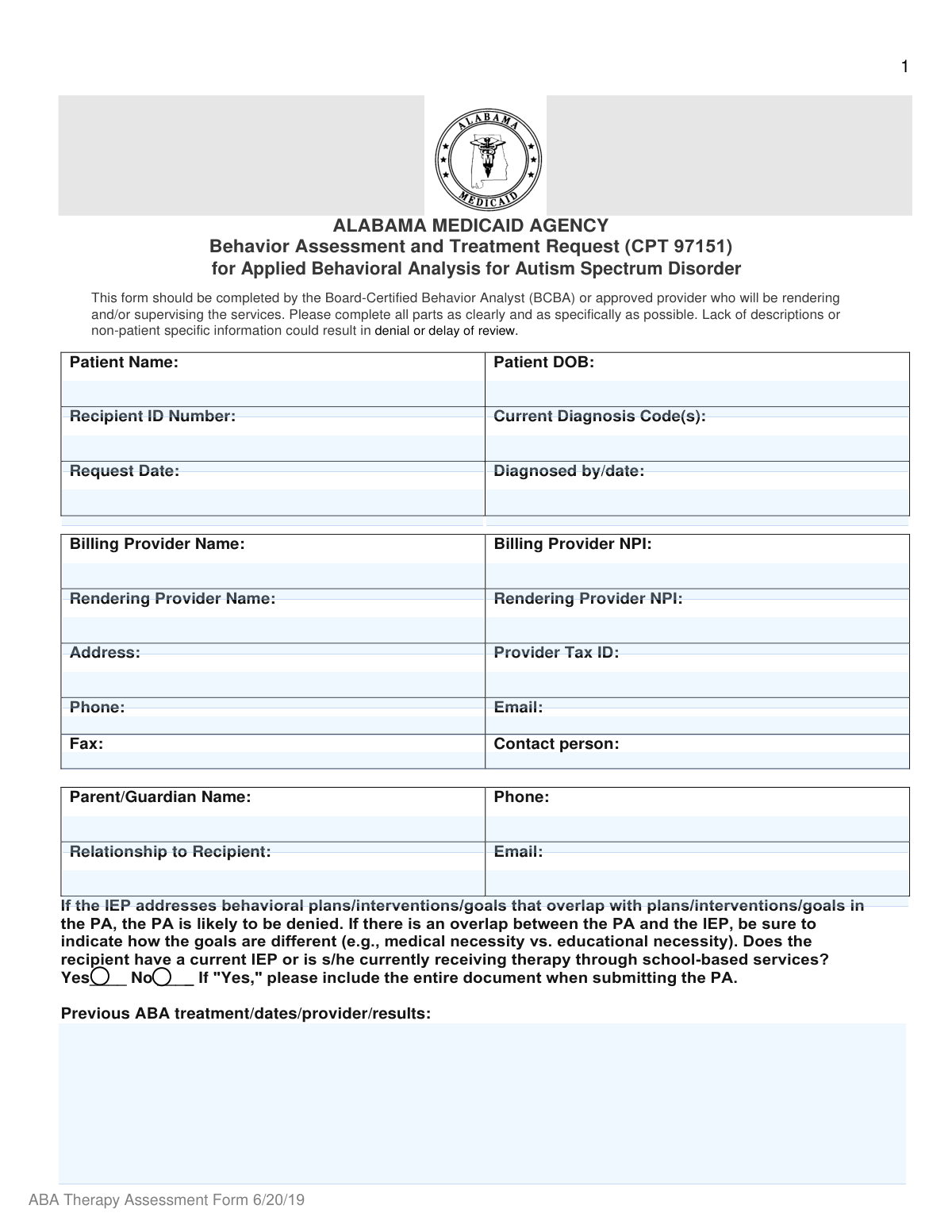
If you are a Board-Certified Behavior Analyst (BCBA) or an approved provider operating within the Alabama Medicaid system, you will likely require the Alabama Medicaid Agency ABA Therapy Assessment Form (6/20/19). This specific document is used for:
- Initial Assessments and Treatment Planning: It is specifically designed for requesting authorization for the Behavior Assessment and Treatment Request under CPT code 97151.
- Demonstrating Medical Necessity: The form is essential for documenting DSM-5 criteria, evaluation findings, and standardized test scores to prove that ABA services are medically necessary for a patient with Autism Spectrum Disorder (ASD).
- Coordinating Care: Use this form if you need to detail how Medicaid-funded therapy interacts with school-based services or an existing IEP to ensure there is no duplication of services.
When to Use This Form
You should select the Alabama Medicaid Agency ABA Therapy Assessment Form (6/20/19) if your goal is to secure authorization for a comprehensive behavior assessment. It is not a general therapy log; rather, it is a high-level clinical and administrative request that captures baselines, measurable goals, and recommended treatment hours.
Because Medicaid reviewers require patient-specific documentation to avoid delays or denials, using a digital tool like Instafill.ai can help ensure every field—from clinical history to transition plans—is completed accurately. If you are looking for physical or occupational therapy forms for other states, you may need to navigate to those specific state categories, as this section is currently tailored to Alabama's ABA-specific Medicaid requirements.
Form Comparison
| Form | Primary Purpose | Who Files It | Key Requirements | Target Diagnosis |
|---|---|---|---|---|
| Alabama Medicaid Agency ABA Therapy Assessment Form (6/20/19) | Request authorization for ABA behavior assessment and treatment planning (CPT 97151). | Board-Certified Behavior Analysts (BCBA) or approved Medicaid providers. | DSM-5 criteria, clinical findings, targeted behaviors, and measurable treatment goals. | Medicaid-eligible patients diagnosed with Autism Spectrum Disorder (ASD). |
Tips for Medicaid therapy forms
Ensure your documentation explicitly links the child's diagnosis to the requested treatment hours. Medicaid reviewers look for a direct connection between evaluation findings and the clinical need for ABA services to avoid authorization delays or denials.
Medicaid typically does not cover services that are the responsibility of the school system. When filling out these forms, clearly state how the requested therapy differs from and complements the child’s Individualized Education Program (IEP) to ensure coverage eligibility.
Vague descriptions of behavior often lead to rejections. Use specific, quantifiable data for baseline behaviors and set clear, time-bound goals to demonstrate exactly how progress will be measured during the requested authorization period.
Many Medicaid therapy forms require specific certifications, such as a Board-Certified Behavior Analyst (BCBA) designation. Double-check that all provider identifiers are accurate and that all required signature fields are completed before submission.
AI-powered tools like Instafill.ai can complete these complex forms in under 30 seconds with high accuracy by extracting data from your existing clinical records. This ensures your data stays secure while significantly reducing the administrative burden of manual entry.
Ensure the CPT codes, such as 97151 for assessments, accurately reflect the number of units or hours requested in the clinical section. Discrepancies between the narrative description and the unit count are a frequent cause of administrative rejections.
Medicaid forms often require a plan for how therapy will be coordinated with other healthcare providers. Including a thoughtful transition or discharge plan from the start shows the reviewer that there is a clear long-term strategy for the patient's care.
Frequently Asked Questions
Medicaid therapy forms are used to document clinical needs and request prior authorization for specialized treatments like Applied Behavioral Analysis (ABA). These documents ensure that the services provided meet state-specific medical necessity criteria and are appropriately billed under approved procedure codes.
These forms are typically completed by a Board-Certified Behavior Analyst (BCBA) or an approved Medicaid provider. The provider must detail the patient's clinical history, evaluation findings, and proposed treatment plan to justify the request for authorization.
A provider should submit this form when requesting authorization for a behavior assessment and treatment planning service, specifically under CPT code 97151. It is required before therapy begins and may be needed again when a significant update to the treatment plan is necessary.
Medicaid requires this information to ensure that the requested ABA services are medically necessary and distinct from educational services provided by schools. This helps prevent a duplication of services and ensures that the clinical treatment addresses needs that are not already being met in an academic setting.
Incomplete or non-patient-specific documentation is a common reason for delays or denials in service authorization. Ensuring all fields, including baseline data and measurable goals, are accurately filled is critical for a smooth approval process and timely care for the patient.
Yes, you can fill out Medicaid therapy forms using AI tools like Instafill.ai. These tools can accurately extract data from source documents and place it into the correct fields, which helps reduce the risk of manual entry errors in clinical documentation.
Using AI-powered services, these forms can often be filled out in under 30 seconds. These platforms can also convert static or non-fillable PDF versions into interactive forms, making the administrative process significantly faster than manual typing.
These forms require detailed information including DSM-5 criteria, standardized test scores, and targeted behaviors with established baselines. Providers must also outline measurable goals and the recommended number of treatment units or hours for the upcoming period.
Yes, a formal diagnosis, such as Autism Spectrum Disorder, is generally required to support the medical necessity of the therapy. The form includes specific sections to record patient identifiers and the relevant diagnostic information from a qualified professional.
Once completed, these forms are usually submitted directly to the state's Medicaid agency or its designated third-party administrator for clinical review. Submission methods typically include secure provider portals, though some regions may still accept fax or mail.
By capturing specific evaluation findings and treatment goals, these forms allow Medicaid reviewers to determine if the requested services are appropriate for the patient's condition. They provide a structured way to demonstrate that the therapy is clinically indicated and likely to result in measurable improvement for the individual.
Glossary
- Form Complexity Index
- Instafill’s 0–100 measure of how much effort a form takes to complete, calculated deterministically from the form’s own structure rather than estimated. It combines the number of fillable fields (the largest factor), how difficult those fields are to complete based on their type, the number of pages that contain fields, the amount of conditional “fill-only-if” logic, and how many sections the form is divided into, then adds modifiers for tables and repeating lists, bundled instruction pages, and dense page layouts. A higher score means the form is harder to fill out by hand. The forms in this category have a median Form Complexity Index of 57/100 (Moderate). See exactly how it is calculated.
- ABA (Applied Behavior Analysis)
- A type of therapy that focuses on improving specific behaviors, such as social skills, communication, and reading, often used as a primary treatment for individuals with Autism Spectrum Disorder.
- BCBA (Board-Certified Behavior Analyst)
- A healthcare professional with a graduate-level certification in behavior analysis who is responsible for designing, implementing, and overseeing ABA treatment plans.
- Medical Necessity
- The clinical standard used by Medicaid to determine if a therapy or service is required to diagnose or treat a condition according to established medical guidelines.
- CPT Code 97151
- A specific billing code used for the initial assessment and treatment planning phase of ABA therapy, where a professional evaluates the patient and develops a clinical plan.
- Prior Authorization
- A formal approval process where Medicaid reviews clinical documentation before a service is provided to ensure it is covered and medically necessary.
- IEP (Individualized Education Program)
- A legal document for students receiving special education in schools; Medicaid requires this information to coordinate care and ensure services do not overlap with school-funded programs.
- Baseline
- The measured level of a patient's behavior or skill before treatment begins, which serves as a starting point to track progress and the effectiveness of the therapy.
- DSM-5 Criteria
- The standard classification of mental disorders used by healthcare professionals to provide formal diagnoses, such as identifying the severity levels of Autism Spectrum Disorder.