Yes! You can use AI to fill out West Virginia Medicaid Hepatitis-C Therapy Prior Authorization Form

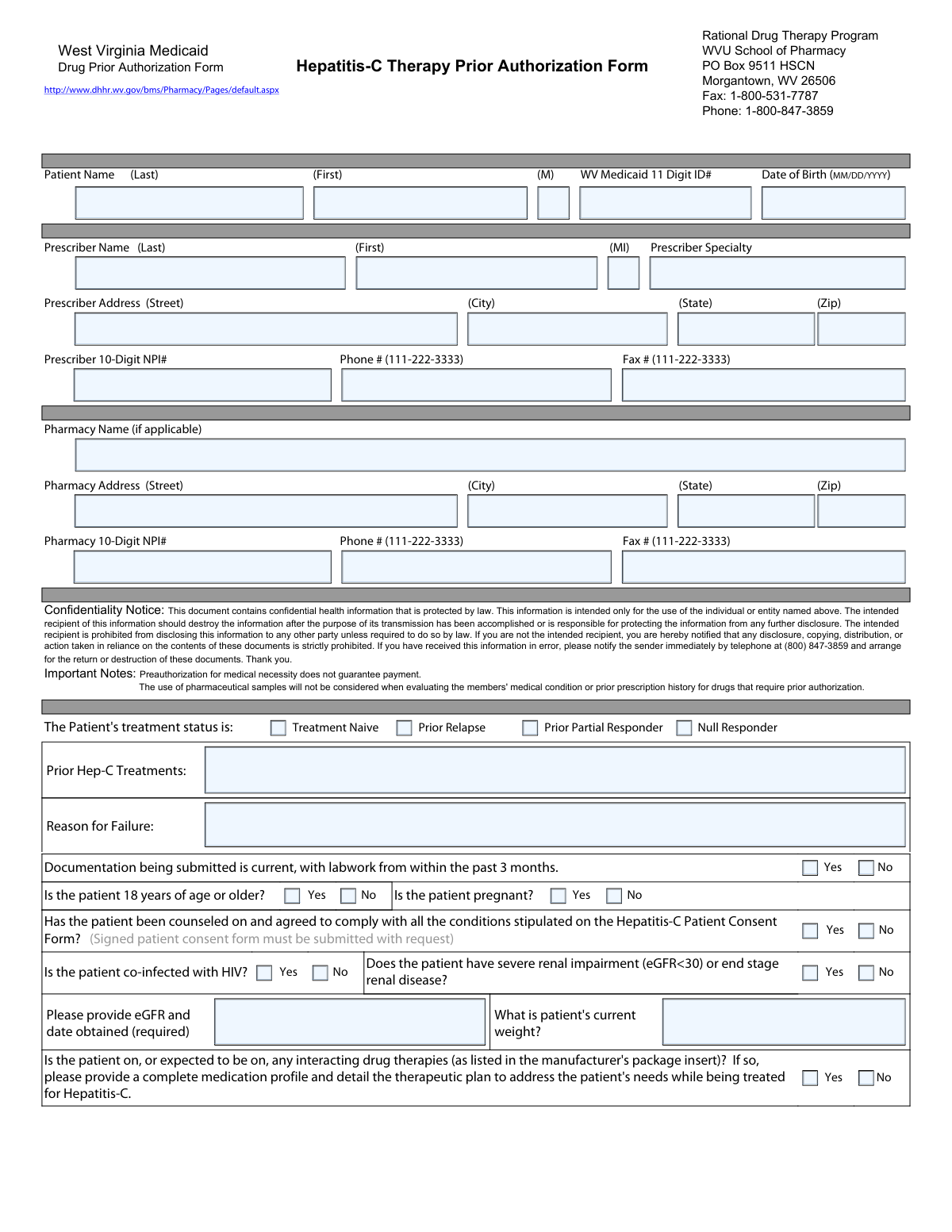
The West Virginia Medicaid Hepatitis-C Therapy Prior Authorization Form is a document required by prescribers to justify the medical necessity of specific, often costly, Hepatitis-C treatments for a patient. It ensures the requested therapy aligns with the state's clinical criteria for efficacy, safety, and cost-effectiveness before approval for coverage. Today, this form can be filled out quickly and accurately using AI-powered services like Instafill.ai, which can also convert non-fillable PDF versions into interactive fillable forms.
Our AI automatically handles information lookup, data retrieval, formatting, and form filling.
It takes less than a minute to fill out WV Medicaid Hep-C PA using our AI form filling.
Securely upload your data. Information is encrypted in transit and deleted immediately after the form is filled out.

Form specifications

Form name: West Virginia Medicaid Hepatitis-C Therapy Prior Authorization Form
Number of fields: 77
Number of pages: 2
Filled form examples: Form WV Medicaid Hep-C PA Examples
Language: English
main-image

Instafill Demo: How to fill out PDF forms in seconds with AI

How to Fill Out WV Medicaid Hep-C PA Online for Free in 2026

Are you looking to fill out a WV MEDICAID HEP-C PA form online quickly and accurately? Instafill.ai offers the #1 AI-powered PDF filling software of 2026, allowing you to complete your WV MEDICAID HEP-C PA form in just 37 seconds or less.
Follow these steps to fill out your WV MEDICAID HEP-C PA form online using Instafill.ai:
  1. 1 Navigate to Instafill.ai and upload or select the Hepatitis-C Therapy Prior Authorization Form.
  2. 2 Provide the patient's demographic information, including their name, date of birth, and West Virginia Medicaid ID number.
  3. 3 Enter the complete details for the prescriber and the dispensing pharmacy, including names, addresses, and NPI numbers.
  4. 4 Fill in the patient's clinical information, such as diagnosis with ICD code, genotype, viral load, fibrosis level, and cirrhosis status, ensuring all required lab results are attached.
  5. 5 Detail the patient's treatment history, current status (e.g., treatment-naive, relapser), and answer questions regarding pregnancy, HIV co-infection, and renal function.
  6. 6 Specify the exact drug regimen being requested, including drug names, doses, and duration, and check any applicable criteria for interferon or ribavirin ineligibility.
  7. 7 Review all AI-populated fields for accuracy, have the prescriber electronically sign the attestation, and submit the completed form to the Rational Drug Therapy Program.

Our AI-powered system ensures each field is filled out correctly, reducing errors and saving you time.

Why Choose Instafill.ai for Your Fillable WV Medicaid Hep-C PA Form?

Speed

Complete your WV Medicaid Hep-C PA in as little as 37 seconds.

Up-to-Date

Always use the latest 2026 WV Medicaid Hep-C PA form version.

Cost-effective

No need to hire expensive lawyers.

Accuracy

Our AI performs 10 compliance checks to ensure your form is error-free.

Security

Your personal information is protected with bank-level encryption.

Frequently Asked Questions About Form WV Medicaid Hep-C PA

This form is used by prescribers to request coverage from West Virginia Medicaid for specific Hepatitis-C drug therapies. It serves to document the medical necessity of a treatment to get it approved before it is dispensed to the patient.

The patient's prescribing healthcare provider (e.g., a physician, specialist, or nurse practitioner) must complete and submit this form on behalf of the patient.

You must include a signed Hepatitis-C Patient Consent Form, recent lab results (from the last 3 months) for viral load and genotype, and documentation supporting the patient's fibrosis level.

The completed form and all required supporting documents should be faxed to the Rational Drug Therapy Program at 1-800-531-7787.

All submitted documentation, including lab work for viral load, genotype, and eGFR, must be current and dated within the three months prior to the submission date.

The fibrosis level (F1-F4) indicates the severity of liver disease and is a critical factor used by Medicaid to determine the medical necessity and urgency of the requested therapy. Supporting documentation for the indicated level is required.

This is a separate document where the patient acknowledges and agrees to the conditions of their Hepatitis-C treatment. A signed copy of this consent form must be submitted along with the prior authorization request.

You must provide the patient's most recent eGFR value and the date it was measured. You also need to specify if the patient has severe renal impairment (eGFR<30) or end-stage renal disease, as this impacts treatment options.

If the patient is taking any drugs that could interact with the requested Hepatitis-C therapy, you must provide a complete medication profile and detail the plan to manage these interactions.

If you have questions while completing the form, you can contact the Rational Drug Therapy Program by phone at 1-800-847-3859.

Yes, services like Instafill.ai use AI to accurately auto-fill form fields from patient records, which can save you time and help prevent clerical errors.

Simply upload the form to the Instafill.ai platform, and its AI will identify all the fields. You can then have it automatically populate patient, prescriber, and clinical information from your records.

If you have a non-fillable or 'flat' PDF, you can use a service like Instafill.ai to instantly convert it into an interactive, fillable form. This allows you to easily type in the information or have it auto-filled.

You can use your valid electronic signature and must check the 'Check here for electronic signature' box. Your signature certifies that the request is medically necessary and documented in the patient's medical records.

Compliance WV Medicaid Hep-C PA
Validation Checks by Instafill.ai

1
WV Medicaid ID Format and Length
This check ensures the 'WV Medicaid 11 Digit ID#' field contains exactly 11 digits and no other characters. This ID is the primary patient identifier for West Virginia Medicaid, and its accuracy is critical for linking the authorization request to the correct patient record and for billing. If the ID is incorrectly formatted, the submission will be rejected until a valid 11-digit numeric ID is provided.
2
NPI Number Format and Length
Validates that both the 'Prescriber 10-Digit NPI#' and 'Pharmacy 10-Digit NPI#' fields contain exactly 10 numeric digits. The National Provider Identifier (NPI) is a standard, unique identifier for healthcare providers. An invalid NPI prevents verification of the prescriber or pharmacy, which can halt the authorization process. Submissions with invalid NPIs will be returned for correction.
3
Date of Birth and Age Confirmation Consistency
This validation cross-references the patient's 'Date of Birth' with the answer to 'Is the patient 18 years of age or older?'. The system calculates the patient's age from the DOB and verifies it matches the checkbox selection. This check prevents data entry errors and confirms the patient meets a key eligibility criterion. A mismatch will trigger an error, requiring the user to correct one of the fields.
4
Conditional Requirement for Child-Pugh Score
This check ensures the 'Child-Pugh Score' field is filled out if, and only if, the answer to 'Does the patient have cirrhosis?' is 'Yes'. The Child-Pugh score is essential for assessing the severity of cirrhosis and determining the appropriate treatment regimen. If 'Yes' is selected for cirrhosis without a score, the form is considered incomplete and will be rejected.
5
Conditional Requirement for Transplant Date
Validates that the 'Potential liver transplant date' field is completed with a valid future date when 'Is the patient awaiting liver transplantation?' is answered 'Yes'. This information is critical for care coordination and assessing the urgency of treatment. If 'Yes' is checked without a date, the submission will be flagged as incomplete.
6
eGFR and Renal Impairment Consistency
This check verifies the logical consistency between the numeric value entered for 'eGFR' and the selection for 'Does the patient have severe renal impairment (eGFR<30)'. If the eGFR value provided is less than 30, the 'Yes' box must be checked. This cross-validation helps prevent data entry mistakes on a critical clinical value that impacts drug choice and dosing.
7
Labwork Currency Requirement
Ensures that the 'Yes' option is selected for 'Documentation being submitted is current, with labwork from within the past 3 months.' Treatment decisions for Hepatitis-C are highly dependent on recent lab values. If 'No' is selected or the field is left blank, the prior authorization request will be rejected as it cannot be evaluated with outdated clinical data.
8
Patient Consent Confirmation Requirement
This validation confirms that 'Yes' is selected for 'Has the patient been counseled on and agreed to comply with all the conditions stipulated on the Hepatitis-C Patient Consent Form?'. The form explicitly states a signed consent form must be submitted, making this a mandatory prerequisite for authorization. A 'No' response will result in immediate rejection of the request.
9
Prior Treatment Details Requirement
If the patient's treatment status is marked as 'Null Responder', 'Prior Partial Responder', or 'Prior Relapse', this check ensures that the 'Prior Hep-C Treatments' and 'Reason for Failure' fields are not empty. This history is essential for selecting an appropriate subsequent therapy. If 'Treatment Naive' is selected, these fields should be empty; otherwise, the form is incomplete.
10
Cirrhosis and Fibrosis Level Consistency
This check ensures consistency between the selected fibrosis level and the cirrhosis status. If the fibrosis level is marked as 'F4', which indicates advanced fibrosis or cirrhosis, the answer to 'Does the patient have cirrhosis?' must be 'Yes'. This logical check ensures clinical data is reported consistently across the form, preventing contradictory information.
11
Ineligibility Justification Requirement
Validates that if 'IFN-Ineligible' or 'Ribavirin-Ineligible' is checked, at least one of the corresponding specific reason checkboxes below it is also selected. Simply claiming ineligibility is insufficient; a documented clinical reason is required for approval of alternative, often more expensive, regimens. A submission without this specific justification will be considered incomplete.
12
Prescriber Signature and Date Requirement
This check ensures that either the 'Prescriber Signature' field is signed or the 'Electronic signature' box is checked, and that the 'Date' field is filled with a valid, recent date. The signature and date serve as a legal attestation of medical necessity. A missing signature or date invalidates the entire request, leading to its rejection.
13
Diagnosis and Lab Results Completeness
Verifies that the 'Diagnosis (Include ICD9 Code)', 'Viral Load', and 'Genotype' fields are all completed. These three pieces of information are fundamental to establishing medical necessity and determining the correct treatment protocol. The form will be rejected if any of these core diagnostic fields are left blank, as evaluation is impossible without them.
14
Fibrosis Level Selection Requirement
This validation ensures that one and only one fibrosis level ('F1', 'F2', 'F3', or 'F4') is selected. The form indicates this is a required field, and the level of fibrosis is a key factor in determining treatment urgency and regimen choice. Submissions with no selection or multiple selections will be rejected for being incomplete or ambiguous.
15
Pregnancy and Ribavirin Ineligibility Cross-Check
This is a critical safety check that validates if 'Is the patient pregnant? - Yes' is selected, then the 'Pregnant women and men with pregnant partners' box under Ribavirin-Ineligible criteria must also be checked. Ribavirin is a known teratogen and is strictly contraindicated in pregnancy. A failure to correctly flag this ineligibility would represent a significant patient safety risk and cause the form to be rejected for review.

Common Mistakes in Completing WV Medicaid Hep-C PA

Failing to Submit Required Supporting Documentation

The form explicitly requires several attachments, including a signed patient consent form and recent lab results for viral load, genotype, and fibrosis level. A frequent error is checking the boxes on the form but forgetting to fax or upload the corresponding documents. This results in an incomplete submission, which is automatically delayed or denied until the missing information is provided.

Incorrect or Missing Medicaid and NPI Numbers

The 11-digit WV Medicaid ID and the 10-digit Prescriber NPI are critical identifiers prone to transcription errors. Entering even one wrong digit will cause the system to fail in identifying the patient or provider, leading to an immediate rejection of the prior authorization request. These numbers must be carefully double-checked against source documents before submission.

Using an Outdated ICD-9 Diagnosis Code

The form specifically requests an 'ICD-9 Code,' which is an obsolete coding system, as ICD-10 is the current standard. This ambiguity causes users to enter invalid or outdated codes, or to enter a correct ICD-10 code that may be flagged as an error by the system. This discrepancy can halt processing and require manual clarification, delaying the review process.

Contradictory or Incomplete Clinical Status Information

The form contains several conditional fields that are often filled out incorrectly. For instance, a user might check 'Yes' for 'Does the patient have cirrhosis?' but then leave the required 'Child-Pugh Score' field blank. This creates an incomplete clinical picture, forcing the reviewer to send the form back for clarification and delaying the patient's access to therapy.

Providing an Incomplete or Vague Drug Regimen Request

The section for the requested drug regimen requires the drug name, dose, and duration of therapy. A common mistake is to provide only partial information, such as the drug name without the treatment duration (e.g., 'Mavyret' instead of 'Mavyret for 8 weeks'). This ambiguity makes it impossible to approve the request and necessitates a follow-up with the prescriber's office.

Submitting Outdated or Undated Lab Information

This prior authorization requires that all submitted lab work be from within the past 3 months, and the eGFR value must include the date it was obtained. Submitters often overlook this requirement, providing old labs or omitting the date for the eGFR. Because treatment decisions for Hepatitis-C rely on current data, outdated information will trigger a request for new labs, significantly postponing treatment.

Missing Prescriber Signature or Date

The prescriber's signature and date serve as a legal attestation of medical necessity, and forgetting either one invalidates the entire request. This is a simple but surprisingly common error, especially on faxed forms where the signature line is easily overlooked. The submission will be returned unprocessed until a properly signed and dated form is received.

Illegible Handwriting on a Printed Form

This form is often distributed as a non-fillable PDF, forcing staff to print it and complete it by hand, which can result in illegible handwriting. Critical data like patient ID numbers, lab values, and prescriber names can be easily misread, leading to processing errors or outright rejection. AI-powered tools like Instafill.ai can convert such non-fillable PDFs into fillable versions, ensuring all information is typed, clear, and legible.

Incorrectly Selecting Patient Treatment Status

The form provides four mutually exclusive options for prior treatment history: 'Treatment Naive,' 'Prior Relapse,' 'Prior Partial Responder,' and 'Null Responder.' Office staff may not know the precise clinical definitions or may accidentally check multiple boxes. This is a critical error, as the choice of the new therapy regimen is highly dependent on the patient's past treatment experience and response.

Ignoring Data Format Requirements

The form specifies formats like MM/DD/YYYY for dates and 111-222-3333 for phone numbers, but users often enter them in different formats. While this seems minor, inconsistent formatting can cause errors in automated data entry systems or require manual correction, adding unnecessary delays to the approval process. Using a tool like Instafill.ai can help prevent these mistakes by automatically validating and formatting data correctly as it's entered.

Inadequate Disclosure of Interacting Drug Therapies

The form asks if the patient is on interacting drugs and requires a complete medication profile if the answer is 'Yes'. A common oversight is to check 'Yes' but fail to attach the required list, or to check 'No' without performing a thorough medication reconciliation. Given the significant drug-drug interactions with Hepatitis-C antivirals, this omission poses a safety risk and will lead to requests for more information, delaying treatment.
Saved over 80 hours a year

“I was never sure if my IRS forms like W-9 were filled correctly. Now, I can complete the forms accurately without any external help.”

Kevin Martin Green

Your data stays secure with advanced protection from Instafill and our subprocessors

Robust compliance program

Transparent business model

You’re not the product. You always know where your data is and what it is processed for.

ISO 27001, HIPAA, and GDPR

Our subprocesses adhere to multiple compliance standards, including but not limited to ISO 27001, HIPAA, and GDPR.

Security & privacy by design

We consider security and privacy from the initial design phase of any new service or functionality. It’s not an afterthought, it’s built-in, including support for two-factor authentication (2FA) to further protect your account.

Fill out WV Medicaid Hep-C PA with Instafill.ai

Worried about filling PDFs wrong? Instafill securely fills west-virginia-medicaid-hepatitis-c-therapy-prior-authorization-form forms, ensuring each field is accurate.