Fill out Medicaid authorization forms
with AI.
Medicaid authorization forms are essential documents used to secure approval for specialized medical and behavioral health services before they are provided. These forms ensure that treatments meet medical necessity criteria and that coverage is confirmed, preventing unexpected costs for patients and payment denials for providers. This category specifically covers critical documentation required for services like Applied Behavior Analysis (ABA) and other specialized care programs managed under state Medicaid frameworks.
By continuing, you acknowledge Instafill's Privacy Policy and agree to get occasional product update and promotional emails.
About Medicaid authorization forms
Healthcare providers, including board-certified behavior analysts (BCBAs), psychologists, and clinical administrators, typically handle these forms to coordinate care for Medicaid members. Whether you are submitting a request to a state agency like Virginia DMAS or a managed care organization in Louisiana or Arkansas, accurate completion is vital. These forms are required during initial intake, for treatment plan renewals, or when adjusting service hours to ensure patients receive consistent, high-quality care without administrative delays.
Navigating the complexities of prior authorization can be time-consuming, but tools like Instafill.ai allow providers to complete these forms using AI in under 30 seconds while maintaining high standards for data accuracy and security. By automating the data entry process, clinics can focus more on patient outcomes and less on the repetitive paperwork often associated with behavioral health and Medicaid compliance.
Every form on this page can be completed without typing. Instafill is form filling software that reads a PDF and fills it for you — including flat and scanned documents that carry no fillable fields at all.
Forms in This Category
The forms in this category have a median Form Complexity Index of 57/100 (Moderate), measured across 4 forms by field count, input difficulty, length, conditional logic and structure. See how it is calculated.
| Form Name | Pages | FCI | |
|---|---|---|---|
| 1. | Arkansas Medicaid Applied Behavioral Analysis (ABA) Authorization Request | 6 | Moderate 59 |
| 2. | Medicaid Managed Care Applied Behavior Analysis — Authorization Request (Healthy Blue Louisiana, BLAPEC-1989-20) | 4 | Moderate 53 |
| 3. | Medicaid of Alaska Provider Electronic Remittance (835) Authorization and Claims Enrollment Form | 1 | Basic 35 |
| 4. | West Virginia Medicaid Hepatitis-C Therapy Prior Authorization Form | 2 | Moderate 57 |
- Enterprise-grade security & data encryption
- 99%+ accuracy powered by AI
- 1,000+ forms from all industries
- Complete forms in under 60 seconds
How to Choose the Right Form
Selecting the correct Medicaid authorization form is critical to ensuring that behavioral health services are covered and that reimbursement is not delayed. Because Medicaid is administered at the state level through various Managed Care Organizations (MCOs), these forms are state-specific and are not interchangeable.
Choose by State and Health Plan
The primary factor in your selection is the state where the patient receives benefits and the specific insurance carrier managing their care:
- Louisiana (Healthy Blue): If you are a licensed psychologist or BCBA providing services to Medicaid recipients in Louisiana under the Healthy Blue plan, use the Medicaid Managed Care Applied Behavior Analysis — Authorization Request (Healthy Blue Louisiana, BLAPEC-1989-20). This form is tailored for CPT codes 97151–97158 and requires specific attestations regarding living arrangements and ensuring services do not duplicate IFSP or IEP plans.
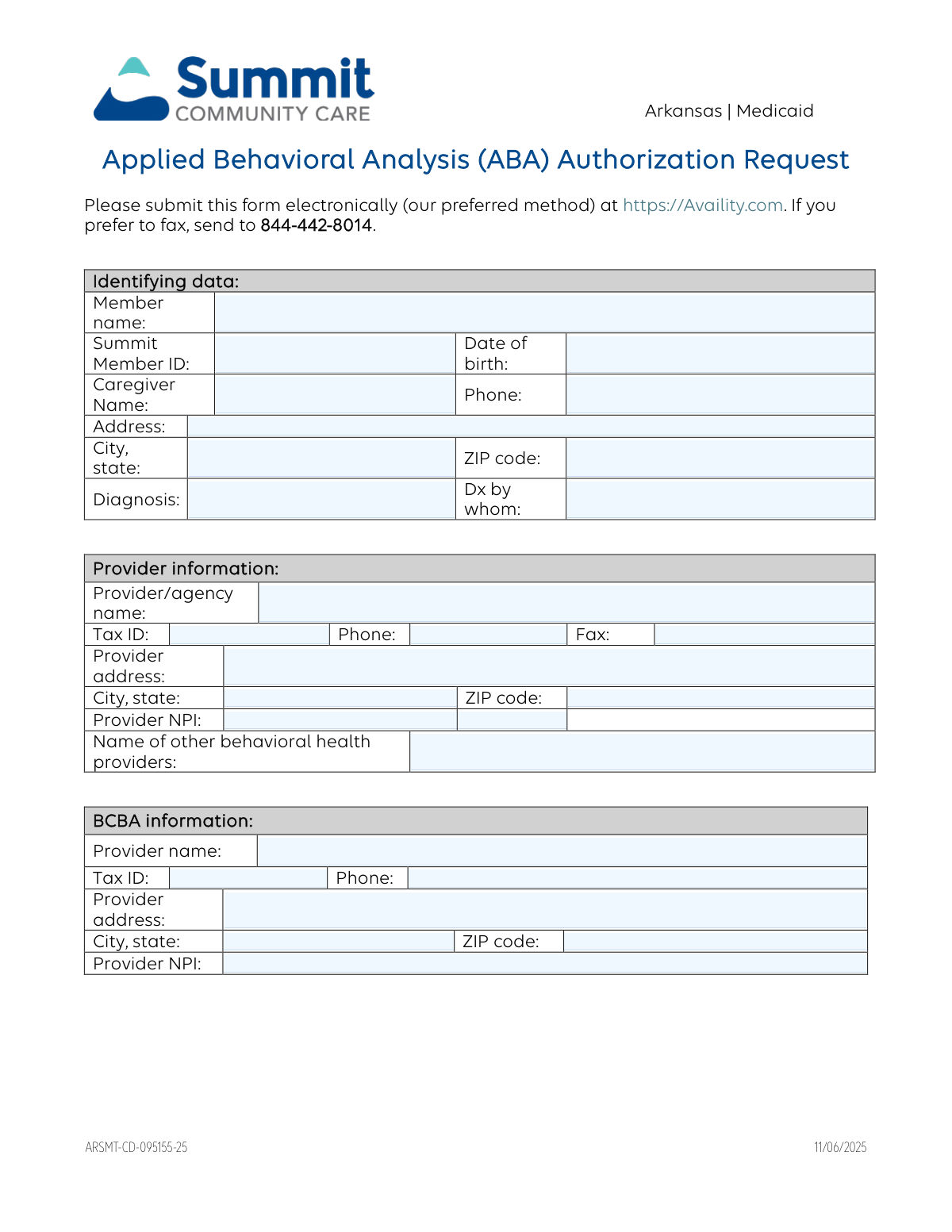
- Arkansas (Summit Community Care): If you are providing ABA therapy to Medicaid members in Arkansas through Summit Community Care, select the Arkansas Medicaid Applied Behavioral Analysis (ABA) Authorization Request. This document (ARSMT-CD-095155-25) focuses on DSM-V diagnosis data, current medication lists, and detailed behavior reduction plans.
Verify the Service Type and Requirements
Both forms currently in this category are dedicated specifically to Applied Behavior Analysis (ABA). To expedite the filing process, ensure you have the following documentation ready before you begin:
- Provider & Member Identifiers: You will need the member's Medicaid ID, the provider's NPI, and the specific BCBA certification information.
- Clinical Justification: Both forms require functional assessment results, requested hours/units per CPT code, and clearly defined treatment goals.
- Coordination of Care: Information regarding the Primary Care Physician (PCP) and other involved specialists is typically required to prove medical necessity.
If you are searching for Virginia DMAS forms or authorizations for other states, always verify the MCO logo on the patient's insurance card to ensure you are using the correct regional document.
Form Comparison
| Form | State & Managed Care Organization | CPT Codes Covered | Key Documentation Required |
|---|---|---|---|
| Medicaid Managed Care Applied Behavior Analysis — Authorization Request (Healthy Blue Louisiana, BLAPEC-1989-20) | Louisiana (Healthy Blue Medicaid Managed Care) | CPT codes 97151 through 97158 | Treatment plan attestations, living arrangements, and non-duplication of IEP services. |
| Arkansas Medicaid Applied Behavioral Analysis (ABA) Authorization Request | Arkansas (Summit Community Care Medicaid) | CPT codes 97151, 97153, 97155, and 97156 | DSM-V diagnosis, current medications, and detailed functional assessment results. |
Tips for Medicaid authorization forms
Medicaid ABA authorizations rely on specific CPT codes like 97151 or 97153. Double-check that the requested hours match the units allowed per code to prevent immediate administrative denials or delays in processing.
Ensure that treatment goals and behavioral reduction plans are clearly linked to the member’s DSM-V diagnosis. Specificity in functional assessment results helps reviewers understand the medical necessity of the requested intervention.
Managing multiple Medicaid authorizations can be time-consuming, but AI-powered tools like Instafill.ai can complete these forms in under 30 seconds with high accuracy. Your data stays secure during the process, making it a reliable real-world time-saver for busy behavioral health providers.
Most Medicaid ABA forms require the signature or NPI of the member's PCP. Having this information ready before you start filling out the form prevents the need to stop and search for records mid-process.
Clearly state how the requested ABA services differ from those provided through an Individualized Education Program (IEP). Medicaid typically requires assurance that clinical services are not duplicative of what the school district is already providing.
Minor discrepancies in a member's ID number or birth date can cause an automatic system rejection. Always verify the member's current Medicaid status and ID against the state portal before submitting the authorization request.
Keep a timestamped copy of every authorization request and the supporting documentation sent to the Managed Care Organization. This organization is vital for tracking expiration dates and providing proof of submission during future audits.
Frequently Asked Questions
These forms are used by healthcare providers to request approval from Medicaid Managed Care organizations before providing Applied Behavior Analysis (ABA) therapy. They ensure the requested services are medically necessary and meet specific state and plan requirements for behavioral health coverage.
Typically, the requesting provider, such as a Board-Certified Behavior Analyst (BCBA), licensed psychologist, or a qualified healthcare professional, must fill out and submit the form. They must provide their clinical assessment, diagnosis details, and the proposed treatment plan to justify the requested service hours.
You should select the form based on the state where the Medicaid recipient is enrolled and the specific Managed Care Organization (MCO) managing their benefits. For example, providers in Louisiana serving Healthy Blue members would use the BLAPEC-1989-20 form, while those in Arkansas working with Summit Community Care use the ARSMT-CD-095155-25 form.
Most forms require the member's Medicaid ID, the provider’s NPI and contact information, DSM-V diagnoses, and specific CPT codes like 97151 or 97153. You will also need to include details on treatment goals, behavior reduction plans, and the number of service units requested.
Yes, AI tools like Instafill.ai can process these forms in under 30 seconds by accurately extracting data from your source documents and placing it directly into the correct fields. This technology also allows you to convert static PDF versions into interactive, fillable documents for much faster completion.
Requests should generally be submitted well before the start of a new treatment cycle or when an existing authorization is about to expire. Submitting early helps prevent gaps in therapy while the Medicaid provider reviews the clinical documentation and issues a decision.
Current Procedural Terminology (CPT) codes are standardized codes used to identify the specific behavioral services being requested. In ABA therapy, codes like 97151 (assessment) or 97155 (adaptive behavior treatment) tell the insurance provider exactly what type of intervention is being planned and how many units are needed for billing.
While the BCBA or psychologist usually completes the clinical portions, many states require coordination with the member's Primary Care Physician (PCP). The form often asks for the PCP’s name and contact information to ensure that behavioral health services are integrated with the patient’s overall medical care.
Using AI-powered services like Instafill.ai, complex Medicaid forms can be filled out in less than 30 seconds. The AI identifies the required fields and maps the information from your clinical notes or intake files, significantly reducing the manual data entry usually required for behavioral health authorizations.
If a request is denied, the Managed Care Organization will provide a reason, such as missing documentation or a lack of demonstrated medical necessity. Providers can usually appeal the decision or submit additional clinical evidence to support the original request for services.
Many Medicaid plans use the same comprehensive form for both initial assessments and treatment renewals, but you must select the appropriate box for the request type. An initial request may focus more on the diagnosis, while a renewal request will require data showing the member's progress toward their treatment goals.
Yes, most Medicaid authorization processes require a detailed treatment plan or functional behavior assessment to be submitted as an attachment. These documents provide the clinical context that justifies the specific number of hours and types of service codes requested in the application.
Glossary
- Form Complexity Index
- Instafill’s 0–100 measure of how much effort a form takes to complete, calculated deterministically from the form’s own structure rather than estimated. It combines the number of fillable fields (the largest factor), how difficult those fields are to complete based on their type, the number of pages that contain fields, the amount of conditional “fill-only-if” logic, and how many sections the form is divided into, then adds modifiers for tables and repeating lists, bundled instruction pages, and dense page layouts. A higher score means the form is harder to fill out by hand. The forms in this category have a median Form Complexity Index of 57/100 (Moderate). See exactly how it is calculated.
- Prior Authorization (PA)
- A requirement that your healthcare provider obtains approval from your Medicaid plan before certain services are provided for them to be covered.
- Applied Behavior Analysis (ABA)
- A type of therapy focused on improving specific behaviors and social skills, often used for individuals with autism or other developmental disorders.
- Board Certified Behavior Analyst (BCBA)
- A professional with specialized training in behavior analysis who typically designs and supervises the treatment plans listed on these authorization forms.
- Managed Care Organization (MCO)
- A private health insurance company, such as Healthy Blue or Summit Community Care, that is contracted by the state to manage Medicaid benefits.
- Medical Necessity
- A clinical standard used by insurers to determine if a service is essential for a patient's health and meets accepted standards of medical practice.
- CPT Codes
- A set of five-digit numbers used to identify specific healthcare services and procedures so insurance companies can process claims and authorizations.
- DMAS (Department of Medical Assistance Services)
- The state agency responsible for administering the Medicaid program in Virginia and overseeing behavioral health service authorizations.
- DSM-5
- The standard manual used by healthcare providers to diagnose mental health conditions; these diagnoses are required to justify the need for ABA services.