Fill out therapy forms
with AI.
Therapy forms are essential documentation in behavioral and physical healthcare, serving as the bridge between clinical observation and administrative approval. This category encompasses a wide range of documents used to establish medical necessity, track patient progress, and secure authorization for specialized treatments. Whether dealing with Applied Behavior Analysis (ABA) for autism or occupational therapy for workplace injuries, these forms ensure that patients receive the specific care they need while maintaining compliance with insurance and state regulations. Accurate documentation is critical, as missing details in a behavior assessment or a treatment request can lead to significant delays in care.
By continuing, you acknowledge Instafill's Privacy Policy and agree to get occasional product update and promotional emails.
About therapy forms
These forms are primarily used by licensed professionals, including Board-Certified Behavior Analysts (BCBAs), occupational therapists, and clinical administrators. They are typically required during initial intake, periodic reassessments, or when requesting prior authorization from providers like Medicaid or private insurers. For instance, an Initial Assessment Report might be necessary to document a worker's functional status after an injury, while an ABA Therapy Request Form is vital for outlining measurable goals and treatment hours for a child with a developmental diagnosis. In these high-stakes environments, the burden of paperwork can often detract from patient-facing time.
Managing this volume of paperwork can be streamlined with modern technology. Tools like Instafill.ai use AI to fill these forms in under 30 seconds, ensuring that data is handled accurately and securely while saving practitioners valuable time. This allows providers to focus more on clinical outcomes and less on the manual entry of repetitive patient data.
Every form on this page can be completed without typing. Instafill is form filling software that reads a PDF and fills it for you — including flat and scanned documents that carry no fillable fields at all.
Forms in This Category
The forms in this category have a median Form Complexity Index of 54/100 (Moderate), measured across 4 forms by field count, input difficulty, length, conditional logic and structure. See how it is calculated.
| Form Name | Pages | FCI | |
|---|---|---|---|
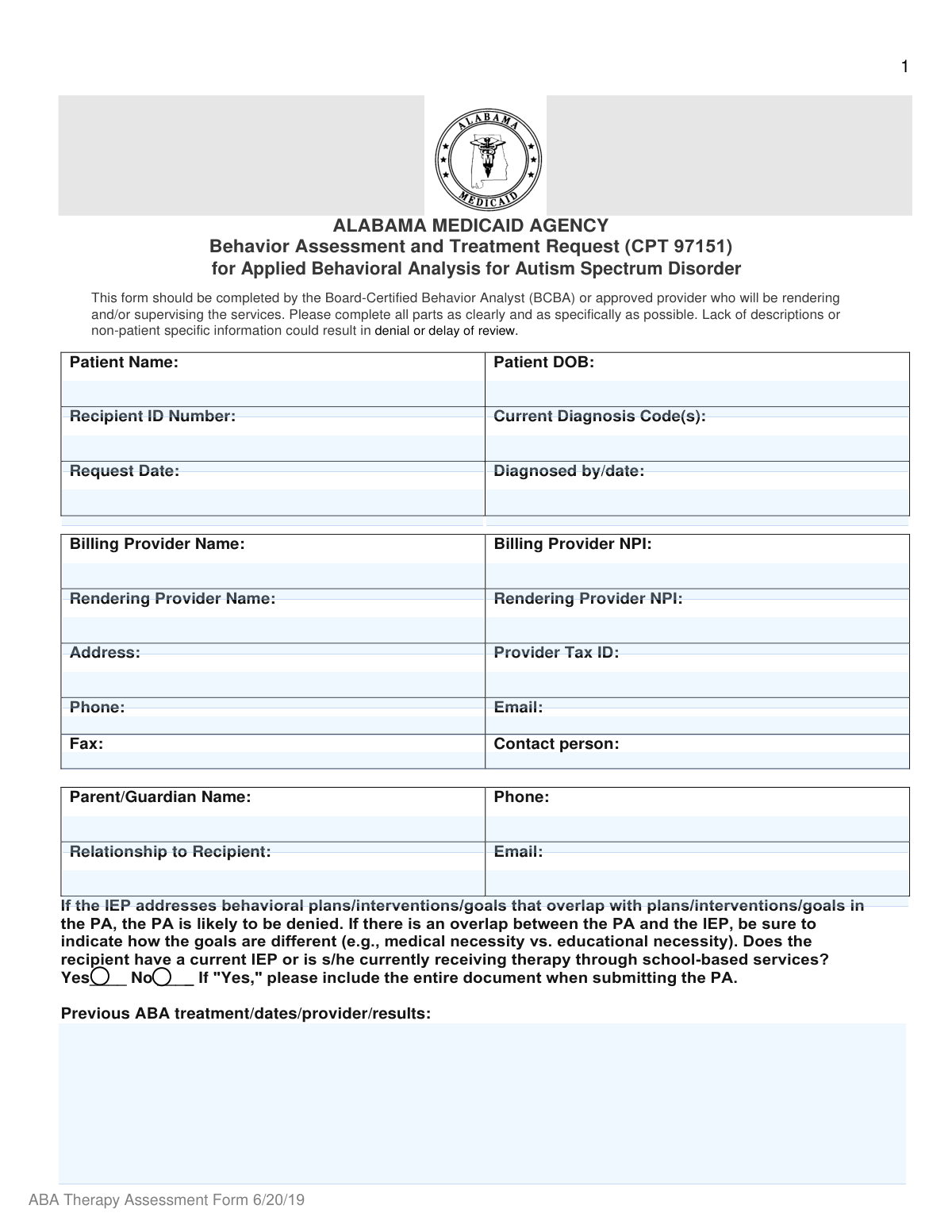
| 1. | Alabama Medicaid Agency ABA Therapy Assessment Form (6/20/19) — Behavior Assessment and Treatment Request (CPT 97151) for Applied Behavioral Analysis for Autism Spectrum Disorder | 5 | Moderate 53 |
| 2. | Applied Behavior Analysis (ABA) Therapy Request Form | 2 | Moderate 52 |
| 3. | Occupational Therapy (OT) Services Initial Assessment Report | 3 | Moderate 54 |
| 4. | West Virginia Medicaid Hepatitis-C Therapy Prior Authorization Form | 2 | Moderate 57 |
- Enterprise-grade security & data encryption
- 99%+ accuracy powered by AI
- 1,000+ forms from all industries
- Complete forms in under 60 seconds
How to Choose the Right Form
Selecting the correct documentation is critical for ensuring medical necessity and securing timely authorizations for behavioral and physical health services. Use the following guide to identify the specific form required for your clinical or administrative needs.
Applied Behavior Analysis (ABA) Therapy
If you are providing behavioral health services for patients with Autism Spectrum Disorder, your choice depends on the specific insurance payer and the stage of treatment:
- Alabama Medicaid Providers: Use the Alabama Medicaid Agency ABA Therapy Assessment Form (6/20/19) if you are a Board-Certified Behavior Analyst (BCBA) requesting authorization for behavior assessment and treatment planning under CPT code 97151. This form is essential for documenting DSM-5 criteria and clinical history specifically for Alabama Medicaid reviewers.
- SmartHealth Network Providers: Select the Applied Behavior Analysis (ABA) Therapy Request Form for prior authorization of services for SmartHealth members. This form is required before therapy begins and must be submitted alongside a functional behavior assessment and an individualized treatment plan.
Occupational Therapy & Workplace Injuries
For therapists focusing on physical rehabilitation rather than behavioral health, the requirements shift toward vocational and functional recovery:
- WorkSafeBC Claims: If you are an occupational therapist treating a worker who has suffered a workplace injury, use the Occupational Therapy (OT) Services Initial Assessment Report (Form 83D488). This form is used to establish a baseline of the worker’s functional status and to justify a treatment plan aimed at returning them to the workforce.
Quick Selection Tips
- Check the Payer: Always verify the insurance provider (e.g., Alabama Medicaid vs. SmartHealth) before starting, as these forms are not interchangeable between networks.
- Identify the Service Code: If you are billing specifically for CPT 97151, the Alabama Medicaid form is the specialized choice for that assessment code.
- Gather Supporting Data: Both ABA forms require detailed clinical findings and standardized test scores to be successful.
Form Comparison
| Form | Primary Focus | Target Population | Core Objective |
|---|---|---|---|
| Alabama Medicaid Agency ABA Therapy Assessment Form (6/20/19) | Applied Behavior Analysis (ABA) | Alabama Medicaid members with Autism Spectrum Disorder | Requesting authorization for CPT 97151 assessment and treatment hours |
| Applied Behavior Analysis (ABA) Therapy Request Form | Applied Behavior Analysis (ABA) | SmartHealth members with a clinical ASD diagnosis | Securing prior authorization before rendering behavioral therapy services |
| Occupational Therapy (OT) Services Initial Assessment Report | Occupational Therapy (OT) | Injured workers under a WorkSafeBC claim | Establishing baseline functional status and vocational recovery plans |
Tips for therapy forms
Ensure the CPT codes, such as 97151 for ABA assessments, match the specific units requested in your treatment plan. Discrepancies between the requested hours and the billing codes can lead to immediate administrative denials or delays in authorization.
When filling out behavioral health forms, clearly separate clinical interventions from school-based IEP services. Medicaid and private insurers often deny coverage if the requested therapy appears to duplicate services already provided by the school system.
For both ABA and OT assessments, always include measurable baseline data such as frequency, duration, or standardized test scores. Clear objective findings make it significantly easier for insurance reviewers to establish medical necessity and track future progress.
Double-check that patient identifiers, such as WorkSafeBC claim numbers or ICD-10 diagnosis codes like F84.0, are accurate and legible. Incorrect identifiers are a common cause of processing errors that can stall the start of a patient's treatment plan.
AI-powered tools like Instafill.ai can complete these complex therapy forms in under 30 seconds with high accuracy. This technology ensures your data stays secure during the process and is a major time-saver for providers managing high volumes of behavioral health paperwork.
Many therapy request forms require additional attachments like functional behavior assessments or individualized treatment plans. Having these documents ready to upload or fax alongside the main form ensures a complete submission and helps prevent requests for additional information.
Frequently Asked Questions
These forms are used to document a patient's clinical needs, establish a baseline for treatment, and request authorization for services from insurance providers or government agencies. They ensure that therapy, such as ABA or occupational therapy, is medically necessary and that the treatment plan is tailored to the specific diagnosis of the individual.
These documents generally must be completed by a licensed healthcare professional, such as a Board-Certified Behavior Analyst (BCBA) for ABA therapy or a registered Occupational Therapist (OT) for vocational recovery. The forms require professional clinical observations and standardized test scores that only qualified providers can supply.
Prior authorization ensures that the insurance payer, such as Alabama Medicaid or SmartHealth, agrees that the requested units of service are appropriate for the patient's condition. Submitting these forms before starting treatment helps prevent claim denials and ensures the provider is reimbursed for the behavioral health services rendered.
Yes, AI tools like Instafill.ai can fill out complex therapy and behavioral health forms in under 30 seconds. These tools accurately extract clinical data from your source documents and place it into the correct fields, significantly reducing the administrative time spent on paperwork.
While manual entry for detailed assessments can take quite a while, using an AI-powered service like Instafill.ai allows you to complete these forms in less than 30 seconds. This technology can also convert non-fillable PDF versions of therapy forms into interactive, digital documents for easier completion.
Most therapy forms require additional attachments, such as a formal diagnosis of Autism Spectrum Disorder (ASD), a Functional Behavior Assessment (FBA), or an Individualized Treatment Plan (ITP). For workplace injury claims, you may also need to provide objective physical findings and vocational status reports.
Many therapy forms, particularly for ABA, ask for information regarding a student's Individualized Education Program (IEP) to ensure that clinical services do not duplicate what the school is already providing. This coordination helps medical reviewers determine that the requested clinical hours are distinct and necessary for the patient's overall development.
Forms are often denied if they contain incomplete patient identifiers, lack specific measurable goals, or use generic clinical descriptions that are not patient-specific. Ensuring that every field is filled with accurate, data-driven information is essential for demonstrating medical necessity and securing approval.
This report is typically required at the start of a treatment cycle, especially following a workplace injury or a new insurance claim. It establishes the patient's current functional status and vocational abilities, providing a baseline against which future progress and the effectiveness of the treatment plan can be measured.
Completed therapy forms are usually submitted to the specific insurance carrier or health agency via a secure provider portal, fax, or mail. For example, forms for Alabama Medicaid or SmartHealth have designated fax numbers and clinical review departments that must receive the documentation before services can be authorized.
Most authorizations are valid for a specific period, such as six months, after which a new assessment or progress report must be submitted. Regular updates are necessary to justify the continuation of services and to adjust the treatment goals based on the patient's improvement or changing needs.
These forms are often specific to certain disciplines, such as Applied Behavior Analysis (ABA) or Occupational Therapy (OT). It is important to select the form that matches the specific CPT codes or service types you are billing for to ensure the clinical data provided aligns with the payer's requirements.
Glossary
- Form Complexity Index
- Instafill’s 0–100 measure of how much effort a form takes to complete, calculated deterministically from the form’s own structure rather than estimated. It combines the number of fillable fields (the largest factor), how difficult those fields are to complete based on their type, the number of pages that contain fields, the amount of conditional “fill-only-if” logic, and how many sections the form is divided into, then adds modifiers for tables and repeating lists, bundled instruction pages, and dense page layouts. A higher score means the form is harder to fill out by hand. The forms in this category have a median Form Complexity Index of 54/100 (Moderate). See exactly how it is calculated.
- Applied Behavior Analysis (ABA)
- A therapeutic approach focused on improving specific behaviors and social skills through reinforcement and systematic intervention, often used for individuals with Autism.
- Prior Authorization
- A requirement by an insurance provider that a specific treatment or service must be approved in advance before it is eligible for coverage.
- Medical Necessity
- The clinical justification used to prove that a specific service or treatment is essential and appropriate for a patient’s diagnosis and care.
- BCBA (Board-Certified Behavior Analyst)
- A healthcare professional with advanced certification who is qualified to design, implement, and oversee behavior analysis treatment plans.
- CPT Code
- A standardized set of five-digit numbers used by healthcare providers to identify and bill specific medical services and procedures to insurance companies.
- Functional Behavior Assessment (FBA)
- A clinical process used to determine the underlying cause or purpose of a patient's behavior to develop an effective treatment strategy.
- ICD-10 Code
- A standardized alphanumeric code used globally by medical professionals to classify and record specific diagnoses and health conditions.
- IEP (Individualized Education Program)
- A formal document describing the specialized instruction and services a child with a disability receives in a school setting, often coordinated with private therapy.