Fill out military record forms
with AI.
Military record forms are official government documents used to request, verify, or transfer service-related records maintained by the National Archives and Records Administration (NARA) and various military branches. These records play a critical role in establishing proof of service, accessing veterans' benefits, supporting disability claims, and preserving family history. Because military records are governed by strict privacy and disclosure rules under the Freedom of Information Act (FOIA) and the Privacy Act, using the correct form and providing accurate identifying information is essential to getting a timely response.
By continuing, you acknowledge Instafill's Privacy Policy and agree to get occasional product update and promotional emails.
About military record forms
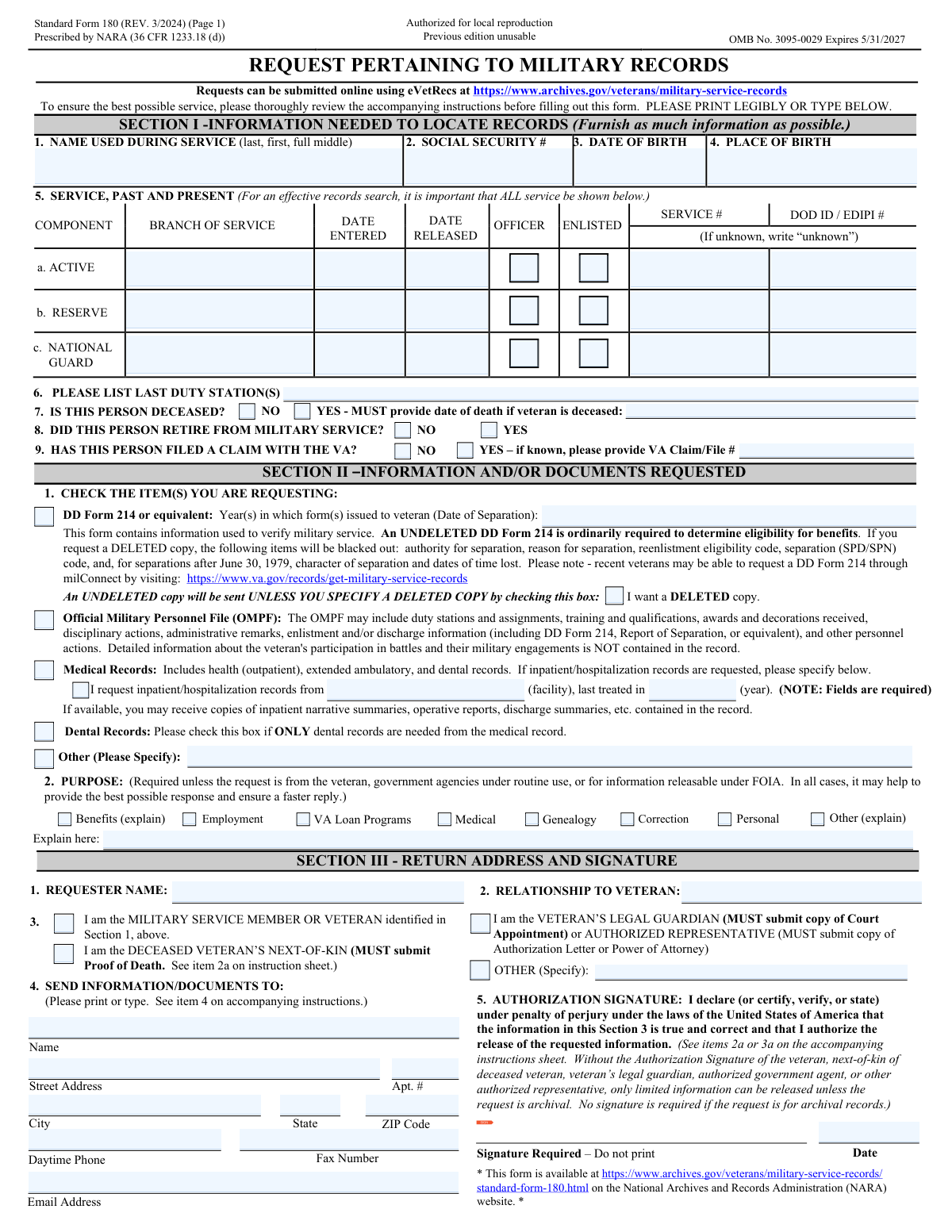
The people who typically need these forms include veterans seeking copies of their discharge papers or service history, family members of deceased service members researching military history or settling estates, and legal or medical professionals who require documented proof of someone's military service. The most commonly requested document in this category is the SF 180 (Standard Form 180), which is used to obtain records like the DD-214 (Certificate of Release or Discharge from Active Duty), Official Military Personnel Files (OMPF), and medical or dental treatment records.
Filling out these forms correctly matters — incomplete or inaccurate submissions can delay processing significantly. Tools like Instafill.ai use AI to fill these forms in under 30 seconds, helping ensure that every required field is completed accurately before submission.
Every form on this page can be completed without typing. Instafill is form filling software that reads a PDF and fills it for you — including flat and scanned documents that carry no fillable fields at all.
Forms in This Category
The forms in this category have a median Form Complexity Index of 54/100 (Moderate), measured across 2 forms by field count, input difficulty, length, conditional logic and structure. See how it is calculated.
| Form Name | Pages | FCI | |
|---|---|---|---|
| 1. | Standard Form 180, Request Pertaining to Military Records | 2 | Moderate 54 |
| 2. | Standard Form 180 (SF 180), Request Pertaining to Military Records (REV. 3/2024) | 2 | Moderate 51 |
- Enterprise-grade security & data encryption
- 99%+ accuracy powered by AI
- 1,000+ forms from all industries
- Complete forms in under 60 seconds
How to Choose the Right Form
When it comes to accessing official military documentation, there is one primary tool used by the National Archives and Records Administration (NARA). Navigating military bureaucracy can be complex, but choosing the right form is straightforward because the Standard Form 180 (SF 180), Request Pertaining to Military Records serves as the universal request document for almost all service-related history.
When to Use SF 180
The SF 180 is the correct choice if you are looking to retrieve any of the following critical documents:
- Separation Documents (DD Form 214/215): These are essential for proving veteran status for VA benefits, home loans, or civilian employment.
- Official Military Personnel Files (OMPF): This provides a complete record of a service member’s career, including awards, decorations, and assignments.
- Medical and Health Records: This includes outpatient service treatment records as well as dental and inpatient files, often required for disability claims.
Choosing Based on Your Relationship to the Veteran
The information required and the level of access granted on the SF 180 depends on your status:
- Veterans: If you are the person who served, you have the broadest access to your own records under the Privacy Act.
- Next-of-Kin: If the veteran is deceased, the "next-of-kin" (un-remarried surviving spouse, parent, child, or sibling) can use this form to request records for commemorative or benefit purposes.
- Authorized Representatives: If you are acting on behalf of a veteran, you will need to provide legal authorization alongside the completed SF 180.
Ensuring a Successful Request
To ensure your request is processed quickly, the Standard Form 180 requires specific identifiers. Be prepared to provide the service member’s full name used during service, Social Security Number, branch of service, and approximate dates of service. Using an AI-powered tool like Instafill.ai helps you populate these critical fields accurately, reducing the risk of the records custodian being unable to locate the correct file.
Form Comparison
| Form | Primary Purpose | Authorized Requestors | Key Records Requested |
|---|---|---|---|
| Standard Form 180 (SF 180), Request Pertaining to Military Records (REV. 3/2024) | Request official copies of military personnel, health, and medical service records. | Veterans, next-of-kin, or authorized legal representatives of the service member. | DD-214, personnel folders, medical/dental records, and clinical treatment history. |
Tips for military record forms
Ensure that the name used during service, Social Security Number, and service dates match your official history exactly. Inaccurate identifiers are the leading cause of 'record not found' responses from the National Personnel Records Center, which can significantly delay your request.
Rather than asking for an entire personnel file, check the specific boxes for the documents you actually need, such as the DD-214 or medical records. This targeted approach helps the records custodian locate and duplicate your files much faster than a general request for a complete file.
If you are a survivor requesting records for a veteran, you must include a copy of the death certificate or a link to a published obituary. Without this proof of death, the agency cannot release private records to anyone other than the veteran themselves due to privacy regulations.
Different branches of the military and different eras of service have distinct storage locations ranging from St. Louis to regional VA offices. Review the mailing instructions carefully to ensure your form reaches the correct custodian on the first try, as sending it to the wrong office will result in a return.
Using AI-powered tools like Instafill.ai allows you to complete complex military forms in under 30 seconds with high accuracy. Your sensitive personal data stays secure during the process, making it a reliable way to handle multiple requests without manual data entry errors or formatting issues.
If your request is for a time-sensitive matter like a burial or an urgent medical claim, note this clearly in the purpose section of the form. Providing a specific reason helps the processing staff understand the priority of the request and ensures you receive the correct documentation for that specific need.
Frequently Asked Questions
Military record forms are primarily used to request official documentation regarding an individual's service history, including discharge papers, medical records, and personnel files. These documents are often necessary for applying for veteran benefits, proving service for employment, or conducting genealogical research.
Generally, the veteran themselves or their next-of-kin (un-remarried surviving spouse, parent, child, or sibling) can request records. Authorized representatives or third parties may also request records, though they may require a signed authorization or be subject to Freedom of Information Act (FOIA) limitations.
The Standard Form 180 (SF 180) is the standard document used to request military personnel, health, and medical records from the National Personnel Records Center (NPRC) or other record custodians. It allows the requester to specify exactly which parts of the record they need, such as the DD Form 214.
To ensure the correct records are located, you typically need the veteran's full name used during service, Social Security Number, date of birth, and service dates. Providing the branch of service and the last duty station can also significantly speed up the search process for the record custodian.
The submission location depends on the branch of service and the dates of service; the instructions on the SF 180 provide a detailed table of addresses for various record custodians. Many requests are sent to the National Personnel Records Center in St. Louis, Missouri, though active-duty records may be held elsewhere.
Yes, you can use AI tools like Instafill.ai to complete military record forms efficiently. These tools can accurately extract data from your source documents and place it into the correct fields on the form in under 30 seconds.
In most cases, there is no charge for basic military personnel and medical record copies provided to veterans, next-of-kin, or authorized representatives. However, some requests from the general public or those involving older archival records may involve a reproduction fee determined by the National Archives.
When using AI-assisted platforms like Instafill.ai, filling out a complex form like the SF 180 takes less than 30 seconds. The AI automates the data entry process, ensuring that critical information like service dates and identification numbers are transcribed correctly from your original documents.
Personnel records contain administrative data such as assignments, promotions, and discharge papers, while medical records focus on health history, including clinical treatments and dental records. You can use the same request form to ask for both, but you must clearly specify which categories you require on the form.
Records of veterans who left the service more than 62 years ago are generally considered archival and open to the public. For more recent records, access is restricted by the Privacy Act, and only limited information can be released to the public without the veteran's or next-of-kin's written consent.
While a Social Security Number is the most helpful identifier, you can still submit a request using a Service Number or by providing as much identifying information as possible. The more details you provide regarding birth dates and specific years of service, the better the chance the custodian has of finding the correct file.
Glossary
- Form Complexity Index
- Instafill’s 0–100 measure of how much effort a form takes to complete, calculated deterministically from the form’s own structure rather than estimated. It combines the number of fillable fields (the largest factor), how difficult those fields are to complete based on their type, the number of pages that contain fields, the amount of conditional “fill-only-if” logic, and how many sections the form is divided into, then adds modifiers for tables and repeating lists, bundled instruction pages, and dense page layouts. A higher score means the form is harder to fill out by hand. The forms in this category have a median Form Complexity Index of 54/100 (Moderate). See exactly how it is calculated.
- DD-214
- Commonly known as the Certificate of Release or Discharge from Active Duty, this document is essential for proving military service and qualifying for veteran benefits.
- Next-of-Kin (NOK)
- For the purpose of requesting records, this refers specifically to the un-remarried surviving spouse, parent, child, or sibling of a deceased veteran.
- OMPF (Official Military Personnel File)
- A comprehensive collection of documents detailing a service member's entire career, including administrative data, performance reports, and training history.
- NPRC (National Personnel Records Center)
- The central repository located in St. Louis, Missouri, that stores and manages the majority of military personnel, health, and medical records for all branches.
- Service Treatment Records (STR)
- These are the chronological medical and dental records created during a service member's time in the military, often requested for VA disability claims.
- Archival Records
- Military records of individuals who were discharged, retired, or died in service more than 62 years ago, which are accessible to the general public under different rules than modern records.
- Service Number
- A unique identification number assigned to personnel before the military transitioned to using Social Security Numbers in the late 1960s and early 1970s.
- NARA (National Archives and Records Administration)
- The independent federal agency that oversees the preservation of government and historical records, including the SF 180 request process.