Fill out Ohio commerce forms
with AI.
Ohio commerce forms cover a range of official documents managed by the Ohio Department of Commerce and its various divisions, including the Division of Unclaimed Funds. These forms serve important legal and financial purposes — from claiming property that has been turned over to the state to documenting family relationships for estate-related matters. Whether you're navigating unclaimed property, business licensing, or financial compliance, these forms are often required steps in formal processes governed by Ohio law.
By continuing, you acknowledge Instafill's Privacy Policy and agree to get occasional product update and promotional emails.
About Ohio commerce forms
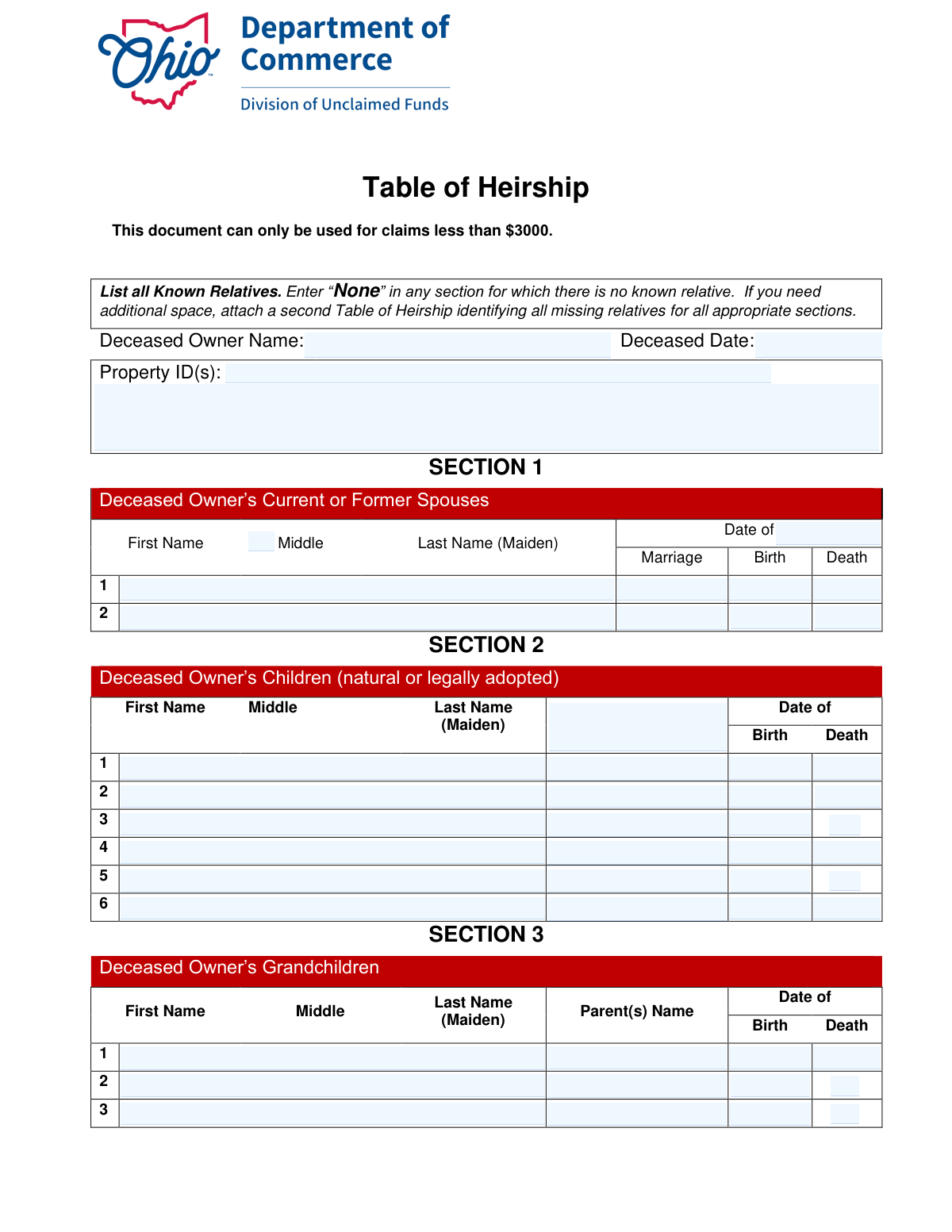
The forms in this category are most commonly needed by individuals dealing with the estates of deceased family members or attempting to recover unclaimed funds on behalf of a loved one. For example, the Table of Heirship form is a sworn legal document used when filing an unclaimed funds claim under $3,000 for a deceased owner. It requires accurate, complete information about all known relatives — living or deceased — and is signed under penalty of perjury, making precision essential. Errors or omissions can delay claims or trigger further investigation.
Because these forms carry legal weight and require careful attention to detail, tools like Instafill.ai use AI to help users complete them accurately in under 30 seconds, reducing the risk of mistakes and saving significant time during what is often an already stressful process.
Every form on this page can be completed without typing. Instafill is form filling software that reads a PDF and fills it for you — including flat and scanned documents that carry no fillable fields at all.
Forms in This Category
The forms in this category have a median Form Complexity Index of 63/100 (Complex), measured across 2 forms by field count, input difficulty, length, conditional logic and structure. See how it is calculated.
| Form Name | Pages | FCI | |
|---|---|---|---|
| 1. | Ohio Department of Commerce Table of Heirship (Division of Unclaimed Funds) | 1 | – |
| 2. | Ohio Department of Commerce – Table of Heirship (Unclaimed Funds Claim, Claims Less Than $3,000) | 3 | Complex 63 |
- Enterprise-grade security & data encryption
- 99%+ accuracy powered by AI
- 1,000+ forms from all industries
- Complete forms in under 60 seconds
How to Choose the Right Form
Navigating the Ohio Department of Commerce's Division of Unclaimed Funds can be complex when dealing with the estate of a deceased relative. If you are trying to claim funds valued at less than $3,000, you will likely need to complete a Table of Heirship to prove your relationship to the original owner.
Determining Your Eligibility
Both forms in this category serve the same legal purpose: providing a sworn statement that documents the deceased owner’s family tree. You should use these forms if:
- The total value of the unclaimed property is less than $3,000.
- You are prepared to list all known relatives, including spouses, children, grandchildren, parents, and siblings (both living and deceased).
- You have a certified, unredacted death certificate for the original owner.
Which Form Should You Use?
Because these forms are nearly identical, your choice depends on the specific instructions provided in your claim initiation paperwork:
- Ohio Department of Commerce Table of Heirship (Division of Unclaimed Funds): Select this version for general claims where the Division has requested a Table of Heirship. It is the standard document used to document family relationships under penalty of perjury.
- Ohio Department of Commerce – Table of Heirship (Unclaimed Funds Claim, Claims Less Than $3,000): Choose this form if your claim documentation specifically highlights the $3,000 threshold. It is explicitly labeled to match the small-claim process requirements.
Tips for Accurate Completion
Since these forms are signed under penalty of perjury and may be investigated by the state, accuracy is critical. Ensure you have the full names and current addresses of all living heirs, as well as the dates of death for any deceased relatives.
Using Instafill.ai, you can quickly complete either the Ohio Department of Commerce Table of Heirship or the Claims Less Than $3,000 variant. Our AI-powered tools help you navigate the fields accurately, ensuring your claim isn't delayed by missing information.
Form Comparison
| Form | Purpose | Claim Limit | Key Requirements | Target Audience |
|---|---|---|---|---|
| Ohio Department of Commerce Table of Heirship (Division of Unclaimed Funds) | Identifies family relationships to determine rightful heirs for unclaimed property. | Generally used for smaller claims within the Division of Unclaimed Funds. | Requires a certified unredacted death certificate and sworn signature. | Heirs of deceased owners claiming assets from the state of Ohio. |
| Ohio Department of Commerce – Table of Heirship (Unclaimed Funds Claim, Claims Less Than $3,000) | Documents the deceased owner's family tree to verify legal heirs. | Specifically restricted to unclaimed fund claims valued under $3,000. | Must list all known relatives and be signed under penalty of perjury. | Individuals claiming deceased owner's funds worth less than $3,000. |
Tips for Ohio commerce forms
These specific Ohio Table of Heirship forms are strictly designed for unclaimed fund claims valued at less than $3,000. If your claim exceeds this amount, you may need to provide alternative probate documentation or different commerce forms to satisfy the Division of Unclaimed Funds.
Using AI-powered tools like Instafill.ai can complete these complex heirship forms in under 30 seconds with high accuracy. Your sensitive family data stays secure during the process, making it a reliable time-saver when you need to navigate state commerce requirements quickly.
A common mistake is only listing living heirs, but the Division of Unclaimed Funds requires a complete family history. Ensure you include all known spouses, children, parents, and siblings, noting whether they are currently living or deceased to provide a clear line of succession.
The State of Ohio typically requires a certified, unredacted death certificate for the deceased owner to process these heirship claims. Having this document ready before you start the form will prevent delays, as the Division often requests it as primary supporting evidence.
Because these forms are sworn statements signed under penalty of perjury, every name and relationship must be 100% accurate. Double-check spellings and familial links against official records before submitting to ensure the state does not flag your claim for investigation.
To save time, sketch a quick family tree including full names and approximate dates of birth or death for all relevant parties. Having this information organized beforehand allows you to move through the Table of Heirship sections without having to stop and search for family records mid-form.
Frequently Asked Questions
These forms are used by the Ohio Department of Commerce, Division of Unclaimed Funds, to process claims for money or property that has been forgotten or abandoned. They help the state verify the identity of the rightful owner or their legal heirs before releasing the funds to the public.
This form is typically required when a person is claiming unclaimed funds that belonged to a deceased individual. It helps the Division of Unclaimed Funds map out the family tree to ensure the money is distributed according to Ohio's inheritance laws.
Yes, the standard Table of Heirship forms provided in this category are generally intended for claims valued at less than $3,000. For claims exceeding this amount, the Division of Unclaimed Funds may require additional legal documentation or formal probate court involvement.
You must provide details about the deceased owner’s spouse, children, grandchildren, parents, and siblings. It is important to list all known relatives, whether they are living or deceased, to provide a complete picture of the heirship structure for the state's review.
Yes, AI tools like Instafill.ai can fill these forms in under 30 seconds by accurately extracting data from your source documents and placing it into the correct fields. This technology simplifies the process and helps ensure that the information matches your official records.
Because these forms are signed under penalty of perjury, accuracy is critical. Providing false or incomplete information can lead to the denial of your claim or potential legal investigations by the Ohio Department of Commerce.
Along with the Table of Heirship, claimants are usually required to submit a certified, unredacted death certificate of the deceased owner. The Department of Commerce may request further documentation, such as birth certificates or marriage licenses, after their initial review of the claim.
While manually searching for family records and typing them in can take time, using an AI-powered service like Instafill.ai can complete these forms in less than 30 seconds. These tools can also convert non-fillable PDF versions into interactive forms for a much smoother experience.
Typically, the person making the claim (the claimant) must sign the form. Since it is a sworn statement, the signer is affirming that the genealogical information provided is true and complete to the best of their knowledge under Ohio law.
Completed forms and supporting documentation should be sent to the Ohio Department of Commerce, Division of Unclaimed Funds. Specific submission instructions, including mailing addresses or online upload options, are usually provided on the official claim receipt or the department's website.
For claims under $3,000, a lawyer is generally not required if you can accurately provide the family history requested. However, you may choose to consult legal counsel if the family tree is complex or if there are disputes among potential heirs regarding the distribution of the funds.
The state needs information on deceased relatives to determine if their descendants, such as grandchildren or nieces and nephews, have a legal right to a portion of the unclaimed funds under Ohio’s laws of intestate succession.
Glossary
- Form Complexity Index
- Instafill’s 0–100 measure of how much effort a form takes to complete, calculated deterministically from the form’s own structure rather than estimated. It combines the number of fillable fields (the largest factor), how difficult those fields are to complete based on their type, the number of pages that contain fields, the amount of conditional “fill-only-if” logic, and how many sections the form is divided into, then adds modifiers for tables and repeating lists, bundled instruction pages, and dense page layouts. A higher score means the form is harder to fill out by hand. The forms in this category have a median Form Complexity Index of 63/100 (Complex). See exactly how it is calculated.
- Unclaimed Funds
- Money or assets, such as forgotten bank accounts, uncashed checks, or insurance benefits, that have been turned over to the state because the owner cannot be located.
- Division of Unclaimed Funds
- The specific office within the Ohio Department of Commerce responsible for safeguarding lost assets and returning them to their rightful owners or heirs.
- Table of Heirship
- A formal document used to map out the family tree of a deceased person to identify who is legally entitled to inherit their unclaimed property.
- Claimant
- The person or legal entity that is formally filing a request with the state to recover unclaimed funds.
- Heir
- An individual who is legally entitled to the property or money of a person who has died, usually based on family relationship or a will.
- Certified Unredacted Death Certificate
- An official government-issued record of a person's death that contains all original information without any sections blacked out or removed.
- Sworn Statement
- A document signed under oath, meaning the individual signing it is legally promising that all information provided is true under penalty of perjury.
- Intestate
- A legal term describing a person who died without leaving a valid will, which often requires the state to use a Table of Heirship to find legal heirs.