Fill out patient authorization forms
with AI.
Patient authorization forms are essential legal documents designed to protect your privacy while facilitating the necessary sharing of medical records. These forms serve as the formal consent required for healthcare providers to release Protected Health Information (PHI) to insurance companies, legal representatives, or other medical facilities. By adhering to federal HIPAA regulations and state-specific privacy laws, these authorizations ensure that sensitive data is only disclosed to approved parties for specific purposes, such as continuing care or processing insurance claims.
By continuing, you acknowledge Instafill's Privacy Policy and agree to get occasional product update and promotional emails.
About patient authorization forms
Individuals typically encounter these forms when transitioning between healthcare systems, such as moving records to UCLA Health or Kaiser Permanente, or when seeking prior authorization for specialized procedures like MRIs and CT scans. They are also frequently used in legal contexts, such as personal injury or workers' compensation cases, where medical evidence is required to support a claim. For healthcare administrators, tracking these authorizations is a critical part of managing patient encounters and ensuring that every diagnostic test or surgery is properly cleared for billing.
Completing these technical documents can be time-consuming, but modern tools like Instafill.ai use AI to fill these forms in under 30 seconds. This technology handles your data accurately and securely, providing a practical way to manage administrative requirements without the manual effort.
Every form on this page can be completed without typing. Instafill is form filling software that reads a PDF and fills it for you — including flat and scanned documents that carry no fillable fields at all.
Forms in This Category
The forms in this category have a median Form Complexity Index of 48/100 (Moderate), measured across 5 forms by field count, input difficulty, length, conditional logic and structure. See how it is calculated.
| Form Name | Pages | FCI | |
|---|---|---|---|
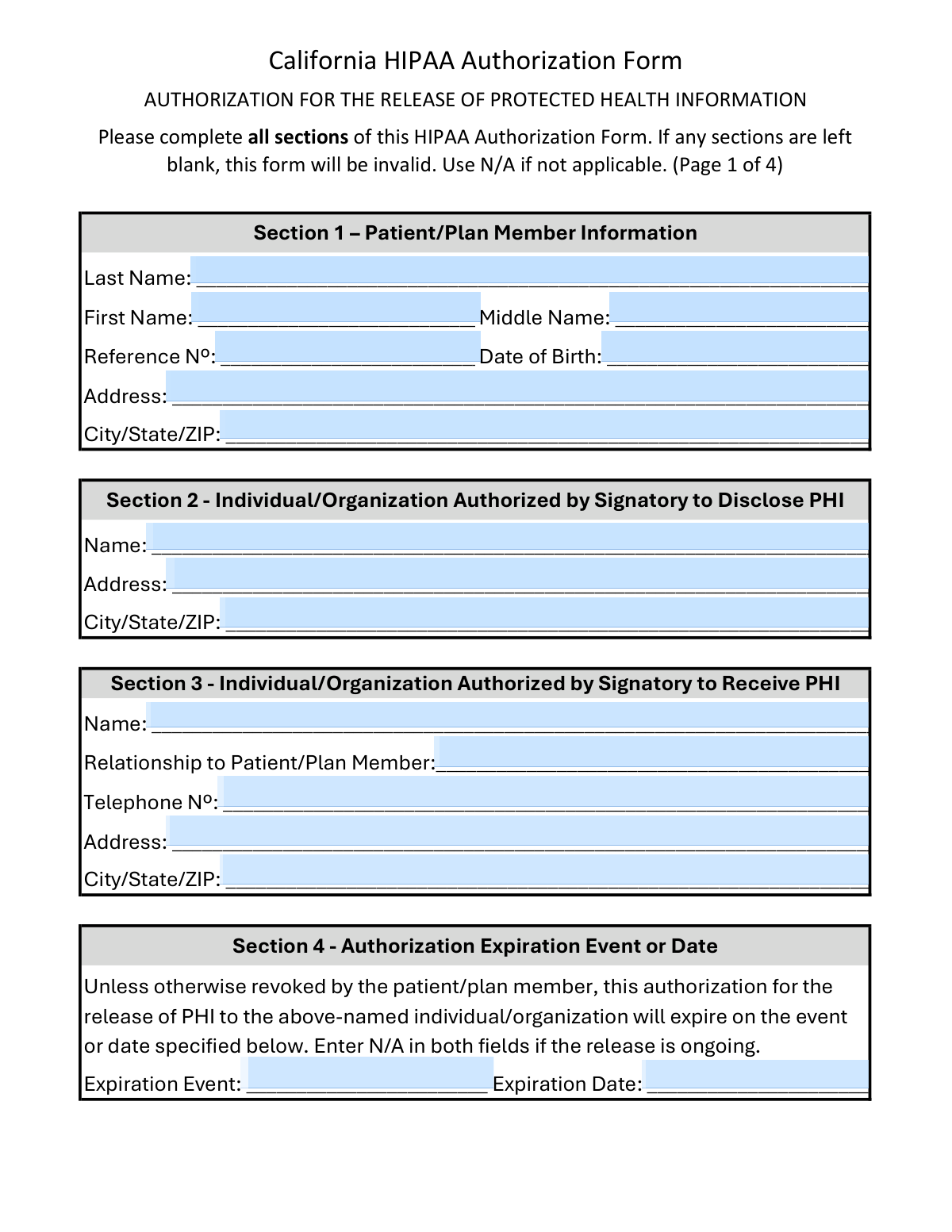
| 1. | California HIPAA Authorization Form, Authorization for the Release of Protected Health Information | 4 | Moderate 48 |
| 2. | Kaiser Permanente Authorization for Use or Disclosure of Patient Health Information | 1 | Basic 41 |
| 3. | Outpatient Imaging Prior Authorization Request Form | 1 | Moderate 51 |
| 4. | Patient Encounter and Authorization Tracking Form | 1 | Complex 67 |
| 5. | UCLA Form #30910, Authorization for Release of Health Information | 4 | Moderate 47 |
- Enterprise-grade security & data encryption
- 99%+ accuracy powered by AI
- 1,000+ forms from all industries
- Complete forms in under 60 seconds
How to Choose the Right Form
Releasing Medical Records to Third Parties
If you are a patient or a legal representative needing to share medical history with an attorney, insurance company, or another healthcare provider, you must select the form specific to your location or healthcare network:
- California HIPAA Authorization Form: Choose this for general medical releases within the state of California. It is designed to comply with both federal HIPAA regulations and California’s specific Confidentiality of Medical Information Act (CMIA).
- Kaiser Permanente Authorization (Form NS-9934): Use this specific form if you are a Kaiser Permanente patient requesting the disclosure of health records to an outside party.
- UCLA Form #30910 (Authorization for Release of Health Information): This is the required document for patients of UCLA Health who need to transfer confidential records for continuing care or personal use.
Obtaining Insurance Approval for Procedures
For healthcare providers and office staff, ensuring that a procedure is covered before it happens is critical to avoiding billing disputes.
- Outpatient Imaging Prior Authorization Request Form: Use this form if you are a network provider seeking pre-service approval for specialized diagnostic imaging, such as MRI, CT, or PET scans. This ensures the service is deemed medically necessary by the insurer.
Administrative and Internal Tracking
Not all authorization forms are meant for external release; some are designed to help a practice stay organized during a patient's treatment lifecycle.
- Patient Encounter and Authorization Tracking Form: This is an internal tool for healthcare administrators. It is best used for tracking the status of authorizations for surgeries or therapies and managing specific case types like Workers' Compensation or Personal Injury claims.
By using Instafill.ai, you can quickly convert these standard PDFs into interactive, AI-assisted forms, ensuring that every required field is completed accurately to prevent delays in care or record processing.
Form Comparison
| Form | Primary Purpose | Who Submits It | Key Information Required |
|---|---|---|---|
| California HIPAA Authorization Form, Authorization for the Release of Protected Health Information | Authorize disclosure of protected health information under California and federal privacy laws. | Patients or their legal representatives within the state of California. | Specific records to disclose, recipient details, and the authorization expiration date. |
| Kaiser Permanente Authorization for Use or Disclosure of Patient Health Information | Grant permission to share Kaiser Permanente medical records with third-party recipients. | Kaiser Permanente patients or their authorized legal representatives. | Patient Medical Record Number (MRN), specific records requested, and recipient information. |
| Outpatient Imaging Prior Authorization Request Form | Obtain insurance approval for specialized scans like MRI, CT, or PET scans. | Healthcare providers or clinical staff on behalf of the patient. | Clinical diagnosis, requested CPT codes, and documentation of medical necessity. |
| Patient Encounter and Authorization Tracking Form | Internally track patient visits, case types, and procedure authorization statuses. | Medical office staff or administrative healthcare personnel. | Case type, appointment details, and authorization status for surgeries or therapies. |
| UCLA Form #30910, Authorization for Release of Health Information | Permit UCLA Health to share medical records with external providers or individuals. | UCLA Health patients or their legal guardians. | Patient identifiers, specific UCLA clinics involved, and designated recipient contact info. |
Tips for patient authorization forms
Ensure that the patient's full name, date of birth, and contact information match their official medical records exactly. Even minor discrepancies in these identifiers can lead to the rejection of the authorization, causing significant delays in the release of health information.
Avoid requesting 'all records' unless absolutely necessary for your situation. By specifying exact dates of service or specific types of reports, such as radiology or lab results, you protect your privacy and help the provider process the request more efficiently.
Most patient authorization forms require an expiration date or a specific event that triggers the end of the permission. Setting a clear timeframe ensures that your sensitive health data is not accessible indefinitely to third parties after the initial need has passed.
Using AI-powered tools like Instafill.ai can complete these forms in under 30 seconds with high accuracy. These tools are designed to handle your sensitive data securely while saving you the time and effort of manual data entry for multiple health providers.
Always fill out the 'Purpose' section, even if it seems obvious. Indicating whether the records are for continuing care, legal matters, or personal use helps health information management departments prioritize your request and comply with specific state regulations.
Always save a copy of the signed and dated authorization form before submitting it to the healthcare provider. Having a copy on hand allows you to verify what was requested and provides a reference point if you need to follow up on a delayed transfer.
Frequently Asked Questions
A patient authorization form is a legal document that grants healthcare providers permission to share or disclose protected health information (PHI) to a third party. These forms are essential for coordinating care between different specialists, processing insurance claims, or releasing medical records for legal and personal use.
Generally, the patient whose records are being shared must sign the form. If the patient is a minor, a person with power of attorney, or otherwise unable to sign, a legally authorized representative such as a parent or guardian must provide the signature to make the document valid.
Yes, you can use AI tools like Instafill.ai to complete these forms. The AI can accurately extract relevant data from your source documents and place it into the required fields in under 30 seconds, ensuring that sensitive information is transcribed correctly and professionally.
A release of information form allows a provider to share existing medical history and records with another entity. A prior authorization request is a specific document sent to an insurance company to verify that a proposed treatment or imaging procedure is medically necessary and covered by your plan.
While manual entry can take several minutes and carries the risk of typos, using an AI-powered service like Instafill.ai allows you to complete these forms in under 30 seconds. The system automates the data entry process, making it much faster to prepare documents for submission.
Although HIPAA provides a federal standard for privacy, individual healthcare networks often use branded forms to ensure they capture all internal administrative data needed to locate records quickly. Using the specific form provided by your healthcare system often results in faster processing of your request.
The expiration date varies depending on the specific form and the reason for the disclosure. Many authorizations are valid for one year from the date of the signature, but they can also be set to expire after a single event or be revoked by the patient in writing at any time.
Most forms require the patient's full legal name, date of birth, contact information, and specific details about what information is being released. You will also need to identify the recipient of the information and the specific purpose for which the records are being shared.
Completed forms are typically submitted to the Health Information Management (HIM) or Medical Records department of the facility holding the records. Depending on the provider, you may be able to submit the form via a secure patient portal, fax, or traditional mail.
Yes, the forms in this category are designed to meet the standards of the Health Insurance Portability and Accountability Act (HIPAA). In specific regions like California, they also incorporate state-level protections such as the Confidentiality of Medical Information Act (CMIA) to ensure maximum data privacy.
Glossary
- Form Complexity Index
- Instafill’s 0–100 measure of how much effort a form takes to complete, calculated deterministically from the form’s own structure rather than estimated. It combines the number of fillable fields (the largest factor), how difficult those fields are to complete based on their type, the number of pages that contain fields, the amount of conditional “fill-only-if” logic, and how many sections the form is divided into, then adds modifiers for tables and repeating lists, bundled instruction pages, and dense page layouts. A higher score means the form is harder to fill out by hand. The forms in this category have a median Form Complexity Index of 48/100 (Moderate). See exactly how it is calculated.
- HIPAA
- The Health Insurance Portability and Accountability Act is a federal law that sets national standards to protect sensitive patient health information from being disclosed without the patient's consent.
- PHI (Protected Health Information)
- Any individually identifiable health information, such as medical history, test results, or insurance details, that is transmitted or maintained by a healthcare provider.
- Prior Authorization
- A requirement by health plans for patients or providers to obtain approval before a specific medical service, such as an MRI or PET scan, is performed for it to be covered by insurance.
- Disclosure
- The release, transfer, or provision of access to health information to an individual or organization outside of the entity that originally created the records.
- CMIA (Confidentiality of Medical Information Act)
- A California state law that provides extra layers of privacy protection for medical information, often requiring more specific authorization than federal HIPAA rules.
- Medical Necessity
- A formal determination that a specific medical service or procedure is essential and appropriate for the diagnosis or treatment of a patient's condition.
- Patient Encounter
- Any documented interaction between a patient and a healthcare professional, which can include office visits, phone consultations, or diagnostic testing.
- Covered Entity
- A healthcare provider, health plan, or clearinghouse that is legally required to comply with HIPAA regulations regarding the handling of patient data.