Fill out patient release forms
with AI.
Patient release forms, often referred to as HIPAA forms or medical consent forms, are essential legal documents that authorize healthcare providers to share a patient's protected health information with specific third parties. These forms are designed to protect patient privacy while ensuring that vital health data can be transferred when necessary. By signing these documents, patients provide explicit permission for the disclosure of their records, which is a fundamental requirement under both federal and state health records acts to prevent unauthorized access to sensitive information.
By continuing, you acknowledge Instafill's Privacy Policy and agree to get occasional product update and promotional emails.
About patient release forms
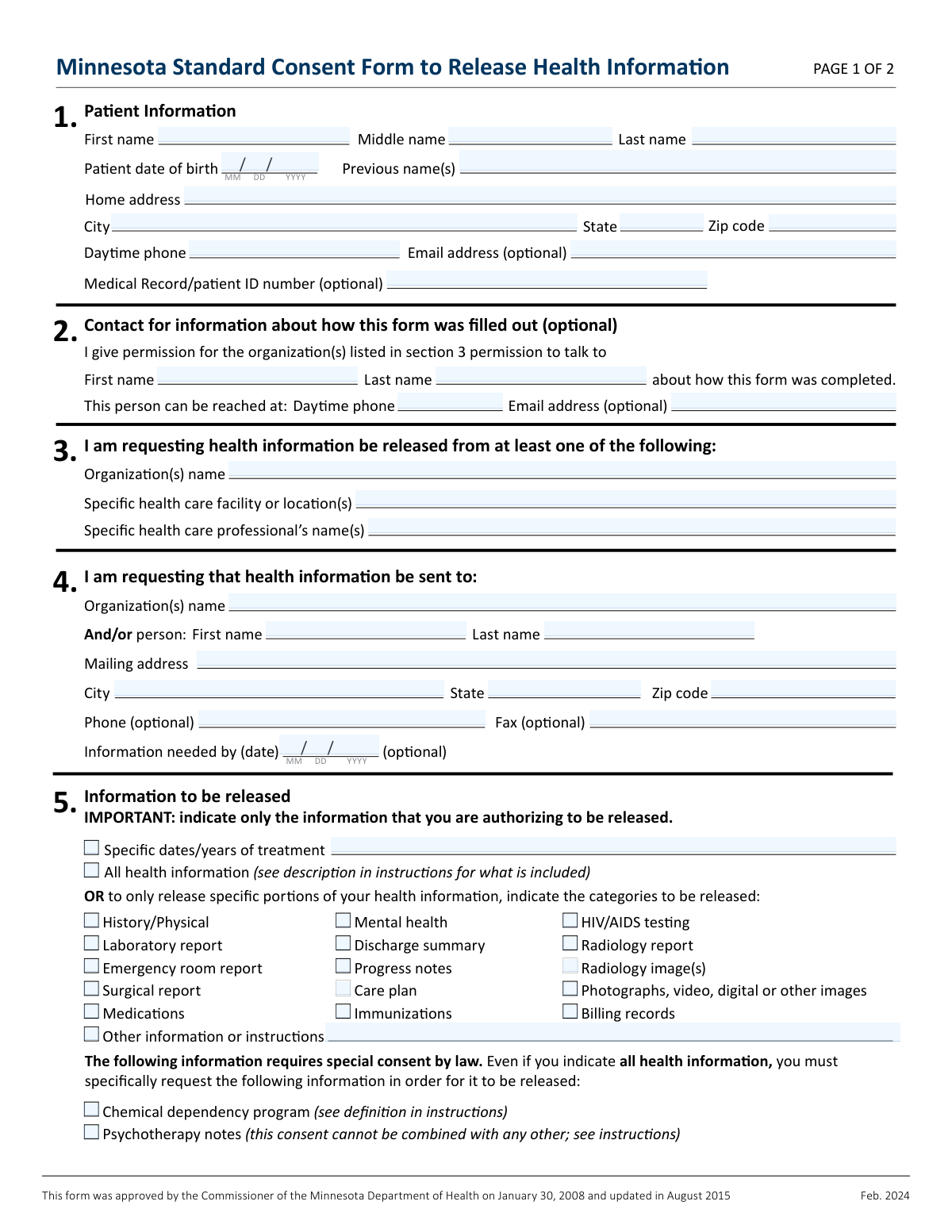
These forms are typically needed by individuals transitioning to a new primary care physician, consulting with specialists, or coordinating care between multiple facilities. They are also frequently used in legal matters, insurance claims processing, or when a family member needs to manage a patient's healthcare affairs. For example, the Minnesota Standard Consent Form to Release Health Information is a specialized document used to comply with specific state regulations, ensuring that all legal benchmarks for data sharing are met. Without these accurately completed forms, the flow of medical information can stall, potentially delaying treatments or insurance approvals.
Navigating the complexities of health information forms can be time-consuming, but tools like Instafill.ai use AI to fill these forms in under 30 seconds. This technology handles the data accurately and securely, providing a practical way to manage administrative requirements without the manual effort usually associated with medical paperwork.
Every form on this page can be completed without typing. Instafill is form filling software that reads a PDF and fills it for you — including flat and scanned documents that carry no fillable fields at all.
Forms in This Category
The forms in this category have a median Form Complexity Index of 41/100 (Basic), measured across 1 forms by field count, input difficulty, length, conditional logic and structure. See how it is calculated.
| Form Name | Pages | FCI | |
|---|---|---|---|
| 1. | Minnesota Standard Consent Form to Release Health Information | 1 | Basic 41 |
- Enterprise-grade security & data encryption
- 99%+ accuracy powered by AI
- 1,000+ forms from all industries
- Complete forms in under 60 seconds
How to Choose the Right Form
Understanding Patient Release Requirements
Patient release forms, also known as medical consent or health information forms, are essential for maintaining privacy while ensuring your medical history is available when needed. Choosing the right form depends primarily on your location and the specific legal requirements of your healthcare jurisdiction.
For Residents and Healthcare Providers in Minnesota
If you are seeking medical records within the state of Minnesota, the primary document you will need is the Minnesota Standard Consent Form to Release Health Information. This form is specifically approved by the Minnesota Department of Health and is designed to comply with the Minnesota Health Records Act.
You should choose this form if you are dealing with any of the following scenarios:
- Switching Providers: You need to transfer your medical history to a new specialist or primary care physician to ensure continuity of care.
- Insurance Claims: Your insurance company requires detailed documentation to process a claim or verify treatment history.
- Legal Proceedings: You or your legal representative need records for a personal injury case, disability claim, or other legal matters.
- Personal Use: You want a copy of your own health information for your personal records or to share with family members.
Why This Specific Form Matters
Unlike generic HIPAA forms, the Minnesota Standard Consent Form to Release Health Information includes specific state-mandated language that ensures the request is legally binding within the Minnesota healthcare system. Using the official standard form prevents administrative delays caused by providers rejecting non-compliant or generic documents.
How to Complete Your Form Efficiently
Filling out medical forms can be tedious and prone to errors. Using Instafill.ai, you can process the Minnesota Standard Consent Form to Release Health Information quickly. Our AI tools help you identify required fields so no section is missed and can even convert static PDF versions into interactive, fillable documents. By selecting the correct localized form and using AI-assisted filling, you ensure that your protected health information (PHI) is handled securely and in full compliance with both state and federal laws.
Form Comparison
| Form | Purpose | Who Signs | Key Requirement |
|---|---|---|---|
| Minnesota Standard Consent Form to Release Health Information | Authorizes the release of protected health information to a designated third party. | The patient or their legally authorized representative. | Must comply with the Minnesota Health Records Act for official data transfers. |
Tips for patient release forms
Instead of requesting all records, specify the exact dates of service or treatment relevant to your current needs. This helps the provider process your request faster and ensures you do not receive or pay for unnecessary copies of unrelated medical history.
Clearly state why the information is being released, such as for continuity of care, an insurance claim, or legal proceedings. Providing a clear purpose ensures the receiving party uses the data appropriately and helps the health provider fulfill the request under the correct guidelines.
Filling out complex medical consent forms manually can be prone to errors that cause processing delays. AI-powered tools like Instafill.ai can complete these forms in under 30 seconds with high accuracy, ensuring your data stays secure while saving you significant time when managing multiple releases.
Most patient release forms require an expiration date or a specific event to remain valid. Ensure this field is filled out correctly to prevent the release from remaining open indefinitely, which helps protect your long-term privacy and data security.
Ensure the name and date of birth on the form match exactly what is on file with the healthcare provider. Even minor discrepancies, like using a nickname instead of a legal name, can lead to the request being rejected for security reasons.
Always save a copy of every signed release form you submit to a healthcare provider. This allows you to track exactly which organizations have access to your health information and serves as a reference if you ever need to revoke access in the future.
Frequently Asked Questions
A patient release form, often called a medical release or HIPAA authorization, allows healthcare providers to share your protected health information with third parties. This is necessary for coordinating care between different doctors, processing insurance claims, or providing documentation for legal matters.
Generally, any competent adult can sign a release for their own records. For minors or adults unable to make their own decisions, a parent, legal guardian, or an individual with a designated medical power of attorney is usually required to sign on their behalf.
Yes, these forms typically allow you to specify exactly what information should be released, such as specific lab results, imaging reports, or records from a certain date range. You are not required to release your entire medical history if only a portion is needed for a specific purpose.
Most release forms include an expiration date or a specific event that triggers the end of the authorization. If no date is specified, the release may be valid for a standard period determined by state law, though you have the right to revoke it in writing at any time.
Yes, AI tools like Instafill.ai can streamline the process by automatically extracting relevant data from your source documents and placing it into the correct fields. This reduces the risk of manual entry errors and ensures that all required sections of the health information form are completed accurately.
Using AI-powered services, you can often complete a patient release form in under 30 seconds. These systems quickly parse your information and populate the PDF, allowing you to review and sign the document much faster than manual handwriting or typing.
Once the form is signed, you should submit it to the healthcare provider or organization that currently holds the records. They will verify the authorization and then transmit the requested information to the designated recipient via secure mail, fax, or encrypted digital transfer.
Insurance providers often require these forms to verify the medical necessity of treatments before issuing payment. By signing the release, you allow your doctor to provide the insurer with the clinical documentation needed to process your claim or authorize specific procedures.
Generally, yes, because each healthcare entity requires its own authorization to release the records it maintains. However, standardized forms like those approved by state health departments are often accepted across different organizations within that specific state, simplifying the request process.
You have the right to revoke your consent at any time by providing a written notice to the healthcare provider holding your records. Note that the revocation will not apply to any information that has already been released based on the prior authorization.
Most healthcare providers and legal entities now accept electronic signatures on patient release forms, provided they meet security and verification standards. This allows patients to manage health information requests entirely online without the need for physical printing or mailing.
Glossary
- Form Complexity Index
- Instafill’s 0–100 measure of how much effort a form takes to complete, calculated deterministically from the form’s own structure rather than estimated. It combines the number of fillable fields (the largest factor), how difficult those fields are to complete based on their type, the number of pages that contain fields, the amount of conditional “fill-only-if” logic, and how many sections the form is divided into, then adds modifiers for tables and repeating lists, bundled instruction pages, and dense page layouts. A higher score means the form is harder to fill out by hand. The forms in this category have a median Form Complexity Index of 41/100 (Basic). See exactly how it is calculated.
- HIPAA (Health Insurance Portability and Accountability Act)
- A federal law that sets national standards to protect sensitive patient health information from being disclosed without the patient's consent or knowledge.
- PHI (Protected Health Information)
- Any individually identifiable health data, including medical history, test results, and insurance information, that is protected under privacy laws.
- Disclosure
- The act of releasing, transferring, or providing access to a patient's medical records to an outside individual or organization.
- Minnesota Health Records Act
- A state-specific law that establishes strict guidelines for how healthcare providers in Minnesota must handle and share patient records, often providing more privacy protection than federal law.
- Revocation
- The formal process of canceling a previously signed consent form to stop any future sharing of medical information.
- Sensitive Health Information
- Specific categories of medical data, such as mental health records, HIV status, or substance abuse treatment, that often require explicit, additional permission to release.
- Authorized Representative
- A person with the legal right to sign forms on behalf of a patient, such as a parent of a minor, a legal guardian, or someone with power of attorney.
- Purpose of Disclosure
- A required section on the form where the patient must state why the information is being shared, such as for insurance claims, legal proceedings, or a second medical opinion.