Fill out purchase and sale forms
with AI.
Purchase and sale forms serve as the legal backbone of property transactions, establishing the formal terms and conditions of a real estate transfer. These documents are essential for defining the rights, obligations, and contingencies of both the buyer and the seller. By clearly outlining details such as the purchase price, earnest money requirements, and inspection periods, these forms ensure that all parties have a mutual understanding of the deal, providing a necessary layer of protection and legal clarity throughout the escrow process.
By continuing, you acknowledge Instafill's Privacy Policy and agree to get occasional product update and promotional emails.
About purchase and sale forms
These forms are most commonly used by real estate professionals, brokers, and individuals navigating private sales. Whether you are drafting a standard Residential Purchase and Sale Agreement (such as Form 21) or managing specific addenda, these documents are required the moment an offer is put on the table. They help manage the complexities of home buying and selling, from initial negotiations to the final closing procedures. Navigating these requirements accurately is vital for a smooth transition of ownership.
Because of the precision required for these contracts, many users now leverage modern technology to streamline the paperwork. Instafill.ai uses AI to help users fill out these purchase and sale forms in under 30 seconds, ensuring that data is handled accurately and securely. This practical approach saves time and reduces the likelihood of manual errors during the critical stages of a property transaction.
Every form on this page can be completed without typing. Instafill is form filling software that reads a PDF and fills it for you — including flat and scanned documents that carry no fillable fields at all.
Forms in This Category
The forms in this category have a median Form Complexity Index of 68/100 (Complex), measured across 7 forms by field count, input difficulty, length, conditional logic and structure. See how it is calculated.
| Form Name | Pages | FCI | |
|---|---|---|---|
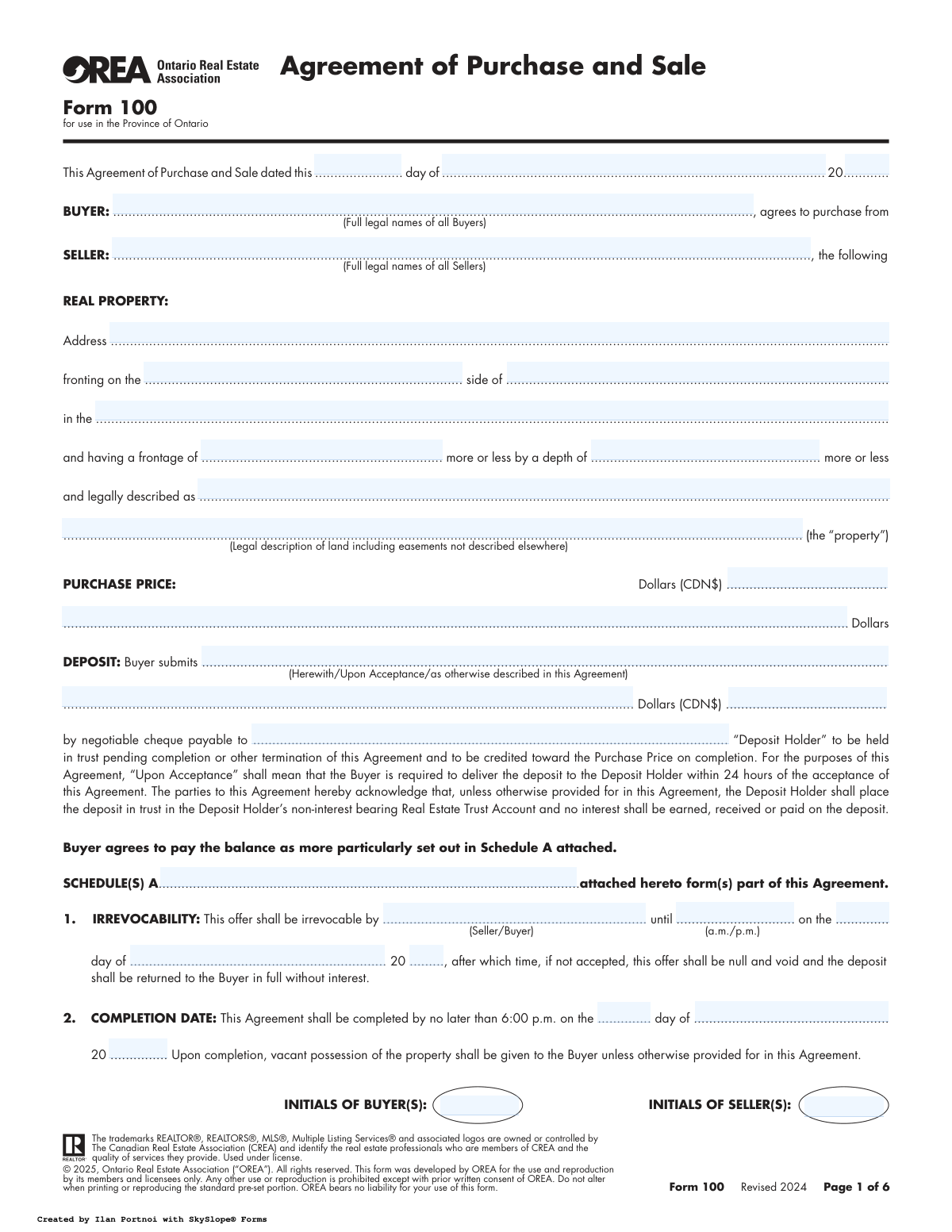
| 1. | Form 100, Agreement of Purchase and Sale | 6 | Complex 72 |
| 2. | Form 101, Agreement of Purchase and Sale Condominium Resale | 6 | Moderate 60 |
| 3. | Form 120, Amendment to Agreement of Purchase and Sale | 2 | Moderate 59 |
| 4. | Form 143, Amendment to Assignment of Agreement of Purchase and Sale | 2 | Complex 68 |
| 5. | Form 145, Assignment of Agreement of Purchase and Sale | 6 | Complex 70 |
| 6. | Form 21, Residential Purchase and Sale Agreement | 13 | Complex 73 |
| 7. | Form 801, Offer Summary Document for use with Agreement of Purchase and Sale | 1 | Moderate 62 |
- Enterprise-grade security & data encryption
- 99%+ accuracy powered by AI
- 1,000+ forms from all industries
- Complete forms in under 60 seconds
How to Choose the Right Form
Choosing the right documentation for a real estate transaction is critical to ensuring legal protection for both buyers and sellers. In the Northwest region, residential transactions are standardized to ensure all parties are on the same page regarding price, timelines, and contingencies.
The Standard for Residential Real Estate
If you are buying or selling a single-family home, the Form 21, Residential Purchase and Sale Agreement is the foundational document you will need. This form, established by the Northwest Multiple Listing Service (NWMLS), serves as the master contract for the entire transaction.
You should select Form 21 if:
- You are initiating a residential sale: It acts as the formal offer from a buyer to a seller.
- You need to define financial terms: It specifically outlines the purchase price, down payment, and earnest money deposits.
- You are setting timelines: The form establishes the closing date, possession date, and expiration of the offer.
Key Components of Form 21
While this is a single comprehensive form, it covers multiple legal bases that are essential for a smooth closing. When filling out this document, you will be addressing:
- Contingencies: It includes sections for inspection results, financing approval, and title reviews.
- Property Disclosures: It provides the framework for referencing necessary addenda required to disclose the condition of the property.
- Agency Relationships: It clarifies which real estate brokers represent which parties in the transaction.
Why Use This Form?
Using the Form 21, Residential Purchase and Sale Agreement ensures that your transaction follows standardized industry practices. Because it is the recognized standard in the Northwest, using it reduces the risk of legal errors or omissions that often occur with generic or outdated templates.
At Instafill.ai, we simplify the process of managing this complex document. Our AI-powered tools allow you to quickly fill out Form 21 accurately, ensuring all checkboxes and data fields are completed before you finalize your agreement.
Form Comparison
| Form | Primary Purpose | Key Parties | Common Contingencies | Typical Usage |
|---|---|---|---|---|
| Form 21, Residential Purchase and Sale Agreement | Establishes the legally binding terms and conditions for purchasing residential property. | Completed and signed by the property buyer and seller. | Includes inspection results, financing approval, appraisal values, and title reviews. | Standard contract for residential real estate transactions within the NWMLS region. |
Tips for purchase and sale forms
When filling out residential purchase forms, do not rely solely on the street address. Ensure the legal description or tax parcel number is accurate to prevent title issues and ensure the contract is legally binding for the specific plot of land.
Specify exact dates for inspection, financing, and appraisal contingencies rather than using vague language. Clear deadlines protect your earnest money and provide both buyers and sellers with a transparent roadmap toward closing.
AI-powered tools like Instafill.ai can complete these complex real estate forms in under 30 seconds with high accuracy. This is a significant time-saver for real estate professionals or buyers dealing with multiple forms, and your sensitive transaction data stays secure throughout the process.
Avoid assumptions about what stays with the house. Use the agreement to explicitly list items like appliances, window treatments, or smart home devices to prevent disputes during the final walkthrough and closing process.
Residential purchase agreements often require additional forms, such as financing addenda or lead-based paint disclosures. Keep these documents bundled together to ensure that the entire contract package is complete before submitting it to the other party.
Be precise about the amount and the specific timeframe for delivering earnest money to the escrow agent. Failing to meet these strict deadlines can result in a breach of contract and the loss of your right to purchase the property.
Frequently Asked Questions
A residential purchase and sale agreement is a contract between a buyer and a seller that outlines the terms of a real estate transaction. It includes the purchase price, closing date, and specific conditions that must be met before the property ownership is legally transferred.
These forms are typically prepared by the buyer or their real estate agent when making a formal offer on a property. Once the seller reviews and signs the document, it becomes a binding agreement that governs the escrow and closing process.
The form should be signed as soon as a buyer is ready to make a formal offer and a seller is ready to accept those specific terms. Signing the document officially triggers the timeline for important milestones like home inspections and securing financing.
Most residential contracts include contingencies for professional home inspections, mortgage financing approval, and a clear title report. These clauses protect the buyer by allowing them to withdraw from the deal or renegotiate if significant issues are discovered.
Yes, once both the buyer and the seller have signed the document, it becomes a legally binding contract. It obligates both parties to fulfill their requirements as specified in the agreement, provided all contingencies are successfully met.
Completed and signed forms are generally distributed to the real estate agents involved, the escrow or title company, and the buyer's mortgage lender. These parties use the document to coordinate the transfer of funds and the legal deed to the property.
Residential purchase and sale forms are specifically designed for homes, condominiums, and small multi-family units. Commercial transactions usually require different legal forms that account for complex zoning laws, environmental audits, and business revenue structures.
Yes, you can fill out purchase and sale forms using AI tools like Instafill.ai. These systems can accurately extract data from your source documents or property listings and place it into the correct fields in under 30 seconds.
Using AI-powered automation, completing complex real estate forms online is significantly faster than manual entry. AI tools can process and populate these documents in less than 30 seconds, ensuring high accuracy by pulling data directly from your supporting files.
In most jurisdictions, electronic signatures are legally valid and widely accepted for real estate contracts. Using digital platforms to sign and share these forms helps speed up the negotiation process and ensures all parties receive an immediate copy of the executed agreement.
Once accepted, the transaction enters the 'under contract' phase where the buyer usually pays earnest money into an escrow account. During this time, the buyer performs due diligence, such as inspections and appraisals, while the title company prepares the final transfer documents.
Glossary
- Form Complexity Index
- Instafill’s 0–100 measure of how much effort a form takes to complete, calculated deterministically from the form’s own structure rather than estimated. It combines the number of fillable fields (the largest factor), how difficult those fields are to complete based on their type, the number of pages that contain fields, the amount of conditional “fill-only-if” logic, and how many sections the form is divided into, then adds modifiers for tables and repeating lists, bundled instruction pages, and dense page layouts. A higher score means the form is harder to fill out by hand. The forms in this category have a median Form Complexity Index of 68/100 (Complex). See exactly how it is calculated.
- Earnest Money
- A deposit made by the buyer to the seller to demonstrate their serious intent to purchase the property, which is typically held in escrow until the deal closes.
- Contingency
- A specific condition or action that must be met for the real estate contract to become legally binding, such as a satisfactory home inspection or the buyer securing a mortgage.
- Escrow
- A legal arrangement where a neutral third party holds funds or assets on behalf of the buyer and seller until all conditions of the purchase agreement are fulfilled.
- Addendum
- An additional document attached to the main purchase agreement that includes extra terms, conditions, or disclosures not found in the original form.
- Title Insurance
- A policy that protects the buyer and lender against financial loss from defects in the property title, such as liens, encumbrances, or ownership disputes.
- Closing Costs
- The various fees and expenses paid by buyers and sellers at the end of a real estate transaction, including taxes, recording fees, and loan origination charges.
- NWMLS
- The Northwest Multiple Listing Service, an organization of real estate brokers that provides the standardized forms and data used for residential transactions in the Pacific Northwest.
- Disclosure Statement
- A required document where the seller provides detailed information about the property's physical condition and any known issues that could affect its value.