Fill out RMD forms
with AI.
Required Minimum Distribution (RMD) forms are essential financial documents used by retirement account owners to comply with IRS regulations. Once you reach a specific age—typically 72 or 73—the law requires you to begin withdrawing a minimum amount from tax-deferred accounts such as Traditional IRAs, SEP IRAs, and employer-sponsored plans. These forms ensure that distributions are calculated correctly and reported accurately to the government, helping you avoid significant tax penalties that can reach up to 25% of the amount that should have been withdrawn.
By continuing, you acknowledge Instafill's Privacy Policy and agree to get occasional product update and promotional emails.
About RMD forms
These forms are typically needed by retirees or those approaching retirement who hold accounts with major financial institutions like Empower, Fidelity, or Merrill. Whether you are setting up an automatic annual enrollment, requesting a one-time distribution from an employer-sponsored plan, or managing annuity distributions, RMD forms help you specify payment frequencies and tax withholding preferences. They are also essential for former employees of state university systems to access their optional retirement programs once they meet age and termination requirements. Tools like Instafill.ai use AI to fill these forms in under 30 seconds, handling your financial data with high accuracy and security to simplify your retirement planning.
Every form on this page can be completed without typing. Instafill is form filling software that reads a PDF and fills it for you — including flat and scanned documents that carry no fillable fields at all.
Forms in This Category
The forms in this category have a median Form Complexity Index of 40/100 (Basic), measured across 6 forms by field count, input difficulty, length, conditional logic and structure. See how it is calculated.
- Enterprise-grade security & data encryption
- 99%+ accuracy powered by AI
- 1,000+ forms from all industries
- Complete forms in under 60 seconds
How to Choose the Right Form
Navigating Required Minimum Distribution (RMD) requirements is critical to avoiding IRS penalties. To choose the correct form, you first need to identify the financial institution holding your assets and the specific type of retirement account you own.
For Merrill Lynch Account Holders
If you have a retirement account such as a Traditional, SEP, or SIMPLE IRA with Merrill, use the Merrill RMD Service Enrollment and Authorization Form. This form is designed for those who want the institution to automatically calculate and distribute their annual RMD, simplifying compliance and ensuring you don't miss a deadline.
For Fidelity Account Owners
Fidelity provides different forms based on whether your funds are in an employer-sponsored plan or a personal IRA:
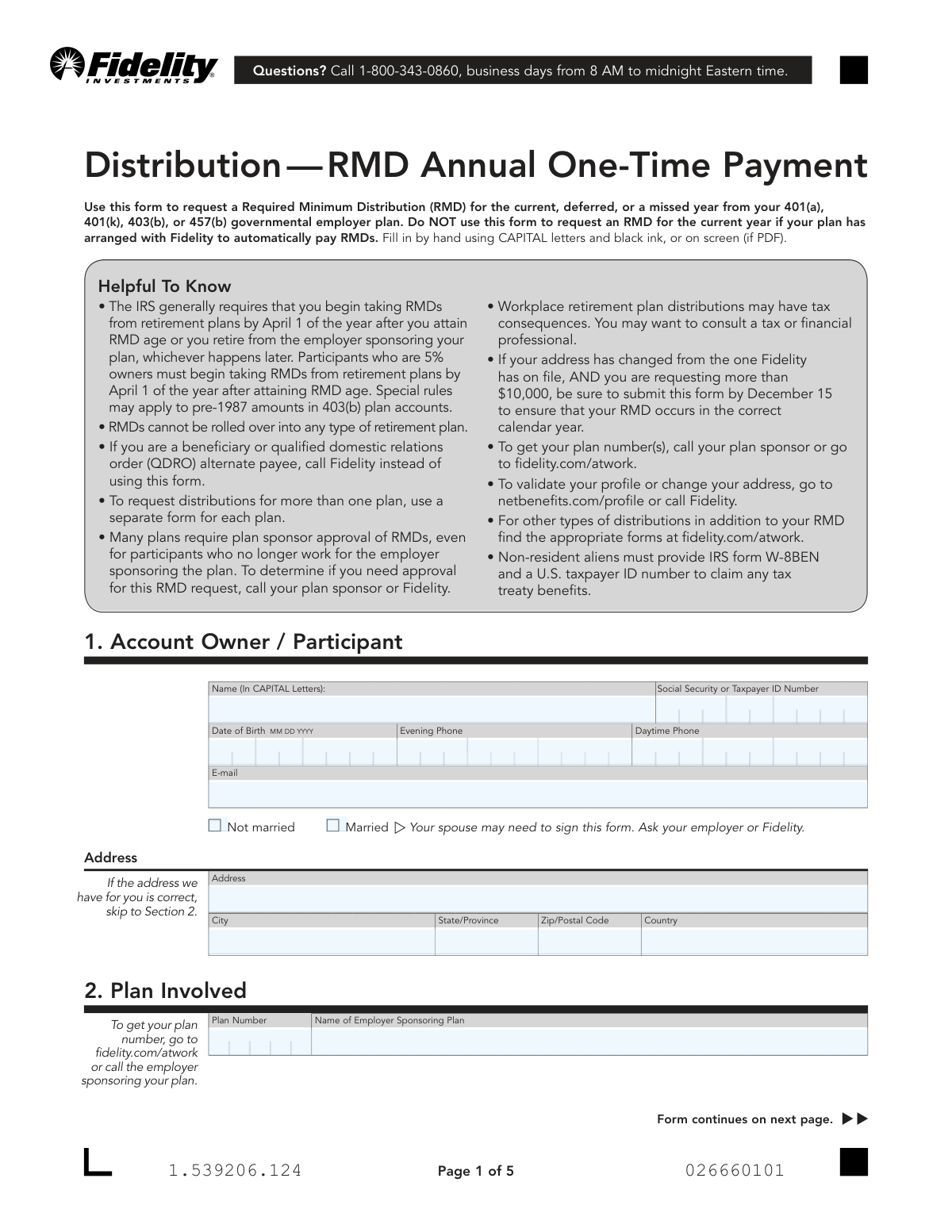
- Distribution — RMD Annual One-Time Payment: Select this form if your funds are in a Fidelity-administered employer plan and you need to request a single payment for the current year or catch up on a missed distribution.
- Fidelity Automatic Withdrawals — RMD/Life Expectancy: Choose this for personal IRAs (including Rollover and Roth IRAs) to establish ongoing, automatic withdrawals based on your life expectancy.
For Annuity and Insurance Contracts
If your retirement funds are held within an annuity through Fidelity & Guaranty Life, you will need the Fidelity & Guaranty Life Required Minimum Distribution (RMD) Form for IRA Owner/Plan Participant (Form ADMIN 5275). This form is unique because it allows you to either schedule your distribution or formally waive it if you are fulfilling your RMD requirement using a different qualified account.
For Florida Public University Employees
Former employees of Florida’s State University System should use Form ORP-RMD-1, State University System Optional Retirement Program (SUSORP) Application for a Required Minimum Distribution. This specific form is required for participants who are at least 70½ years old and have terminated all employment with SUSORP or Florida Retirement System (FRS) employers.
Form Comparison
| Form | Account Type | Distribution Schedule | Key Feature |
|---|---|---|---|
| Merrill RMD Service Enrollment and Authorization Form | Merrill IRA, SEP IRA, and SIMPLE IRA accounts | Automated annual distributions calculated by Merrill | Enrolls clients in a service that automatically calculates and pays RMDs |
| Distribution — RMD Annual One-Time Payment | Fidelity-administered employer retirement plans | Single one-time payment per request | Allows participants to request payments for current, deferred, or missed years |
| Fidelity Automatic Withdrawals — RMD/Life Expectancy | Fidelity Traditional, Rollover, Roth, SEP, or SIMPLE IRAs | Ongoing, recurring automatic withdrawal schedule | Calculates payments based on IRS life expectancy tables for automated compliance |
| Request for Required Minimum Distribution (RMD) - IRA Owner/Plan Participant | Fidelity & Guaranty Life Insurance annuity contracts | Flexible frequency or formal waiver of payment | Allows participants to waive RMD if taken from other qualified funds |
| Fidelity & Guaranty Life Required Minimum Distribution (RMD) Form for IRA Owner/Plan Participant | F&G Life IRA, SEP, or 403(b) annuity plans | Customizable payment methods and distribution schedules | Used to manage RMDs or certify compliance via other retirement accounts |
| Form ORP-RMD-1, State University System Optional Retirement Program (SUSORP) Application for a Required Minimum Distribution | Florida State University System Optional Retirement Program (SUSORP) | Standard RMD distribution upon reaching age 70½ | Specifically for terminated Florida university employees seeking SUSORP account distributions |
Tips for RMD forms
Different retirement accounts like IRAs, SEP IRAs, and 403(b)s have distinct distribution rules. Before filling out a form, verify that it is designated for your specific plan type to prevent processing errors or IRS compliance issues.
RMDs are generally treated as taxable income, and most forms allow you to specify how much federal and state tax to withhold. If you do not provide a specific percentage, the institution may apply a default rate that does not align with your actual tax liability.
Completing complex financial paperwork can be tedious, but AI-powered tools like Instafill.ai can complete these forms in under 30 seconds with high accuracy. Your sensitive financial data stays secure during the process, making it a reliable way to handle multiple RMD requests quickly.
While you can aggregate RMD totals for multiple IRAs and take the total from one account, other plans like 403(b)s typically require separate distributions. If you are waiving a distribution because you took it from another account, ensure you check the waiver or certification box correctly.
Many forms allow you to choose between a one-time payment or a recurring schedule. Clearly indicate whether you want the distribution to happen monthly, quarterly, or annually to ensure you meet annual deadlines without manual intervention.
To avoid delays in receiving your funds, ensure the bank account information provided on the RMD form matches the records held by your financial institution. Any discrepancy in account numbers or routing information can lead to the distribution being rejected or delayed.
Frequently Asked Questions
Required Minimum Distribution (RMD) forms are documents used to request the mandatory annual withdrawals from tax-deferred retirement accounts like IRAs and 401(k)s. The IRS requires these distributions once you reach a certain age to ensure that tax-deferred savings are eventually taxed as income.
Generally, you must begin taking distributions when you reach age 73 (or 72 depending on your birth year) for most retirement accounts. Specific programs, like the Florida State University System Optional Retirement Program (SUSORP), may have their own age-related eligibility requirements for filing.
You should select the form that corresponds to the specific financial institution or retirement plan holding your assets. For example, use the Merrill form for Merrill Lynch accounts, or the SUSORP form if you are a former employee of the Florida State University System.
Yes, you can use AI tools like Instafill.ai to complete these financial documents quickly. The AI accurately extracts data from your source documents and places it into the correct fields, ensuring that complex financial information is transferred without manual entry errors.
Using AI-powered services like Instafill.ai, most RMD forms can be completed in under 30 seconds. The system automates the data entry process, which is significantly faster than manually typing in account numbers, personal details, and distribution preferences.
A one-time payment form is used for a single withdrawal in a specific year, while automatic or enrollment forms allow you to set up recurring distributions. Services like the Merrill RMD Service or Fidelity Automatic Withdrawals help you stay compliant every year without needing to refile annually.
Some forms, such as those from Fidelity & Guaranty Life, include sections where you can formally waive a distribution from a specific annuity. This is typically done if you are taking the total required amount for all your accounts from a different qualified retirement fund.
Once completed, these forms are typically submitted directly to the financial institution or plan administrator managing your retirement account, not the IRS. Submission methods usually include secure online upload, mail, or fax as specified by the institution's instructions.
Yes, most RMD forms include a section for federal and state tax withholding preferences. You can choose to have a specific percentage of your distribution withheld for taxes to avoid a large bill or potential penalties when you file your annual tax return.
These forms cover a variety of retirement accounts including Traditional IRAs, SEP IRAs, SIMPLE IRAs, 403(b) plans, and employer-sponsored plans. It is important to match the form to the specific account type and the institution that holds it.
Some forms, such as the Fidelity RMD One-Time Payment form, allow you to request distributions for a missed year. This is a critical step in correcting past errors and minimizing the heavy excise taxes the IRS imposes on undistributed RMD amounts.
While the forms often ask for your age or birthdate, many financial institutions will calculate the distribution amount for you based on IRS life expectancy tables. Some forms allow you to choose between your own life expectancy or a joint life expectancy if you have a much younger spouse as the sole beneficiary.
Glossary
- Form Complexity Index
- Instafill’s 0–100 measure of how much effort a form takes to complete, calculated deterministically from the form’s own structure rather than estimated. It combines the number of fillable fields (the largest factor), how difficult those fields are to complete based on their type, the number of pages that contain fields, the amount of conditional “fill-only-if” logic, and how many sections the form is divided into, then adds modifiers for tables and repeating lists, bundled instruction pages, and dense page layouts. A higher score means the form is harder to fill out by hand. The forms in this category have a median Form Complexity Index of 40/100 (Basic). See exactly how it is calculated.
- Required Minimum Distribution (RMD)
- The minimum amount the IRS requires you to withdraw annually from your retirement accounts once you reach a certain age, typically 72 or 73.
- IRA (Individual Retirement Account)
- A tax-advantaged savings plan for retirement, including Traditional, SEP, and SIMPLE versions, which are subject to mandatory annual withdrawal rules.
- Tax Withholding
- The process of setting aside a percentage of your distribution to be paid directly to federal or state tax authorities to cover income taxes owed on the withdrawal.
- Uniform Lifetime Table
- An IRS-provided chart used to determine the distribution period based on the account owner's age, which is essential for calculating the correct RMD amount.
- Qualified Plan
- A retirement plan that meets specific IRS tax-code requirements, such as a 401(k), 403(b), or the State University System Optional Retirement Program (SUSORP).
- RMD Waiver
- A certification used when an individual chooses not to take a distribution from a specific account because they are satisfying their total RMD requirement through other eligible accounts.
- Excise Tax
- A penalty tax imposed by the IRS on account owners who fail to withdraw the full Required Minimum Distribution amount by the annual deadline.
- Deferred Distribution
- A provision that allows an individual to delay their first-ever RMD until April 1st of the year following the year they reach the RMD age.