Fill out trustee certification forms
with AI.
Trustee certification forms, often referred to as Certifications of Trust, are essential legal documents used to verify the existence of a trust and the authority of its trustees without requiring the disclosure of the entire private trust agreement. These forms are critical when dealing with financial institutions, as they provide proof that a trustee has the legal power to manage assets, open accounts, or execute transactions on behalf of the trust. By using these certifications, individuals can maintain the privacy of their sensitive estate planning details while still satisfying the due diligence requirements of banks and investment firms.
By continuing, you acknowledge Instafill's Privacy Policy and agree to get occasional product update and promotional emails.
About trustee certification forms
These forms are typically needed by newly appointed trustees, grantors setting up new accounts, or when changes occur within a trust's leadership. For instance, you might encounter a Fidelity Trustee Certification when adding or removing trustees from a brokerage account, or the Vanguard 529TCF when managing college savings plans. Similarly, insurance providers like Transamerica require specific certification forms to ensure that any actions taken regarding a life insurance policy align with the trust’s governing documents. Whether you are settling an estate or simply updating financial records, having the correct certification ensures that fiduciary responsibilities are clearly defined and legally recognized.
Managing these administrative tasks can be time-consuming, but tools like Instafill.ai use AI to fill these forms in under 30 seconds while ensuring data accuracy and security. This allows trustees to focus on their fiduciary duties rather than manual paperwork.
Every form on this page can be completed without typing. Instafill is form filling software that reads a PDF and fills it for you — including flat and scanned documents that carry no fillable fields at all.
Forms in This Category
The forms in this category have a median Form Complexity Index of 58/100 (Moderate), measured across 3 forms by field count, input difficulty, length, conditional logic and structure. See how it is calculated.
| Form Name | Pages | FCI | |
|---|---|---|---|
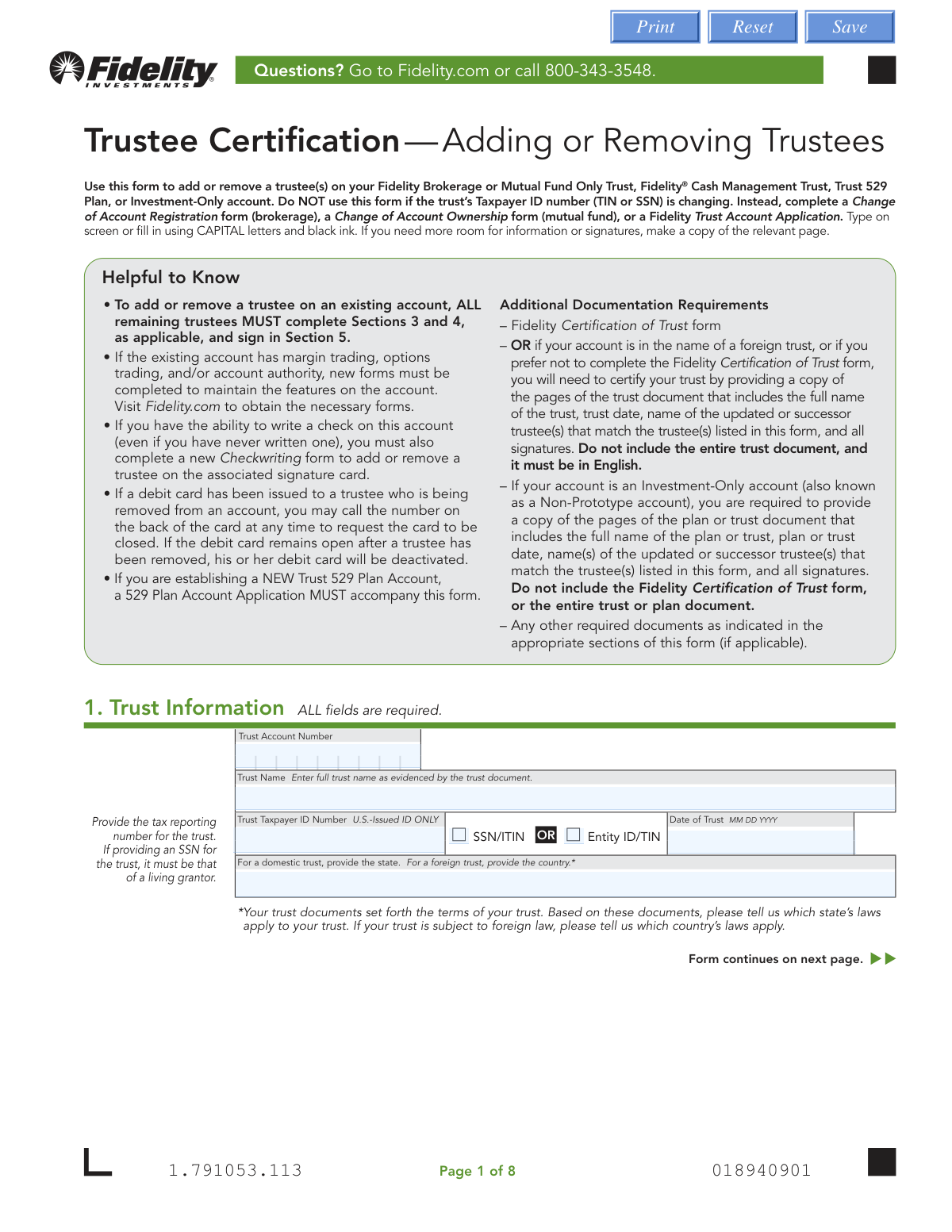
| 1. | Fidelity Trustee Certification — Adding or Removing Trustees | 1 | Moderate 58 |
| 2. | Form 529TCF, The Vanguard 529 College Savings Plan, Trustee Certification | 1 | Moderate 46 |
| 3. | Trust Certification and Trustee Powers | 1 | – |
- Enterprise-grade security & data encryption
- 99%+ accuracy powered by AI
- 1,000+ forms from all industries
- Complete forms in under 60 seconds
How to Choose the Right Form
Selecting the correct trustee certification form depends primarily on which financial institution holds your trust's assets and the specific type of account you are managing. These forms serve as a legal shorthand, allowing you to prove your authority as a trustee without having to provide the entire, often private, trust document.
Forms for Investment and Brokerage Accounts
If you are managing assets within a standard brokerage or investment environment, look for forms specific to that firm:
- Fidelity Trustee Certification — Adding or Removing Trustees: Choose this form if you have an existing trust account at Fidelity and need to update who is authorized to manage it. It is specifically designed for the formal process of onboarding a new trustee or documenting the removal of a former one to maintain legal compliance.
Forms for Education Savings Plans
Trusts are often used to fund educational goals, which requires specialized documentation for tax-advantaged accounts:
- Form 529TCF, The Vanguard 529 College Savings Plan, Trustee Certification: Use this form exclusively for trust accounts established under the Vanguard 529 plan. You will need this when setting up a new account, changing the acting trustees, or if Vanguard requires updated certification to verify who has the power to authorize distributions for beneficiaries.
Forms for Insurance and Fiduciary Powers
When dealing with insurance policies or verifying the specific scope of your legal authority, certain providers require a detailed breakdown of your powers:
- Trust Certification and Trustee Powers (Transamerica): This form is the correct choice for Transamerica clients. Beyond simply identifying the trustees, it requires you to certify the trust’s tax ID and grantors. Most importantly, it is used to confirm that specific transactions—such as managing a life insurance policy—are permitted under the terms of your trust agreement.
By using Instafill.ai, you can quickly complete these complex legal documents, ensuring all fiduciary details are accurate and ready for submission to your financial institution.
Form Comparison
| Form | Financial Institution | Specific Use Case | Key Certifications |
|---|---|---|---|
| Fidelity Trustee Certification — Adding or Removing Trustees | Fidelity Investments | Formally adding or removing individuals from a trust account record. | Identity and fiduciary responsibility of current and new trustees. |
| Form 529TCF, The Vanguard 529 College Savings Plan, Trustee Certification | Vanguard | Establishing or updating trustee authority for a 529 savings plan. | Trust identity, tax ID, and list of authorized trustees. |
| Trust Certification and Trustee Powers | Transamerica | Verifying authority for transactions like managing life insurance policies. | Official trust name, date, tax ID, and specific trustee powers. |
Tips for trustee certification forms
AI-powered tools like Instafill.ai can complete these complex trustee forms in under 30 seconds with high accuracy. This technology ensures your data stays secure during the process while drastically reducing the time spent on manual data entry for financial institutions.
Ensure the trust name on the certification form matches your original trust agreement character-for-character, including specific dates and suffixes. Discrepancies between the form and the legal deed are a common cause for rejection by institutions like Fidelity or Vanguard.
Before certifying, review your trust deed to confirm you have the authority to perform the requested transaction, such as managing a 529 plan or life insurance policy. Many forms require you to explicitly check boxes indicating which powers are granted to the active trustees.
If the trust requires multiple signatures, collect the full legal names, addresses, and social security numbers of all active trustees beforehand. Having this information ready prevents delays when filling out sections regarding the addition or removal of fiduciaries.
Many trustee certifications require a notary public or a medallion signature guarantee to be legally binding. Review the submission instructions for your specific form to determine if you must sign the document in the presence of a legal official.
Having a searchable PDF of your full trust document allows you to quickly find specific articles or clauses requested by the certification form. This is particularly helpful when you need to identify the exact date the trust was established or the specific names of the grantors.
Frequently Asked Questions
A trustee certification form is a legal document used to verify the existence of a trust and the authority of the trustees to act on its behalf. Financial institutions use these forms to confirm who has the power to manage assets without needing to review the entire, often private, trust agreement.
These forms are typically required when opening a new trust account, changing the designated trustees, or when a financial institution needs to verify that the trust's powers cover a specific transaction. For example, you would use these when adding a new trustee to a Fidelity account or setting up a Vanguard 529 plan under a trust.
Generally, no. The primary benefit of a certification of trust is that it summarizes the essential terms of the trust—such as the trust's name, date, and trustee powers—without revealing confidential details like beneficiary identities or asset distributions.
The current, acting trustees of the trust are responsible for signing the certification. By signing, they are legally attesting that the information provided is accurate and that the trust remains in full force and effect.
Usually, each financial institution, such as Fidelity, Vanguard, or Transamerica, requires its own specific version of the trustee certification form. While the information requested is similar across the board, the forms are tailored to the institution's internal compliance and record-keeping systems.
When a trustee is added or removed, you must file an updated certification form with each institution holding trust assets. This ensures that the records accurately reflect who is authorized to manage the funds and prevents unauthorized individuals from making changes to the account.
Yes, you can use AI tools to streamline the process of completing these forms. Platforms like Instafill.ai can accurately extract data from your source documents and place it into the correct fields of the trustee certification form in under 30 seconds.
Using AI-powered services like Instafill.ai, completing a trustee certification form typically takes less than 30 seconds. The AI automatically identifies the required fields and populates them using information from your existing legal documents, significantly reducing manual entry time.
Yes, institutions like Transamerica require a trust certification to confirm that the trustees have the specific power to manage life insurance policies. This ensures that any actions taken, such as changing beneficiaries or withdrawing cash value, are permitted under the trust agreement.
Many financial institutions require trustee certification forms to be notarized to verify the identity of the signers and the authenticity of the document. You should check the specific instructions on the Fidelity or Vanguard form to see if a notary seal is mandatory for your specific update.
You will generally need the official name of the trust, the date it was executed, the Taxpayer Identification Number (TIN) or Social Security Number associated with the trust, and the names of all current trustees. You should also be prepared to list the specific powers granted to the trustees by the trust agreement.
Keeping certifications current is vital for maintaining legal compliance and ensuring smooth account management. Outdated information can lead to account freezes, delays in processing transactions, or potential legal disputes regarding the authority of the trustees.
Glossary
- Form Complexity Index
- Instafill’s 0–100 measure of how much effort a form takes to complete, calculated deterministically from the form’s own structure rather than estimated. It combines the number of fillable fields (the largest factor), how difficult those fields are to complete based on their type, the number of pages that contain fields, the amount of conditional “fill-only-if” logic, and how many sections the form is divided into, then adds modifiers for tables and repeating lists, bundled instruction pages, and dense page layouts. A higher score means the form is harder to fill out by hand. The forms in this category have a median Form Complexity Index of 58/100 (Moderate). See exactly how it is calculated.
- Trustee
- The individual or entity legally authorized to hold and manage assets on behalf of a trust's beneficiaries according to the terms of the trust agreement.
- Certification of Trust
- A legal document that proves a trust exists and identifies the current trustees without requiring the disclosure of the entire, private trust agreement to third parties.
- Grantor
- Also referred to as a settlor or trustor, this is the person who originally created the trust and transferred their assets into it.
- Successor Trustee
- A person designated in the trust document to take over management of the trust if the current trustee dies, resigns, or is otherwise unable to serve.
- Trustee Powers
- The specific legal authorities granted to a trustee, such as the power to buy or sell investments, withdraw funds, or change beneficiaries.
- Tax Identification Number (TIN)
- A unique nine-digit number assigned by the IRS to the trust for tax reporting purposes; it is often required to open or manage financial accounts.
- Fiduciary Responsibility
- The legal and ethical obligation of a trustee to act solely in the best interests of the trust and its beneficiaries, rather than for personal gain.
- 529 College Savings Plan
- A tax-advantaged investment account designed to save for education expenses, which can be owned or managed by a trust for the benefit of a student.