Fill out Utah Medicaid forms
with AI.
Utah Medicaid forms are essential documents for healthcare providers and facilities seeking to participate in the state’s healthcare network. These forms facilitate the enrollment and credentialing process, ensuring that practitioners can legally provide services to Medicaid beneficiaries and receive appropriate reimbursement. Whether you are a solo practitioner, a specialized doula, or a large medical facility, completing these forms accurately is the first step toward integrating with Utah’s Division of Medicaid and Health Financing and maintaining compliance with state and federal regulations.
By continuing, you acknowledge Instafill's Privacy Policy and agree to get occasional product update and promotional emails.
About Utah Medicaid forms
The forms in this category are typically used during initial provider enrollment, contract renewals, or when specific attestations are required for specialized services. For example, the Utah Medicaid Provider Application and the associated Provider Agreement are foundational documents that establish the contractual relationship between the healthcare professional and the state. These documents cover critical details such as billing procedures, record-keeping standards, and eligibility requirements. Accurately submitting these forms is vital to avoid administrative delays in processing or potential issues with insurance claims and reimbursements.
Navigating government paperwork can be time-consuming, but tools like Instafill.ai use AI to fill these forms in under 30 seconds while ensuring data accuracy and security. By automating the data entry process, healthcare professionals can focus more on patient care and less on administrative hurdles, streamlining the transition into the Utah Medicaid network.
Every form on this page can be completed without typing. Instafill is form filling software that reads a PDF and fills it for you — including flat and scanned documents that carry no fillable fields at all.
Forms in This Category
The forms in this category have a median Form Complexity Index of 51/100 (Moderate), measured across 2 forms by field count, input difficulty, length, conditional logic and structure. See how it is calculated.
| Form Name | Pages | FCI | |
|---|---|---|---|
| 1. | Utah Department of Health Provider Agreement for Medicaid | 8 | Basic 43 |
| 2. | Utah Medicaid Doula Provider Attestation | 3 | Moderate 51 |
- Enterprise-grade security & data encryption
- 99%+ accuracy powered by AI
- 1,000+ forms from all industries
- Complete forms in under 60 seconds
How to Choose the Right Form
Navigating the Utah Medicaid system as a healthcare professional requires specific documentation to ensure you can be reimbursed for your services. While many people search for patient enrollment, the forms in this category are specifically designed for healthcare providers, groups, and facilities looking to join the state network.
General Provider Enrollment
If you are a doctor, facility, or medical group looking to start seeing Medicaid patients, you will likely need to complete two primary documents:
- Utah Medicaid Provider Application: This is the essential first step. It is the primary document used to collect your professional details, facility information, and tax ID to establish you in the system.
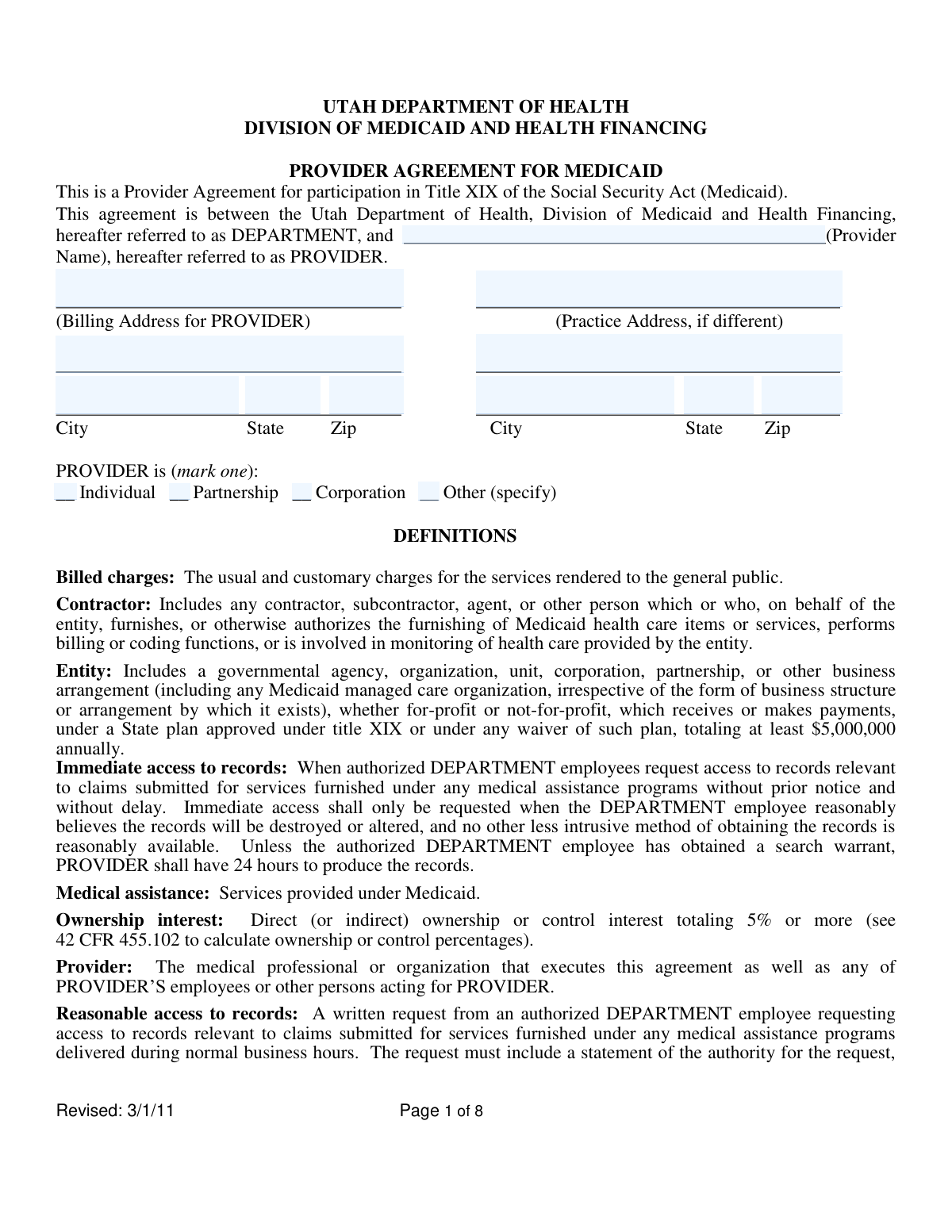
- Utah Department of Health Provider Agreement for Medicaid: This is the legally binding contract between your practice and the state. It outlines your responsibilities regarding billing, record-keeping, and compliance with Title XIX regulations. Most providers must submit this alongside their application to finalize their enrollment.
Specialized Doula Certification
Utah Medicaid has specific requirements for non-traditional providers. If you are a birth worker seeking to provide support services to Medicaid members, you must use the Utah Medicaid Doula Provider Attestation. This form allows you to qualify via two distinct routes:
- Certification Pathway: For doulas with formal training from recognized national or international organizations.
- Experience Pathway: For doulas who may not have a specific certification but meet the state’s requirements for births attended and professional experience.
Tips for Fast Processing
To avoid delays in your enrollment or reimbursement, ensure that your NPI and state license numbers are ready before starting the Utah Medicaid Provider Application. Using AI-powered tools like Instafill.ai can help you accurately complete these complex PDFs, ensuring that every required field in the Provider Agreement is filled correctly before submission.
Form Comparison
| Form | Primary Purpose | Targeted User | Key Requirement |
|---|---|---|---|
| Utah Department of Health Provider Agreement for Medicaid | Establishes a legally binding contract for Medicaid program participation. | Individual healthcare providers or medical facilities. | Commitment to billing, record-keeping, and federal compliance standards. |
| Utah Medicaid Doula Provider Attestation | Verifies specific qualifications and training for doula enrollment. | Individual doulas applying for Medicaid provider status. | Documentation of certification or specific birth attendance experience. |
| Utah Medicaid Provider Application | Standard application for healthcare providers to receive Medicaid reimbursement. | Healthcare professionals, medical groups, and facilities. | Submission of professional credentials and billing setup information. |
Tips for Utah Medicaid forms
Ensure your National Provider Identifier (NPI) and specific taxonomy codes match your official registration exactly. Incorrect codes are a leading cause of application processing delays or reimbursement issues within the Utah Medicaid system.
Before starting your application or attestation, gather digital copies of your professional licenses, certifications, and proof of insurance. Having these ready prevents the session from timing out and ensures all dates provided are consistent across all forms.
For specialized roles like doulas, carefully review the requirements for the 'Certification' versus 'Experience' pathways before filling out the attestation. Choosing the wrong path can lead to an immediate denial, requiring you to restart the entire enrollment process.
AI-powered tools like Instafill.ai can complete these complex Utah Medicaid forms in under 30 seconds with high accuracy. Your sensitive provider data stays secure during the process, making it a reliable way to handle multiple enrollment documents quickly.
The name on your Provider Agreement must perfectly match the name on your Provider Application and IRS records. Even small discrepancies, such as using an abbreviation in one place but not another, can trigger a manual review and slow down your approval.
Store completed copies of your provider agreements and attestations in a secure, organized folder. These documents are essential references for future Medicaid renewals, billing audits, or when updating your provider profile with the Utah Department of Health.
Frequently Asked Questions
These forms are designed for healthcare professionals, medical facilities, and specialized practitioners, such as doulas, who wish to provide services to Medicaid members in Utah. Completing these documents is a mandatory step for any provider seeking to be reimbursed by the Utah Department of Health and Human Services (DHHS).
The Provider Application is used to collect essential data regarding a provider's credentials, practice location, and tax information. In contrast, the Provider Agreement is a legally binding contract that outlines the specific terms, conditions, and regulatory responsibilities a provider must adhere to while participating in the Medicaid program.
Yes, you can use AI-powered tools like Instafill.ai to complete these forms. The technology can extract data from your existing professional documents and accurately populate the PDF fields in under 30 seconds, significantly reducing the time required for manual data entry.
Doulas must complete a specific Provider Attestation form that documents their qualifications. Applicants can typically qualify through either a 'Certification Pathway,' which requires proof of training from an approved organization, or an 'Experience Pathway,' which involves documenting a specific number of births attended and professional recommendations.
Most provider enrollment forms are submitted to the Utah Department of Health and Human Services, Division of Integrated Healthcare. While many forms are processed through the state's PRISM (Provider Resources Information System for Medicaid) online portal, some specific attestations or supplemental documents may need to be uploaded or mailed as directed by the enrollment instructions.
When using traditional manual methods, these forms can take 15 to 30 minutes to complete due to the level of detail required. However, using an AI tool like Instafill.ai allows you to finish the process in less than a minute by automatically placing your data into the correct fields with high precision.
You will generally need your National Provider Identifier (NPI), professional license numbers, federal tax ID (FEIN) or Social Security Number, and detailed information about your practice locations. Depending on the provider type, you may also need to provide proof of liability insurance and disclosures regarding ownership and control.
Yes, Utah Medicaid requires providers to keep their information current. If you change your primary practice location or add a new service site, you must typically submit an update or a new application through the PRISM system to ensure proper billing and communication.
No, the forms in this specific category are for healthcare providers seeking to join the Medicaid network. Patients looking to apply for medical assistance or check their eligibility should look for the 'Medicaid Member' or 'Beneficiary' application forms provided by the Utah Department of Workforce Services.
Providers are generally required to revalidate their enrollment every three to five years to maintain active status. During the revalidation period, you may be asked to review and sign a new Provider Agreement to ensure compliance with the most current state and federal regulations.
Glossary
- Form Complexity Index
- Instafill’s 0–100 measure of how much effort a form takes to complete, calculated deterministically from the form’s own structure rather than estimated. It combines the number of fillable fields (the largest factor), how difficult those fields are to complete based on their type, the number of pages that contain fields, the amount of conditional “fill-only-if” logic, and how many sections the form is divided into, then adds modifiers for tables and repeating lists, bundled instruction pages, and dense page layouts. A higher score means the form is harder to fill out by hand. The forms in this category have a median Form Complexity Index of 51/100 (Moderate). See exactly how it is calculated.
- Title XIX
- The formal section of the Social Security Act that established the Medicaid program, often referenced in provider contracts and legal agreements.
- NPI (National Provider Identifier)
- A unique 10-digit identification number issued to health care providers in the United States by the Centers for Medicare and Medicaid Services (CMS).
- DMHF (Division of Medicaid and Health Financing)
- The specific division within the Utah Department of Health and Human Services responsible for managing and administering Medicaid services.
- Prior Authorization (PA)
- A requirement that a healthcare provider must obtain approval from Utah Medicaid before a specific service or medication is provided for the cost to be covered.
- Taxonomy Code
- A unique alphanumeric code that identifies a healthcare provider's specialty or service area, used for categorization during the enrollment and billing process.
- Provider Attestation
- A formal, signed declaration where a healthcare professional confirms they meet specific training, experience, or legal requirements for the program.
- Certification vs. Experience Pathway
- The two distinct methods doulas can use to qualify for Utah Medicaid enrollment, based either on formal training or a documented history of births attended.
- EFT (Electronic Funds Transfer)
- The digital method used by the state to deposit Medicaid reimbursements directly into a provider's bank account.