Back (Thoracolumbar Spine) Conditions Disability Benefits Questionnaire Completed Form Examples and Samples
Explore detailed examples of AI-filled Back (Thoracolumbar Spine) Conditions Disability Benefits Questionnaires (DBQ). See how our AI accurately extracts diagnoses, ICD codes, range of motion, radiculopathy, and functional impact for VA disability claims.
Back (Thoracolumbar Spine) Conditions Disability Benefits Questionnaire has a very complex Form Complexity Index of 92/100 — Instafill’s AI completes it in under a minute.
Form Complexity Index
Very Complex
92 / 100
| Fillable fields | 439 |
| Pages | 14 |
| Fields per page | 31 |
| Sections | 140 |
| Conditional rules | 216 |
| Tables & lists | 9 |
| Instruction pages | — |
| Instafill Form ID | IF-BACK-THORACOLUMBAR-SPINE-CONDITIONS-DISABILITY-BEN |
Back (Thoracolumbar Spine) Conditions DBQ
How this form was filled:
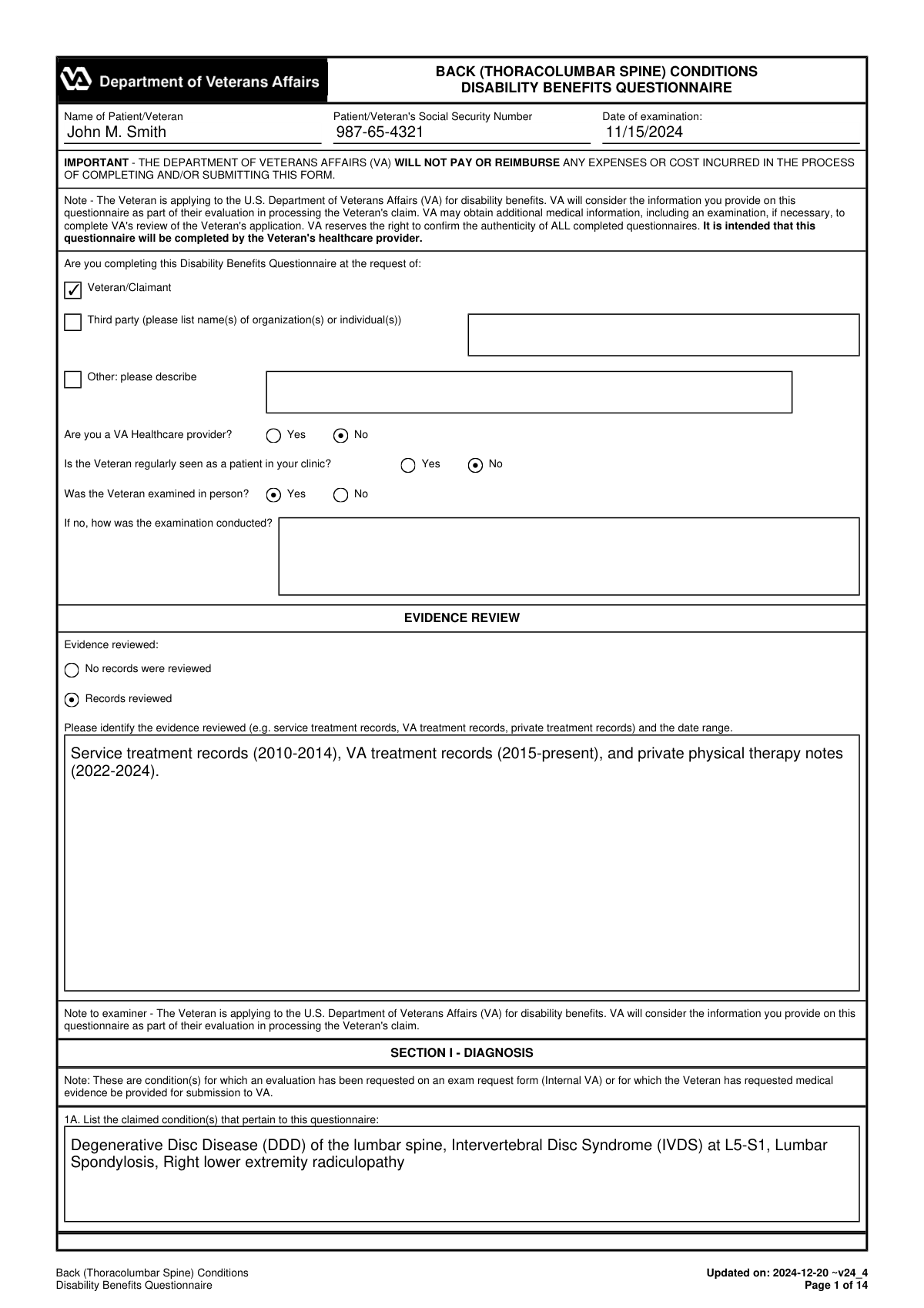
Our AI efficiently extracted intricate medical details from comprehensive doctor's dictation notes, accurately filling out the Back (Thoracolumbar Spine) Conditions Disability Benefits Questionnaire, including specific ICD codes, range of motion measurements, and detailed functional impact.
Source document used: Doctor's Dictation Notes
Patient: John M. Smith, DOB 1975-03-12, SSN: 987-65-4321.

Today's date is November 15, 2024. This examination was conducted in person at the request of the Veteran/Claimant. I am a private orthopedic spine specialist, not a VA Healthcare provider, and Mr. Smith is not a regular patient in my clinic, though I have reviewed his extensive records. Records reviewed include service treatment records (2010-2014), VA treatment records (2015-present), and private physical therapy notes (2022-2024).

**History of Present Illness**: Mr. Smith presents with chronic low back pain which began after a service-related injury in 2012. Initially mild, the pain has progressed over time to a chronic, moderate level (4-6/10), with periodic severe flare-ups, particularly affecting his right leg. He reports that his condition significantly limits his ability to perform daily activities. Conservative management, including physical therapy, epidural injections, and various oral medications, has provided only temporary relief.

**Flare-ups**: Patient reports frequent flare-ups, approximately monthly, characterized by severe, sharp pain in the lower back, radiating down his right leg to the foot. These episodes typically last 2-3 days and are precipitated by prolonged standing or lifting. Relief is usually found with strict bed rest and application of heat. During these flare-ups, his ability to walk or sit is severely compromised, describing it as 'being locked up'.

**Functional Loss after Repetitive Use**: Mr. Smith states, 'After about 30 minutes of walking or standing, my back stiffens significantly, and the pain intensifies to a 7/10. I have to sit or lie down to get relief. It makes household chores and grocery shopping very difficult.'

**Diagnosis**:
1.  Degenerative Disc Disease (DDD) of the lumbar spine (ICD: M51.36), diagnosed May 20, 2018, based on MRI findings.
2.  Intervertebral Disc Syndrome (IVDS) at L5-S1 (ICD: M51.16), diagnosed March 10, 2020.
3.  Lumbar Spondylosis (ICD: M47.816), diagnosed October 1, 2019.

**Range of Motion (ROM)**: All testing performed today. Active ROM: Forward flexion 60 degrees, Extension 15 degrees, Right lateral flexion 15 degrees, Left lateral flexion 15 degrees, Right lateral rotation 20 degrees, Left lateral rotation 20 degrees. Pain was noted with forward flexion, extension, right lateral flexion, and left lateral flexion. Limitation of motion is due to pain, fatigability, and weakness, causing functional loss. Passive ROM was assessed and found to be the same as active ROM. Pain (6/10) was reported with any active movement, particularly lumbar flexion and extension, which causes functional loss. Wincing was observed on palpation. No crepitus. Moderate tenderness to palpation over L4-L5 and L5-S1 paraspinal muscles, right greater than left, associated with muscle guarding. Repetitive use testing performed. After three repetitions, forward flexion decreased to 50 degrees, extension to 10 degrees, right lateral flexion to 10 degrees, and left lateral rotation to 15 degrees. Patient reports significant increase in pain and stiffness after 30 minutes of activity, leading to inability to sustain posture or ambulate effectively. During flare-ups, estimated ROM: Forward flexion 30 degrees, Extension 5 degrees, Right/Left lateral flexion 5 degrees, Right/Left lateral rotation 10 degrees. The Veteran's statement of 'being locked up' and requiring bed rest during flare-ups is consistent with severe limitations; his PCP records corroborate these episodes.

**Guard/Spasm/Tenderness**: Localized tenderness L4-S1 paraspinal muscles, right greater than left. Chronic muscle spasm in lumbar paraspinal muscles, particularly on the right, exacerbated by activity, but not causing obvious abnormal gait or spinal contour at rest. Mild guarding of lumbar spine noted on rapid movement, not resulting in abnormal gait or spinal contour.

**Additional Functional Factors**: Interference with sitting and standing for prolonged periods (greater than 30 minutes). Disturbance of locomotion (stiff, hesitant gait). Less movement than normal (spinal stiffness). Weakened movement (difficulty climbing stairs due to right leg weakness). Instability of station (frequent loss of balance when shifting weight).

**Muscle Strength (0-5 scale)**: Right Hip Flexion 4/5, Right Ankle Dorsiflexion 4/5, Right Great Toe Extension 4/5. All other lower extremity muscle groups 5/5. No muscle atrophy noted.

**Deep Tendon Reflexes (DTRs)**: Right Knee 2+, Right Ankle 1+. Left Knee 2+, Left Ankle 2+.

**Sensory Exam**: Light touch decreased in right L4, L5, S1 dermatomes. Hypoesthesia noted in right S1 dermatome. Left side sensation normal.

**Straight Leg Raise Test**: Right: Positive at 45 degrees, with pain radiating to the foot. Left: Negative.

**Radiculopathy**: Patient experiences constant, moderate pain in the right lower extremity, and intermittent, severe pain in the right lower extremity. Paresthesias/dysesthesias are moderate in the right lower extremity, with mild numbness. This indicates involvement of the L4/L5/S1/S2/S3 nerve roots (sciatic nerve) on the right side. The likely cause of these findings is a herniated disc at L5-S1 compressing the right S1 nerve root, secondary to chronic degenerative disc disease.

**IVDS Episodes Requiring Bed Rest**: Yes, Mr. Smith has had episodes of acute IVDS requiring bed rest and physician treatment in the past 12 months. Total duration of bed rest was at least 1 week but less than 2 weeks, as documented in his file. Specifically, records from Dr. Eleanor Vance (Primary Care, VA Clinic) on 2024-02-10 and Dr. Robert Kim (Orthopedic Spine, Private Practice) on 2024-07-22 show prescribed muscle relaxants and oral steroids, along with physical therapy referrals for these episodes.

**Assistive Devices**: Mr. Smith regularly uses a cane for balance and stability due to right leg weakness and pain, especially when walking long distances or on uneven surfaces, related to his lumbar radiculopathy.

**Functional Impairment**: No functional impairment equivalent to amputation with prosthesis.

**Other Pertinent Findings**: None. No scars or skin disfigurement related to his back conditions.

**Diagnostic Testing**: Lumbar MRI dated September 1, 2024, revealed L5-S1 disc herniation with effacement of the right S1 nerve root, and multilevel degenerative disc disease (L4-L5, L5-S1) with osteophyte formation. Degenerative arthritis is clearly documented. No vertebral fracture observed. MRI findings directly correlate with clinical presentation of chronic low back pain, radiculopathy, and functional limitations. Degenerative changes and disc herniation explain nerve root compression.

**Functional Impact (Occupational Tasks)**: Yes. Chronic low back pain and right radiculopathy severely limit the ability to sit or stand for more than 30 minutes, preventing sustained desk work or jobs requiring prolonged standing. Lifting is restricted to less than 10 lbs. Walking is limited to short distances (approx. 0.5 miles) before significant pain escalation.

**Remarks**: Patient expresses significant frustration with persistent pain and limitations despite conservative management. His quality of life is notably impacted.

**Examiner Certification**: Dr. Sarah Jenkins, MD, Orthopedic Spine Specialist, signed this report on 2024-11-15. Phone: (555) 123-4567, Fax: (555) 123-4568. NPI: 1234567890. Medical License: MED-9876543, CA. Address: 100 Ortho Way, Suite 200, Sacramento, CA 95814.
Information used to fill out the document:
- Veteran's Name: John M. Smith
- SSN: 987-65-4321
- Date of Examination: 2024-11-15
- Diagnoses: Degenerative Disc Disease (M51.36), Intervertebral Disc Syndrome (M51.16), Lumbar Spondylosis (M47.816)
- Range of Motion (Active): Forward flexion 60°, Extension 15°, Right/Left lateral flexion 15°, Right/Left lateral rotation 20°
- Radiculopathy Symptoms: Constant moderate pain, intermittent severe pain, moderate paresthesias/dysesthesias, mild numbness in right lower extremity (sciatic nerve involvement)
- IVDS Bed Rest Episodes: Total duration at least 1 week but less than 2 weeks in past 12 months, documented by Dr. Vance (2024-02-10) and Dr. Kim (2024-07-22)
- Assistive Device: Cane (regular use) for balance/stability due to right leg weakness/pain
- Functional Impact: Limited sitting/standing (<30 min), lifting (<10 lbs), walking (<0.5 miles), preventing sustained occupational tasks
What this filled form sample shows:
- Identified and correctly formatted multiple diagnoses with corresponding ICD codes and dates from narrative text.
- Extracted precise active, passive, and post-repetition range of motion measurements and their associated pain and functional limitations.
- Accurately detailed radiculopathy symptoms, severity, and nerve root involvement from detailed neurological findings.
- Summarized IVDS bed rest episodes, including duration and specific documentation details with dates and providers.
- Recognized the use of an assistive device (cane) and its frequency/reason, correlating it to the diagnosed condition.
- Comprehensively described the functional impact on occupational tasks, providing specific limitations for sitting, standing, lifting, and walking.
Form specifications and details:
| Use Case: | Disability claim for chronic thoracolumbar spine conditions with radiculopathy |
| Source Document: | Doctor's Dictation Notes during a special medical examination |
| Categories: | disability forms, benefit forms, ACO forms, disability benefits forms |
| Created: | March 10, 2026 04:03 AM |