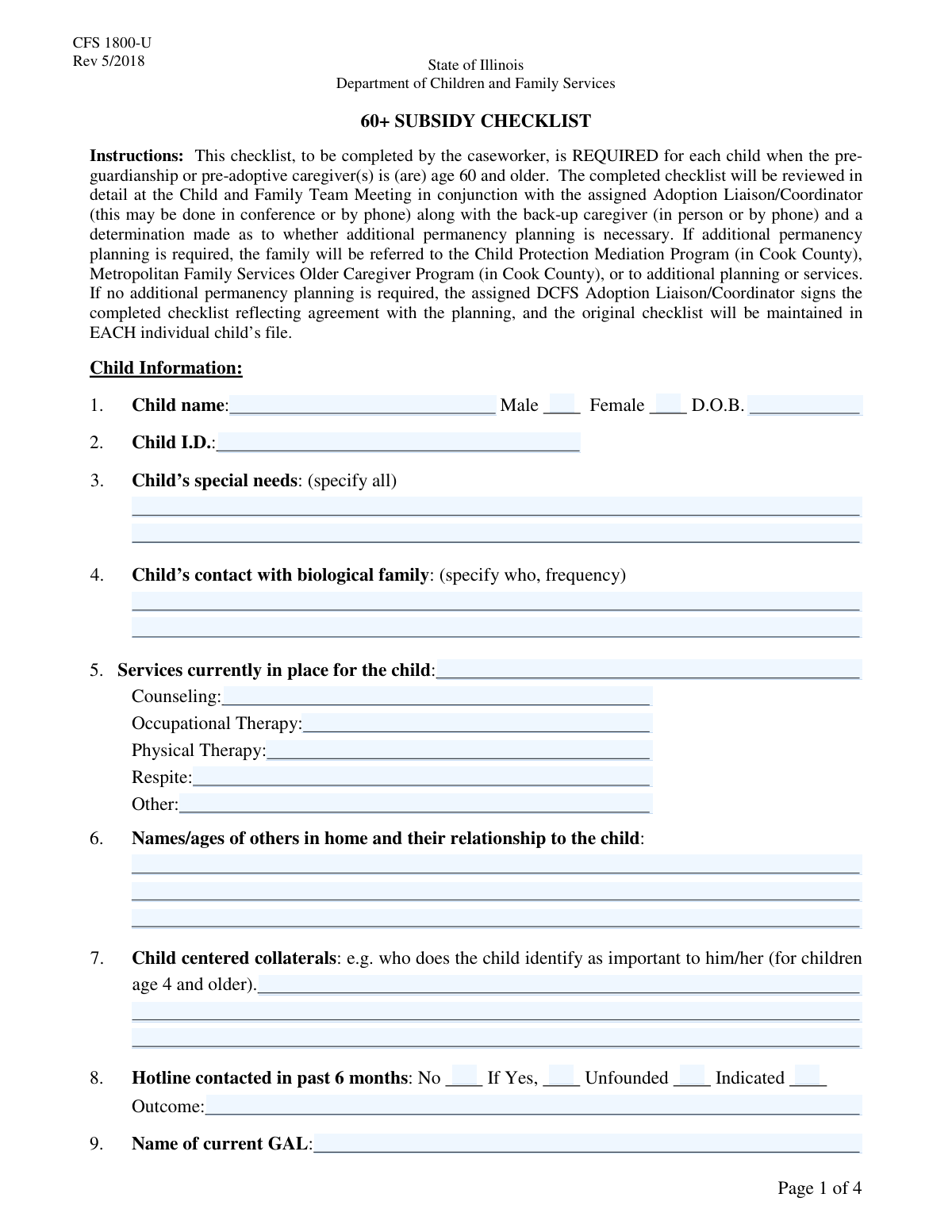
Yes! You can use AI to fill out Caregiver 60 and Over Checklist

The Caregiver 60 and Over Checklist is a critical assessment tool for child welfare caseworkers to ensure the long-term safety and stability of a child placed with an older caregiver. It documents the caregiver's health, support systems, living arrangements, and mandates the creation of a detailed back-up care plan. Today this form can be filled out quickly and accurately using AI-powered services like Instafill.ai, which can also convert non-fillable PDF versions into interactive fillable forms.
Caregiver 60+ Checklist is part of the CAR forms and L.A. Care forms categories on Instafill.
Our AI automatically handles information lookup, data retrieval, formatting, and form filling.
It takes less than a minute to fill out Caregiver 60+ Checklist using our AI form filling.
Securely upload your data. Information is encrypted in transit and deleted immediately after the form is filled out.

Form specifications

Form name: Caregiver 60 and Over Checklist
Number of fields: 115
Number of pages: 4
Filled form examples: Form Caregiver 60+ Checklist Examples
Language: English
main-image

Instafill Demo: How to fill out PDF forms in seconds with AI

How to Fill Out Caregiver 60+ Checklist Online for Free in 2026

Are you looking to fill out a CAREGIVER 60+ CHECKLIST form online quickly and accurately? Instafill.ai offers the #1 AI-powered PDF filling software of 2026, allowing you to complete your CAREGIVER 60+ CHECKLIST form in just 37 seconds or less.
Follow these steps to fill out your CAREGIVER 60+ CHECKLIST form online using Instafill.ai:
  1. 1 Navigate to Instafill.ai and upload or select the Caregiver 60 and Over Checklist.
  2. 2 Use the AI assistant to accurately input the child's basic information, special needs, and any services they currently receive.
  3. 3 Provide detailed information for the primary caregiver(s), including their date of birth, health status, and placement details.
  4. 4 Document all formal and informal support systems available to the caregiver, including any services from the Department of Aging.
  5. 5 If the caregiver is 60 or older, meticulously fill out the sections for the back-up caregiver, including their personal details, relationship to the child, and the reviewed plan for future care.
  6. 6 Enter the details for the caseworker, supervisor, and any reviewing adoption liaisons.
  7. 7 Review all the information populated by the AI for completeness and accuracy before finalizing the document for submission.

Our AI-powered system ensures each field is filled out correctly, reducing errors and saving you time.

Why Choose Instafill.ai for Your Fillable Caregiver 60+ Checklist Form?

Speed

Complete your Caregiver 60+ Checklist in as little as 37 seconds.

Up-to-Date

Always use the latest 2026 Caregiver 60+ Checklist form version.

Cost-effective

No need to hire expensive lawyers.

Accuracy

Our AI performs 10 compliance checks to ensure your form is error-free.

Security

Your personal information is protected with bank-level encryption.

Frequently Asked Questions About Form Caregiver 60+ Checklist

This form is a comprehensive checklist used to assess a child's placement with a caregiver, ensuring the child's safety, well-being, and the stability of their care environment. It is particularly detailed when the caregiver is aged 60 or older.

This form is typically completed by a Placement/Permanency Caseworker from a child welfare agency (like DCFS). The caseworker gathers information from the child's case file, caregivers, and service providers to fill it out.

For caregivers aged 60 or older, the form requires additional details about their health, household income, and a designated back-up caregiver. This is a proactive measure to ensure a long-term, stable plan is in place for the child's future care.

You need to provide the full name of the child's current Guardian ad Litem (GAL). If a GAL is assigned, you must also detail any concerns they have about the placement and the date of your last conversation with them.

The Home Safety Checklist (CFS 2025) is only required if the child is in an unlicensed placement. If the caregiver is unlicensed, you must check the box confirming its completion and enter the date it was completed.

First, indicate if the child abuse hotline has been contacted about this child in the past 6 months by checking 'Yes' or 'No'. If you check 'Yes', you must then specify the outcome of the contact, such as 'Unfounded' or 'Indicated'.

Informal supports are unpaid help from individuals like family, friends, or neighbors. Formal supports are services provided by professional agencies, which should be detailed with the agency name and their level of involvement.

If the primary caregiver is 60 or older, you must identify a back-up caregiver and provide their name, date of birth, address, and relationship to the child. You also need to document their current involvement and preparedness to assume care.

This section is for listing the names of individuals whom the child (if aged 4 or older) identifies as being important to them. This helps in understanding the child's personal support network.

It is helpful to have the child's case file, medical evaluation forms for caregivers over 60, results from CANTS/LEADS background checks, and the Home Safety Checklist (CFS 2025) if the placement is unlicensed.

Yes, services like Instafill.ai use AI to accurately auto-fill form fields from your records, which can save significant time and reduce errors. This is especially helpful for long, detailed forms like this one.

Simply upload the form to the Instafill.ai platform, and its AI will identify the fields. You can then connect your data sources to automatically populate the information, review it for accuracy, and complete the form efficiently.

You can use a service like Instafill.ai, which can convert flat, non-fillable PDFs into interactive, fillable forms. This allows you to easily type in your information or use AI to auto-fill the fields digitally.

This section tracks services for caregivers or family members, often related to the needs of older adults. You need to enter the number of services in place and needed, and specify what they are, such as homemaker services or Meals on Wheels.

After the caseworker and their supervisor complete and sign the form, it is submitted for review by an Adoption Liaison or another designated reviewer. They assess the appropriateness of the care plan, especially the back-up plan for older caregivers.

Compliance Caregiver 60+ Checklist
Validation Checks by Instafill.ai

1
Mutually Exclusive Gender Selection
This validation ensures that only one of the 'Male' or 'Female' checkboxes can be selected for the child's gender. It prevents logically impossible data where a child is marked as both male and female. If a user tries to select both, the system should either automatically deselect the previous choice or display an error message prompting the user to select only one.
2
Hotline Contact Outcome Dependency
This check validates that the 'Unfounded', 'Indicated', and 'Outcome' fields are only filled if the 'Yes' checkbox for 'Hotline Contact Information' is selected. This is a conditional logic check that prevents irrelevant data from being entered. If 'No' is selected for hotline contact, these subsequent fields should be disabled or hidden to avoid confusion and erroneous data entry.
3
GAL Conversation Date Recency
This validation ensures that the 'Date of Last Conversation with GAL' is not only a valid date but is also within the last 6 months from the date the form is submitted. This is a critical business rule to ensure the information is current and relevant for review. If the date entered is older than 6 months, the system should flag it as an error and require an updated date or justification.
4
Unlicensed Placement Safety Checklist Requirement
This check enforces that if the 'Unlicensed' checkbox is selected for 'Licensing Status', then the 'Home Safety Checklist Completed' field must be checked and a valid 'Checklist Completion Date' must be provided. This is a crucial safety and compliance validation. Failure to provide this information for an unlicensed placement would represent a significant gap in protocol, so the form submission should be blocked until the required information is entered.
5
Caregiver Age-Based Section Trigger
This is a major conditional validation that checks if either caregiver's age is 60 or older, calculated from their Date of Birth. If this condition is met, a large number of subsequent sections and fields (e.g., 'Caregiver Health Status', 'Household Income', 'Back-up Caregiver Details') must be filled out. This rule ensures that specific protocols for older caregivers are followed, and if the caregivers are younger than 60, these sections should be hidden or disabled to streamline the form.
6
Child Agreement Based on Age
This validation checks the child's age, calculated from the 'Date of Birth' field. If the child is 4 years of age or older, the 'Child Agreement' field regarding the back-up caregiver becomes a required field. This rule ensures that the child's perspective is considered as required by policy. If the child is under 4, this field may be optional or disabled.
7
Reviewer Concerns Logic
This check ensures a logical hierarchy within the 'Reviewer's Assessment' section. The specific concern checkboxes, 'Concerns: Living Arrangement' and 'Concerns: Back-up Plan', can only be selected if the primary 'Has Concerns' checkbox is also checked. This prevents contradictory data where specific concerns are noted without a general concern being flagged.
8
Valid and Past Date of Birth
This validation applies to all date of birth fields ('Child', 'First Caregiver', 'Second Caregiver', 'Back-up Caregiver'). It ensures that the entered value is a valid date and that the date is in the past, not the current day or a future date. This prevents basic data entry errors and ensures the feasibility of the entered information for age calculations.
9
Conditional GAL Information
This validation ensures that the 'GAL Concerns' and 'Date of Last Conversation with GAL' fields are only enabled and required if a name has been entered into the 'Current GAL Name' field. This prevents users from entering details about a GAL's concerns or conversations without first identifying who the GAL is. If the GAL name field is empty, these dependent fields should be disabled.
10
Mutually Exclusive Status Pairs
This check validates several pairs of checkboxes to ensure they are mutually exclusive, including 'Licensed'/'Unlicensed', 'Relative'/'Non-relative', and the 'Yes'/'No' pairs for hotline contact and conference participation. A user should not be able to select both options in any given pair. This enforces clear, unambiguous status choices and prevents logical conflicts in the submitted data.
11
Phone Number Format Validation
This validation applies to all phone number fields, such as 'Placement Phone Number' and 'Back-up Caregiver Phone Number'. It checks that the entered value conforms to a standard phone number format (e.g., 10 digits, allowing for common separators like parentheses, spaces, or hyphens). This improves data quality and ensures that the contact information is usable.
12
Conference Participation Count Logic
This check validates the logic for conference participation. If 'Yes' is checked for 'Conference Participation', then the sum of 'In Person Participations' and 'Telephone Participations' must be greater than zero. This ensures that a 'Yes' response is substantiated with at least one participation count. Conversely, if 'No' is checked, these count fields should be disabled and have a value of zero.
13
Date Chronology Check
This validation performs a logical check between different date fields. For example, the 'Date of Placement' must be on or after the child's 'Date of Birth', and the 'Checklist Completion Date' for the home safety checklist must be on or before the form submission date. This prevents chronological impossibilities and ensures the timeline of events is logical.
14
Caregiver Medical Evaluation Dependency
This validation ensures that the 'Caregiver 1 Evaluation Date' and 'Caregiver 1 Evaluation Doctor/Clinic' fields are required if and only if the 'Caregiver #1 Health Status' field is filled. The same logic applies to Caregiver #2. This rule ensures that if a health status is documented, the required details of the medical evaluation that determined this status are also captured.

Common Mistakes in Completing Caregiver 60+ Checklist

Incomplete Information for Caregivers Aged 60+

A large portion of the form, including sections on health status, financial verification, and back-up caregiver plans, is only required if a primary caregiver is 60 or older. Users often miss this conditional requirement or miscalculate the age, leading them to skip these critical sections entirely. This results in an incomplete application that cannot be processed, causing significant delays in permanency planning. To avoid this, carefully verify the caregiver's date of birth and ensure all dependent sections are completed; AI-powered tools like Instafill.ai can automatically reveal and prompt for these required conditional fields based on the entered age.

Contradictory Hotline Contact Entries

Users may incorrectly check 'No' for 'Hotline Contact Information' but then proceed to fill in a conflicting outcome like 'Unfounded' or 'Indicated'. This contradiction happens due to simple oversight or misunderstanding the form's logic. It creates confusion for reviewers and requires manual follow-up to clarify the child's history, delaying the assessment. To prevent this, ensure that if 'No' is selected, all subsequent fields in that section ('Unfounded', 'Indicated', 'Outcome') are left blank.

Outdated Guardian ad Litem (GAL) Conversation Date

The form explicitly states that the 'Date of Last Conversation with GAL' must be within 6 months of the submission date. A common mistake is entering an older date that falls outside this window, rendering the information invalid for the current review. This error can halt the entire process until a more recent conversation with the GAL is conducted and documented. Before filling, always confirm the date of the last contact and ensure it meets the 6-month requirement.

Vague Descriptions for Needs and Services

Fields like 'Child's Special Needs,' 'Services Currently In Place,' and 'Biological Family Contact Details' require specific, actionable information. People often enter vague phrases like 'therapy,' 'sees mom,' or 'behavioral issues,' which are insufficient for a proper assessment. This lack of detail forces caseworkers to spend extra time gathering the necessary information, hindering their ability to coordinate appropriate care. Be specific: instead of 'therapy,' write 'Weekly cognitive behavioral therapy with Dr. Smith for anxiety every Tuesday at 4 PM.'

Missing Home Safety Checklist Details for Unlicensed Placements

The form requires completion details for the 'Home Safety Checklist (CFS 2025)' specifically if the placement is 'Unlicensed.' Users frequently check the 'Unlicensed' box but then forget to fill in whether the checklist was completed and the corresponding date. This is a critical compliance failure that can jeopardize the child's safety and invalidate the placement approval. If a placement is unlicensed, you must confirm the checklist is done and enter the correct completion date.

Incomplete Data for Other Household Members

The 'Other Household Members' field asks for three distinct pieces of information for each person: name, age, and relationship to the child. A frequent error is to list only names, omitting the ages or relationships. This incomplete data prevents a full assessment of the child's living environment and the support system available, requiring follow-up. To avoid this, list each person separately and ensure all three data points are provided for every individual in the home.

Confusing Informal and Formal Supports

The form has separate sections for 'Informal Supports' (e.g., a neighbor who helps with childcare) and 'Formal Supports' (e.g., a state agency). Users often mix these up, listing an agency under informal supports or a family member under formal ones. This mischaracterization can lead to a misunderstanding of the family's resource network and needs. Carefully distinguish between unpaid, personal help (informal) and professional, agency-based services (formal) when filling out these sections.

Incomplete Back-up Caregiver Plan

When the primary caregiver is over 60, a comprehensive back-up plan is mandatory, including the back-up caregiver's name, DOB, address, and their involvement. A common mistake is providing just a name, leaving out the contact details and the specifics of their role and preparedness. An incomplete back-up plan is a major red flag for reviewers, as it calls into question the long-term stability of the placement. Ensure all fields in the 'Back-up Caregiver Details' and subsequent review sections are filled out completely.

Illegible Handwriting on a Non-Fillable Form

Often, complex government forms are only distributed as flat, non-fillable PDFs, forcing users to print and complete them by hand. This frequently leads to illegible handwriting, especially in small text boxes, which causes data entry errors, misinterpretations, and significant processing delays. To avoid this, use a tool like Instafill.ai, which can convert a non-fillable PDF into an interactive, fillable version, ensuring all entries are typed, clear, and legible.

Using Inconsistent or Invalid Date Formats

The form contains over a dozen date fields, and users often enter them in various formats (e.g., MM-DD-YY, DD/MM/YYYY, Month Day, Year). This inconsistency can cause data entry errors and confusion, especially for fields with age-based conditional logic. This can lead to sections being incorrectly hidden or shown. Always use a consistent MM/DD/YYYY format to ensure clarity, or use an AI form-filling tool that automatically standardizes date formats.
Saved over 80 hours a year

“I was never sure if my IRS forms like W-9 were filled correctly. Now, I can complete the forms accurately without any external help.”

Kevin Martin Green

Your data stays secure with advanced protection from Instafill and our subprocessors

Robust compliance program

Transparent business model

You’re not the product. You always know where your data is and what it is processed for.

ISO 27001, HIPAA, and GDPR

Our subprocesses adhere to multiple compliance standards, including but not limited to ISO 27001, HIPAA, and GDPR.

Security & privacy by design

We consider security and privacy from the initial design phase of any new service or functionality. It’s not an afterthought, it’s built-in, including support for two-factor authentication (2FA) to further protect your account.

Fill out Caregiver 60+ Checklist with Instafill.ai

Worried about filling PDFs wrong? Instafill securely fills caregiver-60-and-over-checklist forms, ensuring each field is accurate.