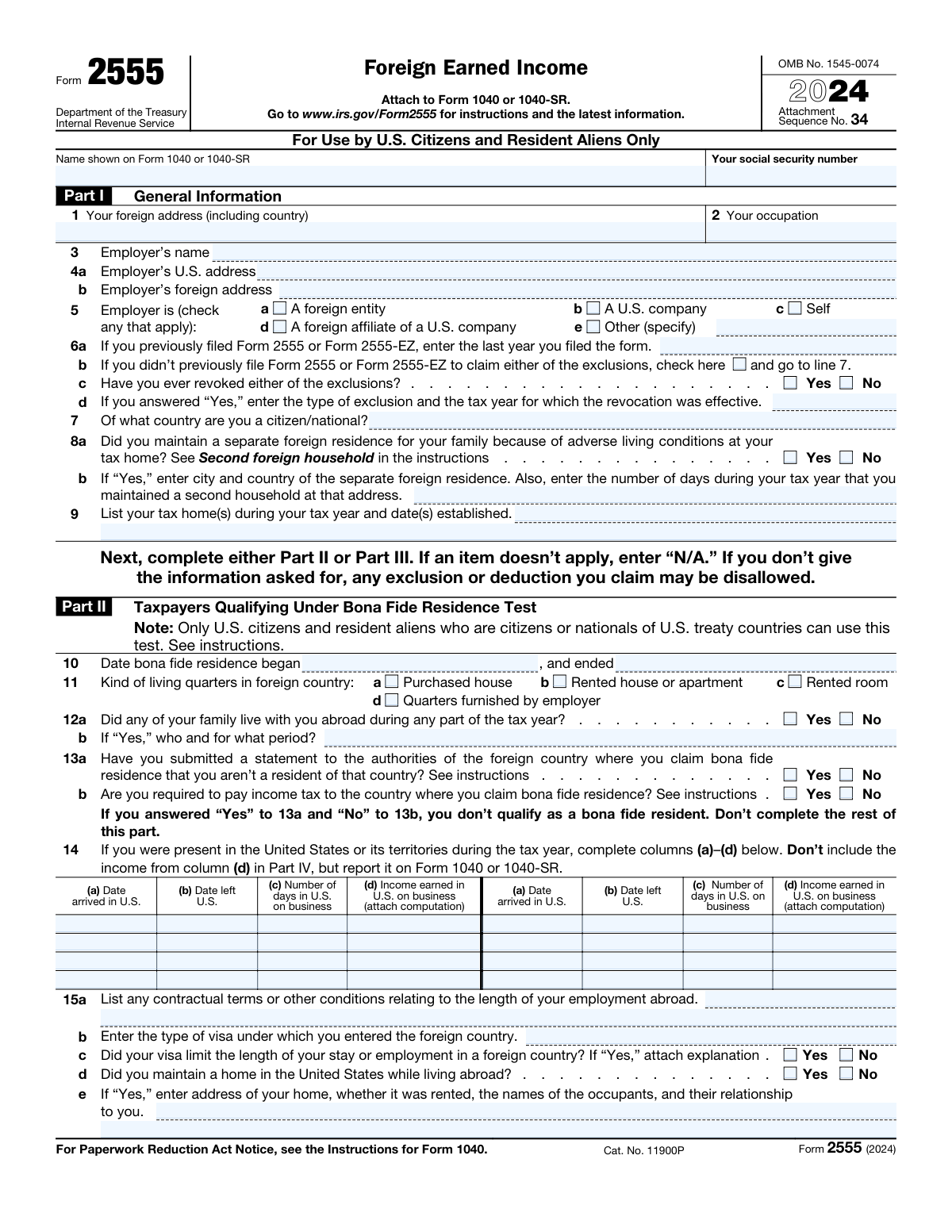
Yes! You can use AI to fill out Form 2555, Foreign Earned Income
Form 2555, Foreign Earned Income, is an essential IRS tax form for U.S. citizens and resident aliens who live and work abroad. It allows eligible taxpayers to claim the foreign earned income exclusion, foreign housing exclusion, or foreign housing deduction, which can significantly reduce their U.S. income tax liability. This form is critical for avoiding double taxation and ensuring compliance with U.S. tax law while overseas. Today, this form can be filled out quickly and accurately using AI-powered services like Instafill.ai, which can also convert non-fillable PDF versions into interactive fillable forms.
Our AI automatically handles information lookup, data retrieval, formatting, and form filling.
It takes less than a minute to fill out Form 2555 using our AI form filling.
Securely upload your data. Information is encrypted in transit and deleted immediately after the form is filled out.
Form specifications
| Form name: | Form 2555, Foreign Earned Income |
| Number of fields: | 161 |
| Number of pages: | 3 |
| Language: | English |
| Categories: | income forms |
Instafill Demo: How to fill out PDF forms in seconds with AI
How to Fill Out Form 2555 Online for Free in 2026
Are you looking to fill out a FORM 2555 form online quickly and accurately? Instafill.ai offers the #1 AI-powered PDF filling software of 2026, allowing you to complete your FORM 2555 form in just 37 seconds or less.
Follow these steps to fill out your FORM 2555 form online using Instafill.ai:
- 1 Navigate to Instafill.ai and upload or select IRS Form 2555.
- 2 Provide your personal information, including your name, Social Security number, and foreign address in Part I.
- 3 Complete either Part II (Bona Fide Residence Test) or Part III (Physical Presence Test) to establish your eligibility for the exclusion.
- 4 Detail your foreign earned income in Part IV, including wages, noncash income, and allowances.
- 5 If applicable, complete Part VI to calculate your foreign housing exclusion and/or deduction.
- 6 Use the information from the previous parts to calculate your total foreign earned income exclusion in Part VII.
- 7 Review all the auto-filled information for accuracy, make any necessary corrections, and then download the completed Form 2555 to attach to your Form 1040.
Our AI-powered system ensures each field is filled out correctly, reducing errors and saving you time.
Why Choose Instafill.ai for Your Fillable Form 2555 Form?
Speed
Complete your Form 2555 in as little as 37 seconds.
Up-to-Date
Always use the latest 2026 Form 2555 form version.
Cost-effective
No need to hire expensive lawyers.
Accuracy
Our AI performs 10 compliance checks to ensure your form is error-free.
Security
Your personal information is protected with bank-level encryption.
Frequently Asked Questions About Form Form 2555
Form 2555 is used by U.S. citizens and resident aliens living abroad to claim the foreign earned income exclusion, the foreign housing exclusion, or the foreign housing deduction. These tax benefits can help reduce your U.S. income tax liability.
You should file Form 2555 if you are a U.S. citizen or resident alien who lived and worked in a foreign country and want to claim an exclusion or deduction for your foreign earned income or housing costs. You must meet either the Bona Fide Residence Test or the Physical Presence Test to qualify.
The Bona Fide Residence Test (Part II) is for U.S. citizens who have been a resident of a foreign country for an entire tax year. The Physical Presence Test (Part III) is for U.S. citizens or residents who were physically present in a foreign country for at least 330 full days during any 12-consecutive-month period.
You do not file Form 2555 by itself. You must attach the completed form to your annual U.S. income tax return, Form 1040 or 1040-SR.
In Part IV, you must report all income you earned for services performed in a foreign country, including wages, salaries, bonuses, and noncash income like employer-provided lodging or a car. Report all amounts in U.S. dollars using the exchange rate in effect when you received the income.
Your tax home is the general area of your main place of business, employment, or post of duty, regardless of where you maintain your family home. To claim these exclusions, your tax home must be in a foreign country.
No, you only need to complete the part for the test you qualify under. Complete Part II if you meet the Bona Fide Residence Test or Part III if you meet the Physical Presence Test.
If you have a flat, non-fillable PDF, you can use a service like Instafill.ai to convert it into an interactive, fillable form. This allows you to easily type your information directly into the fields.
Yes, services like Instafill.ai use AI to help you complete forms like this one more efficiently. The AI can accurately auto-fill many of the required fields based on your data, which saves time and reduces the chance of errors.
To fill out this form online, you can upload it to Instafill.ai. The platform will make the form fillable and guide you through the fields, allowing you to complete and download it from your browser.
The housing exclusion (Part VI) applies to employer-provided amounts used for housing expenses. The housing deduction (Part IX) is for self-employed individuals or those with housing expenses not covered by an employer, and it is limited to your foreign earned income after other exclusions.
Part I of the form requires your employer's name and address (both U.S. and foreign, if applicable). You also need to check boxes to specify the type of employer, such as a U.S. company, a foreign entity, or self-employment.
If you qualify under the Bona Fide Residence Test, you must list your travel dates to the U.S. in Part II. If you qualify under the Physical Presence Test, any full days spent in the U.S. do not count toward the 330-day requirement.
Compliance Form 2555
Validation Checks by Instafill.ai
1
Validates Social Security Number Format
This check ensures that the 'Your social security number' field is entered in a valid format, either as a 9-digit number with no dashes (XXXXXXXXX) or with dashes in the correct positions (XXX-XX-XXXX). This is critical for correctly identifying the taxpayer with the IRS master file. A failure in this validation would prevent the form from being processed and linked to the correct taxpayer account.
2
Ensures Mutual Exclusivity of Part II and Part III
The form requires the taxpayer to qualify under either the Bona Fide Residence Test (Part II) or the Physical Presence Test (Part III), but not both. This validation checks that fields have been filled in for only one of these two parts. Submitting a form with data in both Part II and Part III would create ambiguity and may lead to the disallowance of any claimed exclusion.
3
Bona Fide Residence Disqualification Logic
This check enforces the rule stated between lines 13a and 13b. If the taxpayer answers 'Yes' to line 13a (submitted a statement of non-residence) and 'No' to line 13b (not required to pay foreign income tax), they are not eligible for the Bona Fide Residence Test. The validation prevents the user from proceeding with Part II if this condition is met, as any claimed exclusion under this test would be invalid.
4
Physical Presence Test 12-Month Period Duration
This validation verifies that the date range entered on line 16 spans a continuous 12-month period. The 'through' date must be exactly one day less than a year after the 'from' date (e.g., April 15, 2023, through April 14, 2024). An incorrect period invalidates the entire basis for the Physical Presence Test, making the taxpayer ineligible for the exclusion under this test.
5
Conditional Requirement for Revocation Details
This check ensures that if the taxpayer answers 'Yes' to line 6c ('Have you ever revoked either of the exclusions?'), then line 6d ('type of exclusion and the tax year for which the revocation was effective') must be completed. This information is necessary for the IRS to determine current eligibility for exclusions, as rules apply to re-electing a revoked exclusion. Failure to provide these details when required will result in an incomplete form and potential processing delays or rejection.
6
Conditional Requirement for Second Foreign Household Details
This validation confirms that if 'Yes' is checked on line 8a, indicating a separate foreign residence for family, then line 8b must be filled out with the city, country, and number of days. This information is essential for calculating certain housing cost adjustments. If line 8a is 'Yes' but 8b is empty, the form is incomplete and the related housing calculations cannot be verified.
7
Verifies Total Foreign Earned Income Calculation
This check validates the arithmetic on line 24. The amount on line 24 must be the sum of lines 19, 20a, 20b, 21a through 21d, 22g, and 23. This sum represents the total foreign earned income before exclusions, so its accuracy is fundamental to all subsequent calculations on the form.
8
Enforces Housing Expense Limit
This validation ensures the amount on line 30 is correctly reported as the smaller of the qualified housing expenses (line 28) or the applicable expense limit (line 29b). This step is crucial as it establishes the maximum allowable housing expense figure used to calculate the housing exclusion. An incorrect value on line 30 will lead to an incorrect housing exclusion amount.
9
Validates Housing Base Amount Calculation
This check verifies that the amount on line 32 is correctly calculated by multiplying the number of days from line 31 by $55.30 (or is set to $20,240 if line 31 is 366). This 'base amount' represents a non-excludable portion of housing costs and is a critical component in determining the final housing exclusion. An error here directly impacts the amount on line 33 and all subsequent housing calculations.
10
Housing Exclusion Prerequisite Check
This validation enforces the rule on line 33, which requires the taxpayer to stop if the result of subtracting line 32 from line 30 is zero or less. This indicates that the taxpayer's housing expenses do not exceed the base amount, making them ineligible for the housing exclusion or deduction. The check prevents the user from incorrectly completing Parts VI and IX.
11
Verifies Entry Conditions for Part IX
This validation acts as a gatekeeper for Part IX, which is for claiming the housing deduction. It confirms that Part IX is only completed if both prerequisite conditions are met: line 33 is greater than line 36, AND line 27 is greater than line 43. Filling out Part IX without meeting these conditions means the taxpayer is not eligible for the housing deduction, and any claimed amount would be disallowed.
12
Foreign Earned Income Exclusion Limit
This check ensures the amount on line 42, the 'Foreign earned income exclusion,' is correctly entered as the smaller of line 40 (the prorated maximum exclusion) or line 41 (foreign earned income after housing exclusion). This is the final determination of the income exclusion amount, a primary purpose of the form. An incorrect value here would lead to an incorrect tax liability on the main Form 1040.
13
Employer Type Specification
This validation ensures that at least one checkbox is selected in line 5 to identify the employer type. Furthermore, if checkbox 5e ('Other') is selected, the corresponding specification field must not be empty. This information helps the IRS verify the nature of the foreign employment, and failure to provide it results in an incomplete return.
14
Logical Date Sequence in U.S. Presence Table
For each row completed in the table on line 14, this check verifies that the 'Date left U.S.' (column b) is on or after the 'Date arrived in U.S.' (column a). An illogical date sequence where the departure date is before the arrival date makes the entry invalid. This data is used to determine time spent in the U.S., which can affect qualification, so date accuracy is essential.
Common Mistakes in Completing Form 2555
A taxpayer's tax home is the general area of their main place of business, employment, or post of duty, regardless of where they maintain their family home. People often mistakenly list their foreign residence or U.S. family home instead of their actual place of work. An incorrect tax home can invalidate the entire foreign earned income exclusion, leading to the disallowance of the claim and significant back taxes and penalties. To avoid this, carefully read the IRS definition of a tax home and ensure the location on Line 9 reflects your principal place of business. Since this form is often a non-fillable PDF, tools like Instafill.ai can convert it into a fillable version and provide guidance on complex fields.
To meet the Physical Presence Test, you must be physically present in a foreign country for 330 full days during any 12-month period. Filers often make errors in counting days, such as including partial days, travel days over international waters, or misremembering trip dates for the table in Part III. A miscalculation of even one day can cause you to fail the test, resulting in the complete loss of the exclusion for that year. Maintain a meticulous travel log throughout the year, and remember that a 'full day' is a continuous 24-hour period spent in the foreign country. AI-powered tools can help track and calculate these days automatically, reducing the risk of human error.
Filers often only report their base salary on Line 19, forgetting to include all other compensation received for services performed abroad. This includes bonuses, commissions, and especially non-cash income like employer-provided housing, meals, or a car (Line 21), as well as various allowances for cost of living or education (Line 22). Omitting this income understates your total foreign earnings, which can lead to an incorrect exclusion calculation, an IRS audit, and penalties for underreporting. You must report the fair market value of all compensation in U.S. dollars; review your employment contract and pay stubs carefully to ensure everything is included.
All amounts on Form 2555 must be reported in U.S. dollars. A common mistake is using a single, year-end exchange rate for all transactions, or simply guessing. The IRS requires you to use the exchange rate that was in effect when you actually or constructively received the income. This means you may need to use different rates for each paycheck or payment received throughout the year. Using the wrong rate can significantly understate or overstate your income and exclusion, triggering IRS scrutiny. To avoid this, use the specific rates for the dates income was received, which can be found from official sources, or use software that handles these conversions automatically.
The maximum foreign earned income exclusion ($126,500 for 2024) is only available if your qualifying period covers the entire tax year. Many filers who start or end their foreign assignment mid-year mistakenly claim the full amount. The exclusion must be prorated based on the number of qualifying days within the tax year (Line 38 and 39), which will result in a lower maximum exclusion on Line 40. Claiming the full, un-prorated amount leads to an overstated exclusion, underpayment of tax, and potential penalties. AI-powered form fillers like Instafill.ai can automatically perform this proration calculation based on your qualifying dates, ensuring accuracy.
Part II, Line 13 contains questions that can automatically disqualify you from the Bona Fide Residence Test. If you answer 'Yes' to 13a (that you submitted a statement to a foreign country that you are not a resident) and 'No' to 13b (that you are not required to pay tax in that country), you are ineligible. People sometimes misunderstand what constitutes a 'statement' (it can include forms for visa renewal or tax exemption) and answer incorrectly. This mistake leads to the immediate denial of the Bona Fide Residence claim, forcing you to rely on the Physical Presence Test, which you may not meet. Always review your visa and tax status in the foreign country before answering.
The housing exclusion/deduction is limited, and the limit varies significantly by location. While there is a base limit, many high-cost cities have a much higher allowable limit published by the IRS. Filers often make the mistake of using the standard base limit instead of looking up the specific, higher limit for their city on Line 29b. This error causes them to under-claim their housing exclusion, resulting in a smaller tax benefit and a higher tax liability. Always consult the current year's IRS Instructions for Form 2555 to find the correct housing expense limit for your specific location.
Both the Bona Fide Residence Test (Part II, Line 14) and the Physical Presence Test (Part III, Line 18) require a detailed log of travel, especially trips to the U.S. Common mistakes include forgetting short trips, failing to accurately record arrival and departure dates, and not separating days spent on business in the U.S. from personal days. Inaccurate logs can lead to a failure to meet residency requirements or incorrect allocation of income earned in the U.S., which is not excludable. Keeping detailed, contemporaneous records of all travel is crucial for accurately completing these sections.
Taxpayers must qualify under either the Bona Fide Residence Test or the Physical Presence Test, but they often misunderstand the criteria and choose the wrong one to complete. The Bona Fide test requires establishing residency for an entire tax year and is not available to all resident aliens, while the Physical Presence test is a strict day-counting test. Choosing a test you don't qualify for will lead to the disallowance of your exclusion. It's important to analyze your situation—your citizenship, the length of your foreign assignment, and your travel patterns—to determine which test you meet and which offers the most benefit.
On lines 3, 4, and 5, filers must provide details about their employer, including whether it's a U.S. company, a foreign entity, or a foreign affiliate of a U.S. company. When working for a large multinational corporation, it can be confusing to determine the legal nature and address of the specific entity that pays you. Listing the wrong employer type or address can cause processing delays or questions from the IRS about the source of your income. To avoid this, check your employment contract or consult with your HR/payroll department to confirm the correct legal name, address, and classification of your employer entity.
Saved over 80 hours a year
“I was never sure if my IRS forms like W-9 were filled correctly. Now, I can complete the forms accurately without any external help.”
Kevin Martin Green
Your data stays secure with advanced protection from Instafill and our subprocessors

Robust compliance program
Transparent business model
You’re not the product. You always know where your data is and what it is processed for.
ISO 27001, HIPAA, and GDPR
Our subprocesses adhere to multiple compliance standards, including but not limited to ISO 27001, HIPAA, and GDPR.
Security & privacy by design
We consider security and privacy from the initial design phase of any new service or functionality. It’s not an afterthought, it’s built-in, including support for two-factor authentication (2FA) to further protect your account.
Fill out Form 2555 with Instafill.ai
Worried about filling PDFs wrong? Instafill securely fills form-2555-foreign-earned-income forms, ensuring each field is accurate.