Yes! You can use AI to fill out Form CA-230, Three-Day Notice to Pay Rent or Quit

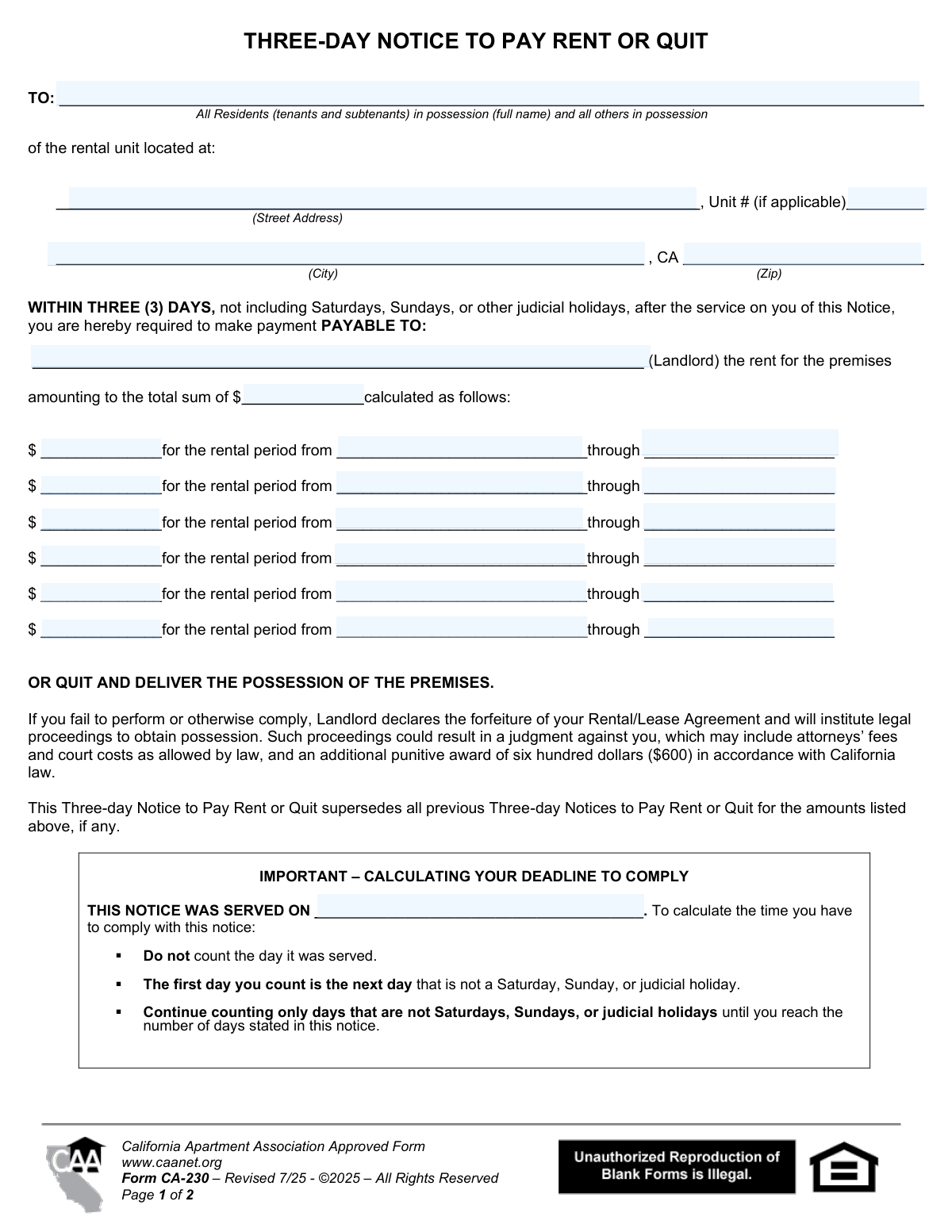
Form CA-230, the Three-Day Notice to Pay Rent or Quit, is a legal notice served by a landlord to a tenant in California who has failed to pay rent. This document is a mandatory prerequisite for a landlord to initiate eviction proceedings (an unlawful detainer lawsuit) for non-payment, formally demanding the tenant pay the specified overdue rent within three days or vacate the property. Today, this form can be filled out quickly and accurately using AI-powered services like Instafill.ai, which can also convert non-fillable PDF versions into interactive fillable forms.
Our AI automatically handles information lookup, data retrieval, formatting, and form filling.
It takes less than a minute to fill out CA-230 using our AI form filling.
Securely upload your data. Information is encrypted in transit and deleted immediately after the form is filled out.

Form specifications

Form name: Form CA-230, Three-Day Notice to Pay Rent or Quit
Number of fields: 65
Number of pages: 3
Filled form examples: Form CA-230 Examples
Language: English
main-image

Instafill Demo: How to fill out PDF forms in seconds with AI

How to Fill Out CA-230 Online for Free in 2026

Are you looking to fill out a CA-230 form online quickly and accurately? Instafill.ai offers the #1 AI-powered PDF filling software of 2026, allowing you to complete your CA-230 form in just 37 seconds or less.
Follow these steps to fill out your CA-230 form online using Instafill.ai:
  1. 1 Navigate to Instafill.ai and upload or select Form CA-230.
  2. 2 Enter the full names of all tenants and the complete address of the rental property.
  3. 3 Itemize the overdue rent by specifying the rental periods and the amount due for each, then enter the total sum.
  4. 4 Provide clear payment instructions, including the payee's name, delivery address, and acceptable payment hours and methods.
  5. 5 The landlord or their authorized agent must sign and date the notice before serving.
  6. 6 After serving the notice, complete the 'Proof of Service' section, detailing the date, time, and method of delivery.
  7. 7 Review all entered information for accuracy with the AI assistant, then download the completed form for your records and for serving.

Our AI-powered system ensures each field is filled out correctly, reducing errors and saving you time.

Why Choose Instafill.ai for Your Fillable CA-230 Form?

Speed

Complete your CA-230 in as little as 37 seconds.

Up-to-Date

Always use the latest 2026 CA-230 form version.

Cost-effective

No need to hire expensive lawyers.

Accuracy

Our AI performs 10 compliance checks to ensure your form is error-free.

Security

Your personal information is protected with bank-level encryption.

Frequently Asked Questions About Form CA-230

This is a legal document used by a landlord in California to demand that a tenant either pay their overdue rent or vacate the property within three business days.

The landlord or their authorized agent (like a property manager) must fill out and serve this form to a tenant who has failed to pay rent.

It means your landlord is formally requesting that you pay the total rent amount listed on the notice or move out within three business days. Failure to do either may lead to an eviction lawsuit.

Do not count the day you received the notice, and do not count Saturdays, Sundays, or judicial holidays. Your three-day period begins on the next business day after service.

The landlord can file a legal action (an unlawful detainer lawsuit) to evict you. This could result in a court judgment against you, which may include court costs and attorneys' fees.

This form is specifically for demanding 'rent.' Including other charges like late fees or utilities could invalidate the notice, so landlords should be cautious and typically only include the actual past-due rent amount.

The 'Proof of Service' is a mandatory section where the person who delivered the notice formally declares under penalty of perjury how and when it was served. This is critical evidence if the case goes to court.

The form outlines three legal methods of service: personally handing it to the tenant, leaving it with a suitable person at the property and mailing a copy, or posting it in a conspicuous place and mailing a copy.

Page 2 of the form has a detailed section where you must provide the name and address for payment delivery, the hours for in-person payment, and the acceptable payment methods (e.g., check, money order, cash).

You must list each rental period for which rent is due (e.g., 'from 03/01/2025 through 03/31/2025') and the specific dollar amount owed for that period.

Yes, services like Instafill.ai use AI to accurately auto-fill form fields from your saved data, which can save time and help prevent errors when preparing the notice.

You can use a service like Instafill.ai to fill out this form online. Simply upload the document, and the platform will make it an interactive, fillable form you can complete, sign, and download.

If you have a flat, non-fillable PDF, you can upload it to a platform like Instafill.ai. It can convert the static document into an interactive form that you can easily fill out on your computer.

The 'Declarant' is the individual, who must be at least 18 years old, that physically served the notice to the tenant. This could be the landlord, their agent, or another adult acting on their behalf.

Compliance CA-230
Validation Checks by Instafill.ai

1
Verifies Total Rent Calculation
Checks that the sum of all itemized rent period amounts equals the 'Total Amount Due'. This is crucial for the legal validity of the notice, as an incorrect amount can invalidate the entire eviction process. If the amounts do not match, the form submission should be rejected with an error prompting the user to correct the itemization or the total.
2
Ensures Rental Period Date Chronology
Validates that for each itemized rental period, the 'End Date' is on or after the 'Start Date'. This prevents logical errors and ensures the rental period described is a valid time frame. An invalid period could be legally challenged, so the system flags this to prevent nonsensical date ranges.
3
Validates Service Date is Not in the Future
Confirms that the 'Notice Served Date' is not a future date. A notice cannot be legally served on a date that has not yet occurred. This check prevents post-dating and ensures the integrity of the legal timeline established by the notice.
4
Requires At Least One Payment Method
Ensures that at least one checkbox under 'Acceptable methods of payment' is selected. The law requires the landlord to specify how the tenant can pay the overdue rent. Failing to provide a valid payment method can render the notice defective.
5
Validates In-Person Payment Hours Logic
Checks that if a 'Start Time' for in-person payments is entered, an 'End Time' is also entered, and the 'End Time' is later than the 'Start Time'. This ensures the provided payment window is logical and clear to the tenant. It also requires at least one day of the week to be selected if times are provided.
6
Cross-references Service Dates
Verifies that the 'Notice Served Date' on page 1 is identical to the service date (day, month, year) entered in the 'Proof of Service' section on page 2. Consistency between these dates is critical for establishing a clear and legally defensible timeline of events. A mismatch could be used to challenge the validity of the service.
7
Enforces Exclusive Service Method Selection
Confirms that exactly one of the three service method checkboxes ('BY DELIVERING', 'BY LEAVING', 'BY POSTING') is selected in the 'Proof of Service' section. The method of service is a key legal element, and selecting multiple or none creates ambiguity and invalidates the proof. The system should enforce a single choice.
8
Validates Total Amount Due Format
Checks that the 'Total Amount Due' is a valid, positive number greater than zero. A notice to pay rent must demand a specific, non-zero amount. This validation prevents entries like zero, negative numbers, or non-numeric text, which would make the notice legally meaningless.
9
Ensures Completeness of Tenant and Property Address
Verifies that the 'Tenant Name(s)', 'Street Address', 'City', and 'ZIP Code' fields are all filled. A legally valid notice must clearly identify the tenant(s) being served and the specific property in question. Missing any of this information makes the notice unenforceable.
10
Validates Signature Date vs. Service Date
Confirms that the 'Date Signed' by the landlord or agent is on or before the 'Notice Served Date'. A notice cannot be served before it has been formally signed and dated. This chronological check ensures the document's internal logic is sound and follows proper legal procedure.
11
Requires Payment Delivery Information
Ensures that the 'Payment Recipient Name' and 'Payment Delivery Address' fields are not empty. The notice must clearly state where and to whom the tenant must deliver the rent payment. Omitting this information makes it impossible for the tenant to comply and invalidates the notice.
12
Validates Proof of Service Execution Date
Checks that the 'Executed this... day of...' date in the Proof of Service section is on or after the date the notice was served. The declaration of service (Proof of Service) can only be signed on the day of service or after, not before. This maintains the chronological integrity of the legal declaration.
13
Validates ZIP Code Format
Ensures the 'ZIP Code' field for the rental unit address contains a valid 5-digit number. This improves data quality and ensures mailability for any related correspondence. An invalid format would be rejected.
14
Conditional Field for Personal Service
Verifies that if the 'BY DELIVERING a copy of the Notice... PERSONALLY' checkbox is selected, the 'Personal Delivery Recipient Name(s)' field is filled out. This is required to properly document who received the notice in a personal service scenario. If the box is checked and the name is missing, the proof of service is incomplete.

Common Mistakes in Completing CA-230

Including Non-Rent Charges in the Amount Due

Landlords often mistakenly include late fees, utility bills, or other non-rent charges in the total amount demanded. California law for a Three-Day Notice to Pay Rent or Quit is extremely strict and only allows the demand for actual, past-due rent. Including any other fees will invalidate the notice, forcing the landlord to restart the entire process and potentially lose in court.

Incorrect Total Rent Calculation

This mistake involves a mathematical error where the sum of the itemized rental periods does not match the 'total sum' listed. This can happen from a simple typo or miscalculation. If the amount demanded is even slightly overstated, a court will rule the notice is defective, leading to the dismissal of any subsequent eviction lawsuit.

Incomplete Tenant Identification

The form requires the full names of 'All Residents (tenants and subtenants)'. A common error is to list only one tenant or use incomplete names, failing to include all adult occupants named on the lease. This can create a legal loophole, as an unlisted tenant can claim they were not properly served, complicating and delaying the eviction process.

Omitting Payment Location and Hours

The law requires the notice to specify a physical address where the tenant can personally deliver the rent, along with the specific days and hours payment is accepted. Landlords sometimes forget to fill out this section on page 2 completely, leaving out the times or days. An incomplete or missing payment location and schedule makes the notice legally deficient, as the tenant is not given a clear opportunity to cure the default.

Falsifying the Proof of Service Method

The 'Proof of Service' section is a sworn declaration made under penalty of perjury. A frequent and serious error is checking the wrong box, such as claiming 'Personal Delivery' when the notice was actually posted on the door. This invalidates the service, is grounds for immediate dismissal of an eviction case, and exposes the server to legal penalties for perjury.

Incorrect Date of Service

The date the notice is served is critical as it starts the three-day clock for the tenant to comply. Entering the wrong date, either on the main notice or in the Proof of Service section, can lead to filing an eviction lawsuit prematurely. If a landlord files before the legal notice period has expired, the case will be thrown out, wasting time and money.

Ambiguous or Incorrect Rental Periods

Each line item for rent due must correspond to a specific and accurate rental period (e.g., 'from March 1 through March 31'). Mistakes include using vague descriptions like 'March rent' or entering incorrect start and end dates. This ambiguity can be used by the tenant as a defense, arguing the notice is unclear about what is owed, potentially rendering it invalid.

Incomplete Substitute or Posted Service

When not serving the tenant personally, the law requires a two-step process: 'substitute service' (leaving with an adult) and 'posting' both require a copy to also be mailed. A critical error is performing the first step (leaving or posting) but forgetting to mail a copy on the same day. The form explicitly states 'AND MAILING', and failing to complete this second step makes the service invalid.

Using an Incorrect Landlord or Payee Name

The notice must state who the rent is 'PAYABLE TO'. Landlords may incorrectly list their personal name when the property is owned by an LLC or trust, or vice-versa. The name should be consistent with the legal owner listed on the lease agreement to avoid confusion and potential legal challenges from the tenant about who to pay.

Failure to Specify Accepted Payment Methods

Page 2 provides checkboxes for acceptable payment methods like 'Personal Check', 'Money Order', or 'Cash'. Failing to check any of these boxes leaves the tenant without clear instructions on how to tender payment. This omission can be a defense for the tenant, who could argue they were unable to comply because the required payment format was not specified.
Saved over 80 hours a year

“I was never sure if my IRS forms like W-9 were filled correctly. Now, I can complete the forms accurately without any external help.”

Kevin Martin Green

Your data stays secure with advanced protection from Instafill and our subprocessors

Robust compliance program

Transparent business model

You’re not the product. You always know where your data is and what it is processed for.

ISO 27001, HIPAA, and GDPR

Our subprocesses adhere to multiple compliance standards, including but not limited to ISO 27001, HIPAA, and GDPR.

Security & privacy by design

We consider security and privacy from the initial design phase of any new service or functionality. It’s not an afterthought, it’s built-in, including support for two-factor authentication (2FA) to further protect your account.

Fill out CA-230 with Instafill.ai

Worried about filling PDFs wrong? Instafill securely fills form-ca-230-three-day-notice-to-pay-rent-or-quit forms, ensuring each field is accurate.