
Instafill.ai
7 days free
AI form filling · 70 fields · 2 pages · done in seconds

Yes! You can use AI to fill out Regulation Best Interest Questionnaire

Don't type 70 fields by hand. Tell our AI about yourself, or upload a document you already have, and it fills every field in seconds. You check it, then download, print or sign.
7 days free, then $19.99/month · Cancel anytime
AI fills it, no typingEncrypted, never used to train AICancel in two clicks
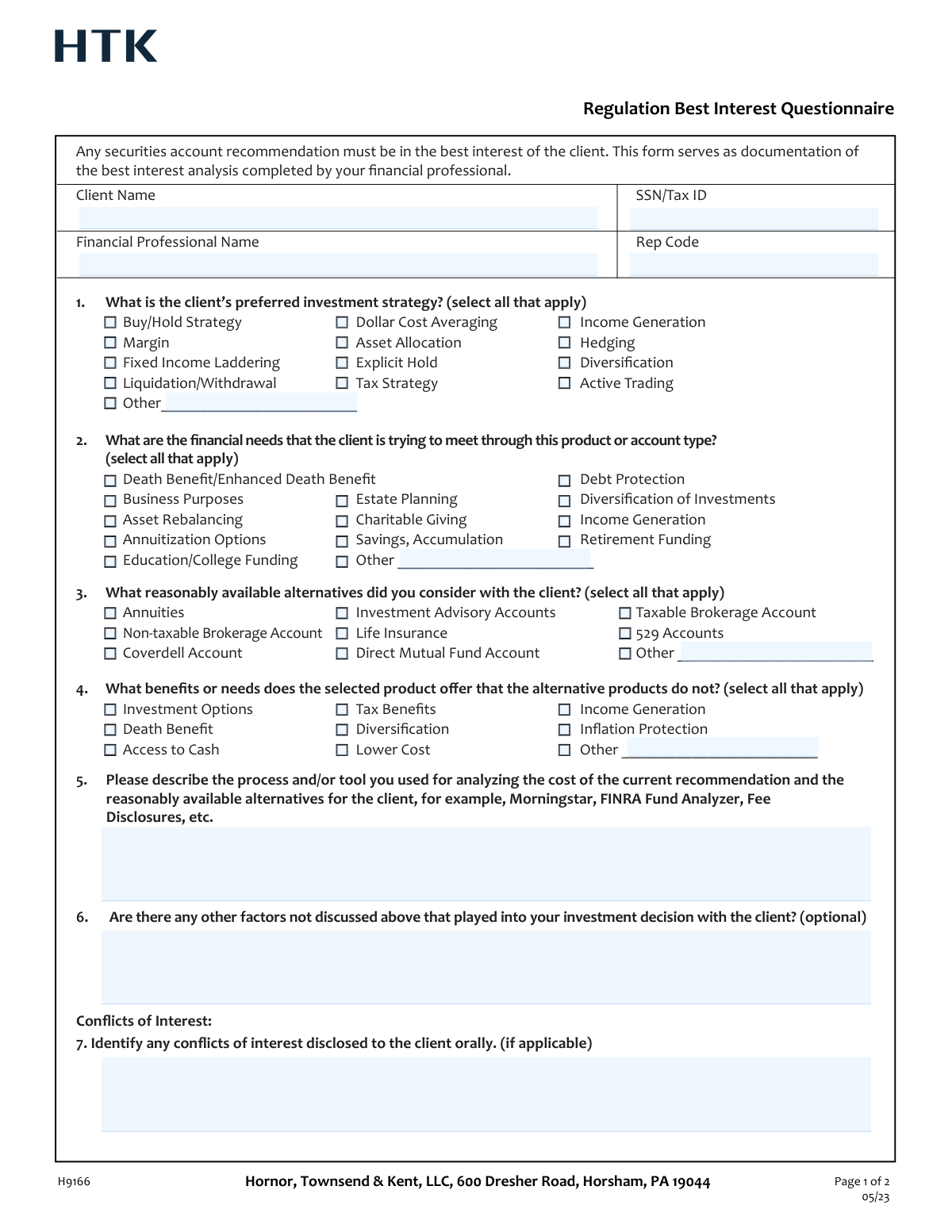
Regulation Best Interest Questionnaire, page 1
Moderate · 55/100Form Complexity Index

The AI does the filling. You just check it.

No typing into boxes, nothing to install.

Tell the AI about youAnswer a few questions in plain words, or upload a document you already have. That is all the typing there is.
AI fills every field in secondsIt puts each answer in the right box on every page, tables and checkboxes included.
Check it and downloadReview every field, change anything, then download, print or sign the PDF.

What this form asks for

The AI fills all of it, from your answers or your documents.

The Regulation Best Interest Questionnaire (H9166) is a document used by financial professionals to record the analysis performed to ensure their investment recommendations align with a client's best interests. It captures the client's investment strategy, financial needs, alternatives considered, and the rationale for the chosen product. This documentation is crucial for regulatory compliance and client protection, and today this form can be filled out quickly and accurately using AI-powered services like Instafill.ai, which can also convert non-fillable PDF versions into interactive fillable forms.
Fillable fields70
Pages2
Sections17
Tables and lists2
Questions that depend on earlier answers11
Form Complexity IndexModerate, 55/100

The AI checks your answers before you download

13 checks built for this form, so a wrong date or a missing answer is caught before anyone else sees it.

Validates SSN/Tax ID Format

This check ensures the Social Security Number or Tax ID is entered in the standard XXX-XX-XXXX or XX-XXXXXXX format. Correct formatting is critical for accurate client identification and integration with other systems. A failure in this validation would prevent form submission until the number is corrected, avoiding data corruption and compliance issues.

Ensures All Required Fields are Populated

This validation verifies that all mandatory fields, such as Client Name, SSN/Tax ID, Financial Professional Name, Rep Code, and key question responses, are filled out before submission. Incomplete forms can lead to regulatory deficiencies and an inability to prove that a best interest analysis was performed. The system should highlight all missing required fields to the user for completion.

Conditional Requirement for 'Other' Text Fields

For questions 1, 2, 3, and 4, this check confirms that if the 'Other' checkbox is selected, the corresponding text field providing details is not empty. This is important for capturing the full context of the recommendation and ensuring that non-standard strategies or needs are properly documented. If the text field is empty while 'Other' is checked, the form will be flagged for correction.

Minimum Selection for Checkbox Groups

This validation ensures that at least one checkbox is selected for each of the mandatory multiple-choice questions (1, 2, 3, and 4). Documenting the client's strategy, needs, alternatives, and product benefits is a foundational part of the best interest analysis. Failure to select an option in any of these sections would mean the form is incomplete.

Uniform Date Format (MM/DD/YYYY)

This check validates that all date fields on the form adhere strictly to the MM/DD/YYYY format. Standardizing the date format is essential for accurate record-keeping, data parsing, and establishing a clear timeline of events. Any date entered in a different format will be rejected, prompting the user to correct the entry.

Logical Date Sequence for CRS Delivery and Signatures

This validation confirms that the 'Client Signature Date' and 'Financial Professional Signature Date' are on or after the 'Form CRS Delivery Date'. This is a critical compliance check to prove the client received the required disclosure before or at the time of the transaction. A signature date preceding the CRS delivery date would indicate a process violation and must be corrected.

And 7 more checks
  • Mandatory Client Signature and Date
  • Mandatory Financial Professional Signature and Date
  • Validates Representative Code
  • Requires Description of Cost Analysis Method (Question 5)
  • Logical Consistency Between Client Needs and Product Benefits
  • Prohibits Future Dates in All Date Fields
  • Logical Consistency for Education Funding

Let AI fill out your H9166

No typing. Every field filled in seconds, checked, ready to sign.

7 days free, then $19.99/month · Cancel anytime

How to Fill Out H9166 Online for Free in 2026

What the AI walks you through.

  1. Navigate to Instafill.ai and upload or select the Regulation Best Interest Questionnaire (H9166).
  2. Provide the client's name, SSN/Tax ID, and the financial professional's details in the designated fields.
  3. Answer the multiple-choice questions by checking the boxes that correspond to the client's investment strategy, financial needs, and the alternatives that were considered.
  4. Describe the cost analysis process, any additional factors, and disclose any conflicts of interest in the provided text boxes.
  5. Enter the date the Form CRS was delivered to the client.
  6. Review all the information entered for accuracy and completeness.
  7. Have the client(s) and financial professional(s) sign and date the form to finalize the documentation.

Common Mistakes in Completing H9166

The ones the AI is built to catch.

Vague or Incomplete Cost Analysis Description
In Question 5, a common mistake is providing a generic answer like 'discussion' or 'fee comparison' instead of naming the specific tools used. The form explicitly prompts for examples like 'Morningstar, FINRA Fund Analyzer, Fee Disclosures' to document the analysis process. A vague response fails to provide adequate proof of analysis, which can lead to compliance rejection and require the form to be redone, delaying the client's investment.
Checking 'Other' Without Providing Details
A frequent error is checking the 'Other' box in Questions 1, 2, 3, or 4 but failing to write the required explanation in the corresponding text field. This makes the selection invalid and results in an incomplete form that will be returned for correction. To avoid this, always ensure that if 'Other' is selected, a clear and concise explanation is provided in the space provided to justify the selection.
Missing or Incorrectly Formatted Dates
The signature sections and the Form CRS delivery date are prone to errors, such as being left blank, using an incorrect format (e.g., YYYY-MM-DD), or entering illogical dates. These simple mistakes can cause significant processing delays and create compliance issues. AI-powered form filling tools like Instafill.ai can help prevent this by automatically validating and formatting dates into the required MM/DD/YYYY format and flagging any missing entries.
Contradictory Checkbox Selections
Financial professionals sometimes select conflicting options, such as choosing both 'Buy/Hold Strategy' and 'Active Trading' in Question 1. This creates a confusing and illogical client profile that can attract regulatory scrutiny and call the validity of the entire best interest analysis into question. It is crucial to review all selections to ensure they form a cohesive and logical narrative that accurately reflects the client's situation and the proposed recommendation.
Omitting the Form CRS Delivery Date
The 'Date Client Relationship Summary (Form CRS) Delivered' is a distinct and mandatory compliance field that is often overlooked because it is positioned just above the main signature lines. Forgetting to fill in this date constitutes a compliance failure, as it is crucial for documenting that the client received this key disclosure document. Before submission, always perform a final check to specifically locate this field and ensure the correct delivery date is entered.
Overlooking Required Signatures
This form requires signatures from the client(s) and the financial professional(s), but it is very common for one of these to be missed, especially the second client signature on a joint account. A missing signature is a critical error that invalidates the form and halts the entire process until it is corrected with a 'wet' signature. Always perform a final check specifically for all required signature and date fields before considering the form complete.
Incorrect or Mismatched Client Identifying Information
Data entry errors such as misspelling a client's name, entering a name that doesn't match their legal ID, or inputting an incorrect SSN/Tax ID are common. These mistakes, often due to typos or referencing outdated information, lead to failed identity verification, account opening delays, and future tax reporting problems. This information must be carefully verified against official documents. If the form is a non-fillable PDF, a tool like Instafill.ai can convert it to a fillable version, reducing the chance of manual errors.
Under-selecting Options, Leading to Weak Justification
In an effort to be concise, a professional might only check one or two boxes in sections like Question 2 (Financial Needs) or Question 4 (Product Benefits). This can create a weak or incomplete justification for the recommendation, making it difficult for a compliance reviewer to understand the full rationale. It is important to select all applicable options to paint a complete picture and build a strong, defensible record of the best interest analysis.
Misinterpreting the 'Conflicts of Interest' Question
Question 7 specifically asks to identify conflicts of interest that were 'disclosed to the client orally.' A common misunderstanding is to leave this blank even when verbal discussions occurred, or to list conflicts that were only disclosed in writing. This section is for documenting verbal communication as part of the regulation, so it is vital to accurately recall and document any conflicts that were discussed with the client, in addition to written disclosures.

Frequently Asked Questions About H9166


Is it really free for 7 days?
Yes. You pay $0 today. Cancel before Nov 10 and you are never charged. Keep it, and it is $19.99 a month for 5 fills of your H9166.
Can I fill other forms too?
This plan is for your H9166: your own AI agent fills it as often as 5 times a month. To fill other forms and upload your own, choose a Professional plan from your account.
How do I cancel?
From your account, in two clicks, any time. No email, no call.
How does the AI fill out H9166?
You answer a few questions in plain words, or upload a document you already have. The AI reads what you give it and puts each answer into the right field of H9166, on every page, in seconds. It checks the answers against the form's own rules, and you review and change anything before you download, print or sign.
What happens to my information?
It is encrypted in transit and at rest, and it is never used to train AI.
How complex is H9166 to fill out?
H9166 has a Form Complexity Index of 55 out of 100, in the moderate tier: 70 fillable fields across 2 pages. Instafill.ai's AI fills it in under a minute, with every field there for you to review before you download.
What is the purpose of the Regulation Best Interest Questionnaire?
This form is used by your financial professional to document the analysis performed to ensure an investment recommendation is in your best interest. It captures your financial needs, investment strategy, and the alternatives that were considered.
Who is responsible for filling out this form?
Your financial professional completes the questionnaire based on discussions with you. As the client, you are responsible for reviewing the information for accuracy and signing to confirm your agreement.
What information do I need to provide for this form?
You will need to provide your full name and SSN/Tax ID, and be prepared to discuss your investment preferences, financial goals, and needs with your financial professional. The professional will use this discussion to complete the rest of the form.
What does 'reasonably available alternatives' in Question 3 refer to?
This section documents other types of products or accounts, such as annuities, life insurance, or different brokerage accounts, that were considered and discussed with you before arriving at the final recommendation.
For Question 5, what kind of tools are used for cost analysis?
Financial professionals use various industry tools like Morningstar or the FINRA Fund Analyzer to compare the costs, fees, and performance of different investment options. This helps them determine the most suitable and cost-effective choice for your situation.
What is a 'conflict of interest' as mentioned in Question 7?
A conflict of interest is any situation where your financial professional's interests might differ from yours, such as receiving higher compensation for one product over another. This section documents that any such conflicts were disclosed to you.
The form mentions 'PTE 2020-02'. What does this mean?
This refers to a specific regulatory requirement that applies if you are rolling over or transferring funds from a qualified retirement account, like a 401(k). Your financial professional will handle the necessary additional documentation if this applies to your transaction.
What is the 'Form CRS' and why is its delivery date on this form?
The Client Relationship Summary (Form CRS) is a disclosure document that explains the firm's services, fees, and conflicts of interest. The date is recorded here to confirm that you received this important information before the investment recommendation was made.
Why are there multiple signature lines for the Financial Professional?
The form includes several signature lines to accommodate situations where a team of financial professionals may be involved in managing your account or providing the recommendation. In most cases, only one or two signatures will be necessary.
What happens after I sign this form?
Once signed, this form becomes an official record of the best interest analysis for your account. It is kept on file by the financial firm to demonstrate regulatory compliance.
Can AI tools help fill out this form?
Yes, services like Instafill.ai use AI to help financial professionals accurately auto-fill form fields with client data, saving time and reducing manual errors. This ensures the documentation process is both efficient and precise.
How can I fill out this form online using Instafill.ai?
Your financial professional can upload the Regulation Best Interest Questionnaire to Instafill.ai, which makes the form interactive. They can then quickly fill in the required information, and the platform can even pre-populate known data like your name and their representative code.
What should I do if the PDF version of this form I received is not fillable?
If you have a non-fillable or 'flat' PDF, you can use a service like Instafill.ai to instantly convert it into an interactive, fillable form. Simply upload the document, and the AI will detect the fields so you or your professional can complete it online.
Encrypted in transit and at restNever used to train AIDelete your forms any time

Get your H9166 filled out by AI

$0 today. Cancel before Nov 10 and you pay nothing.

7 days free, then $19.99/month · Cancel anytime