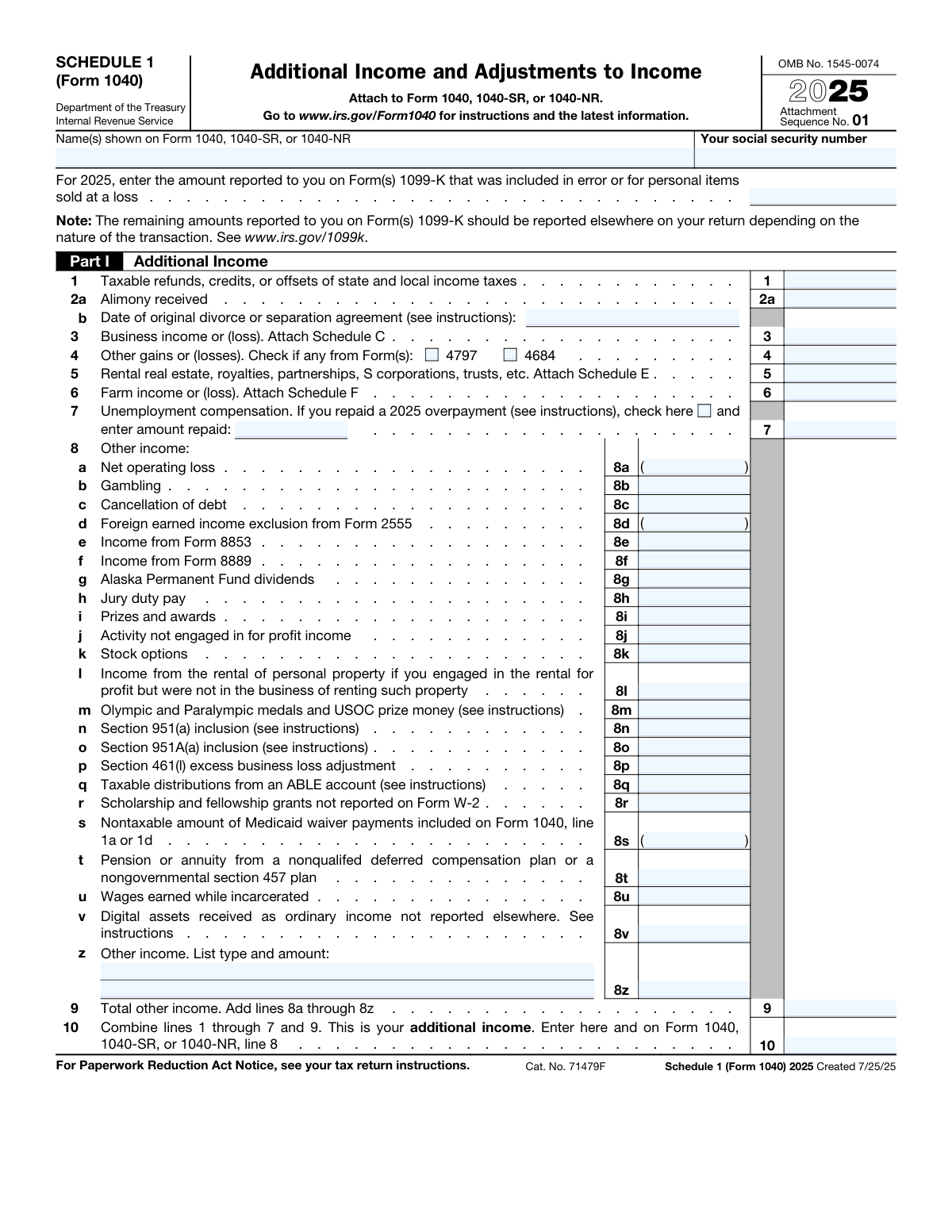
Yes! You can use AI to fill out Schedule 1 (Form 1040), Additional Income and Adjustments to Income
IRS Schedule 1 is a supplemental tax form attached to Form 1040, 1040-SR, or 1040-NR to report certain types of income and deductions. Part I is for reporting additional income like business profits, unemployment compensation, or alimony received, while Part II is for claiming adjustments to income, such as educator expenses, student loan interest, or IRA deductions. Today, this form can be filled out quickly and accurately using AI-powered services like Instafill.ai, which can also convert non-fillable PDF versions into interactive fillable forms.
Our AI automatically handles information lookup, data retrieval, formatting, and form filling.
It takes less than a minute to fill out Schedule 1 (Form 1040) using our AI form filling.
Securely upload your data. Information is encrypted in transit and deleted immediately after the form is filled out.
Form specifications
| Form name: | Schedule 1 (Form 1040), Additional Income and Adjustments to Income |
| Number of fields: | 73 |
| Number of pages: | 2 |
| Language: | English |
| Categories: | income forms |
Instafill Demo: How to fill out PDF forms in seconds with AI
How to Fill Out Schedule 1 (Form 1040) Online for Free in 2026
Are you looking to fill out a SCHEDULE 1 (FORM 1040) form online quickly and accurately? Instafill.ai offers the #1 AI-powered PDF filling software of 2026, allowing you to complete your SCHEDULE 1 (FORM 1040) form in just 37 seconds or less.
Follow these steps to fill out your SCHEDULE 1 (FORM 1040) form online using Instafill.ai:
- 1 Navigate to Instafill.ai and upload your Schedule 1 (Form 1040) or select it from the template library.
- 2 Enter your name and Social Security Number exactly as they appear on your main Form 1040, 1040-SR, or 1040-NR.
- 3 Complete Part I by providing information for any additional income sources you have, such as business income (Schedule C), unemployment compensation, or gambling winnings.
- 4 Fill out Part II by entering all applicable adjustments to your income, like educator expenses, student loan interest deduction, or contributions to a health savings account (HSA).
- 5 Let the AI tool automatically calculate the total additional income on Line 10 and the total adjustments to income on Line 26.
- 6 Carefully review all the auto-filled and manually entered information for accuracy.
- 7 Download, print, or e-file the completed Schedule 1, ensuring it is attached to your primary tax return (Form 1040, 1040-SR, or 1040-NR).
Our AI-powered system ensures each field is filled out correctly, reducing errors and saving you time.
Why Choose Instafill.ai for Your Fillable Schedule 1 (Form 1040) Form?
Speed
Complete your Schedule 1 (Form 1040) in as little as 37 seconds.
Up-to-Date
Always use the latest 2026 Schedule 1 (Form 1040) form version.
Cost-effective
No need to hire expensive lawyers.
Accuracy
Our AI performs 10 compliance checks to ensure your form is error-free.
Security
Your personal information is protected with bank-level encryption.
Frequently Asked Questions About Form Schedule 1 (Form 1040)
Schedule 1 is used to report certain types of additional income, like business income or unemployment compensation, and to claim specific deductions known as 'adjustments to income,' such as student loan interest or educator expenses.
You must file Schedule 1 if you have any of the income types listed in Part I or are eligible for any of the deductions (adjustments) listed in Part II. If all your income and deductions are reported directly on Form 1040, you do not need to attach Schedule 1.
Part I is for reporting 'Additional Income' that doesn't appear on the main Form 1040, such as farm income or alimony received. Part II is for claiming 'Adjustments to Income,' which are deductions that lower your adjusted gross income (AGI).
You should report the total amount of unemployment compensation you received on Line 7 of Part I. If you repaid an overpayment in 2025, you can also note the amount repaid on this line.
Yes, eligible educators can deduct unreimbursed expenses for classroom supplies and professional development. This deduction is claimed on Line 11, 'Educator expenses,' in Part II.
You should report your net income or loss from freelance work on Line 3, 'Business income or (loss).' You are also required to complete and attach Schedule C to your tax return to detail your business's profit and loss.
Yes, you can deduct the amount of student loan interest you paid during the year, subject to income limitations. This deduction is claimed on Line 21, 'Student loan interest deduction,' in Part II.
You may need various documents, such as Form 1099-G for unemployment, Form 1098-E for student loan interest, Form 1099-K for payment card transactions, and your own records for business or rental income.
Schedule 1 is not a standalone form; it must be attached to your main tax return (Form 1040, 1040-SR, or 1040-NR). The totals from Schedule 1 are carried over to the appropriate lines on your main tax form.
The form provides a specific line at the very top to report amounts from Form 1099-K that were for personal items sold at a loss or were included in error. This ensures you are not taxed on these non-taxable transactions.
If you received digital assets as ordinary income (for example, as payment for services) and it's not reported elsewhere, you should enter the amount on Line 8v, 'Digital assets received as ordinary income'.
Yes, services like Instafill.ai use AI to accurately auto-fill form fields, which can save you time and help prevent errors. This is particularly useful for transferring data from multiple source documents like 1099s.
Simply upload the Schedule 1 PDF to the Instafill.ai platform. The AI will make the form fillable, and you can either type directly into the fields or upload your financial documents to have the information automatically extracted and placed into the correct lines.
If you have a non-fillable or 'flat' PDF, you can use a tool like Instafill.ai. It can convert the static PDF into an interactive, fillable form that you can easily complete and sign online.
Compliance Schedule 1 (Form 1040)
Validation Checks by Instafill.ai
1
SSN Format and Presence
This check verifies that the 'Your social security number' field contains a value formatted as a valid nine-digit Social Security Number (XXX-XX-XXXX or XXXXXXXXX). It is crucial for correctly identifying the taxpayer and linking the schedule to the main tax return. A failure would prevent the form from being processed, as the IRS cannot associate the income and adjustments with the correct taxpayer account.
2
Cross-Form Name Consistency
Validates that the 'Name(s) shown on Form 1040' field on Schedule 1 exactly matches the primary taxpayer name(s) entered on the associated Form 1040, 1040-SR, or 1040-NR. This consistency is essential for the IRS automated systems to correctly link all parts of a tax return together. A mismatch could lead to processing delays, rejection of the e-filing, or manual review correspondence from the IRS.
3
Alimony Received Date Requirement
This validation ensures that if an amount is entered for 'Alimony received' on line 2a, then a valid date must be entered in the 'Date of original divorce or separation agreement' field on line 2b. The date is required by the IRS to determine the taxability of the alimony based on when the agreement was executed. If the date is missing when alimony is reported, the form is incomplete and may be rejected or flagged for review.
4
Other Gains or Losses Form Reference
Checks that if a monetary value is entered on Line 4 for 'Other gains or (losses)', at least one of the corresponding checkboxes for Form 4797 or Form 4684 is checked. This provides necessary context for the source of the gain or loss, which is required for proper tax assessment. Failure to check a box when an amount is present would result in an incomplete entry, potentially triggering an IRS inquiry.
5
Unemployment Repayment Conditional Entry
This rule verifies that if the checkbox on Line 7 indicating repayment of a 2025 unemployment overpayment is checked, then the 'amount repaid' field must contain a numeric value greater than zero. This ensures that the filer provides the specific amount being claimed as a repayment. If the box is checked but the amount is missing, the form is considered incomplete and the intended tax benefit cannot be calculated.
6
Total Other Income Calculation (Line 9)
Performs an arithmetic check to confirm that the value on Line 9, 'Total other income', is the correct sum of all amounts entered on lines 8a through 8z. This is a critical calculation that ensures the sub-total for various income types is accurate before being carried forward. An incorrect sum will cause all subsequent totals on the return to be wrong, leading to an incorrect tax liability and likely requiring an amended return.
7
Total Additional Income Calculation (Line 10)
This validation confirms that the amount on Line 10 is the correct sum of lines 1, 2a, 3, 4, 5, 6, 7, and 9. This is the final total for the 'Additional Income' section and is a key figure that transfers to the main Form 1040. A miscalculation here directly impacts the taxpayer's Adjusted Gross Income (AGI) and overall tax liability, making its accuracy paramount.
8
Alimony Paid Completeness Check
Ensures that if an amount is entered for 'Alimony paid' on line 19a, then both the 'Recipient’s SSN' (19b) and 'Date of original divorce or separation agreement' (19c) fields are also filled. The IRS requires all three pieces of information to verify the deduction and process the corresponding income on the recipient's return. Missing information will result in the disallowance of the deduction until the required details are provided.
9
Alimony Recipient SSN Format
This check validates that the entry in line 19b, 'Recipient’s SSN', is a valid nine-digit Social Security Number and does not match the primary or secondary taxpayer's SSN on the return. This is required for the IRS to cross-reference the alimony payment with the recipient's tax return. An invalid or missing SSN will cause the alimony paid deduction to be rejected.
10
Student Loan Interest Deduction Limit
Verifies that the amount entered on Line 21, 'Student loan interest deduction', does not exceed the statutory limit (e.g., $2,500 per return, per year). Claiming an amount over the legal maximum is not permitted and would be automatically corrected by the IRS. This validation prevents an immediate error that would lead to an adjustment of the tax due and a notice from the IRS.
11
Jury Duty Pay Adjustment Consistency
This logical check ensures that the adjustment for jury duty pay given back to an employer, claimed on Line 24a, is not greater than the total jury duty pay reported as income on Line 8h. A taxpayer cannot claim an adjustment for more income than they received. An inconsistent entry would be flagged as an error, as it is a logical impossibility and would require correction.
12
Paired 'Other Income' Field Validation (Line 8z)
This rule ensures that if a monetary value is entered in the 'Other income amount' field for line 8z, the corresponding 'Other income description' field must not be empty, and vice versa. The IRS requires both a description and an amount to understand the source of the income. A failure to provide both parts of the entry will result in an incomplete return and may trigger a request for more information.
13
Total Adjustments to Income Calculation (Line 26)
Performs a crucial arithmetic validation to ensure the amount on Line 26 is the correct sum of lines 11 through 23 and line 25. This total represents all 'Adjustments to Income' and is transferred to Form 1040 to calculate the Adjusted Gross Income (AGI). An error in this calculation would lead to an incorrect AGI and an inaccurate tax assessment, requiring correction and potentially penalties.
14
Attached Form Requirement for Business Income
This validation checks that if an amount is entered on Line 3 for 'Business income or (loss)', the system flags that a corresponding Schedule C must be attached or included in the e-filing. Schedule C provides the detailed breakdown of business income and expenses, and it is mandatory for substantiating the amount on Line 3. Filing without the required schedule will result in an incomplete return and rejection by the IRS.
Common Mistakes in Completing Schedule 1 (Form 1040)
A frequent error is when the name(s) and Social Security Number (SSN) at the top of Schedule 1 do not exactly match what is on the main Form 1040. This can happen due to typos, using a nickname instead of a legal name, or name changes that haven't been updated with the Social Security Administration. This mismatch can cause the IRS e-filing system to reject the return or lead to significant processing delays and manual review. To avoid this, meticulously copy the information exactly as it appears on your Form 1040. AI-powered tools like Instafill.ai can prevent this by auto-populating identifying information consistently across all related tax forms.
Several lines on Schedule 1, such as Line 3 (Business Income), Line 5 (Rental Real Estate), and Line 6 (Farm Income), require an entire separate schedule (Schedule C, E, or F, respectively) to be attached. Taxpayers often enter the final profit or loss number on Schedule 1 but forget to include the detailed supporting schedule. Without the required attachment, the IRS cannot verify the figure, which will result in processing delays, correspondence from the IRS, and potential disallowance of claimed losses. Always double-check the line instructions, which explicitly state 'Attach Schedule...'
On Line 8b, taxpayers are required to report their total gross gambling winnings for the year. A very common mistake is to report net winnings, which is the amount won minus the amount lost. This is incorrect and constitutes underreporting of income. Gambling losses are deductible only if you itemize deductions on Schedule A, and the deduction is limited to the amount of your winnings. This error can trigger an IRS notice or audit, leading to back taxes, interest, and penalties. Always report the full amount of winnings from all sources on Line 8b.
Jury duty pay has a unique two-step reporting process that is often handled incorrectly. The income must be reported on Line 8h, but if you gave that pay to your employer (who continued your salary), you can deduct it on Line 24a. People commonly make one of two mistakes: they report the income on Line 8h but forget to take the corresponding deduction on Line 24a, or they omit the income entirely. Forgetting the deduction on Line 24a results in overpaying your taxes. To avoid this, ensure you enter the amount on both lines if you turned the pay over to your employer.
The rules for alimony are complex and depend on the date of the divorce agreement. For alimony paid under pre-2019 agreements (Line 19a), the most critical error is failing to enter the recipient's Social Security Number (SSN) on Line 19b. The IRS requires the recipient's SSN to match the income they report, and omitting it will lead to an automatic disallowance of your deduction. This results in a higher tax bill and requires you to amend your return after obtaining the information. Always ensure you have the recipient's correct SSN before filing.
While student loan interest is deductible on Line 21, there are limits that are often overlooked. The deduction is capped at $2,500 per year and is subject to income phase-outs, meaning the amount you can deduct is reduced or eliminated if your Modified Adjusted Gross Income (MAGI) is too high. People mistakenly claim the full amount of interest they paid, exceeding the cap, or claim the deduction when they are not eligible due to high income. This leads to an incorrect tax calculation that the IRS will later correct, resulting in a balance due with interest. Use the IRS worksheet to confirm your eligibility and calculate the correct amount.
When filling out a form by hand, simple math errors are common when summing up the columns for Line 10 (Total Additional Income) and Line 26 (Total Adjustments to Income). Another frequent mistake is transposing numbers when carrying them over from other forms or schedules (e.g., writing $670 instead of $760). These errors, while unintentional, will cause the IRS's automated systems to issue a math error notice (CP2000), delaying your refund or creating an unexpected tax bill. Using tax software or an AI-powered tool like Instafill.ai, which can make non-fillable PDFs fillable and perform automatic calculations, eliminates these manual errors.
Lines 8z and 24z are catch-all lines for miscellaneous income and adjustments, but they require both a description and an amount. A common oversight is to enter a dollar figure but leave the description field blank. The IRS needs to know the source of the income or the reason for the adjustment to ensure it's being treated correctly. Leaving this blank can halt the processing of your return and trigger a letter from the IRS asking for clarification. Always provide a clear, concise description, such as 'Hobby income' or 'Reforestation expenses'.
Line 8v, for reporting ordinary income from digital assets, is a source of significant confusion. Taxpayers often fail to realize that receiving digital assets from activities like airdrops, staking rewards, or as payment for services constitutes taxable ordinary income that must be reported here. They may omit it entirely or incorrectly believe it's only a capital gain to be reported when sold. This failure to report can lead to substantial underpayment of tax, interest, and penalties. To avoid this, keep detailed records and report the fair market value of any digital assets received as income on Line 8v.
To claim a Health Savings Account (HSA) deduction on Line 13, you must first complete and attach Form 8889. A common mistake is to simply write the total annual HSA contribution on Line 13 without the required supporting form. The deduction amount must be calculated on Form 8889, which accounts for contribution limits and other factors. Without the attached Form 8889, the IRS will disallow the deduction, increasing your tax liability and delaying your return. Always complete Form 8889 first and attach it to your tax filing.
Saved over 80 hours a year
“I was never sure if my IRS forms like W-9 were filled correctly. Now, I can complete the forms accurately without any external help.”
Kevin Martin Green
Your data stays secure with advanced protection from Instafill and our subprocessors

Robust compliance program
Transparent business model
You’re not the product. You always know where your data is and what it is processed for.
ISO 27001, HIPAA, and GDPR
Our subprocesses adhere to multiple compliance standards, including but not limited to ISO 27001, HIPAA, and GDPR.
Security & privacy by design
We consider security and privacy from the initial design phase of any new service or functionality. It’s not an afterthought, it’s built-in, including support for two-factor authentication (2FA) to further protect your account.
Fill out Schedule 1 (Form 1040) with Instafill.ai
Worried about filling PDFs wrong? Instafill securely fills schedule-1-form-1040-additional-income-and-adjustments-to-income forms, ensuring each field is accurate.