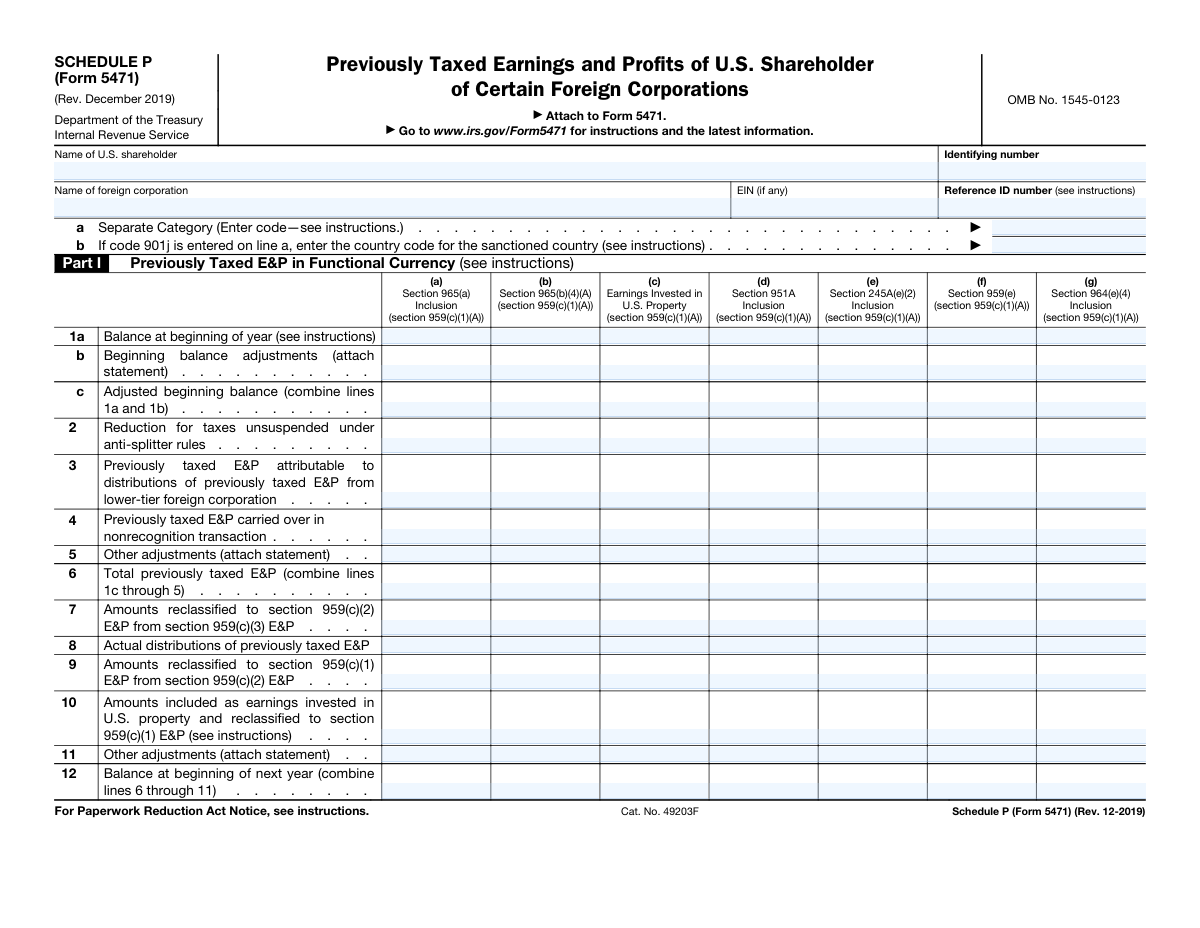
Yes! You can use AI to fill out Schedule P (Form 5471), Previously Taxed Earnings and Profits of U.S. Shareholder of Certain Foreign Corporations
Schedule P (Form 5471) is an Internal Revenue Service (IRS) form attached to Form 5471, Information Return of U.S. Persons With Respect to Certain Foreign Corporations. It is used to maintain a running total of a foreign corporation's previously taxed earnings and profits (PTEP) on a shareholder-by-shareholder basis, which is crucial for preventing double taxation on distributed income. Today, this detailed form can be filled out quickly and accurately using AI-powered services like Instafill.ai, which can also convert non-fillable PDF versions into interactive fillable forms.
Schedule P (Form 5471) is part of the
tax forms category on Instafill.
Our AI automatically handles information lookup, data retrieval, formatting, and form filling.
It takes less than a minute to fill out Schedule P (Form 5471) using our AI form filling.
Securely upload your data. Information is encrypted in transit and deleted immediately after the form is filled out.
Form specifications
| Form name: | Schedule P (Form 5471), Previously Taxed Earnings and Profits of U.S. Shareholder of Certain Foreign Corporations |
| Number of fields: | 483 |
| Number of pages: | 4 |
| Language: | English |
More forms in Tax forms
Instafill Demo: How to fill out PDF forms in seconds with AI
How to Fill Out Schedule P (Form 5471) Online for Free in 2026
Are you looking to fill out a SCHEDULE P (FORM 5471) form online quickly and accurately? Instafill.ai offers the #1 AI-powered PDF filling software of 2026, allowing you to complete your SCHEDULE P (FORM 5471) form in just 37 seconds or less.
Follow these steps to fill out your SCHEDULE P (FORM 5471) form online using Instafill.ai:
- 1 Navigate to an AI-powered form-filling service like Instafill.ai and upload or select Schedule P (Form 5471).
- 2 Enter the identifying information for the U.S. shareholder and the foreign corporation at the top of the form.
- 3 Complete Part I by providing the beginning balances, adjustments, distributions, and reclassifications of previously taxed E&P in the foreign corporation's functional currency.
- 4 Complete Part II by providing the same E&P tracking information as Part I, but translated into U.S. dollars.
- 5 Use the AI tool to accurately input data across the numerous columns, which correspond to different sections of the tax code (e.g., Section 965, Section 951A).
- 6 Review the auto-calculated totals and year-end balances for accuracy and ensure any required statements for adjustments are prepared.
- 7 Securely download the completed Schedule P and attach it to your main Form 5471 for filing with the IRS.
Our AI-powered system ensures each field is filled out correctly, reducing errors and saving you time.
Why Choose Instafill.ai for Your Fillable Schedule P (Form 5471) Form?
Speed
Complete your Schedule P (Form 5471) in as little as 37 seconds.
Up-to-Date
Always use the latest 2026 Schedule P (Form 5471) form version.
Cost-effective
No need to hire expensive lawyers.
Accuracy
Our AI performs 10 compliance checks to ensure your form is error-free.
Security
Your personal information is protected with bank-level encryption.
Frequently Asked Questions About Form Schedule P (Form 5471)
Schedule P is used by U.S. shareholders of certain foreign corporations to track earnings and profits (E&P) that have already been taxed by the U.S. but not yet distributed. This tracking of previously taxed E&P (PTEP) is crucial to prevent double taxation when the earnings are eventually paid out. This schedule must be attached to Form 5471.
Any U.S. shareholder required to file Form 5471 who has previously taxed earnings and profits (PTEP) in a foreign corporation must file Schedule P. This typically applies if you have had income inclusions from the foreign corporation in the current or prior tax years.
Part I requires you to report the previously taxed E&P balances and activities in the foreign corporation's functional currency. Part II requires you to report the exact same information translated into U.S. dollars, ensuring consistency in reporting.
You will need the full name and identifying number (like an SSN or EIN) for the U.S. shareholder. You also need the name of the foreign corporation, its EIN (if it has one), and a Reference ID number if it doesn't.
These columns categorize the previously taxed E&P based on the specific U.S. Internal Revenue Code section under which the income was originally taxed (e.g., Section 965, Section 951A). It is critical to track these amounts separately as different rules may apply to each category.
Schedule P is not a standalone form; it must be attached to your main Form 5471, Information Return of U.S. Persons With Respect to Certain Foreign Corporations. The entire package is then filed with your annual income tax return.
For any line that specifies 'attach statement,' you must prepare a separate document detailing the amounts and reasons for the adjustment. Clearly label the statement with the corresponding form, schedule, and line number and file it with your tax return.
Yes, AI-powered services like Instafill.ai can help by accurately auto-filling form fields from your records, which saves time and reduces the risk of manual errors. This is especially helpful for a complex and detailed form like Schedule P.
You can use a service like Instafill.ai to upload your PDF and make it fillable online. This allows you to easily type your information into the fields, save your progress, and download a completed, professional-looking form.
If you have a non-fillable or 'flat' PDF, platforms like Instafill.ai can convert it into an interactive, fillable form. This allows you to type your information directly into the fields, which is much easier and cleaner than printing and filling it out by hand.
A Reference ID number is a unique identifier you assign to a foreign corporation that does not have an IRS-issued Employer Identification Number (EIN). This number helps the IRS consistently track the entity across different forms and tax years.
You will need detailed financial records from the foreign corporation, including prior and current year E&P calculations, records of distributions, and prior year Form 5471 filings. You will also need your own U.S. tax records showing when the foreign income was originally included.
Accurate PTEP tracking is essential to prevent paying U.S. tax on the same foreign earnings twice—once when they are earned and again when they are distributed. Mistakes in tracking can lead to overpayment of taxes or incorrect tax filings, which could result in IRS notices and penalties.
Compliance Schedule P (Form 5471)
Validation Checks by Instafill.ai
1
U.S. Shareholder Identifying Number Format
This check validates that the 'Identifying number' for the U.S. shareholder is a valid format for a Social Security Number (SSN), Employer Identification Number (EIN), or Individual Taxpayer Identification Number (ITIN). Proper formatting is essential for the IRS to correctly identify the taxpayer and associate the form with the correct tax account. An invalid number will cause the submission to be rejected or delayed.
2
Conditional Sanctioned Country Code Requirement
This validation ensures that 'Line b — Sanctioned country code' is populated if and only if the code '901j' is entered on 'Line a — Separate category code'. This rule enforces a specific dependency outlined in the form instructions. Failure to provide the country code when required, or providing it when not required, results in an incomplete or incorrect filing, potentially triggering IRS review.
3
Foreign Corporation EIN Format
This check verifies that if a value is entered in the 'EIN (if any)' field for the foreign corporation, it adheres to the standard XX-XXXXXXX format. Although this field is optional, any data provided must be valid to ensure it can be correctly processed by IRS systems. An incorrectly formatted EIN can lead to data matching failures and processing issues.
4
Completeness of Header Information
This validation confirms that the 'Name of U.S. shareholder', 'Identifying number', and 'Name of foreign corporation' fields are all filled out. These fields are the primary identifiers for the form and are critical for the IRS to process the filing. A submission missing any of this information is considered incomplete and cannot be processed.
5
Attachment Requirement for Balance Adjustments (Line 1b)
This check flags any entry in the columns for 'Line 1b - Beginning balance adjustments' and verifies that a supporting statement is attached or referenced. The IRS requires documentation for any adjustments to a beginning balance. Failing to provide this required statement can result in the adjustment being disallowed, triggering an audit or other compliance actions.
6
Attachment Requirement for Other Adjustments (Lines 5 and 11)
This validation scans 'Line 5' and 'Line 11' and, if any non-zero values are present, confirms that a supporting statement is indicated as attached. These lines are for miscellaneous adjustments that require explicit explanation for tax authorities. Without the attached statement, the form is incomplete and the adjustments may be questioned or rejected by the IRS.
7
Calculation of Adjusted Beginning Balance (Line 1c)
For every column in both Part I and Part II, this check verifies that the value on 'Line 1c' is the mathematical sum of 'Line 1a' and 'Line 1b'. This is the first major calculation on the form, and its accuracy is fundamental to the rest of the schedule. An error here will cascade and make all subsequent totals incorrect, leading to a flawed tax filing.
8
Calculation of Total Previously Taxed E&P (Line 6)
For every column in both Part I and Part II, this validation ensures the value on 'Line 6' is the correct sum of lines 1c through 5. This subtotal is a critical step in the overall E&P reconciliation. A miscalculation here would directly impact the final ending balance and misrepresent the tax attributes of the foreign corporation.
9
Calculation of Balance at Beginning of Next Year (Line 12)
This check validates that for each column in Part I and Part II, the value on 'Line 12' is the correct result of combining lines 6 through 11, applying additions and subtractions as appropriate (e.g., subtracting distributions on line 8). This is the final calculated value on the schedule, representing the carry-forward balance. An error here would create inconsistencies with future tax filings and could lead to significant compliance issues.
10
Row Total Cross-Footing (Column q)
For each row from 1a to 12 in both Part I and Part II, this validation confirms that the value in the 'Total' column (q) equals the sum of the values in columns (a) through (p). This cross-footing check ensures the horizontal arithmetic of the schedule is correct. A failure indicates a data entry error or a calculation mistake, undermining the reliability of the summary totals.
11
Numeric-Only Data in Financial Grids
This validation scans all financial data cells in Part I and Part II (lines 1a-12, columns a-q) to ensure they contain only valid numeric characters. The presence of text or special characters in these fields would prevent all mathematical calculations from being performed correctly. This check is a prerequisite for all other calculation validations and ensures data integrity.
12
Valid Separate Category Code on Line a
This check ensures the code entered on 'Line a — Separate Category' is a valid code from the list provided in the IRS instructions for Form 5471. Using an invalid or obsolete code will lead to processing errors and incorrect classification of the reported earnings and profits. This is crucial for applying the correct tax treatment.
Common Mistakes in Completing Schedule P (Form 5471)
Filers often mistakenly enter U.S. dollar amounts in Part I or the foreign corporation's functional currency amounts in Part II. This form requires separate and distinct tracking for both, and confusing them leads to incorrect E&P balances and tax miscalculations. This error can trigger an IRS audit and require filing an amended return. To avoid this, carefully ensure all figures in Part I are in the functional currency and all figures in Part II are in U.S. dollars, performing conversions only as instructed.
The beginning balance on Line 1a must exactly match the ending balance from Line 12 of the prior year's Schedule P for the same foreign corporation. Filers often make errors by manually transcribing this number incorrectly or failing to account for corporate changes. An incorrect beginning balance invalidates all subsequent calculations on the form, leading to significant reporting errors and potential penalties. Always verify Line 1a against the previous year's filed return to ensure continuity.
Lines 1b, 5, and 11 explicitly state '(attach statement)' for any adjustments made. Filers frequently enter adjustment amounts but forget to include the corresponding detailed explanatory statement. An incomplete filing can be rejected by the IRS or trigger a notice requesting more information, delaying processing and potentially leading to penalties. Always prepare and attach a clear, concise statement explaining the nature and calculation of any amounts entered on these adjustment lines.
The form has numerous columns for different types of previously taxed earnings and profits (PTEP), such as Section 965(a), 951A, and 964(e)(4). A common mistake is to allocate an amount to the wrong column, which misrepresents the character of the income and can lead to incorrect tax outcomes. This requires a deep understanding of complex tax rules. To avoid this, it is crucial to consult the specific tax code sections and form instructions to ensure each amount is classified correctly.
Lines 1c, 6, and 12, as well as the 'Total' column (q), require combining amounts from other fields. Manual calculation on this complex grid is highly prone to simple arithmetic errors, especially when dealing with a non-fillable PDF. An incorrect total on one line cascades, making the entire schedule inaccurate and potentially understating or overstating tax liability. Using an AI-powered tool like Instafill.ai, which can convert the form to a fillable version and perform automatic calculations, helps eliminate these manual math errors.
The names and identifying numbers (SSN, EIN, Reference ID) for the U.S. shareholder and foreign corporation must be entered exactly as they appear on the main Form 5471. Filers may use abbreviations, slight variations in legal names, or incorrect ID numbers, causing the IRS's automated systems to fail to match the schedule to the main return. This can result in the filing being considered incomplete. Always use the full, official legal names and verify all identifying numbers for consistency across all forms.
Line 'a' requires a specific 'Separate Category' code from the IRS instructions, and Line 'b' requires a country code only if '901j' is entered on Line 'a'. Filers may use an outdated code, guess the code, or incorrectly fill in Line 'b' when it's not required. This leads to incorrect processing and classification of income for foreign tax credit purposes. Always refer to the latest version of the Form 5471 instructions for the correct and current codes.
Lines 7, 9, and 10 track the reclassification of E&P between different categories (e.g., from §959(c)(2) to §959(c)(1)). These entries are complex and governed by specific tax rules, such as when earnings are invested in U.S. property. Mistakes here, like double-counting or misinterpreting the reclassification event, can severely distort the PTEP account balances and lead to incorrect taxation of distributions. Meticulous tracking and a firm understanding of the Section 959 ordering rules are essential to avoid these errors.
This form is often distributed as a non-fillable PDF, forcing filers to print it and fill it out by hand or use clunky text box tools. This can lead to illegible handwriting, data entered in the wrong boxes, and an inability to perform automatic calculations. Such submissions can be difficult for the IRS to process, leading to delays or rejection. Using a tool like Instafill.ai can convert the flat PDF into a smart, fillable form, ensuring data is legible, correctly placed, and can be validated to prevent manual entry mistakes.
The Reference ID number is used to uniquely identify a foreign corporation, especially when an EIN is not available. Filers often overlook this field, assuming it's optional. However, this ID is crucial for the IRS to correctly associate all related forms and schedules. Omitting it can cause processing errors and difficulty in tracking the entity's information across tax years. Ensure a unique and consistent Reference ID is used for each foreign corporation as specified in the instructions.
Saved over 80 hours a year
“I was never sure if my IRS forms like W-9 were filled correctly. Now, I can complete the forms accurately without any external help.”
Kevin Martin Green
Your data stays secure with advanced protection from Instafill and our subprocessors

Robust compliance program
Transparent business model
You’re not the product. You always know where your data is and what it is processed for.
ISO 27001, HIPAA, and GDPR
Our subprocesses adhere to multiple compliance standards, including but not limited to ISO 27001, HIPAA, and GDPR.
Security & privacy by design
We consider security and privacy from the initial design phase of any new service or functionality. It’s not an afterthought, it’s built-in, including support for two-factor authentication (2FA) to further protect your account.
Fill out Schedule P (Form 5471) with Instafill.ai
Worried about filling PDFs wrong? Instafill securely fills schedule-p-form-5471-previously-taxed-earnings-and-profits-of-us-shareholder-of-certain-foreign-corporations forms, ensuring each field is accurate.