Yes! You can use AI to fill out Subpoena Ad Testificandum - Tax Court (Request Someone’s Testimony in Court)
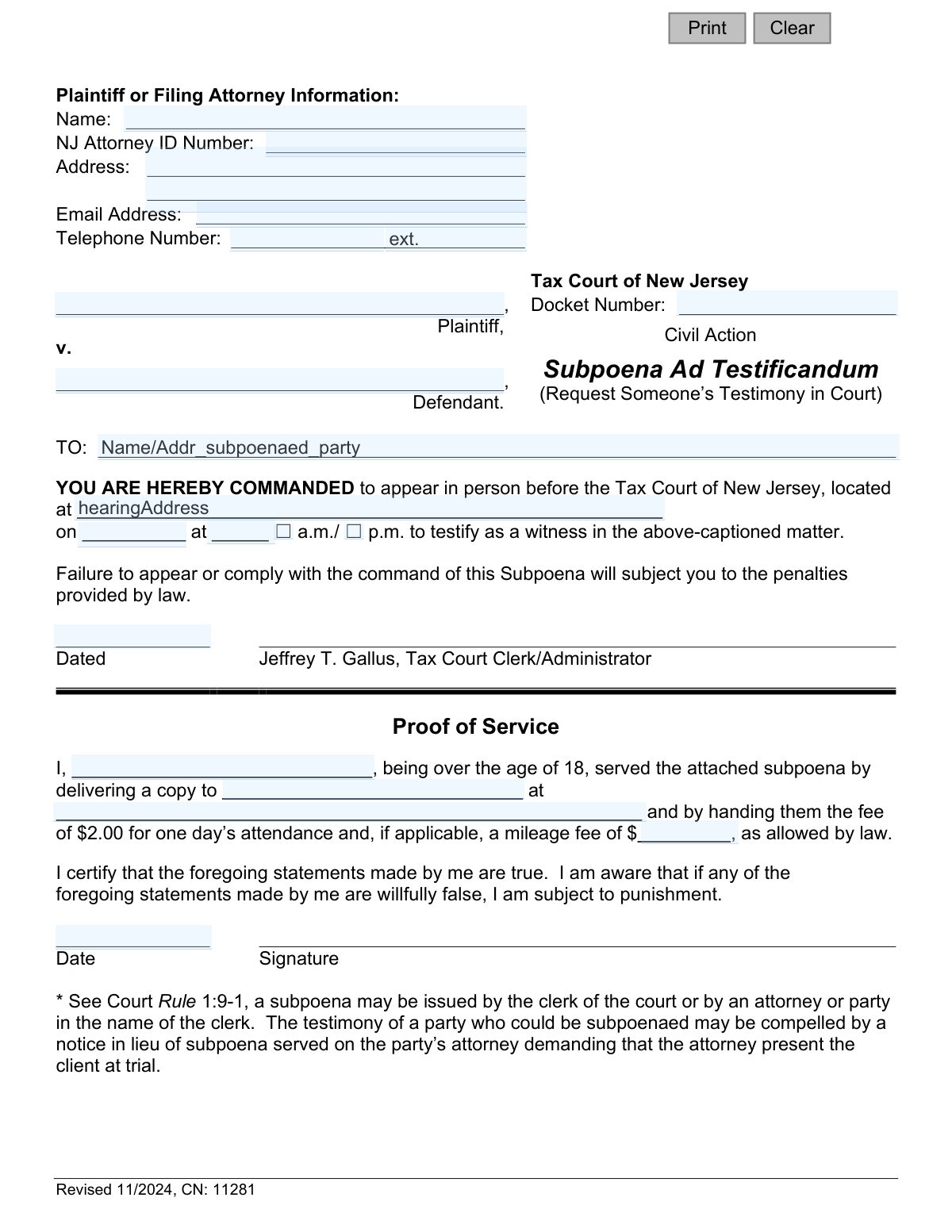
This form, officially titled Subpoena Ad Testificandum, is a legal command issued for the New Jersey Tax Court compelling an individual to appear in court and provide testimony in a specific case. It is a critical tool in legal proceedings to ensure that necessary witnesses are present to give evidence. Today, this form can be filled out quickly and accurately using AI-powered services like Instafill.ai, which can also convert non-fillable PDF versions into interactive fillable forms.
CN 11281 is part of the
New Jersey forms category on Instafill.
Our AI automatically handles information lookup, data retrieval, formatting, and form filling.
It takes less than a minute to fill out CN 11281 using our AI form filling.
Securely upload your data. Information is encrypted in transit and deleted immediately after the form is filled out.
Form specifications
| Form name: | Subpoena Ad Testificandum - Tax Court (Request Someone’s Testimony in Court) |
| Number of fields: | 23 |
| Number of pages: | 1 |
| Language: | English |
Instafill Demo: How to fill out PDF forms in seconds with AI
How to Fill Out CN 11281 Online for Free in 2026
Are you looking to fill out a CN 11281 form online quickly and accurately? Instafill.ai offers the #1 AI-powered PDF filling software of 2026, allowing you to complete your CN 11281 form in just 37 seconds or less.
Follow these steps to fill out your CN 11281 form online using Instafill.ai:
- 1 Navigate to Instafill.ai and upload or select the Subpoena Ad Testificandum form.
- 2 Provide the filing attorney or plaintiff's information, including name, NJ Attorney ID, address, and contact details.
- 3 Enter the specific case information, such as the Tax Court docket number and the names of the plaintiff and defendant.
- 4 Fill in the details of the person being subpoenaed and specify the exact location, date, and time they are commanded to appear.
- 5 Complete the 'Proof of Service' section after the subpoena has been served, detailing who served it, to whom it was delivered, and any fees provided.
- 6 Review all the information populated by the AI for accuracy, making any necessary edits to ensure all fields are correct.
- 7 Download the finalized, signed document to be filed with the court and served according to New Jersey court rules.
Our AI-powered system ensures each field is filled out correctly, reducing errors and saving you time.
Why Choose Instafill.ai for Your Fillable CN 11281 Form?
Speed
Complete your CN 11281 in as little as 37 seconds.
Up-to-Date
Always use the latest 2026 CN 11281 form version.
Cost-effective
No need to hire expensive lawyers.
Accuracy
Our AI performs 10 compliance checks to ensure your form is error-free.
Security
Your personal information is protected with bank-level encryption.
Frequently Asked Questions About Form CN 11281
This form is a legal order used to command a person to appear in the New Jersey Tax Court at a specific date and time to provide testimony as a witness in a case.
The plaintiff, defendant, or their attorney in a Tax Court case fills out this form to compel a witness to testify. It can be issued by the court clerk, an attorney, or a party acting in the clerk's name.
You will need the case details like plaintiff/defendant names and the docket number, the full name of the person being subpoenaed, and the specific date, time, and location of the court hearing.
This section is a sworn statement completed by the person who delivers the subpoena. It confirms who was served, where they were served, and that the required witness fees were paid, providing legal proof of delivery.
The subpoena must be personally delivered to the witness by someone over 18 years old. At the time of delivery, you must also pay them a $2.00 attendance fee and any applicable mileage fees.
As stated on the form, failure to appear in court as commanded by the subpoena will subject the individual to legal penalties, which can include fines or being held in contempt of court.
No, this form is for testimony only ('Ad Testificandum'). To compel the production of documents, you would need a different form called a Subpoena Duces Tecum.
The Docket Number is assigned by the court when the case is first filed. You can find it on any official court notices or documents you have already received for your Tax Court case.
This is a simplified notice served on a party's attorney to compel that party (the plaintiff or defendant) to testify at trial. It avoids the need for personal service on the party themselves.
Yes, Court Rule 1:9-1 allows a party to the case (plaintiff or defendant) to issue a subpoena in the name of the court clerk, in addition to attorneys or the clerk themselves.
Yes, services like Instafill.ai use AI to accurately auto-fill form fields. This can save you time and help ensure the information is entered correctly.
Simply upload the Subpoena Ad Testificandum PDF to the Instafill.ai platform. The AI will identify the fields, allowing you to quickly provide the necessary information and generate a completed form.
You can use a service like Instafill.ai, which is designed to convert flat, non-fillable PDFs into interactive, fillable forms. This allows you to easily type your information directly into the fields before printing.
Compliance CN 11281
Validation Checks by Instafill.ai
1
Validates NJ Attorney ID Format
Checks if the `attyId` field contains a value that conforms to the standard format for New Jersey Attorney ID numbers. This is crucial for verifying the attorney's credentials and ensuring they are authorized to issue subpoenas in the state. If the ID is invalid or missing for a listed attorney, the form submission should be rejected to prevent unauthorized legal actions.
2
Ensures Docket Number is Provided and Formatted Correctly
This validation confirms that the `docketNum` field is not empty and follows the expected Tax Court docket number syntax. The docket number is the primary identifier for the case, and an incorrect or missing number would make it impossible to file the subpoena with the correct court record. Failure to provide a valid docket number will prevent form submission.
3
Verifies Completeness of Case Party Information
This check ensures that both the Plaintiff (`plaName`) and Defendant (`defName`) fields are filled out. These names define the primary parties in the civil action and are essential for the legal validity of the subpoena. A subpoena without this information is incomplete and legally deficient, so the form cannot be processed until both fields are populated.
4
Confirms Hearing Date is in the Future
This validation checks that the `hearingDt` is a valid date that occurs after the current date. A subpoena must command a future appearance; a date in the past is nonsensical and renders the document unenforceable. This check prevents the creation of logically flawed and invalid legal documents, and submissions with past dates must be corrected.
5
Validates Hearing Time and AM/PM Selection
This check ensures that the `hearingTime` field is populated with a valid time in HH:MM format and that one of the `hearingAmpm` checkboxes (a.m. or p.m.) is selected. Ambiguity in the hearing time can make the subpoena unenforceable as the witness would not know the precise time of their required appearance. The form should not be submittable without a complete and unambiguous time.
6
Ensures Subpoenaed Witness is Identified
This validation verifies that the `partyName` field, corresponding to the 'TO:' line, is not empty. The subpoena is a direct command to a specific person or entity, and failing to name them makes the document completely ineffective. The form must be rejected if the party being subpoenaed is not clearly identified.
7
Verifies Hearing Location is Specified
This check confirms that the `hearingAddr` field, which specifies the location of the court appearance, is filled in. A witness cannot comply with a command to appear if the location is not provided. This is a critical piece of information for the subpoena to be valid and enforceable, and the form is incomplete without it.
8
Validates Attorney Email Address Format
This check ensures the value entered in the `attyEmail` field follows the standard `local-part@domain` format for email addresses. A valid email is essential for court communications, notifications, and correspondence related to the subpoena. An invalid format could lead to missed communications, so the user should be prompted to correct it before submission.
9
Ensures Proof of Service Section is Fully Completed
This validation confirms that if any part of the 'Proof of Service' section is filled, then all its required fields (`serveName`, `posName`, `posAddr`, `posSigDt`) are completed. The Proof of Service is a sworn statement, and its integrity depends on completeness. An incomplete affidavit of service can be legally challenged and may invalidate the subpoena's service.
10
Validates Logical Date for Proof of Service
This check ensures the `posSigDt` (Proof of Service Signature Date) is on or before the `hearingDt` (Hearing Date). It is logically impossible to validly serve a subpoena for a hearing that has already passed. This validation prevents the creation of legally and logically flawed documents, ensuring the service is documented as having occurred prior to the required appearance.
11
Validates Service Fee is a Valid Currency Amount
This check verifies that the `posFee` field contains a valid numeric or currency value, and is greater than or equal to the legally mandated minimum of $2.00. The field documents the payment made to the witness as required by law. An invalid entry would cause processing errors and may indicate non-compliance with legal requirements.
12
Distinguishes Between Plaintiff and Defendant
This validation checks that the name entered for the Plaintiff (`plaName`) is not identical to the name entered for the Defendant (`defName`). While a party can have multiple roles in complex litigation, in a simple v. structure, the same entity cannot be both plaintiff and defendant. This check helps catch significant data entry errors that would call the entire case into question.
13
Ensures Consistent and Valid Date Formatting
This validation rule ensures that all date fields, specifically `hearingDt` and `posSigDt`, adhere to a standard and valid format like MM/DD/YYYY. Inconsistent or invalid date formats can lead to misinterpretation by court staff and computer systems, potentially jeopardizing the legal timeline. The system should enforce a single, unambiguous format for all dates.
14
Verifies Completeness of Attorney Contact Information
This check ensures that the primary attorney contact fields (`attyName`, `attyAddr`, `attyPh`) are all filled out. This information is critical for the court and opposing parties to identify and communicate with the filing attorney. Missing contact details can delay proceedings and cause communication failures, so these fields are considered mandatory for a valid submission.
Common Mistakes in Completing CN 11281
The docket number is the unique identifier that links the subpoena to the correct case file in the Tax Court. People often mistype this number or omit it entirely, causing the court clerk to reject the document or misfile it. A misfiled subpoena is legally ineffective and will cause significant delays, potentially requiring the entire process to be restarted. To avoid this, carefully double-check the docket number against official court documents for the case. AI-powered tools like Instafill.ai can help by saving and correctly populating recurring information like docket numbers across multiple case documents, reducing the risk of manual entry errors.
The 'TO:' field requires the full, legal name of the person being commanded to appear. A common mistake is using a nickname, initials without the full name, or an incomplete name. This provides the recipient with a plausible reason to claim they were not the person named, allowing them to ignore the subpoena without immediate penalty. To ensure the subpoena is enforceable, always use the person's complete and correct legal name. Using a tool like Instafill.ai can help maintain a consistent and accurate record of party names, preventing typos or the use of informal names.
The form requires the full address of the court where the testimony will occur, but filers sometimes just write 'Tax Court' or provide a partial address. This is insufficient and can confuse the witness, potentially causing them to go to the wrong building or fail to appear. A subpoena with an ambiguous location may be deemed defective. Always provide the complete street address, city, and ZIP code of the courthouse. If the form is a non-fillable PDF, a tool like Instafill.ai can convert it into a smart, fillable version, making it easier to enter complete and properly formatted addresses.
The form includes mandatory checkboxes for 'a.m.' or 'p.m.' next to the hearing time. A frequent and critical oversight is writing down a time like '2:00' but forgetting to check either box. This ambiguity can cause the witness to show up 12 hours early or, more likely, 12 hours late, completely missing the scheduled testimony and rendering the subpoena useless for that date. Always double-check that the correct AM/PM box is selected to avoid any confusion.
The case caption, which includes the Plaintiff and Defendant names, must be perfectly accurate. A common data entry error is transposing the names or using incorrect spellings, which makes the legal document technically inaccurate. While a minor typo may be overlooked, significant errors can lead to rejection by the court or create grounds for the opposing party to challenge the subpoena's validity. Carefully copy the names exactly as they appear on other official case filings. AI-powered form fillers like Instafill.ai can automatically populate case caption information consistently once it's entered for a specific case, eliminating transposition errors.
The 'Proof of Service' section requires documenting the fee paid to the witness, which by law includes a $2.00 attendance fee plus a mileage allowance. Filers often forget to calculate and include the mileage fee or omit payment details altogether. A subpoena served without the proper, tendered fees is not legally binding, and the witness is not obligated to appear. Always calculate the round-trip mileage, add it to the base fee, and document the total amount paid on the form.
When an attorney files this form, their NJ Attorney ID number is a mandatory identifier for the court. Forgetting to include this number can cause the clerk's office to reject the filing, as it cannot be properly logged against the attorney of record. This causes unnecessary delays in having the subpoena issued. Tools like Instafill.ai can securely store and automatically insert an attorney's ID number and other professional details into forms, ensuring consistency and completeness.
The 'Proof of Service' is a sworn statement that must be filled out *after* the subpoena has been successfully delivered to the witness. A frequent error is filling out this section at the same time as the rest of the form, with anticipated details of service. This is legally false and can undermine the validity of the service if challenged. This section must only be completed and signed by the server after the act of service is complete.
This form has multiple date fields: one for when the subpoena is issued ('Dated') and another on the Proof of Service ('Date'). A common mistake is to use the wrong date in these fields or leave them blank. The issue date must be on or before the date of service, and the date on the Proof of Service is when the server certifies the service was made. Incorrect dates can create legal challenges regarding the timeliness and validity of the subpoena. AI-powered form fillers like Instafill.ai can apply validation rules to date fields, flagging inconsistencies like a service date that occurs before the issue date.
Legal forms are periodically updated, as noted by 'Revised 11/2024' on this document. People often find and use old versions of forms from unofficial websites or their own saved files. Submitting an obsolete form can result in an automatic rejection from the court clerk, as it may not comply with current rules or information requirements. This wastes time and filing fees. Always obtain the most current version of any legal form directly from the official court's website before filling it out.
Saved over 80 hours a year
“I was never sure if my IRS forms like W-9 were filled correctly. Now, I can complete the forms accurately without any external help.”
Kevin Martin Green
Your data stays secure with advanced protection from Instafill and our subprocessors

Robust compliance program
Transparent business model
You’re not the product. You always know where your data is and what it is processed for.
ISO 27001, HIPAA, and GDPR
Our subprocesses adhere to multiple compliance standards, including but not limited to ISO 27001, HIPAA, and GDPR.
Security & privacy by design
We consider security and privacy from the initial design phase of any new service or functionality. It’s not an afterthought, it’s built-in, including support for two-factor authentication (2FA) to further protect your account.
Fill out CN 11281 with Instafill.ai
Worried about filling PDFs wrong? Instafill securely fills subpoena-ad-testificandum-tax-court-request-someones-testimony-in-court forms, ensuring each field is accurate.