Fill out amended tax forms
with AI.
Amended tax forms are the official documents used by taxpayers to correct errors or update information on previously filed returns. Whether you missed a deduction, reported the wrong income amount, or need to change your filing status, these forms are essential for maintaining accurate records with both federal and state tax authorities. Filing an amendment correctly is vital because it allows you to claim additional refunds you may be owed or settle unpaid liabilities, helping you stay compliant and avoid future penalties.
By continuing, you acknowledge Instafill's Privacy Policy and agree to get occasional product update and promotional emails.
About amended tax forms
Individuals and business owners typically encounter these forms after receiving updated financial documents, such as a corrected W-2 or 1099, or upon realizing a mistake was made during the initial filing process. For instance, the IRS Form 1040-X is the standard for federal individual returns, while state-specific forms like the IL-1040-X are required for residents needing to adjust their state-level filings. These situations often arise when a federal change impacts your state tax liability, making it necessary to update both records to reflect your true financial situation.
Navigating the complexities of tax amendments can be stressful, but tools like Instafill.ai use AI to fill these forms in under 30 seconds, handling your data accurately and securely to simplify the process. This automation helps ensure that your corrections are precise, allowing you to focus on resolving your tax obligations without the burden of manual data entry.
Every form on this page can be completed without typing. Instafill is form filling software that reads a PDF and fills it for you — including flat and scanned documents that carry no fillable fields at all.
Forms in This Category
The forms in this category have a median Form Complexity Index of 66/100 (Complex), measured across 5 forms by field count, input difficulty, length, conditional logic and structure. See how it is calculated.
| Form Name | Pages | FCI | |
|---|---|---|---|
| 1. | Form 1040-X, Amended U.S. Individual Income Tax Return | 2 | Complex 65 |
| 2. | 2023 Form IL-1040-X, Amended Individual Income Tax Return (Illinois Department of Revenue) | 2 | Moderate 60 |
| 3. | Form 1040-X, Amended U.S. Individual Income Tax Return | 18 | Very Complex 87 |
| 4. | Form 1040-X, Amended U.S. Individual Income Tax Return | 2 | Complex 78 |
| 5. | Form IL-1040-X, Amended Individual Income Tax Return | 2 | Complex 66 |
- Enterprise-grade security & data encryption
- 99%+ accuracy powered by AI
- 1,000+ forms from all industries
- Complete forms in under 60 seconds
How to Choose the Right Form
Choosing the right amended tax form depends primarily on whether you need to correct a mistake on your federal return with the IRS or your state return with the Illinois Department of Revenue.
Federal Income Tax Corrections
If you discovered an error on your federal return—such as a typo in your reported income, a missed deduction, or an incorrect filing status—you must file a federal amendment.
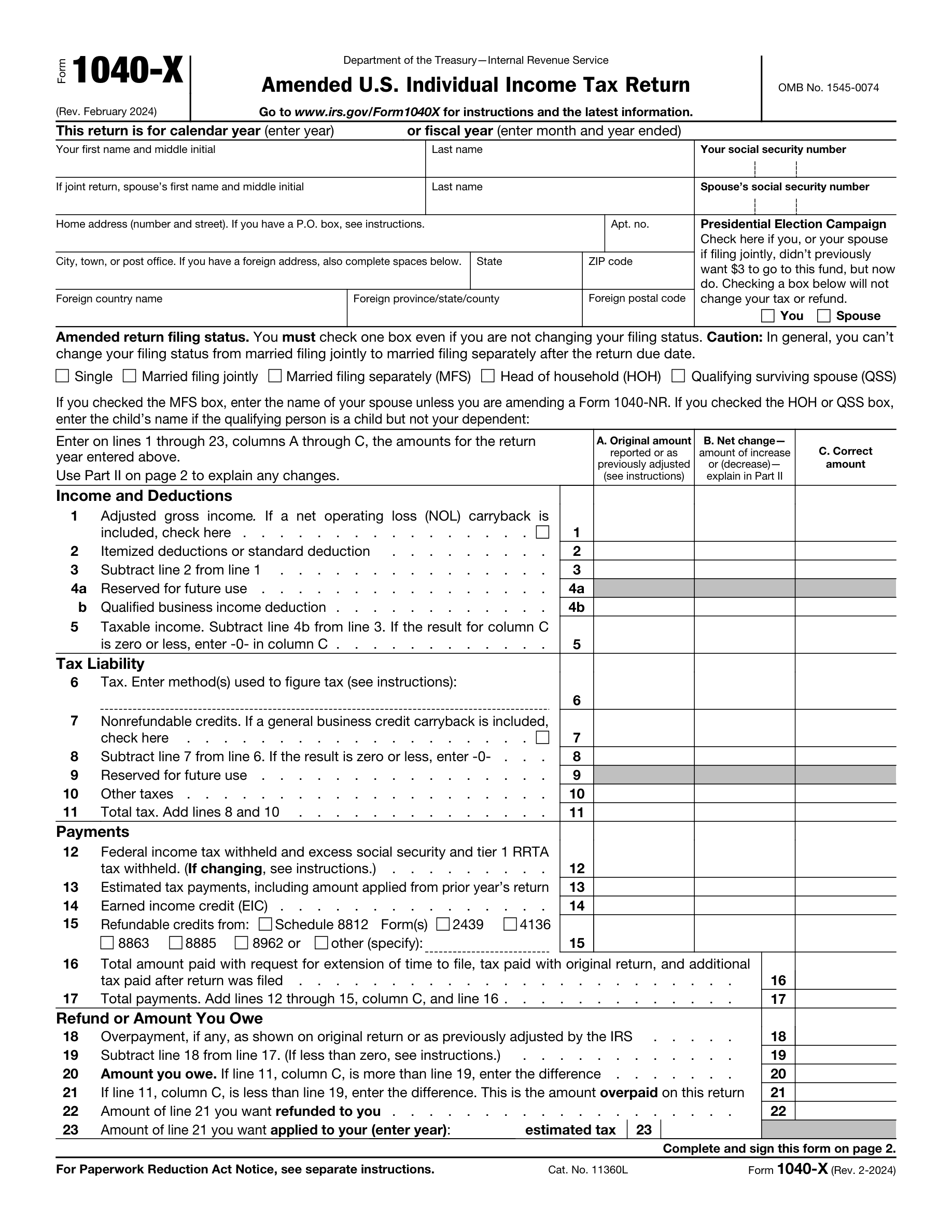
- Form 1040-X, Amended U.S. Individual Income Tax Return: This is the standard document for all federal individual amendments. Use this to correct previously filed 1040, 1040-SR, or 1040-NR forms.
- Form 1040-X (Rev. February 2024): This is the most updated version of the federal amendment form. It utilizes a three-column system (Original Amount, Net Change, and Corrected Amount) to help the IRS quickly identify what has changed. If you are correcting a return from the most recent tax year, this specific revision is often the best choice for compliance.
Illinois State Tax Corrections
If you live in Illinois and your federal changes affect your state tax liability, or if you simply made a mistake on your state-specific filing, you will need an Illinois amended return.
- Form IL-1040-X, Amended Individual Income Tax Return: Use this general form to report changes to your Illinois income, subtractions, or state-specific credits.
- 2023 Form IL-1040-X: If you are specifically updating a return filed for the 2023 tax year, this version is the most accurate for reflecting that year's specific tax laws and credit requirements.
Key Considerations
When selecting your form, keep these tips in mind:
- Sequence Matters: It is usually best to complete your federal Form 1040-X first. State forms like the IL-1040-X often require you to attach a copy of your finalized federal amendment.
- Documentation: Both the IRS and state authorities require a clear explanation of changes. Ensure you have your original return and supporting documents (like W-2s or 1099s) ready to reference while filling out these forms on Instafill.ai.
Form Comparison
| Form | Jurisdiction | Primary Purpose | Key Requirements |
|---|---|---|---|
| Form 1040-X, Amended U.S. Individual Income Tax Return | Federal (IRS) | Correct errors on previously filed individual federal income tax returns | Compare original amounts to corrected amounts with written explanations |
| 2023 Form IL-1040-X, Amended Individual Income Tax Return (Illinois Department of Revenue) | Illinois (State) | Amend 2023 state returns or report accepted federal changes | Requires explanation and supporting state schedules like Schedule M or NR |
| Form 1040-X, Amended U.S. Individual Income Tax Return | Federal (IRS) | Amend federal returns to claim additional refunds or tax credits | Ensures accurate tax records and determines additional refunds or owed amounts |
| Form 1040-X, Amended U.S. Individual Income Tax Return | Federal (IRS) | Correct filing status, income, or deductions after original submission | Essential for federal tax compliance and receiving the proper refund amount |
| Form 1040-X (Rev. February 2024), Amended U.S. Individual Income Tax Return | Federal (IRS) | Latest revision for updating information on previously filed federal returns | Uses a three-column format to calculate net changes and adjustments |
| Form IL-1040-X, Amended Individual Income Tax Return | Illinois (State) | Correct errors or report changes on Illinois individual returns | Often filed after federal amendments to maintain state-level tax accuracy |
Tips for amended tax forms
If you are correcting an error on your federal return that impacts your adjusted gross income, you usually need to file a corresponding state amendment like the IL-1040-X. Ensure the corrected figures on your state form match the final adjusted numbers reported on your federal Form 1040-X.
Amended forms typically use a three-column format to show the original amount, the net change, and the new corrected figure. Double-check your math across these columns to ensure the 'Net Change' accurately reflects the difference between your initial filing and your current correction.
Use the dedicated explanation section to describe exactly why you are amending the return, such as receiving a late 1099 or correcting a filing status. Being specific and referencing the exact lines you are changing helps tax processors understand your request and reduces the likelihood of follow-up questions.
It is best practice to wait until the IRS or state agency has fully processed your original return and issued any initial refund before filing an amendment. Filing an amended form too early can lead to confusion in the system and significantly delay the processing of both the original and the corrected returns.
AI-powered tools like Instafill.ai can complete these complex forms in under 30 seconds with high accuracy, making them a major time-saver for those managing multiple amendments. The platform ensures your data stays secure during the process, allowing you to generate professional, error-free documents quickly.
When you amend a return because of a change to a specific deduction or credit, you must attach the updated version of that specific schedule. For example, if you are changing your itemized deductions, include a revised Schedule A along with your 1040-X to provide the necessary supporting evidence.
Frequently Asked Questions
An amended tax form is a document used to correct errors or update information on a tax return that has already been filed with the IRS or a state revenue department. For federal taxes, this is typically done using Form 1040-X, while states provide their own versions, such as Illinois' Form IL-1040-X.
You should file an amended return if you discovered mistakes in your filing status, total income, deductions, or tax credits after your original return was submitted. It is also required if you receive a corrected W-2 or 1099 that significantly changes your reported financial data for that year.
The form you need depends on which tax return contains the error. Use Form 1040-X for federal individual income tax corrections, and use specific state forms like IL-1040-X for corrections to your state-level filings. Always ensure the form version matches the tax year you are attempting to correct.
Yes, AI tools like Instafill.ai can fill out amended tax forms by accurately extracting data from your source documents and placing it directly into the correct fields. This technology helps ensure that complex figures and explanations are transferred correctly from your original records to the amended PDF.
Using AI-powered services, you can complete forms like the 1040-X or IL-1040-X in under 30 seconds. The AI automates the data entry process, allowing you to generate a ready-to-print or ready-to-file document much faster than manual handwriting or typing.
Generally, it is recommended to wait until the IRS or state agency has processed your original return and issued your initial refund before you file an amendment. This avoids confusion in the processing system and ensures that the changes are applied to a finalized baseline.
You should include any schedules or forms that are being changed by the amendment, such as a corrected Schedule A for itemized deductions. Additionally, state forms like the IL-1040-X often require a copy of the federal 1040-X or the IRS notification of change if the state amendment was triggered by a federal adjustment.
To claim a refund, you typically must file an amended return within three years from the date you filed your original return or within two years from the date you paid the tax, whichever is later. If you owe additional tax, you should file as soon as possible to limit interest and penalty charges.
The IRS and many state agencies often catch and correct simple math errors automatically during processing. However, if the error involves more than basic arithmetic—such as missing income or an incorrect number of dependents—you should file an amended form to ensure your records are legally accurate.
No, you must file a separate amended form for each tax year you wish to correct. Each form must clearly state the tax year it applies to so that the tax authorities can update the correct historical record and calculate adjustments accurately.
Glossary
- Form Complexity Index
- Instafill’s 0–100 measure of how much effort a form takes to complete, calculated deterministically from the form’s own structure rather than estimated. It combines the number of fillable fields (the largest factor), how difficult those fields are to complete based on their type, the number of pages that contain fields, the amount of conditional “fill-only-if” logic, and how many sections the form is divided into, then adds modifiers for tables and repeating lists, bundled instruction pages, and dense page layouts. A higher score means the form is harder to fill out by hand. The forms in this category have a median Form Complexity Index of 66/100 (Complex). See exactly how it is calculated.
- Form 1040-X
- The official IRS document used to correct errors, report changes in income, or update filing status on a federal individual income tax return that has already been submitted.
- Net Change (Column B)
- A specific section on an amended return where you calculate the numerical difference between the amount originally reported and the new, corrected amount.
- Explanation of Changes
- A required narrative section, often labeled as Part II, where the taxpayer must provide a clear and concise reason for every adjustment made on the amended form.
- Federal Finalization
- The point at which the IRS has officially accepted or adjusted a federal return, which frequently serves as the trigger for a taxpayer to file a corresponding state amended return.
- Schedule NR
- A supplemental tax form used by nonresidents or part-year residents to report how much of their income is specifically subject to state-level taxation.
- IL-WIT
- An Illinois-specific schedule used to report and verify the amount of state income tax withheld from your wages, often required when filing an amended state return.
- Statute of Limitations
- The legal time limit, typically three years from the original filing date, within which a taxpayer must file an amended return to successfully claim a tax refund.
- Tax Year
- The specific calendar year for which the income was earned and the original return was filed; amended forms must match the specific year they are correcting.