Fill out domestic partnership forms
with AI.
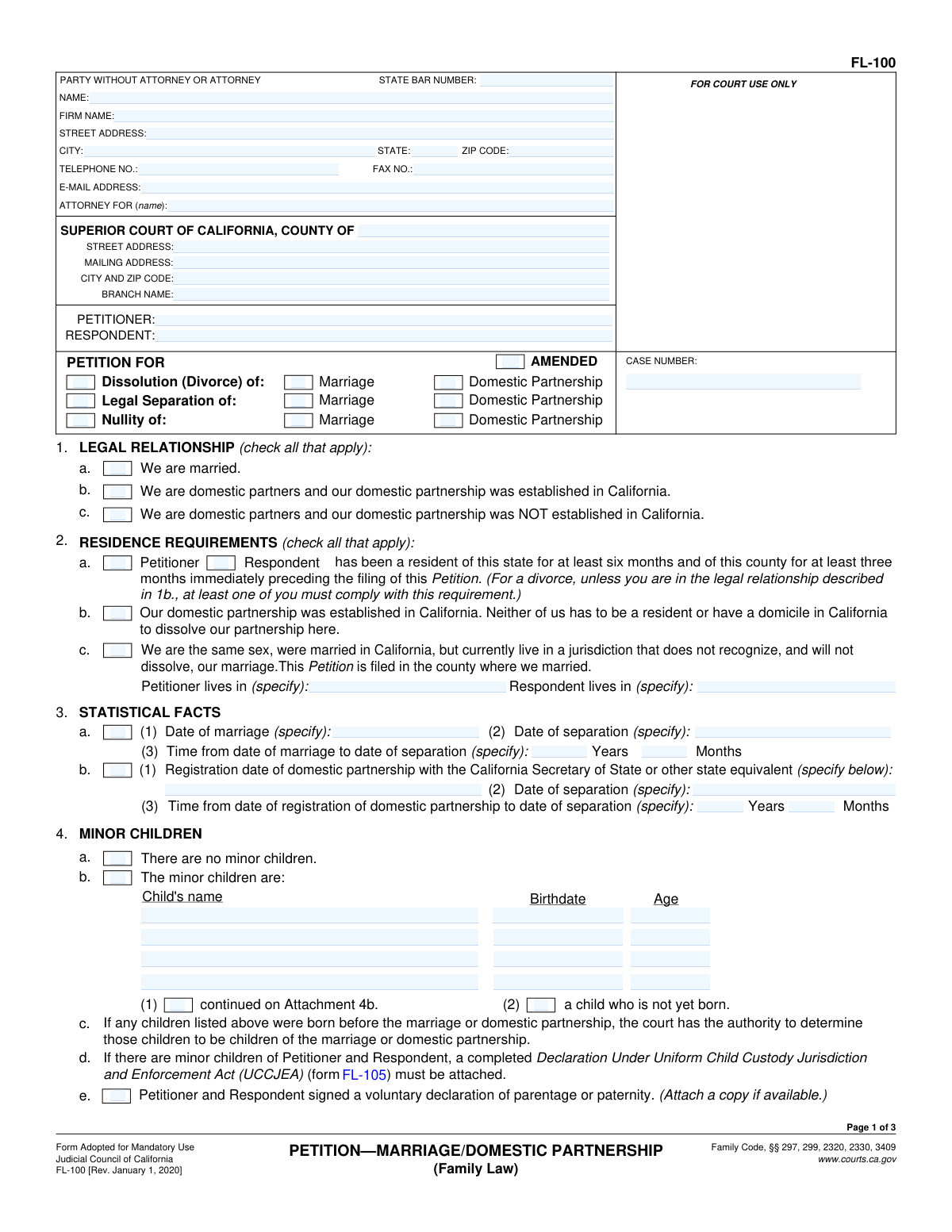
Domestic partnership forms are the legal documents used to formally begin or resolve a registered domestic partnership through California's court system. This category primarily covers the official California Superior Court forms required to initiate proceedings for dissolution (divorce), legal separation, or nullity (annulment) of a marriage or domestic partnership. These forms establish the legal foundation for your case, identifying the parties involved, confirming residency requirements, and outlining the relief being requested — from child custody and support arrangements to property division and spousal or partner support.
By continuing, you acknowledge Instafill's Privacy Policy and agree to get occasional product update and promotional emails.
About domestic partnership forms
People who need these forms are typically individuals in California who are ending a marriage or registered domestic partnership and are filing as the petitioner — the person who initiates the court process. Forms like FL-100 and FL-107 are among the most commonly filed in California family law cases, and getting them right matters because they define the scope of what the court can address and what the other party must respond to. Errors or omissions can cause delays or complications in your case.
Because these forms require precise, consistent information across multiple fields and attachments, tools like Instafill.ai use AI to fill them out accurately in under 30 seconds — a practical option for anyone who wants to avoid the frustration of navigating complex legal paperwork on their own.
Every form on this page can be completed without typing. Instafill is form filling software that reads a PDF and fills it for you — including flat and scanned documents that carry no fillable fields at all.
Forms in This Category
The forms in this category have a median Form Complexity Index of 80/100 (Very Complex), measured across 3 forms by field count, input difficulty, length, conditional logic and structure. See how it is calculated.
| Form Name | Pages | FCI | |
|---|---|---|---|
| 1. | Form FL-100, Petition—Marriage/Domestic Partnership (Family Law) | 3 | Complex 64 |
| 2. | Form FL-107, Petition—Marriage/Domestic Partnership | 3 | Very Complex 80 |
| 3. | Form FL-120, Response—Marriage/Domestic Partnership (Family Law) | 1 | – |
- Enterprise-grade security & data encryption
- 99%+ accuracy powered by AI
- 1,000+ forms from all industries
- Complete forms in under 60 seconds
How to Choose the Right Form
Both forms in this category serve the same core purpose — formally opening a California court case for dissolution (divorce), legal separation, or nullity of a marriage or domestic partnership. Here's how to determine which one applies to your situation.
Form FL-100 vs. Form FL-107: What's the Difference?
These two forms are closely related California family law petitions, but they are different versions used in different contexts:
- Form FL-100 (Petition—Marriage/Domestic Partnership) is the standard, widely used version for most filers. It covers all the essentials: identifying the parties, confirming residency/jurisdiction, listing minor children, and requesting orders on custody, support, and property. If you're unsure which form to use, start here.
- Form FL-107 (Petition—Marriage/Domestic Partnership) is an alternative version that serves the same function but may be required or preferred in certain California Superior Courts or for specific case types. It similarly frames the relief requested and often references attachments like FL-105 and FL-160.
Quick Decision Guide
- Filing a standard divorce or legal separation in California? → Use Form FL-100 as your default starting point.
- Your court specifically requests or accepts Form FL-107? → Use Form FL-107 to comply with local court requirements.
- Involved minor children? → Either form will prompt you to attach Form FL-105 (UCCJEA declaration).
- Have property or debts to address? → Both forms reference Form FL-160 for property declarations.
Bottom Line
For most people, Form FL-100 is the right choice. Check with your local California Superior Court to confirm whether Form FL-107 is required in your jurisdiction. Both forms can be completed quickly and accurately using AI-powered tools on Instafill.ai.
Form Comparison
| Form | Purpose | Who Files It | When to Use |
|---|---|---|---|
| Form FL-107, Petition—Marriage/Domestic Partnership | Open dissolution, legal separation, or nullity case in California | Petitioner spouse or domestic partner initiating the case | When filing for divorce, separation, or annulment in California Superior Court |
| Form FL-100, Petition—Marriage/Domestic Partnership (Family Law) | Open dissolution, legal separation, or nullity case; lists custody and support requests | Petitioner spouse or domestic partner initiating the family law case | Standard filing to begin divorce, separation, or annulment proceedings in California |
Tips for domestic partnership forms
California uses both FL-100 and FL-107 as petition forms for dissolution, legal separation, or nullity — and your specific court or case type may require one over the other. Check with your local Superior Court clerk to confirm which version is currently accepted before you begin filling anything out. Using the wrong form can delay your case or require you to start over.
Both FL-100 and FL-107 often require companion forms — such as FL-105 (UCCJEA Declaration) if minor children are involved, or FL-160 for property declarations. Gathering this information ahead of time prevents you from leaving sections incomplete or submitting a petition that the court will reject. Review the form instructions carefully to identify every attachment that may apply to your situation.
These forms cover marriages, domestic partnerships, and both — and you must clearly indicate whether you are seeking dissolution, legal separation, or nullity. Selecting the wrong category can affect the legal outcome and what the court is authorized to order. If you are unsure which option applies, consult a family law attorney before filing.
California courts require that at least one party meet specific residency requirements in the state and county before a petition can be filed. Filing before these requirements are satisfied can result in your case being dismissed. Confirm that you meet the residency criteria for your specific court before submitting any paperwork.
AI-powered tools like Instafill.ai can complete domestic partnership and divorce petition forms in under 30 seconds with high accuracy, reducing the risk of errors that could slow down your case. Your data stays secure throughout the process, making it a safe option even for sensitive family law matters. This is especially helpful if you are managing multiple forms at once, such as a petition plus required attachments.
Courts are strict about consistency across all filed documents — your full legal name, your partner's name, and dates of marriage or domestic partnership registration must match exactly on every form and attachment. Even minor discrepancies can cause processing delays or require amended filings. Cross-reference your marriage certificate or domestic partnership registration document before finalizing anything.
Once you submit your petition, make sure to retain a complete copy of all filed forms, including any attachments and the court's file-stamped confirmation. These documents establish the official start date of your case and may be needed throughout the legal process. Organize them in a dedicated folder — physical or digital — so they are easy to reference.
Submitting a petition opens your case but does not resolve it — the other party must be formally served with the documents, and additional forms will likely be required as the case progresses. Planning ahead for service of process and subsequent filings will help you avoid unnecessary delays. Familiarize yourself with your court's local rules early in the process.
Frequently Asked Questions
Domestic partnership forms in California are used to legally begin or end a registered domestic partnership through the court system. They cover actions such as dissolution (divorce), legal separation, and nullity (annulment), and allow parties to request orders on matters like property division, support, and child custody.
Both FL-100 and FL-107 are California petition forms used to open a dissolution, legal separation, or nullity case involving a marriage or domestic partnership, and they serve essentially the same purpose. FL-107 is specifically designated for cases involving domestic partnerships, while FL-100 is the more general family law petition form — your local court or case type may determine which version you should file.
The spouse or domestic partner who wants to initiate a dissolution, legal separation, or annulment case in California must file one of these petition forms. This person is called the 'petitioner,' and the other party is the 'respondent' who will be served with the filed documents.
No — only the petitioner (the person initiating the case) signs and files the petition. The other party, the respondent, receives a copy through formal service of process and then has the opportunity to file a response with the court.
These forms are filed with the California Superior Court in the county where either party meets the residency requirements. Each county's courthouse has a family law clerk's office that accepts the petition and any required attachments.
Depending on your situation, you may need to attach additional forms such as FL-105 (UCCJEA Declaration) if minor children are involved, FL-160 (Property Declaration) for property and debt issues, and a Summons (FL-110). The petition form itself will indicate which attachments are required based on the relief you are requesting.
Yes, California generally requires that at least one party has lived in the state and in the filing county for specified minimum periods before a court can grant a dissolution of marriage. Domestic partnerships registered in California may have different or additional eligibility rules, so it is advisable to review current California Family Code requirements or consult an attorney.
Yes — AI-powered tools like Instafill.ai can fill out California domestic partnership petition forms in under 30 seconds by accurately extracting and placing your information from source documents. These tools can also convert non-fillable PDF versions of forms like FL-100 and FL-107 into interactive, completable forms.
Manually completing forms like FL-100 or FL-107 can take anywhere from 30 minutes to a few hours, depending on the complexity of your situation. Using AI-assisted services like Instafill.ai, the data entry portion can be completed in under 30 seconds, with information accurately extracted and placed into the correct fields.
After filing, the court assigns a case number and the petitioner must formally serve the respondent with the filed petition and summons. The respondent then has a set period to file a response, and the case proceeds through the court process, which may involve hearings, negotiations, or a final judgment.
The petition itself establishes the issues the court can address, including custody, support, and property, but temporary orders typically require filing separate request forms (such as FL-300) after the case has been opened. The petition sets the scope of the case, while additional filings are used to request interim relief before a final judgment.
You are not required to have an attorney to file these forms in California — parties who represent themselves are called 'self-represented' or 'pro per' litigants. However, because these petitions frame everything the court can order, consulting a family law attorney is recommended if your case involves significant assets, debts, children, or disputes.
Glossary
- Form Complexity Index
- Instafill’s 0–100 measure of how much effort a form takes to complete, calculated deterministically from the form’s own structure rather than estimated. It combines the number of fillable fields (the largest factor), how difficult those fields are to complete based on their type, the number of pages that contain fields, the amount of conditional “fill-only-if” logic, and how many sections the form is divided into, then adds modifiers for tables and repeating lists, bundled instruction pages, and dense page layouts. A higher score means the form is harder to fill out by hand. The forms in this category have a median Form Complexity Index of 80/100 (Very Complex). See exactly how it is calculated.
- Dissolution
- The legal term California courts use for divorce — the formal ending of a marriage or domestic partnership by court order. It is used interchangeably with 'divorce' on California family law forms.
- Domestic Partnership
- A legally recognized relationship between two individuals who have registered with the California Secretary of State (or another jurisdiction), granting them rights and responsibilities similar to those of married spouses. Domestic partnerships can be dissolved using the same court forms as marriages.
- Petitioner
- The person who initiates the court case by filing the petition form. In a dissolution or legal separation, the petitioner is the spouse or partner who starts the legal process.
- Respondent
- The other spouse or domestic partner in the case — the person who receives the filed petition and has the opportunity to respond to it in court.
- Nullity (Annulment)
- A court ruling that declares a marriage or domestic partnership legally void, as if it never existed. Unlike dissolution, a nullity requires proving specific grounds such as fraud, bigamy, or incapacity.
- Legal Separation
- A court-ordered arrangement that allows spouses or domestic partners to live separately and divide assets/debts without legally ending the relationship. The parties remain legally married or partnered after a legal separation.
- UCCJEA (Uniform Child Custody Jurisdiction and Enforcement Act)
- A uniform law that determines which state has jurisdiction over child custody matters. When minor children are involved, California requires filers to complete form FL-105, the UCCJEA declaration, as an attachment to the petition.
- Spousal/Partner Support
- Court-ordered financial payments from one spouse or domestic partner to the other after separation or dissolution, intended to limit economic unfairness. It is sometimes called 'alimony' and must be specifically requested in the petition.
- Pleading
- A formal written document filed with the court that states a party's position, claims, or requests in a legal case. The petition form (FL-100 or FL-107) is the opening pleading that starts a dissolution or separation case.
- Jurisdiction/Residency Requirement
- The legal basis that gives a California court the authority to hear your case. For marriage or domestic partnership dissolution in California, at least one party must have lived in California for 6 months and in the filing county for 3 months before filing.