Fill out financial authorization forms
with AI.
Financial authorization forms are essential legal documents used to grant specific permissions to financial institutions or third parties to act on your behalf. These forms serve as a critical layer of security and verification, ensuring that significant actions—such as transferring retirement assets, gifting securities, or changing account ownership—are only performed with the account holder's documented consent. By formalizing these instructions, both the individual and the institution are protected, creating a clear record of intent for complex transactions like private equity investments or trust re-titling.
By continuing, you acknowledge Instafill's Privacy Policy and agree to get occasional product update and promotional emails.
About financial authorization forms
These documents are most frequently needed by individual investors, retirees, and estate planners during periods of financial transition or portfolio management. For instance, if you are consolidating accounts from one brokerage to another, such as moving funds from a TIAA account to a private trust, or granting a family member access to monitor your accounts, a specific authorization form is required. They are also vital when setting up specialized payment options, like interest-only distributions, to manage cash flow during retirement.
Completing these detailed PDFs manually can be tedious, but tools like Instafill.ai use AI to fill these forms in under 30 seconds, handling your financial data with high accuracy and security. This streamlined approach helps you finalize your authorizations quickly so you can focus on your broader financial goals.
Every form on this page can be completed without typing. Instafill is form filling software that reads a PDF and fills it for you — including flat and scanned documents that carry no fillable fields at all.
Forms in This Category
The forms in this category have a median Form Complexity Index of 25/100 (Simple), measured across 9 forms by field count, input difficulty, length, conditional logic and structure. See how it is calculated.
- Enterprise-grade security & data encryption
- 99%+ accuracy powered by AI
- 1,000+ forms from all industries
- Complete forms in under 60 seconds
How to Choose the Right Form
Selecting the correct financial authorization form depends on which institution holds your assets and what specific action you need to authorize—whether it’s granting account access to a third party, transferring funds, or changing the legal structure of your account.
Granting Account Access or Power of Attorney
If you need to allow a financial advisor, family member, or trusted individual to view or manage your accounts, look for these specific access forms:
- For Merrill Accounts: Use the Merrill Letter of authorization — Read Only and Trading or Ownership to define exactly what your Power of Attorney can do online.
- For TIAA Accounts: Use Form F10352, Authorization to Access TIAA Accounts for general access, or the TIAA Trust, N.A. Authorization to receive client account information if you specifically need them to receive statements and tax documents.
Account Transfers and Structural Changes
These forms are used when you are moving money between institutions or changing the legal title of your holdings:
- Consolidating Retirement: Use the Authorization to transfer funds from a bank retirement account to move assets from a Bank of America IRA to a Merrill IRA.
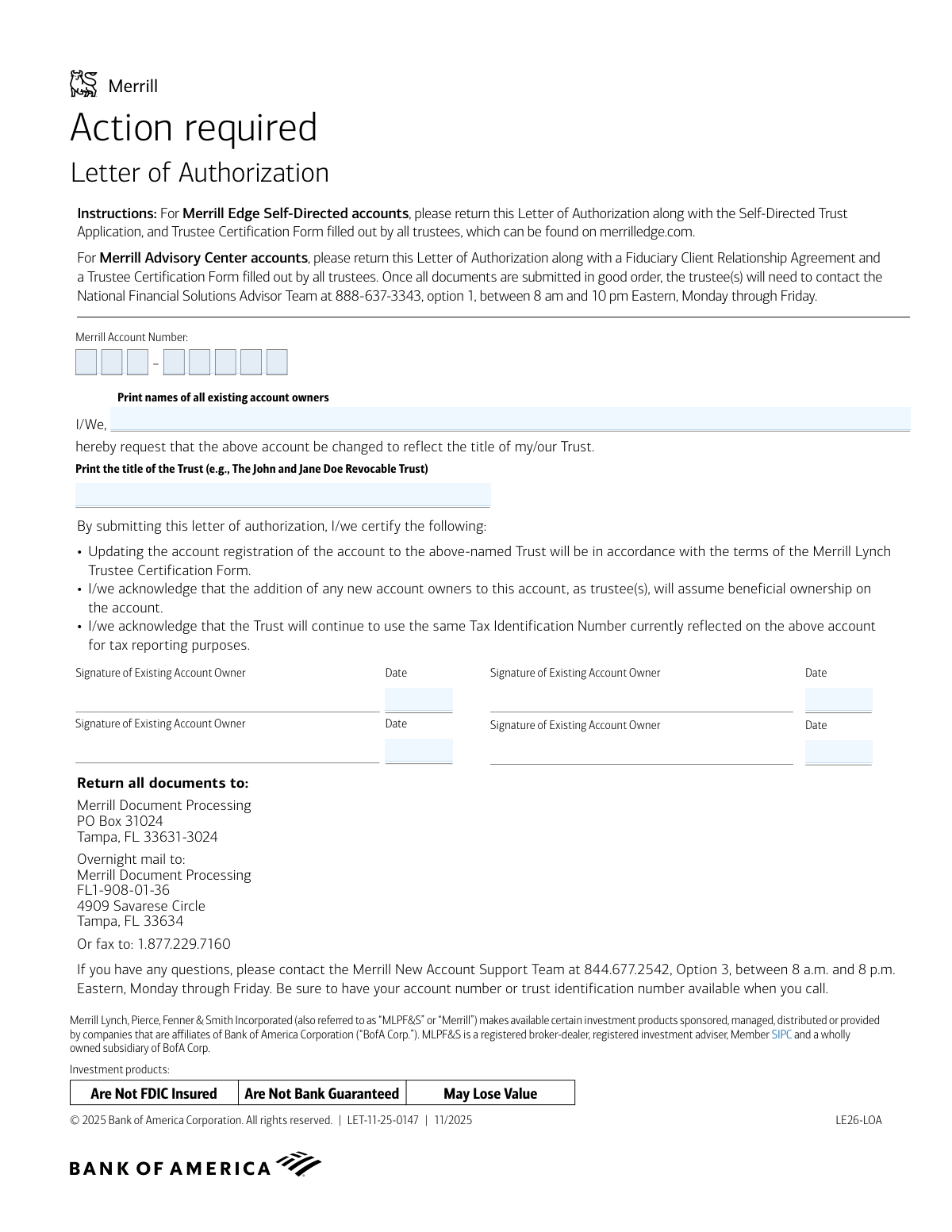
- Trust Management: If you need to move an existing Merrill account into the name of a trust for estate planning, use the Action Required Letter of Authorization - Merrill Lynch.
- Account Status: Use the Merrill Lynch Account downgrade Letter of Authorization specifically for changing a Cash Management Account to a Delaware account.
Special Investment and Distribution Actions
For specific financial maneuvers like gifting or specialized investment types, use these targeted documents:
- Gifting: To move stocks or bonds from a TIAA account to another person or charity, use the TIAA Brokerage Authorization To Gift Securities (Form F11514).
- Private Equity: Use Form AOB-03, Private Equity Investment Authorization to instruct Columbia Private Trust to make a private equity investment.
- Retirement Income: If you want to receive only the interest from your TIAA Traditional accumulation, fill out Form F7381, Authorization of Interest-Only Payments (Non ERISA).
Form Comparison
| Form | Primary Purpose | Specific Financial Action | Institution |
|---|---|---|---|
| Action Required Letter of Authorization - Merrill Lynch | Change the title of an account to a trust name. | Updates beneficial ownership to align with trust terms. | Merrill Lynch |
| Authorization to transfer funds from a bank retirement account | Consolidate retirement assets into a Merrill IRA. | Moves funds directly from Bank of America to Merrill. | Merrill / Bank of America |
| Form AOB-03, Private Equity Investment Authorization | Instruct a custodian to make a private equity investment. | Authorizes funding and acknowledges risks of non-deposit products. | Columbia Private Trust |
| Form F10352, Authorization to Access TIAA Accounts | Grant a third party permission to view account information. | Allows advisors or family members to access confidential details. | TIAA |
| Form F7381, Authorization of Interest-Only Payments (Non ERISA) | Establish an interest-only payment strategy for retirement. | Distributes earned interest while preserving the principal accumulation. | TIAA |
| Merrill Letter of authorization — Read Only and Trading or Ownership | Grant online account access to a Power of Attorney. | Specifies permission levels ranging from view-only to full ownership. | Merrill |
| Merrill Lynch Account downgrade Letter of Authorization | Request a change in the status of an account. | Downgrades a Cash Management Account to a Delaware account. | Merrill Lynch |
| TIAA Brokerage Authorization To Gift Securities | Transfer ownership of securities as a gift. | Gifts stocks or bonds to individuals or organizations. | TIAA Brokerage |
| TIAA Trust, N.A. Authorization to receive client account information | Authorize TIAA to disclose trust account data to others. | Enables designated parties to discuss accounts and view statements. | TIAA Trust |
Tips for financial authorization forms
The most common reason for rejection is a typo in the account or routing number. Always cross-reference the numbers entered on your authorization form with a recent physical or digital statement to ensure accuracy.
Many authorization forms offer a choice between 'view-only' and 'full trading' authority. Carefully select the level of access you wish to grant to third parties to ensure your assets remain protected while still allowing for necessary management.
When transferring funds or securities between different firms, ensure that the names on both accounts match exactly. Discrepancies in account titles, such as using a nickname or omitting a middle initial, can trigger fraud alerts and stall the process.
AI-powered tools like Instafill.ai can complete these financial forms in under 30 seconds with high accuracy. Your sensitive data stays secure during the process, providing a fast and reliable way to handle complex paperwork without manual data entry.
High-value financial authorizations often require more than just a standard signature. Before submitting, check if the form requires a Notary Public seal or a Medallion Signature Guarantee, as these cannot be substituted with a basic digital signature.
Forms involving trusts or powers of attorney usually require supporting documentation like a Certificate of Trust. Keep scanned copies of these documents ready so you can upload or attach them immediately, preventing back-and-forth delays with the institution.
When authorizing the gifting of securities or private equity investments, be as specific as possible regarding the number of shares or the exact dollar amount. Vague instructions often lead to administrative holds while the firm seeks further clarification.
Frequently Asked Questions
These forms are legal documents that allow account holders to grant specific permissions to third parties or instruct financial institutions to perform certain actions. They are commonly used for transferring assets, changing account titles to trusts, or allowing a financial advisor to view sensitive account details.
In most cases, the primary account holder or a legally recognized representative, such as a trustee or person with Power of Attorney, must sign the form. For joint accounts, many institutions require signatures from all owners to authorize significant changes or transfers.
The correct form depends on both the financial institution involved and the specific action you want to take. You should identify whether you are granting access to a third party, gifting securities, or moving funds between specific types of accounts, such as transitioning an IRA from one platform to another.
Yes, AI tools like Instafill.ai can fill these forms in under 30 seconds by accurately extracting and placing data from your source documents. This technology ensures that complex fields are populated correctly, reducing the risk of rejection by the financial institution.
While manual entry for financial documents can be time-consuming, using an AI-powered service can complete the process in less than 30 seconds. These tools can also convert non-fillable PDF versions into interactive forms, making the digital completion process much more efficient.
View-only access allows a designated person to see account balances and transaction history without the ability to execute trades or move money. Trading authority grants the authorized party the power to buy or sell securities and, in some cases, manage distributions on the owner's behalf.
Submission methods vary by institution, but most forms are sent to a specific back-office processing center via mail or uploaded through a secure client portal. Some institutions, such as Merrill Lynch or TIAA, may also accept these forms at local branch offices or via secure fax.
The requirement for a notary or a medallion signature guarantee depends on the sensitivity of the request. While simple information-sharing forms may only require a standard signature, forms involving the transfer of high-value securities or changing account ownership often require official notarization.
Yes, most financial authorizations can be revoked at any time by submitting a written request or a new form that supersedes the previous one. It is important to notify the financial institution promptly to ensure that third-party access or automated payments are stopped according to your wishes.
You will generally need the account numbers for both the sending and receiving accounts, the specific dollar amount or securities to be moved, and the legal names of all parties involved. Providing accurate account titles is essential to prevent delays in the transfer process.
Glossary
- Form Complexity Index
- Instafill’s 0–100 measure of how much effort a form takes to complete, calculated deterministically from the form’s own structure rather than estimated. It combines the number of fillable fields (the largest factor), how difficult those fields are to complete based on their type, the number of pages that contain fields, the amount of conditional “fill-only-if” logic, and how many sections the form is divided into, then adds modifiers for tables and repeating lists, bundled instruction pages, and dense page layouts. A higher score means the form is harder to fill out by hand. The forms in this category have a median Form Complexity Index of 25/100 (Simple). See exactly how it is calculated.
- Letter of Authorization (LOA)
- A formal document provided by an account holder that gives a financial institution specific instructions to perform a task, such as moving funds or changing account titles.
- Power of Attorney (POA)
- A legal designation that grants a trusted third party the authority to access, manage, or make trades within your financial accounts on your behalf.
- Securities
- Tradable financial assets, such as stocks, bonds, or mutual funds, that represent an ownership position or a creditor relationship with an entity.
- Custodian
- A financial institution, such as a bank or trust company, that is responsible for the physical and legal safekeeping of a client's investment assets.
- ERISA
- The Employee Retirement Income Security Act is a federal law that sets standards for private retirement plans; forms marked 'Non-ERISA' apply to accounts not subject to these specific regulations.
- Liquidation
- The process of selling investment assets to convert them into cash, which is often required before transferring funds between different financial institutions.
- Trustee
- An individual or organization legally appointed to manage and oversee assets held within a trust for the benefit of specified beneficiaries.
- Interest-Only Option
- A distribution strategy where the account holder receives only the interest earned on their principal balance, allowing the original investment to remain intact.