Fill out insurance designation forms
with AI.
Insurance designation forms are fundamental legal instruments used to define the distribution of policy benefits upon a specific event, such as the passing of the insured. These documents serve as the definitive record for insurance providers—including major carriers like Principal, TIAA, and Transamerica—to identify primary and contingent beneficiaries. Because these designations often override instructions in a general will, keeping them current is a critical component of responsible estate planning and financial management.
By continuing, you acknowledge Instafill's Privacy Policy and agree to get occasional product update and promotional emails.
About insurance designation forms
Individuals typically encounter these forms during significant life transitions, such as starting a new career with group life benefits, getting married, or welcoming a new family member. Whether you are managing a private life insurance policy or updating your workplace accident coverage, ensuring these forms are completed correctly prevents future legal disputes and ensures that your assets reach the intended recipients without unnecessary administrative delays.
Completing these documents can often feel like a bureaucratic hurdle, especially when dealing with complex layouts or non-interactive PDFs. Tools like Instafill.ai use AI to fill these insurance designation forms in under 30 seconds, handling your data with the accuracy and security required for sensitive financial documents. This modern approach allows you to finalize your designations quickly and move on with your day, knowing your legacy is properly documented.
Every form on this page can be completed without typing. Instafill is form filling software that reads a PDF and fills it for you — including flat and scanned documents that carry no fillable fields at all.
Forms in This Category
The forms in this category have a median Form Complexity Index of 61/100 (Moderate), measured across 6 forms by field count, input difficulty, length, conditional logic and structure. See how it is calculated.
- Enterprise-grade security & data encryption
- 99%+ accuracy powered by AI
- 1,000+ forms from all industries
- Complete forms in under 60 seconds
How to Choose the Right Form
Choosing the right beneficiary designation form depends primarily on your specific insurance provider and the type of policy you hold. Ensuring you use the correct form is vital for making sure your death benefits are distributed according to your wishes without legal delays.
Carrier-Specific Forms
If your policy is held with a major national provider, you must use their specific legal documentation to ensure it is accepted by their claims department:
- Principal Life Insurance Company: Use the Beneficiary Designation/Change - Principal Life Insurance Company form for standard group term or accident insurance. If you need to appoint a custodian for a minor under the Uniform Transfers to Minors Act (UTMA), choose the more specific Principal Life Insurance Company Beneficiary Designation/Change Form (GP34795-14).
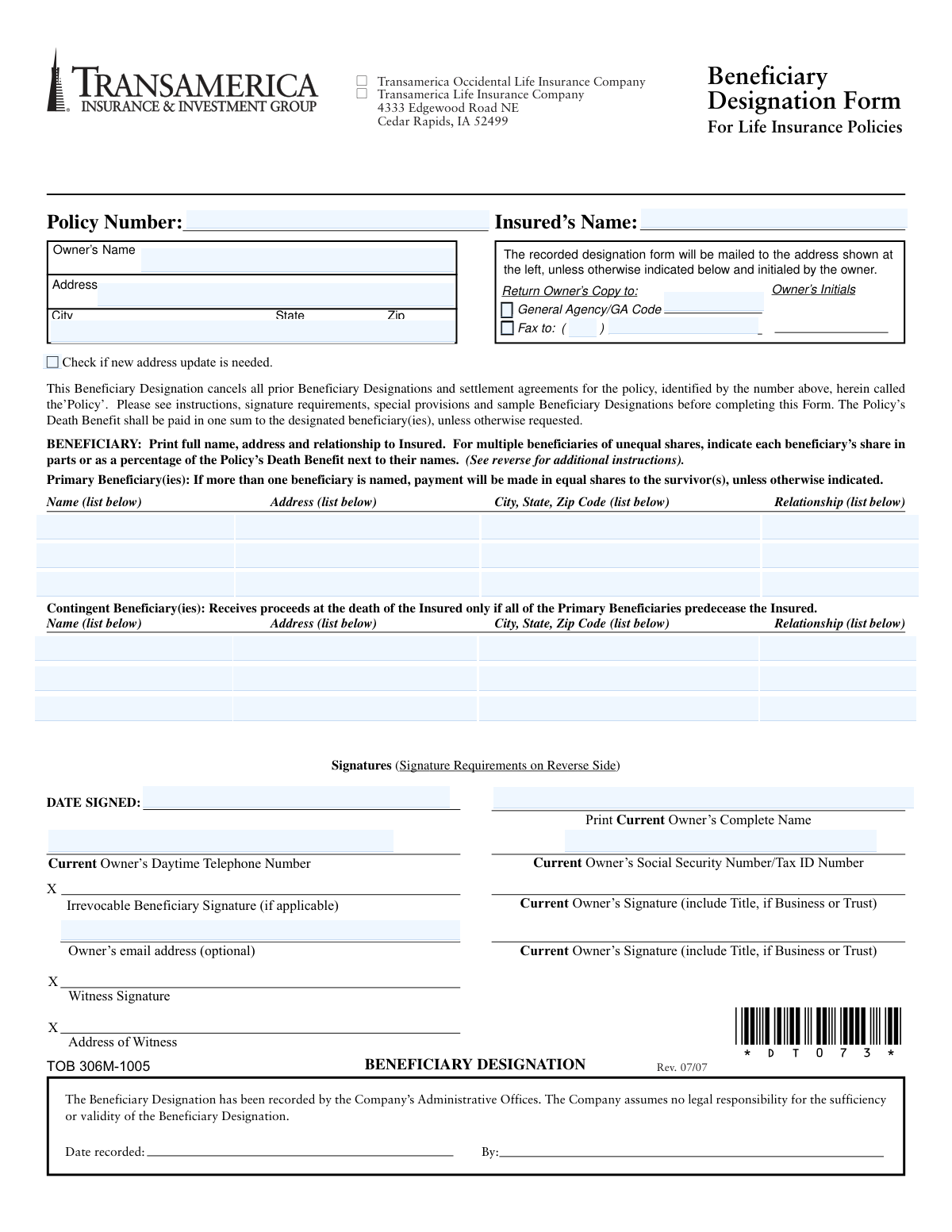
- Transamerica: Most policyholders will use the standard Transamerica Life Insurance Company Beneficiary Designation Form. However, check your policy documents; if they reference specific version codes, you may need the Transamerica Life Insurance Company Beneficiary Designation Form (TOB 306M-0809).
- Fidelity & TIAA: For Fidelity term life policies, use the Fidelity Investments Beneficiaries — Term Life Insurance form. TIAA or TIAA-CREF policyholders should select the TIAA Life Insurance Beneficiary Designation Form.
General or Employer-Provided Policies
If you are looking for a template or your employer has directed you to a non-branded document, the Beneficiary Designation Form For Life Insurance Policies serves as a standard legal document to name primary and contingent beneficiaries. This is often used when a specific carrier form isn't required by a private plan administrator.
Key Considerations
- Primary vs. Contingent: All these forms allow you to name a primary beneficiary (first in line) and a contingent (backup). Ensure you fill out both sections to avoid your estate going into probate.
- Minors: If naming a child, look for forms like the Principal GP34795-14 which include specific language for UTMA custodians.
- Legal Supersession: Remember that filing a new form typically supersedes all previous designations on file for that specific policy.
Tips for insurance designation forms
Use full legal names for all beneficiaries as they appear on government-issued identification. Using nicknames or shortened versions can lead to significant payout delays or legal challenges for your heirs during the claims process.
Naming a secondary beneficiary ensures your policy proceeds have a clear path if your primary beneficiary passes away before you. Without a contingent, the funds may default to your estate, which often triggers a lengthy and expensive probate process.
When dividing benefits among multiple individuals, double-check that the assigned percentages sum up to exactly 100%. Mathematical errors are a frequent cause for form rejection, requiring you to resubmit and re-sign the entire document.
Since insurance companies cannot pay death benefits directly to minors, you should designate a custodian under the Uniform Transfers to Minors Act (UTMA). Failing to do so may require a court-appointed guardian, creating unnecessary administrative burdens for your family.
Providing the Social Security numbers of your beneficiaries helps the insurance company locate and verify them quickly when the time comes. This small detail significantly reduces the risk of the benefit being lost or delayed due to common names or address changes.
When managing designations across different providers like TIAA, Transamerica, or Fidelity, AI-powered tools like Instafill.ai can complete these forms in under 30 seconds with high accuracy. Your data stays secure during the process, making it an efficient way to keep all your policies synchronized.
Treat these forms as living documents that must be updated after marriage, divorce, or the birth of a child. Because beneficiary designations typically supersede a will, keeping these specific forms current is the only way to ensure your wishes are honored.
Frequently Asked Questions
An insurance designation form is a legal document used by a policyholder to specify who will receive the death benefit of an insurance policy. It ensures that the proceeds are distributed according to the owner's wishes, often bypassing the probate process and overriding instructions in a will.
It is recommended to update these forms after significant life events such as marriage, divorce, the birth of a child, or the death of a previously named beneficiary. Reviewing your designations annually ensures that the contact information and distribution percentages remain accurate.
A primary beneficiary is the first person or entity entitled to receive the policy proceeds upon the insured's death. A contingent beneficiary serves as a backup and only receives the benefits if all primary beneficiaries are deceased or unable to claim the funds.
Yes, you can name a minor, but you should typically designate a custodian under the Uniform Transfers to Minors Act (UTMA) or a trust to manage the funds. Without a designated adult or legal structure, the insurance company may be required to hold the funds until a court appoints a guardian.
Completed forms must be submitted directly to the insurance carrier, such as TIAA, Transamerica, or Principal Life. Depending on the company's policy, you may be able to upload the document through their secure member portal, or you may need to send it via mail or fax.
Yes, you can use AI tools like Instafill.ai to fill out these forms efficiently. The AI can accurately extract your personal information from source documents and place it into the correct fields on the PDF, reducing the risk of manual entry errors.
Using traditional manual entry, these forms can take 10 to 15 minutes to complete. However, AI-powered services like Instafill.ai can complete the entire form in under 30 seconds by automatically mapping your data to the required fields.
If no beneficiary is named, the insurance company will typically pay the death benefit to your estate or follow a standard order of precedence defined in the policy contract. This can lead to delays, additional taxes, and the funds being subject to claims from creditors during probate.
Most insurance providers allow you to name a trust or a charitable organization as a beneficiary. You will need to provide the formal legal name of the entity and its Tax Identification Number (TIN) to ensure the funds are routed correctly.
Requirements vary by insurance company and state law; while many forms only require the policyholder's signature, some may require a witness or a notary public. Always check the specific instructions on the form, such as those from Fidelity or Principal, to ensure the document is legally binding.
Glossary
- Form Complexity Index
- Instafill’s 0–100 measure of how much effort a form takes to complete, calculated deterministically from the form’s own structure rather than estimated. It combines the number of fillable fields (the largest factor), how difficult those fields are to complete based on their type, the number of pages that contain fields, the amount of conditional “fill-only-if” logic, and how many sections the form is divided into, then adds modifiers for tables and repeating lists, bundled instruction pages, and dense page layouts. A higher score means the form is harder to fill out by hand. The forms in this category have a median Form Complexity Index of 61/100 (Moderate). See exactly how it is calculated.
- Primary Beneficiary
- The first person or entity designated to receive the insurance proceeds or death benefit upon the death of the insured.
- Contingent Beneficiary
- Also known as a secondary beneficiary, this person or entity receives the policy proceeds only if the primary beneficiary is no longer living when the insured dies.
- Group Term Life Insurance
- Life insurance coverage offered by an employer or organization to a group of people, typically providing a benefit for a specific period or throughout the term of employment.
- UTMA (Uniform Transfers to Minors Act)
- A law that allows an adult to manage assets, such as insurance proceeds, for a minor until the child reaches the age of majority in their state.
- Custodian
- The individual designated on the form to manage and protect the insurance funds on behalf of a minor beneficiary until that minor reaches legal age.
- Death Benefit
- The total amount of money the insurance company agrees to pay out to the designated beneficiaries upon the death of the insured person.
- Per Stirpes
- A legal designation meaning that if a beneficiary dies before the insured, their share of the benefit will be distributed to their own descendants rather than the other surviving beneficiaries.
- Irrevocable Beneficiary
- A beneficiary designation that cannot be changed or removed by the policy owner without the written consent of that specific beneficiary.