Fill out medical provider forms
with AI.
Medical provider forms are essential documents used to bridge the gap between clinical diagnoses and administrative requirements. These forms allow healthcare professionals to provide necessary certifications and treatment orders for patients who need specific accommodations in their professional or academic lives. Whether it is documenting a serious health condition for labor compliance or outlining treatment protocols for a student in a school setting, these documents ensure that clinical information is communicated clearly and accurately to third parties like employers or school districts.
By continuing, you acknowledge Instafill's Privacy Policy and agree to get occasional product update and promotional emails.
About medical provider forms
These forms are typically required when an individual’s health impacts their daily responsibilities outside of the clinic. For example, employees often need certifications like the WH-380-E to secure job-protected leave under the Family and Medical Leave Act (FMLA). Similarly, parents and guardians must coordinate with practitioners to submit treatment orders for students requiring non-medication procedures during the school day. Because these documents often involve sensitive medical data and strict deadlines, precision is vital to avoid delays in services or the denial of leave requests.
Managing this paperwork can be a significant administrative burden for both patients and providers. Tools like Instafill.ai use AI to fill these forms in under 30 seconds, ensuring that the data is handled accurately and securely while saving valuable time for busy medical offices. By streamlining the completion of complex PDFs, these tools help ensure that patients get the documentation they need without unnecessary delays.
Every form on this page can be completed without typing. Instafill is form filling software that reads a PDF and fills it for you — including flat and scanned documents that carry no fillable fields at all.
Forms in This Category
The forms in this category have a median Form Complexity Index of 69/100 (Complex), measured across 4 forms by field count, input difficulty, length, conditional logic and structure. See how it is calculated.
| Form Name | Pages | FCI | |
|---|---|---|---|
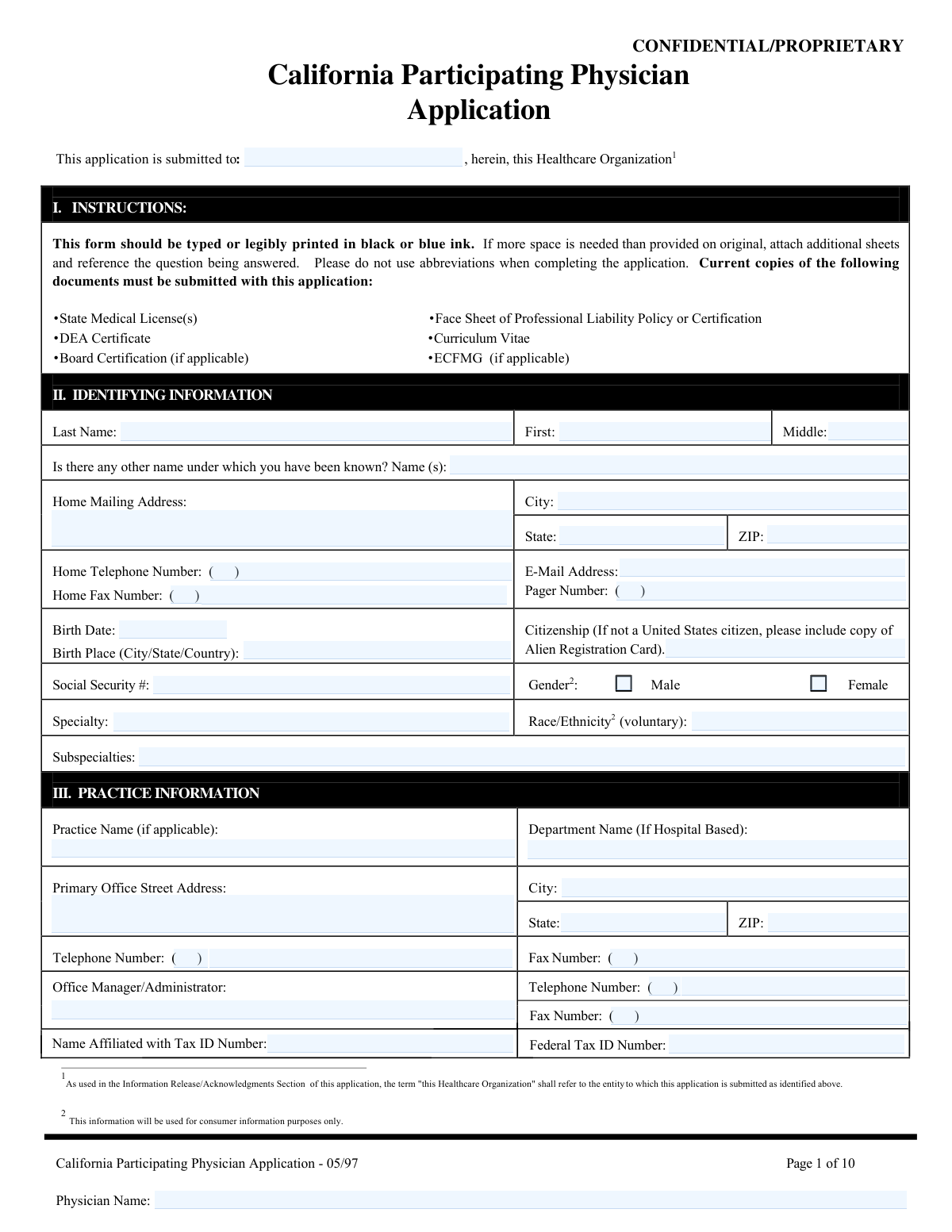
| 1. | California Participating Physician Application | 10 | Very Complex 85 |
| 2. | Form HFS 2243, Provider Enrollment Application Illinois Medical Assistance Program | 1 | Moderate 55 |
| 3. | Medically Prescribed Treatment (Non-Medication) Form — Provider Treatment Order Form | Office of School Health | School Year 2025–2026 | 2 | Complex 69 |
| 4. | Form WH-380-E, Certification of Health Care Provider | 4 | Moderate 59 |
- Enterprise-grade security & data encryption
- 99%+ accuracy powered by AI
- 1,000+ forms from all industries
- Complete forms in under 60 seconds
How to Choose the Right Form
Navigating medical provider forms can be complex, as they often bridge the gap between clinical diagnoses and administrative requirements for work or school. To ensure you select the correct document, first identify the primary setting where the medical information will be used.
Workplace and Employment Leave
If you are an employee seeking job-protected leave due to your own serious health condition, you will likely require the Form WH-380-E, Certification of Health Care Provider for Employee’s Serious Health Condition.
- Who it’s for: Employees covered under the Family and Medical Leave Act (FMLA).
- Purpose: This form allows your healthcare provider to certify the existence of a serious health condition, the duration of the illness, and whether you need continuous or intermittent leave.
- Key Detail: This form is for the *employee's* own health condition. If you are taking leave to care for a family member, a different version of the WH-380 is typically required.
School Health and Student Services
If you are a parent, guardian, or healthcare provider managing a student’s medical needs within a school environment, the Medically Prescribed Treatment (Non-Medication) Form is the appropriate choice.
- Who it’s for: Students attending school during the 2025–2026 school year who require specific clinical procedures (excluding medication) while on campus.
- Purpose: It documents treatment orders such as specialized feedings, catheterization, or other non-medication interventions that must be performed by school nurses or health staff.
- Key Detail: This form requires both a licensed practitioner’s clinical orders and a parent’s signed consent. It must be renewed annually to remain valid for the current school year.
Quick Summary
- Choose Form WH-380-E for U.S. Department of Labor FMLA requests related to your own medical inability to work.
- Choose the Medically Prescribed Treatment (Non-Medication) Form for coordinating student healthcare procedures with the Office of School Health.
Form Comparison
| Form | Primary Purpose | Target Individual | Setting | Key Requirements |
|---|---|---|---|---|
| Form WH-380-E, Certification of Health Care Provider for Employee’s Serious Health Condition under the Family and Medical Leave Act | Certifies a serious health condition to qualify for protected medical leave. | Employees needing time off for their own medical recovery. | Workplace environments governed by FMLA regulations. | Diagnosis, expected duration, and impact on essential job functions. |
| Medically Prescribed Treatment (Non-Medication) Form — Provider Treatment Order Form | Office of School Health | School Year 2025–2026 | Authorizes non-medication medical procedures for students during the school day. | Students requiring clinical procedures like glucose monitoring or catheterization. | Educational settings, school transportation, and school-sponsored trips. | Physician orders for procedures, emergency protocols, and parental consent signature. |
Tips for medical provider forms
Ensure the healthcare professional filling out the form is authorized to do so and that their contact details are legible. If the administrator needs to clarify a specific point, missing or incorrect contact information can cause significant delays in processing your request.
Avoid vague terms like 'as needed' without providing specific context for the treatment or leave. Specifying the expected frequency and duration helps administrators plan appropriately and reduces the chance of the form being returned for clarification.
Managing complex medical forms can be overwhelming, but AI-powered tools like Instafill.ai can complete these forms in under 30 seconds with high accuracy. Your data stays secure during the process, providing a practical and fast solution for those dealing with multiple medical documents.
Medical provider forms often require a dual-signature approach where both the clinician and the patient or parent must sign. Review the document carefully before submission to ensure no signature lines are left blank, as a missing signature is a common reason for rejection.
For school-based medical orders, ensure you are using the version intended for the upcoming school year to avoid expiration issues. Similarly, for employment forms, confirm you are using the most recent regulatory version to ensure the data captured meets current standards.
Before handing the completed form to an employer or school health office, always save a digital or physical copy for your records. This serves as a vital backup if the original document is misplaced and helps you track exactly what your provider documented.
Frequently Asked Questions
Medical provider forms are official documents used to verify a patient's health status, medical needs, or treatment requirements for third parties like employers or schools. They allow licensed healthcare professionals to certify specific conditions, such as the need for medical leave under the FMLA or the administration of specialized treatments in a school setting.
These forms are typically divided into two parts: a section for the patient (or parent/guardian) to provide personal details and consent, and a clinical section that must be completed by a licensed healthcare provider. The provider is responsible for filling out medical diagnoses, treatment parameters, and signing the document to verify the information's accuracy.
You will generally need these forms when requesting a formal accommodation or legal protection based on a medical condition. Common triggers include applying for serious health condition leave from work, requesting medical procedures during school hours, or providing documentation for insurance coverage of specific treatments.
Completed forms should be submitted directly to the requesting organization, such as your employer’s Human Resources department or the school’s Office of Health Services. In most cases, these forms contain sensitive information and should be handled as confidential medical records rather than being sent to general government agencies.
Yes, you can use AI tools like Instafill.ai to fill out medical provider forms. The AI can accurately extract relevant data from your existing medical records or source documents and place it into the correct fields, ensuring that the administrative portions of the form are completed quickly and correctly.
Using AI-powered services, filling out complex medical provider forms can take under 30 seconds. This technology significantly reduces the time spent on manual data entry by automatically populating patient information and clinical details from provided documentation.
Submitting an incomplete form can lead to significant delays in receiving benefits, leave, or medical services. Employers or schools may reject the document, requiring the patient to return to their healthcare provider for corrections, which can postpone the start of protected leave or necessary school-based medical care.
Many medical provider forms are only valid for a specific period, such as a single school year or the duration of a specific medical event. For ongoing conditions, you may be required to submit a new or recertified form annually or whenever there is a significant change in the treatment plan or health status.
Before your appointment, you should have the patient identification sections filled out and a clear understanding of the specific leave or treatment dates you are requesting. Bringing previous medical records or a summary of the health condition can also help your provider complete the clinical sections more efficiently.
Most modern organizations, including many schools and large employers, now accept digital signatures on medical documentation. However, it is always best to verify with the specific HR department or school health office to ensure they do not require a traditional handwritten 'wet' signature from the healthcare provider.
Glossary
- Form Complexity Index
- Instafill’s 0–100 measure of how much effort a form takes to complete, calculated deterministically from the form’s own structure rather than estimated. It combines the number of fillable fields (the largest factor), how difficult those fields are to complete based on their type, the number of pages that contain fields, the amount of conditional “fill-only-if” logic, and how many sections the form is divided into, then adds modifiers for tables and repeating lists, bundled instruction pages, and dense page layouts. A higher score means the form is harder to fill out by hand. The forms in this category have a median Form Complexity Index of 69/100 (Complex). See exactly how it is calculated.
- Medical Certification
- Official documentation provided by a health care professional that verifies a patient's medical condition and supports their request for leave or specific accommodations.
- FMLA (Family and Medical Leave Act)
- A federal law that provides eligible employees with unpaid, job-protected leave for specified family and medical reasons.
- Serious Health Condition
- An illness, injury, or physical/mental condition that involves either inpatient care in a medical facility or continuing treatment by a health care provider.
- Intermittent Leave
- FMLA leave taken in separate blocks of time for a single qualifying reason, rather than for one continuous period.
- Essential Job Functions
- The fundamental duties of a specific position that an employee must be able to perform, which are used to determine if a medical condition prevents them from working.
- Licensed Health Care Practitioner
- A medical professional, such as a doctor, nurse practitioner, or physician assistant, who is legally authorized by the state to diagnose and treat patients.
- Contraindications
- Specific circumstances or conditions under which a particular medical treatment or procedure should not be performed because it may harm the patient.
- Treatment Order
- A formal instruction from a medical provider detailing specific procedures or care that must be administered to a patient in a non-clinical setting, such as a school.