Fill out registry forms
with AI.
Registry forms are essential documents used by government and state agencies to maintain accurate records across various sectors, including healthcare, social services, and legal compliance. These forms serve as the primary mechanism for reporting critical data to centralized databases, ensuring that information is tracked systematically and transparently. Whether it is documenting patient enrollments in specialized treatment programs or maintaining safety standards through background check registries, these government forms play a vital role in public safety and regulatory oversight.
By continuing, you acknowledge Instafill's Privacy Policy and agree to get occasional product update and promotional emails.
About registry forms
Typically, these reporting forms are required by professionals such as clinic administrators, social workers, and licensing agents who must adhere to strict state and federal mandates. For instance, treatment facilities often use Central Registry Reporting forms to prevent dual enrollment in sensitive medical programs, while social service agencies utilize specific checklists to track background clearances and child abuse registry checks. Completing these compliance forms accurately is a matter of legal integrity, often involving detailed personal data and specific dates that must be logged correctly to avoid administrative delays or regulatory penalties.
Managing a high volume of paperwork can be a significant administrative burden for busy organizations. Tools like Instafill.ai use AI to fill these forms in under 30 seconds, ensuring that data is handled accurately and securely while saving valuable time for more critical professional tasks.
Every form on this page can be completed without typing. Instafill is form filling software that reads a PDF and fills it for you — including flat and scanned documents that carry no fillable fields at all.
Forms in This Category
The forms in this category have a median Form Complexity Index of 88/100 (Very Complex), measured across 2 forms by field count, input difficulty, length, conditional logic and structure. See how it is calculated.
| Form Name | Pages | FCI | |
|---|---|---|---|
| 1. | Central Registry Reporting Form | 1 | Basic 38 |
| 2. | Form GEN 1331, Criminal Record and Child Abuse Registry Checklist | 3 | Very Complex 88 |
- Enterprise-grade security & data encryption
- 99%+ accuracy powered by AI
- 1,000+ forms from all industries
- Complete forms in under 60 seconds
How to Choose the Right Form
Registry forms are essential for maintaining accurate records and ensuring compliance with state and federal regulations. Whether you are managing a healthcare facility or applying for a social services license, selecting the correct form is the first step toward regulatory approval.
Healthcare and Substance Abuse Treatment
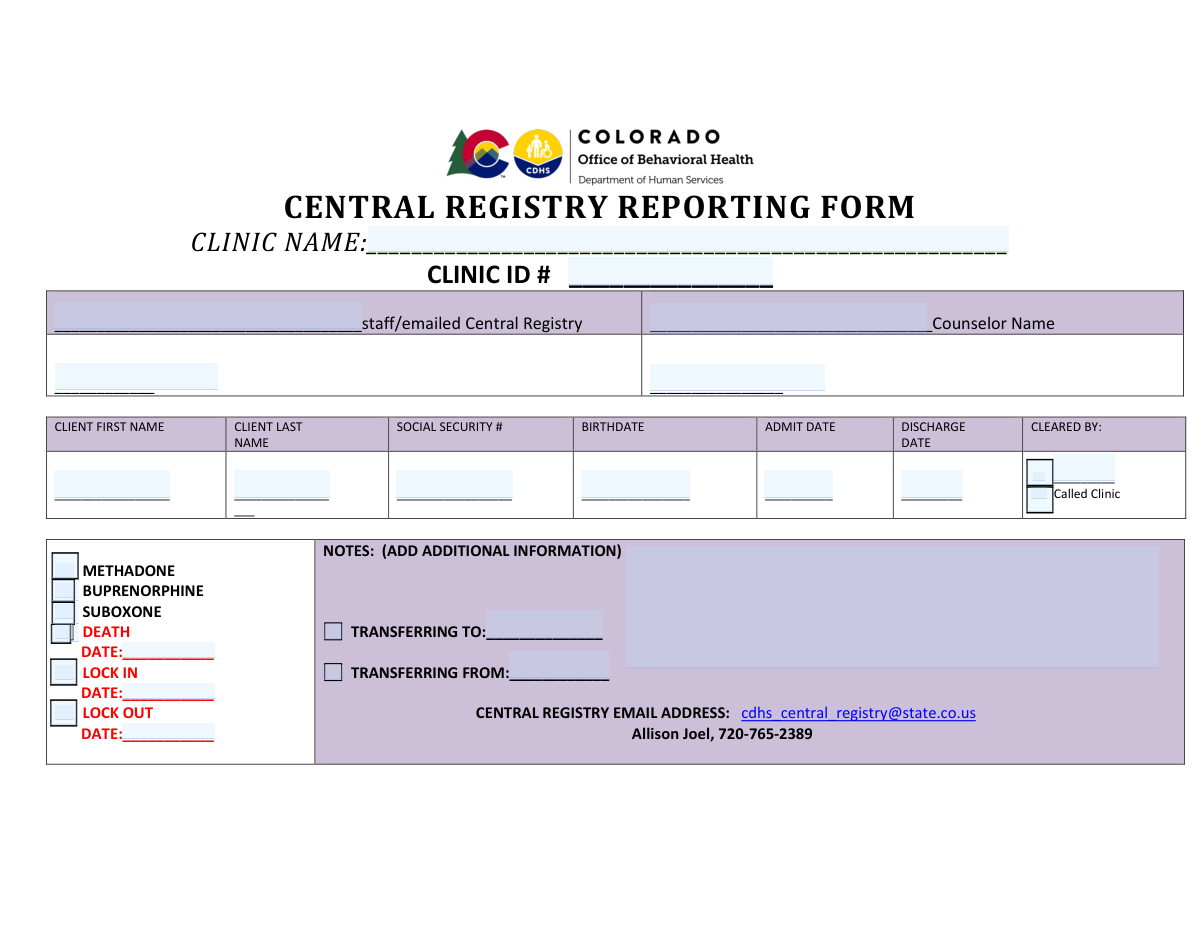
If you operate a clinic or treatment center, you likely need the Central Registry Reporting Form. This document is specifically designed for:
- Preventing Dual Enrollment: Reporting client admissions and discharges to ensure patients are not enrolled in multiple methadone or buprenorphine programs simultaneously.
- Data Accuracy: Tracking treatment types and client transfers to maintain a clean state record.
- Clinical Compliance: Meeting mandatory reporting requirements for substance abuse treatment facilities.
Background Checks and Social Service Licensing
If you are located in California and are involved in child care, foster care, or social service licensing, you will need Form GEN 1331, Criminal Record and Child Abuse Registry Checklist. Use this form to:
- Track Background Screenings: Organize and document the status of Live Scan results (DOJ, FBI, CACI) and Megan’s Law checks.
- Ensure Home Safety: Verify that all adults residing in or regularly present at a home have completed the necessary child abuse registry checks.
- Manage Licensing Applications: Keep a comprehensive checklist of mandatory screenings required for regulatory approval in California.
Summary of Differences
- Choose the Central Registry Reporting Form for patient-level reporting within the healthcare sector to monitor treatment enrollment.
- Choose Form GEN 1331 for administrative compliance and background check tracking in social service and residential care settings.
Using Instafill.ai, you can quickly complete these complex documents by uploading your data or converting static PDFs into interactive, AI-powered forms, ensuring your reporting is both timely and accurate.
Form Comparison
| Form | Primary Purpose | Who Files It | Key Information Tracked |
|---|---|---|---|
| Central Registry Reporting Form | Prevents dual enrollment in substance abuse programs by reporting client treatment data. | Clinics and substance abuse treatment facilities providing specialized medical care. | Admission and discharge dates, treatment types, and client transfer information. |
| Form GEN 1331, Criminal Record and Child Abuse Registry Checklist | Tracks mandatory background checks and registry screenings for licensing and safety compliance. | California social service agencies and licensing applicants for home-based care. | Live Scan results, Megan’s Law status, and out-of-state child abuse registry checks. |
Tips for registry forms
Registry forms rely heavily on precise identifiers like Social Security numbers, birth dates, and full legal names to prevent dual enrollment or record duplication. Double-check these fields against official identification to ensure your submission is processed correctly and does not trigger a compliance flag.
Many registry forms require exact dates for admissions, discharges, or background check submissions. Maintaining an internal log of these events allows you to fill out reporting forms quickly and ensures your records remain consistent with state or federal tracking systems.
AI-powered tools like Instafill.ai can complete complex registry forms in under 30 seconds with high accuracy, saving significant time for administrators. Your sensitive data stays secure during the process, providing a reliable way to handle multiple forms without the risk of manual entry errors.
For checklist-style registry forms, ensure you have documentation for every required screening level, such as DOJ, FBI, or out-of-state abuse registries. Missing a single check or failing to document a specific clearance date can stall the licensing or approval process for your facility.
Registry forms often serve as a summary of actions taken, such as Live Scan results or medical assessments. Gathering these supporting documents beforehand ensures you have all the necessary reference numbers and dates ready for entry, preventing the need to pause and search for records.
Registry and compliance forms are frequently reviewed during site visits or licensing renewals to ensure safety protocols are being followed. Always save a digital copy of your completed forms to provide immediate proof of reporting and compliance during an audit.
Frequently Asked Questions
Registry forms are primarily used by state agencies and healthcare providers to track specific data for public safety and regulatory compliance. These forms help prevent dual enrollment in medical programs and ensure that individuals working in sensitive environments have passed required background checks.
Responsibility typically falls on administrative staff at clinics, social service agencies, or licensing boards. For instance, treatment center staff must report client admissions to a central registry, while licensing agencies use checklists to verify the background status of applicants and residents.
Reporting ensures that patients receiving specialized treatments, such as substance abuse therapy, are not enrolled in multiple programs at once. This tracking is essential for patient safety, accurate record-keeping, and maintaining the integrity of state-monitored treatment data.
These checklists generally require tracking the status of Live Scan results from the DOJ and FBI, as well as clearances from child abuse indexes. You will typically need to document the dates when these screenings were requested and when the results were officially received by the agency.
Yes, AI tools like Instafill.ai can fill out these forms in under 30 seconds. The AI accurately extracts relevant data from your source documents and automatically places it into the correct fields on the PDF form.
Using traditional manual entry, these forms can take a significant amount of time due to the precise data required. However, with AI-powered services, the process is streamlined, allowing you to complete even complex checklists and reporting forms in less than half a minute.
Submission locations depend on the specific form and your state's regulations, but they are usually sent to the Department of Social Services or the state's health and human services department. Many agencies now accept digital submissions through secure portals or encrypted email.
A Megan’s Law check is a mandatory step in many registry checklists to ensure that individuals residing or working in licensed facilities are not registered sex offenders. Documenting this check is a critical part of the compliance process for child care and elder care licensing.
Incorrect data can lead to regulatory delays, the rejection of licensing applications, or errors in patient treatment tracking. It is vital to ensure that dates, identification numbers, and names match official government records exactly to avoid compliance issues.
While the general purpose of these forms is similar across the country, specific forms like the GEN 1331 are often unique to a particular state's licensing requirements. Always ensure you are using the version of the form mandated by the specific state agency you are reporting to.
Glossary
- Form Complexity Index
- Instafill’s 0–100 measure of how much effort a form takes to complete, calculated deterministically from the form’s own structure rather than estimated. It combines the number of fillable fields (the largest factor), how difficult those fields are to complete based on their type, the number of pages that contain fields, the amount of conditional “fill-only-if” logic, and how many sections the form is divided into, then adds modifiers for tables and repeating lists, bundled instruction pages, and dense page layouts. A higher score means the form is harder to fill out by hand. The forms in this category have a median Form Complexity Index of 88/100 (Very Complex). See exactly how it is calculated.
- Central Registry
- A centralized state database used to track and verify the enrollment of individuals in specific programs, such as substance abuse clinics, to maintain accurate records.
- Live Scan
- An electronic fingerprinting technique used to conduct background checks by sending digital prints directly to the Department of Justice or the FBI.
- Dual Enrollment
- The situation where a patient is registered in more than one treatment facility at once, which is monitored via registries to prevent safety risks.
- CACI (Child Abuse Central Index)
- A specialized registry that tracks individuals with substantiated reports of child abuse or neglect, often checked during licensing or employment.
- Megan’s Law
- A statute requiring the public disclosure of information regarding registered sex offenders to help protect communities and vulnerable populations.
- MAT (Medication-Assisted Treatment)
- A healthcare strategy that uses specific medications in conjunction with counseling to treat substance use disorders, often requiring registry reporting.
- DOJ/FBI Clearance
- A status indicating that a background check conducted through the Department of Justice or Federal Bureau of Investigation has been completed and reviewed.
- Out-of-State Registry Check
- A background verification performed in other jurisdictions to ensure an individual does not have a history of child abuse or criminal activity outside their current state.