Fill out residential permit forms
with AI.
Residential permit forms are official documents required by local governments before homeowners, contractors, or developers can legally begin construction, renovation, or other building work on a property. These forms serve a critical purpose: they allow municipalities and counties to verify that proposed projects comply with zoning regulations, building codes, setback requirements, and safety standards before any work begins. Whether you're adding an accessory structure, replacing major systems, or undertaking new construction, submitting the right permit application is a legal requirement — not an optional step.
By continuing, you acknowledge Instafill's Privacy Policy and agree to get occasional product update and promotional emails.
About residential permit forms
The people who typically need these forms include homeowners planning additions or renovations, licensed contractors working across multiple trades, property developers, and anyone applying for a change of use or utility connection. For example, a homeowner in Raleigh might need the City's Residential Permit Application to install a retaining wall or connect a water service line, while a contractor in Fauquier County might file a Building Trades Permit application to document the scope and valuation of a residential project. Each jurisdiction has its own form and requirements, which can make the process feel time-consuming.
Filling out these forms accurately is essential — errors can delay approvals or trigger resubmissions. Tools like Instafill.ai use AI to fill these forms in under 30 seconds, handling property details, contractor credentials, and project specifications accurately and securely, so you can focus on the work itself rather than the paperwork.
Every form on this page can be completed without typing. Instafill is form filling software that reads a PDF and fills it for you — including flat and scanned documents that carry no fillable fields at all.
Forms in This Category
The forms in this category have a median Form Complexity Index of 71/100 (Complex), measured across 3 forms by field count, input difficulty, length, conditional logic and structure. See how it is calculated.
- Enterprise-grade security & data encryption
- 99%+ accuracy powered by AI
- 1,000+ forms from all industries
- Complete forms in under 60 seconds
How to Choose the Right Form
Selecting the correct residential permit form depends primarily on your project's location and the specific nature of the work being performed. Because building codes and zoning laws vary by municipality, you must choose the form that corresponds to the local governing body where the property is located.
Location-Based Selection
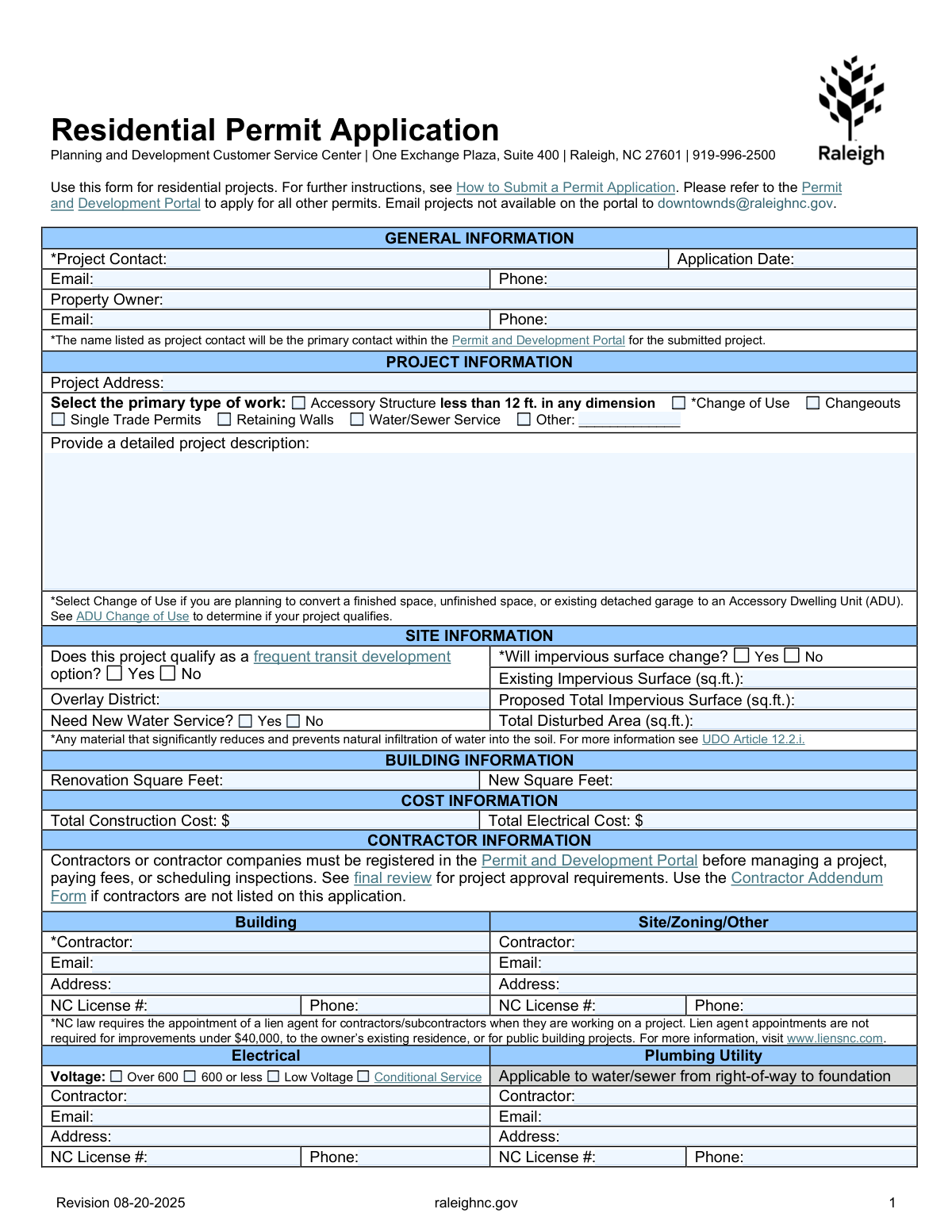
- City of Raleigh, NC: If your project is within Raleigh city limits, use the City of Raleigh Residential Permit Application (Revision 08-20-2025). This form is versatile, covering everything from new single-family home construction and accessory structures to smaller projects like retaining walls or water and sewer service changes.
- Fauquier County, VA: For projects in Fauquier County, the Fauquier County Department of Community Development – Building Trades Permit or Amendment to Existing Permit Application is the standard document. This form is used for both residential and commercial trade work (like electrical or plumbing) and is also the correct choice if you need to modify an existing permit.
Project Type and Scope
- New Structures vs. Repairs: The City of Raleigh Residential Permit Application is a comprehensive document that handles new construction as well as "changeouts" and single-trade work.
- Trade-Specific Work: If you are specifically focused on mechanical, electrical, or plumbing trades in Virginia, the Fauquier County Building Trades Permit captures the necessary contractor credentials and licensing information required for these specialized fields.
- Non-Residential Exception: While listed in this category, the County of Louisa Department of Community Development – New Non-Residential Building Permit Package is specifically for non-residential structures. Use this package only if your project involves commercial or community development zoning review in Louisa County.
Key Information Needed
Before you begin filling out these forms on Instafill.ai, ensure you have your tax map number, zoning district details, and contractor license numbers ready. Providing accurate square footage and estimated construction costs will help prevent delays during the zoning and building plan review process.
Tips for residential permit forms
Before filling out the form, cross-reference your site survey with local zoning requirements to ensure your project doesn't encroach on setbacks. Incorrect measurements are a common cause for application rejection or delays during the zoning review phase.
Most permit applications require valid state and local business license numbers for all trades involved, including electrical, plumbing, and mechanical. Having these credentials ready prevents you from needing to pause your application to track down subcontractor details.
AI-powered tools like Instafill.ai can complete these residential permit forms in under 30 seconds with high accuracy. Your data stays secure during the process, providing a massive time-saving advantage for developers or homeowners managing multiple applications.
Forms for many municipalities require specific data on how much land you are disturbing or covering with non-porous materials. Calculate these totals beforehand to ensure your project complies with local environmental and storm-water management regulations.
Avoid vague descriptions like 'renovation' and instead list specific actions, such as 'adding a 200 sq. ft. deck' or 'installing a retaining wall.' Clearer scopes help zoning and building staff categorize your permit correctly and reduce the need for follow-up questions.
If you are filing for multiple trades—such as building, electrical, and plumbing—ensure the project valuation and square footage match across all documents. Discrepancies between related forms can trigger manual reviews and significantly slow down the approval process.
Frequently Asked Questions
Residential permit forms are official documents used to request legal authorization from local government agencies for construction, renovations, or property additions. These forms ensure that proposed projects comply with safety codes, zoning laws, and environmental regulations before work begins.
You should submit your permit application well before any construction activity is scheduled to start on your property. Most jurisdictions require an approved permit before you can legally break ground, install structures, or perform significant electrical and plumbing work.
While the property owner is ultimately responsible for ensuring the project is permitted, the licensed contractor often handles the actual filing process. Both parties are usually required to provide information, such as the owner's contact details and the contractor's state license and insurance credentials.
Most applications require the property address, tax map or parcel identification number, and a detailed scope of work. You will also need to provide project valuations, square footage impacts, and specific details about the licensed tradespeople involved in the construction.
Yes, AI tools like Instafill.ai can fill these forms in under 30 seconds by accurately extracting data from your project documents and placing it into the correct fields. This technology helps ensure that complex details like contractor licenses and parcel IDs are transferred without manual entry errors.
Manually filling out detailed permit applications can take an hour or more, but using AI-powered services can complete the task in less than a minute. Tools like Instafill.ai can also convert static PDF versions of these permits into interactive, fillable forms for easier digital submission.
This depends on the local municipality; some areas use a single comprehensive permit application for all trades, while others require individual 'trade permits.' For example, Fauquier County provides a specific Building Trades Permit for these specialized types of construction activity.
A zoning review is a check performed by local officials to ensure your project respects property setbacks, easements, and land-use restrictions. Most residential permit applications include a section for zoning approval to verify that the structure is being built in a legal location on the lot.
Starting work without a permit can result in significant fines, 'stop-work' orders, and the potential requirement to tear down completed work that does not meet code. It can also create legal and financial complications if you attempt to sell the property in the future.
Requirements vary by location, but many cities and counties require permits for any structure over a certain square footage or any work that involves structural changes. Even minor trade work, such as water or sewer service changes, often requires a permit to ensure the work is inspected for safety.
Glossary
- Form Complexity Index
- Instafill’s 0–100 measure of how much effort a form takes to complete, calculated deterministically from the form’s own structure rather than estimated. It combines the number of fillable fields (the largest factor), how difficult those fields are to complete based on their type, the number of pages that contain fields, the amount of conditional “fill-only-if” logic, and how many sections the form is divided into, then adds modifiers for tables and repeating lists, bundled instruction pages, and dense page layouts. A higher score means the form is harder to fill out by hand. The forms in this category have a median Form Complexity Index of 71/100 (Complex). See exactly how it is calculated.
- Setback
- The minimum distance required by law between a building or structure and the property line, road, or other protected areas.
- Zoning District
- A designated geographic area that regulates how land can be used and what types of residential or commercial structures are allowed.
- Building Trades
- Specialized construction categories, such as electrical, plumbing, and mechanical work, that often require separate permits and inspections.
- Impervious Surface
- Any man-made surface that prevents rainwater from soaking into the ground, such as rooftops, driveways, and concrete patios.
- Disturbed Area
- The total square footage of land where the natural vegetation or soil is cleared, graded, or excavated during construction.
- Easement
- A legal right granted to another party, such as a utility company or the city, to access or use a specific portion of your property.
- Tax Map Number
- A unique identification number assigned to a specific parcel of land by the local assessor's office for tracking property records.
- Change of Use
- A permit required when the primary function of a building is altered, such as converting a residential garage into a living space or office.