Fill out small business forms
with AI.
Small business forms are essential for administrative compliance, tax status, and government reporting. They bridge the gap between a private entity and regulatory bodies like the IRS or the Department of Veterans Affairs. Whether you are changing your tax classification or reporting on subcontracting activities, these documents ensure your business operates within legal frameworks and can take advantage of specific tax benefits. Proper documentation is a cornerstone of business growth and regulatory transparency.
By continuing, you acknowledge Instafill's Privacy Policy and agree to get occasional product update and promotional emails.
About small business forms
These forms are typically used by business owners, accountants, and administrative professionals during critical transitions or annual reporting cycles. For example, a corporation might file Form 2553 to elect S-Corp status to avoid double taxation, while government contractors use forms like the 0896A to report on their involvement with veteran-owned businesses. Managing these requirements accurately is vital for maintaining good standing and ensuring that financial incentives or contract obligations are met without delay or legal friction.
Completing these complex business tax forms and IRS documents can be time-consuming and prone to manual error, especially when dealing with detailed financial data. Tools like Instafill.ai use AI to fill these forms in under 30 seconds, handling sensitive business data accurately and securely to streamline your administrative workflow. This allows entrepreneurs to spend less time on paperwork and more time building their companies.
Every form on this page can be completed without typing. Instafill is form filling software that reads a PDF and fills it for you — including flat and scanned documents that carry no fillable fields at all.
Forms in This Category
The forms in this category have a median Form Complexity Index of 48/100 (Moderate), measured across 3 forms by field count, input difficulty, length, conditional logic and structure. See how it is calculated.
| Form Name | Pages | FCI | |
|---|---|---|---|
| 1. | Form 2553, Election by a Small Business Corporation | 5 | Moderate 48 |
| 2. | Form SC-103, Fictitious Business Name (Small Claims) | 1 | Simple 27 |
| 3. | Form 0896A, Report of Subcontracts to Small and Veteran-Owned Business | 2 | Moderate 62 |
- Enterprise-grade security & data encryption
- 99%+ accuracy powered by AI
- 1,000+ forms from all industries
- Complete forms in under 60 seconds
How to Choose the Right Form
Choosing the right small business form depends on whether you are managing your company's federal tax structure or reporting on government contract participation. Below is a breakdown of the forms in this category to help you identify the correct document for your needs.
Electing S-Corporation Status
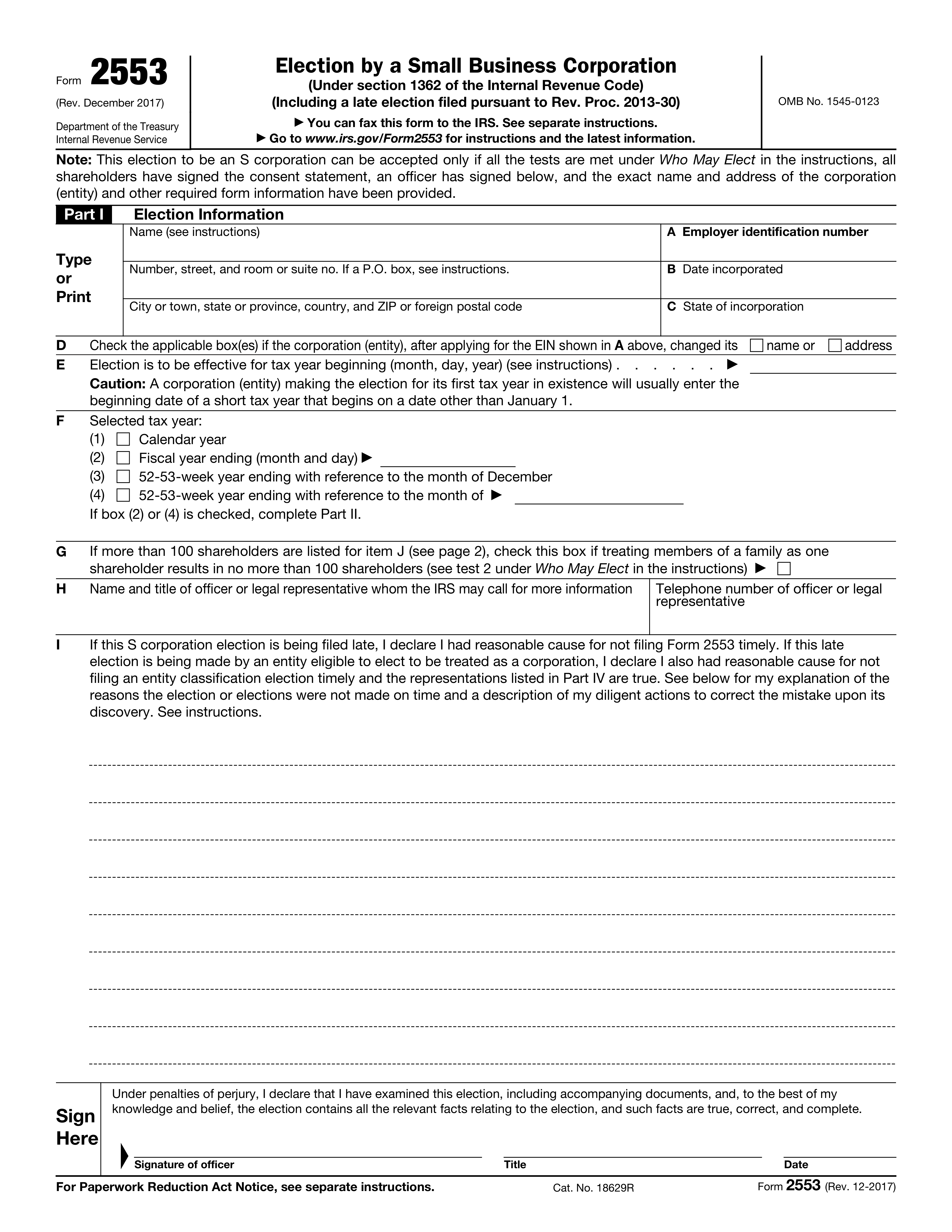
If your goal is to change how your business is taxed by the IRS, you will likely need Form 2553, Election by a Small Business Corporation. This form is used by eligible domestic corporations to elect S-Corp status, which allows corporate income, losses, and credits to pass through to shareholders for federal tax purposes. This is a critical step for small business owners looking to avoid double taxation on corporate earnings.
In this category, you will find two versions:
- Form 2553 (Election by a Small Business Corporation): The standard version used for making a timely election to be treated as an S-Corporation.
- Form 2553 (Rev. December 2017): A specific historical revision. While the standard form is generally preferred, some businesses may require the December 2017 revision for specific late-filing relief or to match historical tax year requirements as advised by a CPA.
Government Contracting and Subcontracting
If your business is involved in government work, particularly with the Department of Veterans Affairs (VA), your administrative requirements focus more on compliance and reporting than on tax status.
- Form 0896A, Report of Subcontracts to Small and Veteran-Owned Business: Choose this form if you are a prime contractor needing to report on subcontracts awarded to small and veteran-owned businesses. This form is essential for ensuring compliance with subcontracting plans and supporting small business participation goals within federal contracts.
Quick Selection Tips
- For Tax Benefits: Use Form 2553 if you want to be taxed as a pass-through entity rather than a C-Corp.
- For VA Compliance: Use Form 0896A if you are reporting subcontracting data to the Department of Veterans Affairs.
Form Comparison
| Form | Purpose | Who Files It | Key Benefit |
|---|---|---|---|
| Form 2553, Election by a Small Business Corporation | Elect S corporation status to pass income and losses to shareholders. | Eligible corporations or entities electing to be treated as corporations. | Avoids double taxation on corporate income for federal tax purposes. |
| Form 0896A, Report of Subcontracts to Small and Veteran-Owned Business | Reports subcontracts awarded to small and veteran-owned businesses. | Prime contractors working with the Department of Veterans Affairs (VA). | Ensures compliance with subcontracting plans and small business participation goals. |
| Form 2553 (Rev. December 2017), Election by a Small Business Corporation | Official IRS election for corporate pass-through tax treatment. | Corporations seeking S-corp status, including those needing late election relief. | Includes sections for fiscal year justification and shareholder consent requirements. |
Tips for small business forms
Many small business tax elections, such as Form 2553, must be filed within a specific window—typically two months and 15 days after the beginning of the tax year. Missing this window can lead to unfavorable tax treatment, so always check the effective date requirements before submitting.
For a corporation to successfully elect S-Corp status, every shareholder must provide their consent and signature on the form. Gathering these signatures in advance prevents last-minute delays and ensures the election is legally valid from your desired start date.
Manually entering business data into complex tax forms is time-consuming and prone to manual errors. AI-powered tools like Instafill.ai can complete these small business forms in under 30 seconds with high accuracy, ensuring your data stays secure throughout the entire process.
Double-check your Employer Identification Number (EIN) and legal business name against your official incorporation documents. Inconsistencies between your small business forms and IRS records are a leading cause of processing delays or rejected applications.
When reporting subcontracts to small or veteran-owned businesses on Form 0896A, always maintain records of the subcontractor's official certification status. This practice ensures your reports are accurate and helps your business remain compliant with federal subcontracting goals.
If you missed the initial filing deadline for an S-Corp election, check the specific sections of Form 2553 regarding relief for late elections. You may still be able to gain S-Corp status if you can provide a reasonable cause for the delay as defined by the IRS.
Keep digital copies of all submitted IRS and VA forms along with their filing receipts in a secure, centralized location. Having these documents organized makes it much easier to respond to audits or provide proof of status during business loan applications.
Frequently Asked Questions
Small business forms cover a variety of administrative, legal, and tax-related tasks necessary for operating a company. They are used to elect specific tax statuses with the IRS, report on government subcontracting goals, and ensure compliance with federal regulations regarding business structure and participation.
Generally, business owners, corporate officers, or authorized representatives like tax professionals are responsible for filing these documents. For specific forms like Form 0896A, government contractors may also be required to file reports regarding their subcontracting activities with small or veteran-owned businesses.
To elect S-Corp status, an eligible domestic corporation must file Form 2553, which requires the signatures and consent of all shareholders. This election allows the corporation's income, losses, and credits to pass through to shareholders for tax purposes, potentially avoiding double taxation on corporate earnings.
Yes, many small business forms have strict filing windows, such as the IRS requirement to file an S-Corp election within a certain timeframe at the start of the tax year. If a deadline is missed, the business may need to provide specific justifications or request late-election relief as outlined in the form instructions.
Yes, AI tools like Instafill.ai can be used to fill out various small business and tax forms. These tools can accurately extract data from your existing source documents and place it into the correct fields on the PDF in under 30 seconds.
When using an AI-powered platform, filling out these forms typically takes less than 30 seconds. The process is much faster than manual entry because the AI automatically identifies and maps the required information from your business records to the form fields.
Reporting subcontracts via forms like Form 0896A helps government agencies like the Department of Veterans Affairs track and verify that small and veteran-owned businesses are receiving a fair share of federal work. This data ensures that prime contractors are adhering to their agreed-upon subcontracting plans.
Most forms require basic business identifiers, such as the legal name of the entity, the Employer Identification Number (EIN), and the business address. Depending on the form, you may also need to provide shareholder names, social security numbers, and details regarding the effective date of the election or contract.
Submission methods vary by form; IRS forms are typically mailed to a specific service center based on your business's primary location, while other forms may be submitted electronically through agency-specific portals. Always check the current instructions for each form to ensure you are sending it to the correct department or contracting officer.
While many small business owners complete these forms themselves, consulting a professional can be helpful for complex elections like S-Corp status. However, using automated tools can help ensure that the data entered matches your official records accurately, which simplifies the self-filing process.
Glossary
- Form Complexity Index
- Instafill’s 0–100 measure of how much effort a form takes to complete, calculated deterministically from the form’s own structure rather than estimated. It combines the number of fillable fields (the largest factor), how difficult those fields are to complete based on their type, the number of pages that contain fields, the amount of conditional “fill-only-if” logic, and how many sections the form is divided into, then adds modifiers for tables and repeating lists, bundled instruction pages, and dense page layouts. A higher score means the form is harder to fill out by hand. The forms in this category have a median Form Complexity Index of 48/100 (Moderate). See exactly how it is calculated.
- S Corporation
- A specific tax designation for corporations that meet certain IRS requirements, allowing them to pass corporate income, losses, and credits through to their shareholders.
- Pass-Through Taxation
- A tax method where business income is not taxed at the corporate level but is instead reported on the individual tax returns of the business owners.
- Shareholder Consent
- The requirement that every shareholder of a corporation must sign and agree to the election of S corporation status for the filing to be valid.
- Fiscal Tax Year
- An accounting period of 12 consecutive months that ends on the last day of any month except December.
- Subcontracting Plan
- A mandatory document for certain government contractors detailing how they will involve small and veteran-owned businesses in their projects.
- QSST (Qualified Subchapter S Trust)
- A type of trust that is eligible to own stock in an S corporation, provided it meets specific IRS distribution and beneficiary requirements.
- Late Election Relief
- A provision that allows a business to request S corporation status even if they missed the standard filing deadline, usually requiring reasonable cause for the delay.
- SDVOSB (Service-Disabled Veteran-Owned Small Business)
- A business category used in government contracting for entities owned and controlled by veterans with service-connected disabilities.