
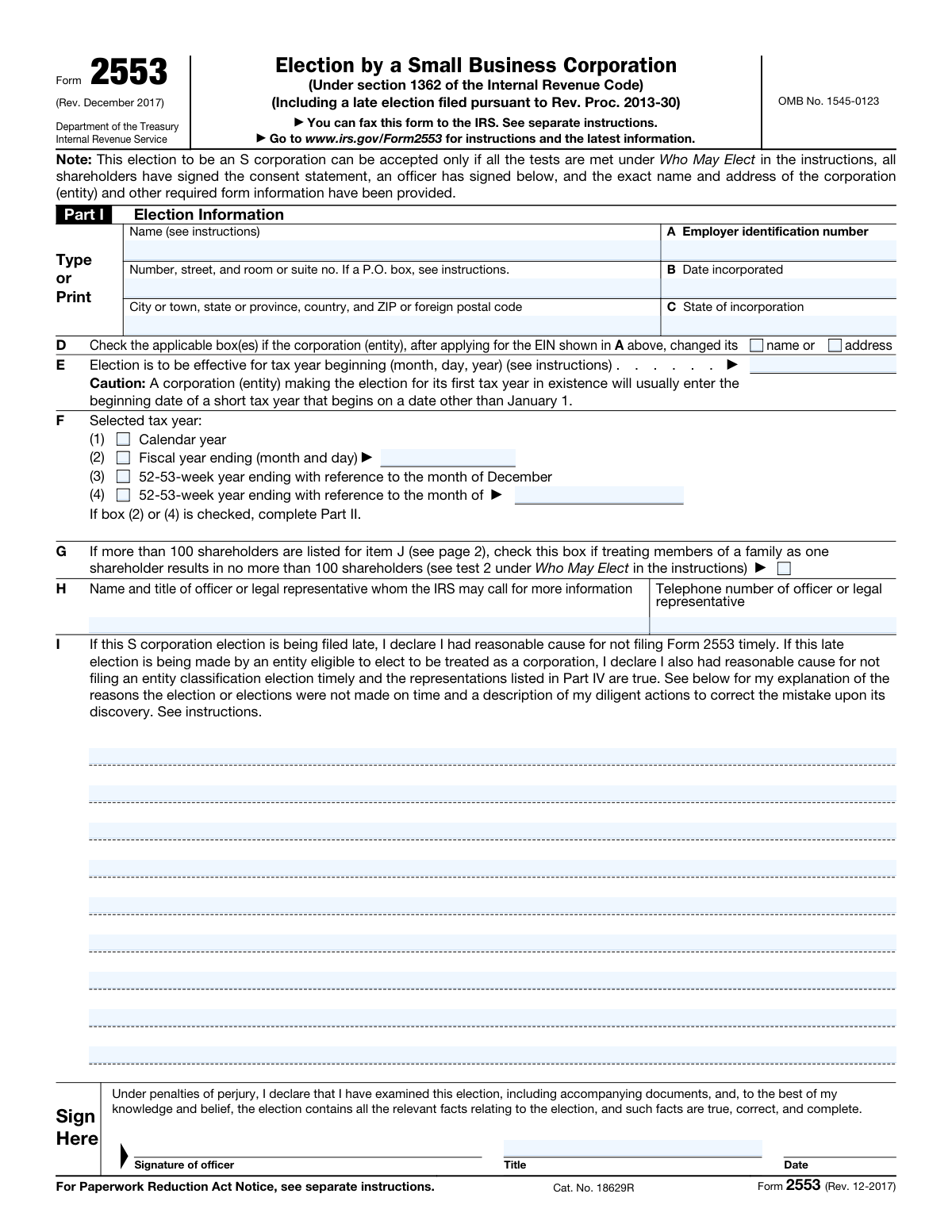
Yes! You can use AI to fill out Form 2553, Election by a Small Business Corporation
Don't type 100 fields by hand. Tell our AI about yourself, or upload a document you already have, and it fills every field in seconds. You check it, then download, print or sign.
The AI does the filling. You just check it.
No typing into boxes, nothing to install.
What this form asks for
The AI fills all of it, from your answers or your documents.
The AI checks your answers before you download
15 checks built for this form, so a wrong date or a missing answer is caught before anyone else sees it.
Ensures that the Form 2553 is submitted to the appropriate IRS address or fax number, which is determined by the corporation's principal business location. This validation is crucial for the timely processing of the form. It prevents delays or rejections due to incorrect submission channels. The AI software cross-references the corporation's location with the IRS's filing instructions to confirm accuracy.
Confirms that the corporation meets all eligibility criteria outlined in the 'Who May Elect' section of Form 2553. This includes verifying that every shareholder has provided their consent to the election by signing the consent statement. Additionally, it checks that an authorized officer of the corporation has signed the form, affirming the corporation's intent to elect S corporation status. This step is vital for ensuring the election's validity and compliance with IRS regulations.
Validates the accuracy of the corporation's identifying information as entered in Part I of Form 2553. This includes the corporation's exact legal name, current address, Employer Identification Number (EIN), date of incorporation, and state of incorporation. Ensuring this information is correct is essential for the IRS to process the election without issues. The AI software cross-checks this data against the corporation's official records to prevent discrepancies.
Verifies whether the corporation has experienced any changes in its name or address since obtaining its Employer Identification Number (EIN). If such changes have occurred, the AI software ensures that they are accurately reflected in Form 2553. This step is important for maintaining up-to-date records with the IRS and avoiding potential communication or processing errors. The software prompts for updates if discrepancies are detected.
Ensures that the effective date of the S corporation election is clearly specified on Form 2553. It also confirms that the correct tax year type—whether calendar year, fiscal year, or 52-53-week year—is selected, based on the corporation's accounting practices. This validation is critical for determining the start of the S corporation status and ensuring accurate tax reporting. The AI software checks for consistency between the selected tax year type and the corporation's fiscal records.
The validation ensures that when family members are treated as a single shareholder, the total number of shareholders does not exceed the limit of 100. This is crucial for maintaining the small business corporation status under the IRS regulations. It checks the shareholder count meticulously to prevent any discrepancies that could affect the corporation's eligibility. This step is vital for ensuring compliance with the S corporation requirements.
And 9 more checks
- Verifies that the name and title of an officer or legal representative whom the IRS may contact for more information, along with their telephone number, are provided.
- Confirms that, if filing a late election, a declaration of reasonable cause for not filing Form 2553 timely and an explanation are provided.
- Ensures that the form is signed and dated under penalties of perjury.
- Checks that Part II is completed if selecting a fiscal tax year, including any necessary representations or elections.
- Verifies that the form is completed in its entirety, with no sections left blank unless explicitly allowed by the instructions.
- Ensures that the form is submitted within the required timeframe, considering any extensions or special circumstances.
- Confirms that all accompanying documents and statements required by the instructions are attached.
- Validates that, if applicable, a Qualified Subchapter S Trust (QSST) election under section 1361(d)(2) is made in Part III.
- Ensures that, if applicable, representations for a late corporate classification election are made in Part IV.
Let AI fill out your Form 2553
No typing. Every field filled in seconds, checked, ready to sign.
How to Fill Out Form 2553 Online for Free in 2026
What the AI walks you through.
- Visit instafill.ai and select Form 2553.
- Enter corporation's name and address.
- Provide Employer Identification Number (EIN).
- Select tax year and fiscal year details.
- List all shareholders and obtain consents.
- Sign and date the form electronically.
- Check for accuracy and submit the form.
Common Mistakes in Completing Form 2553
The ones the AI is built to catch.
Incorrect or missing Employer Identification Number (EIN)
Failure to meet all 'Who May Elect' tests
Missing or incorrect shareholder consents
Incorrect or missing corporation name and address
Failure to indicate name or address change after EIN application
Incorrect or missing effective date of election
Failure to specify tax year type correctly
Incorrect treatment of family members as one shareholder
Missing or incorrect officer/representative contact information
Failure to declare reasonable cause for late election
Missing or incorrect signatures and dates
Incomplete Part II for fiscal tax year selection
Incorrect or missing QSST election in Part III
Incomplete or incorrect Part IV for late corporate classification
Failure to attach required documents and statements
Frequently Asked Questions About Form 2553
Is it really free for 7 days?
Can I fill other forms too?
How do I cancel?
How does the AI fill out Form 2553?
What happens to my information?
How complex is Form 2553 to fill out?
What is Form 2553 and who needs to file it?
How do I determine where to file Form 2553 based on my corporation's location?
Can Form 2553 be faxed to the IRS, and what are the fax numbers?
What are the requirements for a corporation to be eligible to elect S corporation status?
What information is required in Part I of Form 2553?
How do I indicate a change in the corporation's name or address on Form 2553?
What is the significance of the effective date for the S corporation election?
How do I select a tax year for the S corporation on Form 2553?
What should I do if my corporation has more than 100 shareholders?
What is the process for making a late S corporation election on Form 2553?
What are the penalties for perjury related to Form 2553?
How do shareholders consent to the S corporation election on Form 2553?
What information is required for each shareholder in Part I of Form 2553?
How do I complete Part II of Form 2553 for selecting a fiscal tax year?
What is a Qualified Subchapter S Trust (QSST) election, and how is it made on Form 2553?
What are the representations required for a late corporate classification election in Part IV of Form 2553?
Can I request a fiscal tax year based on a business purpose on Form 2553?
What is a section 444 election, and how is it made on Form 2553?
What should I do if I need more space to list shareholders on Form 2553?
Where can I find the latest instructions and information for Form 2553?
Get your Form 2553 filled out by AI
$0 today. Cancel before Nov 1 and you pay nothing.
Other forms like this one
business forms: Form 8829, Expenses for Business Use of Your Home, Form 990-T, Exempt Org Business Income Tax Return, Form 1415, Visitor Visa - Business Stream, Form 0896A, Report of Subcontracts to Small and Veteran-Owned Business, Lifestyle Protector – Risk New Business for Multiple Lives Assured (LPMLA 04/2024), Form 5472 (Rev. December 2023), Information Return of a 25% Foreign-Owned U.S. Corporation or a Foreign Corporation Engaged in a U.S. Trade or Business, DBPR CILB 6-B, Application for Certified Building Contractor Who is Qualifying a Business, Schedule C (Form 1040), Profit or Loss From Business (Sole Proprietorship) (2017), Form 8822-B, Change of Address or Responsible Party — Business, Form 8822-B (Rev. December 2019), Change of Address or Responsible Party — Business, DBPR CILB 6-A, Application for Certified General Contractor Who is Qualifying a Business, Schedule C (Form 1040), Profit or Loss From Business (Sole Proprietorship), American Express Business Travel Account Set-Up Form Hong Kong, American Express Business Travel Account Set-Up Form Hong Kong, Transamerica Life Insurance Company - New Business Cover Sheet, Fidelity® Brokerage Business Account Certification, Merrill Edge® Self‑Directed Business Investor Account (BIA Account) Account Application Booklet and Agreements, Merrill Business Investor Account (BIA) and Working Capital Management Account (WCMA) Account Application Booklet and Agreements, Application for business rates for self-catering properties in England, Los Angeles County Department of Consumer and Business Affairs Tenant Application for Adjustment
small business forms: Form 0896A, Report of Subcontracts to Small and Veteran-Owned Business, Form SC-103, Fictitious Business Name (Small Claims)
Let AI fill out your Form 2553
Your trial starts once a card is added. You pay nothing before Nov 1.
Our AI already knows this form, all 100 fields of it. Skip the typing: tell it about yourself, or upload what you have, and it fills the whole form in seconds.
- AI fills every field on all 4 pages, checkboxes included
- No typing into boxes: answer a few questions, or upload a document you already have, an old copy of this form, a photo of a document
- The AI checks the answers; you review and change anything before you download
- Download the finished PDF, print it, or sign it online
- Encrypted, and never used to train AI
Cancel before Nov 1 and you pay nothing.
A card is needed to start the trial. Cancel in two clicks from your account.
Terms · Privacy