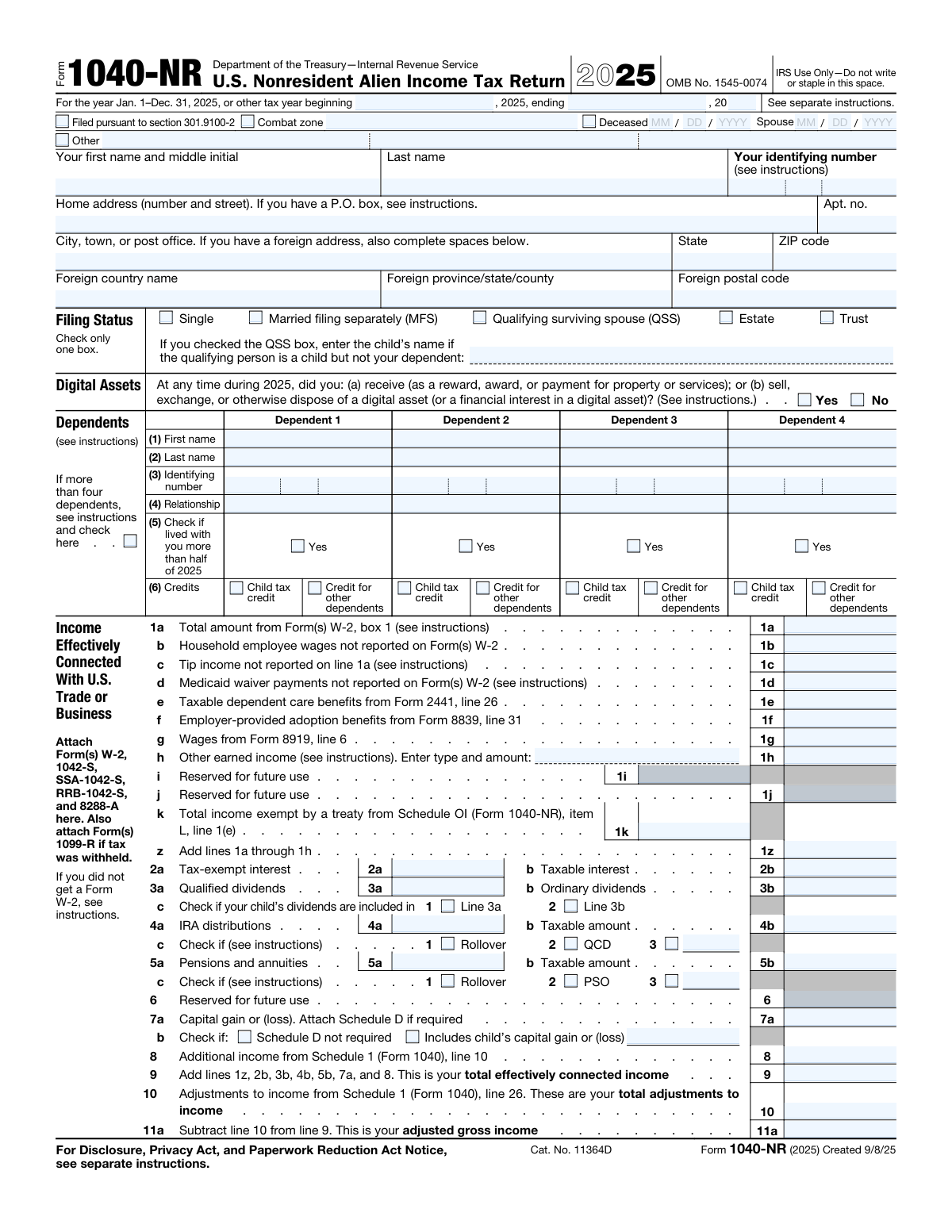
Yes! You can use AI to fill out Form 1040-NR, U.S. Nonresident Alien Income Tax Return
Form 1040-NR, the U.S. Nonresident Alien Income Tax Return, is the standard federal income tax form for nonresident aliens who have earned income from U.S. sources or are engaged in a trade or business in the United States. It is crucial for reporting income, calculating tax liability, and claiming any applicable deductions or credits. Today, this form can be filled out quickly and accurately using AI-powered services like Instafill.ai, which can also convert non-fillable PDF versions into interactive fillable forms.
Our AI automatically handles information lookup, data retrieval, formatting, and form filling.
It takes less than a minute to fill out 1040-NR using our AI form filling.
Securely upload your data. Information is encrypted in transit and deleted immediately after the form is filled out.
Form specifications
| Form name: | Form 1040-NR, U.S. Nonresident Alien Income Tax Return |
| Number of fields: | 171 |
| Number of pages: | 2 |
| Language: | English |
| Categories: | income forms, income tax forms, tax forms |
Instafill Demo: How to fill out PDF forms in seconds with AI
How to Fill Out 1040-NR Online for Free in 2026
Are you looking to fill out a 1040-NR form online quickly and accurately? Instafill.ai offers the #1 AI-powered PDF filling software of 2026, allowing you to complete your 1040-NR form in just 37 seconds or less.
Follow these steps to fill out your 1040-NR form online using Instafill.ai:
- 1 Navigate to Instafill.ai and upload or select Form 1040-NR.
- 2 Provide your personal information, including your name, address, and identifying number (SSN or ITIN).
- 3 Select your filing status and provide information for any dependents you are claiming.
- 4 Use the AI assistant to input all income effectively connected with a U.S. trade or business, as well as any income not effectively connected.
- 5 Enter all applicable adjustments, deductions, and tax credits to accurately calculate your total tax or refund.
- 6 Carefully review the entire form auto-filled by the AI to ensure all information is correct and complete.
- 7 Sign the form electronically and submit it to the IRS according to the filing instructions.
Our AI-powered system ensures each field is filled out correctly, reducing errors and saving you time.
Why Choose Instafill.ai for Your Fillable 1040-NR Form?
Speed
Complete your 1040-NR in as little as 37 seconds.
Up-to-Date
Always use the latest 2026 1040-NR form version.
Cost-effective
No need to hire expensive lawyers.
Accuracy
Our AI performs 10 compliance checks to ensure your form is error-free.
Security
Your personal information is protected with bank-level encryption.
Frequently Asked Questions About Form 1040-NR
Form 1040-NR is the U.S. Nonresident Alien Income Tax Return. You must file this form if you are a nonresident alien who engaged in a trade or business in the United States, or if you have other U.S. income on which the tax was not fully paid by withholding.
You should attach forms that show your income and any federal tax withheld, such as Form W-2, Form 1042-S, Form 1099-R (if tax was withheld), and Form 8288-A. Refer to the "Attach Form(s)" section on the first page for a complete list.
Effectively connected income is earned from a U.S. trade or business and is taxed at graduated rates on page 1 of the form. Other income, like certain U.S. dividends or interest not connected to a business, is reported on Schedule NEC and taxed at a flat rate.
You may be able to claim dependents if they are a U.S. citizen, U.S. national, or a resident of the U.S., Canada, or Mexico. You will need to provide their name, identifying number (SSN or ITIN), and relationship to you in the 'Dependents' section.
You should use your Social Security Number (SSN) if you have one. If you are not eligible for an SSN, you must apply for and use an Individual Taxpayer Identification Number (ITIN) from the IRS.
You must check 'Yes' if you received, sold, exchanged, or otherwise disposed of a digital asset (like cryptocurrency) during the tax year. This question helps the IRS track transactions involving virtual currencies and other digital assets.
If a tax treaty between your home country and the U.S. exempts some of your income, you must report this on Schedule OI (Form 1040-NR). The total exempt amount is then entered on line 1k of Form 1040-NR.
Generally, no, as a nonresident alien you cannot file a joint return. Your filing status will typically be 'Single' or 'Married filing separately,' unless you qualify for a specific exception.
No, the IRS can only direct deposit refunds into a U.S. bank account. If you do not have a U.S. bank account, you can request a paper check be mailed to your foreign address by leaving the direct deposit section blank.
The mailing address depends on whether you are enclosing a payment or not. Always check the official IRS website or the separate instructions for Form 1040-NR for the most current and correct mailing address for your situation.
Yes, services like Instafill.ai use AI to accurately auto-fill form fields from your existing data, which can save you significant time and reduce errors. This helps ensure your personal and financial information is entered correctly.
You can use a service like Instafill.ai to complete the form online. Simply upload the form, and the platform will make it fillable, allowing you to type your information directly into the fields before printing for submission.
You can use a tool like Instafill.ai to make the form interactive. Instafill.ai can convert flat, non-fillable PDFs into fillable forms, so you can easily type your information instead of printing and filling it out by hand.
Compliance 1040-NR
Validation Checks by Instafill.ai
1
Exclusive Filing Status Selection
Verifies that only one box is checked in the 'Filing Status' section (Single, MFS, QSS, Estate, Trust). Selecting multiple statuses is a logical impossibility and indicates a user error. A submission with more than one filing status selected must be flagged for correction before it can be processed.
2
Taxpayer Identifying Number (TIN) Format Validation
Checks if the 'Your identifying number' field contains a 9-digit number in a valid Social Security Number (SSN) or Individual Taxpayer Identification Number (ITIN) format. This is critical for the IRS to correctly identify the taxpayer and process the return. An invalid or missing TIN will result in the rejection of the filing.
3
QSS Child Name Requirement
Ensures that if the 'Qualifying surviving spouse (QSS)' filing status is selected, the corresponding 'child’s name' field is populated. This name is required to validate the QSS status claim. Failure to provide the child's name when claiming QSS will lead to processing delays or rejection of the filing status.
4
Mutually Exclusive Domestic and Foreign Address Fields
Validates that if a 'Foreign country name' is provided, the U.S. 'State' and 'ZIP code' fields are left blank. This prevents contradictory address information which can cause mail to be misdirected or the return to be flagged for review. The system should enforce that only one address type (domestic or foreign) is fully completed.
5
Dependent Credit Exclusivity Check
Verifies that for each dependent listed, either the 'Child tax credit' box or the 'Credit for other dependents' box is checked, but not both. A single dependent cannot qualify for both credits simultaneously. This check prevents incorrect credit calculations and potential rejection of the claimed credits by the IRS.
6
Dividend Consistency Check
Verifies that the amount entered for Qualified Dividends (Line 3a) is less than or equal to the amount entered for Ordinary Dividends (Line 3b). Qualified dividends are a subset of ordinary dividends, so this logical check prevents a common data entry error. An invalid entry would lead to incorrect tax calculations, as these two types of dividends are taxed at different rates.
7
Taxable Distribution Amount Consistency
Validates that the taxable amount of IRA distributions (Line 4b) does not exceed the total IRA distributions (Line 4a), and that the taxable amount of pensions (Line 5b) does not exceed the total pensions (Line 5a). The taxable portion can be equal to or less than the total, but never more. This check prevents a logical error that would result in over-taxation and likely trigger an IRS review.
8
Line 9 Total Effectively Connected Income Calculation
Confirms that the value in Line 9 is the correct sum of lines 1z, 2b, 3b, 4b, 5b, 7a, and 8. This is a critical calculation for determining the taxpayer's total income base. An incorrect sum will cause all subsequent calculations, including AGI and total tax, to be wrong, leading to an inaccurate return.
9
Line 15 Taxable Income Calculation and Non-Negativity
Validates that the amount on Line 15 is correctly calculated by subtracting Line 14 from line 11b, and that the result is not less than zero. This calculation determines the final income amount upon which tax is assessed. An error here directly impacts the tax liability and can lead to underpayment or overpayment issues.
10
Line 33 Total Payments Calculation
Verifies that the value in Line 33 is the correct sum of lines 25d, 25e, 25f, 25g, 26, and 32. This total is essential for determining if the taxpayer has overpaid, underpaid, or paid the exact amount of tax. An incorrect total will lead to an erroneous refund or amount owed calculation.
11
Mutually Exclusive Refund and Amount Owed
Ensures that either Line 34 (Amount you overpaid) or Line 37 (Amount you owe) has a value greater than zero, but not both. A taxpayer cannot simultaneously be owed a refund and owe additional tax on the same return. This check prevents a fundamental logical contradiction in the final outcome of the tax filing.
12
Overpayment Allocation Validation
Ensures that the sum of the amount to be refunded (Line 35a) and the amount to be applied to the next year's estimated tax (Line 36) is exactly equal to the total amount overpaid (Line 34). This check guarantees that the taxpayer has accounted for the entire overpayment amount. Any discrepancy would leave the overpayment unallocated and cause processing errors or delays.
13
Direct Deposit Information Completeness and Format
Checks that if an amount is entered on Line 35a for a refund, then the Routing Number (35b), Account Number (35d), and account type are all provided. The routing number must also be validated for its 9-digit format. Missing or incomplete banking information will prevent the direct deposit from being processed, causing the IRS to issue a paper check instead, which significantly delays the refund.
14
Third Party Designee Information Requirement
Validates that if the 'Yes' box is checked in the 'Third Party Designee' section, then the 'Designee's name,' 'Phone no.,' and 'Personal identification number (PIN)' fields are all completed. This information is required for the IRS to authenticate and speak with the designated person. Failure to provide these details makes the authorization invalid and will be ignored by the IRS.
Common Mistakes in Completing 1040-NR
Nonresident aliens have restricted filing status options, typically limited to 'Single' or 'Married Filing Separately.' Filers often mistakenly choose statuses like 'Head of Household' or 'Married Filing Jointly' (unless a specific election is made), which are generally reserved for U.S. residents. This error leads to incorrect tax calculations, processing delays, and likely rejection of the return, requiring the filer to submit an amended return. To avoid this, carefully review the 1040-NR instructions for filing status eligibility.
Filers must provide a valid Social Security Number (SSN) or Individual Taxpayer Identification Number (ITIN). Common mistakes include entering an expired ITIN, transposing numbers, or leaving the field blank. Using an invalid TIN for the filer or any listed dependents will cause the IRS to reject the return or disallow any related exemptions or credits, significantly delaying refunds and processing. Ensure your TIN is current and entered exactly as issued.
Most nonresident aliens are not eligible for the standard deduction and must itemize deductions on Schedule A (Form 1040-NR). A frequent error is claiming the standard deduction, with the only major exception being for students and business apprentices from India under the U.S.-India tax treaty. Claiming the standard deduction when ineligible will result in the IRS disallowing it, leading to a higher tax liability, a balance due notice, and potential underpayment penalties.
Many nonresidents are eligible for tax treaty benefits but fail to report them correctly on Line 1k and the required Schedule OI (Form 1040-NR). Filers often forget to attach Schedule OI, enter the wrong treaty article, or miscalculate the exempt amount. Without proper documentation, the IRS will disallow the treaty claim, resulting in a higher tax bill and a notice of deficiency. It is crucial to accurately complete and attach all required forms to claim treaty benefits.
Form 1040-NR is for reporting income 'effectively connected' with a U.S. trade or business (ECI), while 'not effectively connected' income (NEC) is taxed separately on Schedule NEC. A common error is mixing these income types, such as reporting NEC portfolio interest on the main form. This misclassification leads to the income being taxed at incorrect progressive rates instead of the flat 30% (or lower treaty) rate, causing an incorrect tax liability and potential IRS inquiries.
The rules for claiming dependents are much stricter for nonresident aliens; dependents must generally be residents of the U.S., Canada, or Mexico and have a valid TIN. Filers often claim dependents who do not meet these residency requirements or attempt to claim credits like the Child Tax Credit (CTC) for which they are ineligible. This leads to the disallowance of the claimed dependents and credits, increasing the tax owed and causing significant processing delays.
The form has separate, specific fields for a foreign address, including country, province, and postal code. Filers frequently try to squeeze their entire foreign address into the U.S. address lines or use incorrect abbreviations. An improperly formatted address can cause critical IRS correspondence, refund checks, or notices to be lost or delayed indefinitely. Use the designated foreign address fields and follow the country's standard postal format.
Filers must accurately report taxes withheld from various sources like Forms W-2, 1042-S, and 8288-A on the correct lines (25a-25g). It's common to lump all withholding onto one line, forget to attach the corresponding forms, or misread the amounts from the source documents. These errors can cause the IRS to question the withholding credits claimed, delaying any refund until the amounts can be verified. Always double-check amounts and attach all required withholding documents.
The question about digital asset transactions is often misunderstood, leading filers to check 'No' incorrectly. The question applies if you received, sold, exchanged, or disposed of a digital asset, not just if you realized a gain or loss. Answering this question incorrectly can flag the return for review and may result in penalties for filing an inaccurate return. Taxpayers must carefully consider all their digital asset activities for the year before answering.
The direct deposit section (lines 35b-35d) is exclusively for U.S. bank accounts and requires a valid U.S. routing and account number. Nonresident filers often mistakenly enter information for their foreign bank account, which will cause the direct deposit to fail. The IRS will then default to mailing a paper check, significantly delaying the refund and introducing the risk of the check being lost or difficult to cash abroad. If you do not have a U.S. bank account, you should expect a paper check.
Saved over 80 hours a year
“I was never sure if my IRS forms like W-9 were filled correctly. Now, I can complete the forms accurately without any external help.”
Kevin Martin Green
Your data stays secure with advanced protection from Instafill and our subprocessors

Robust compliance program
Transparent business model
You’re not the product. You always know where your data is and what it is processed for.
ISO 27001, HIPAA, and GDPR
Our subprocesses adhere to multiple compliance standards, including but not limited to ISO 27001, HIPAA, and GDPR.
Security & privacy by design
We consider security and privacy from the initial design phase of any new service or functionality. It’s not an afterthought, it’s built-in, including support for two-factor authentication (2FA) to further protect your account.
Fill out 1040-NR with Instafill.ai
Worried about filling PDFs wrong? Instafill securely fills form-1040-nr-us-nonresident-alien-income-tax-return forms, ensuring each field is accurate.