Hip and Thigh Conditions Disability Benefits Questionnaire Completed Form Examples and Samples
Explore comprehensive examples of filled Hip and Thigh Conditions Disability Benefits Questionnaires (DBQs). See how detailed medical reports, including Range of Motion (ROM) measurements, diagnoses, surgical history, and functional impacts, are accurately translated into VA disability forms. Ideal for veterans, medical professionals, and advocates seeking detailed samples for hip and thigh disability claims.
Hip and Thigh Conditions Disability Benefits Questionnaire has a very complex Form Complexity Index of 100/100 — Instafill’s AI completes it in under a minute.
Form Complexity Index
Very Complex
100 / 100
| Fillable fields | 725 |
| Pages | 13 |
| Fields per page | 56 |
| Sections | 172 |
| Conditional rules | 508 |
| Tables & lists | 15 |
| Instruction pages | — |
| Instafill Form ID | IF-HIP-AND-THIGH-CONDITIONS-DISABILITY-BENEFITS-QUEST |
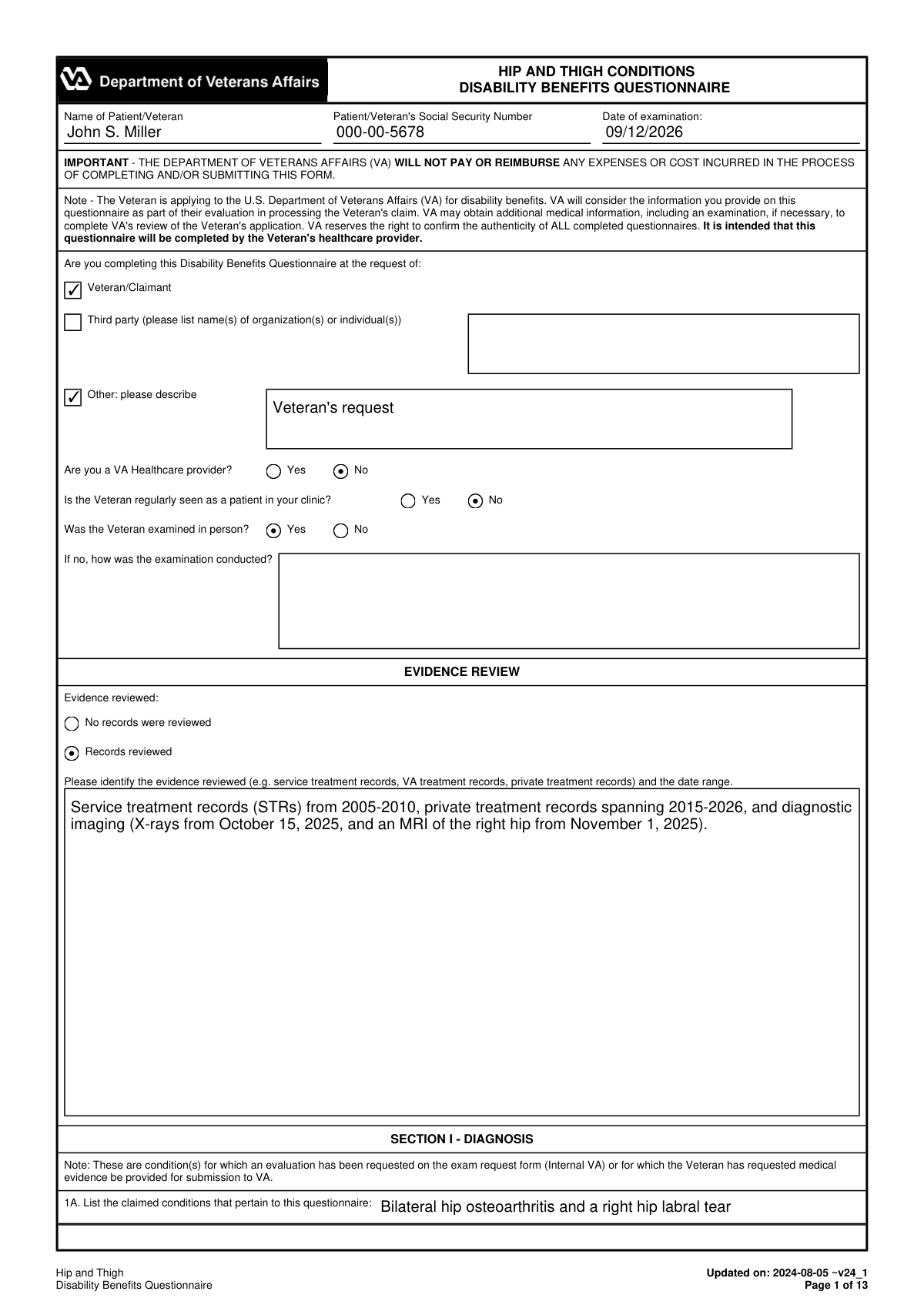
Filled Example: Hip and Thigh Conditions Disability Benefits Questionnaire
How this form was filled:
Our AI efficiently extracted extensive medical details from a detailed Independent Medical Examination Report and automatically populated the Hip and Thigh Conditions Disability Benefits Questionnaire. This includes specific ROM measurements, diagnostic codes, surgical history, and functional impacts, demonstrating robust data interpretation for complex medical forms.
Source document used: Independent Medical Examination Report
Patient: John S. Miller, SSN: 000-00-5678.
Date of Examination: September 12, 2026.

This evaluation is being completed at the Veteran's request for disability benefits related to his hip and thigh conditions. I am not a VA Healthcare provider, nor is Mr. Miller a regularly seen patient in my clinic; he was referred for this independent medical examination. The examination was conducted in person.

**Evidence Reviewed:**
A comprehensive review of Mr. Miller's medical history was performed, including service treatment records (STRs) from 2005-2010, private treatment records spanning 2015-2026, and diagnostic imaging (X-rays from October 15, 2025, and an MRI of the right hip from November 1, 2025).

**Section I - Diagnosis:**
Mr. Miller presents with claimed conditions of bilateral hip osteoarthritis and a right hip labral tear.
*   **Osteoarthritis, hip:** Both sides. ICD: M16.9. Diagnosed: Right hip - October 15, 2025; Left hip - March 20, 2026.
*   **Femoral acetabular impingement syndrome (includes labral tears):** Right side. ICD: M24.151. Diagnosed: Right hip - October 15, 2025.

**Section II - Medical History:**
Mr. Miller reports chronic bilateral hip pain since his military service, which has progressively worsened over the past decade. He recalls a specific fall during a deployment in 2008 as the initial onset of significant right hip discomfort.
He experiences frequent flare-ups, describing them as intense, sharp pain coupled with stiffness and significantly limited mobility. These flare-ups typically last 2-3 days and occur approximately monthly. They are often precipitated by prolonged standing or heavy lifting and are only somewhat alleviated by rest and over-the-counter NSAIDs.
He reports significant functional impairment, particularly in walking long distances, climbing stairs, and getting in and out of low chairs. Bending and lifting, essential for his previous occupation as a warehouse supervisor, are also severely impacted.

**Section III - Range of Motion (ROM) and Functional Limitation:**
**Right Hip:**
Initial ROM measurements were abnormal. The range of motion itself contributes to functional loss. Active ROM: Flexion 100 degrees, Extension 10 degrees, Abduction 30 degrees, Adduction 15 degrees, External Rotation 40 degrees, Internal Rotation 20 degrees. Pain was noted on all active motions. Passive ROM was performed, and the endpoints were similar to active ROM. Pain was present on all passive motions.
Objective crepitus was noted in the right hip. Localized tenderness was evident on palpation over the greater trochanter and anterior joint line.
Repetitive use testing was performed, and there was additional loss of function. After three repetitions: Flexion 80 degrees, Extension 5 degrees, Abduction 20 degrees, Adduction 10 degrees, External Rotation 30 degrees, Internal Rotation 10 degrees. Limitation in adduction after repetitive use prevents him from crossing his legs. Factors contributing: Pain, Weakness, Fatigability.
Based on Veteran's statements and medical records, after repeated use over time, estimated ROM: Flexion 70 degrees, Extension 0 degrees, Abduction 15 degrees, Adduction 5 degrees, External Rotation 25 degrees, Internal Rotation 5 degrees. This also prevents crossing legs. Evidence cited: Patient self-report, prior physician notes documenting chronic pain progression, and observed gait abnormalities. During flare-ups (estimated from history): Flexion 60 degrees, Extension 0 degrees, Abduction 10 degrees, Adduction 0 degrees, External Rotation 20 degrees, Internal Rotation 0 degrees. Factors: Pain, Weakness. This prevents crossing legs. Evidence cited: Patient's detailed symptom diary and emergency room visits for acute pain exacerbations.
**Left Hip:**
Initial ROM measurements were abnormal. Active ROM: Flexion 110 degrees, Extension 15 degrees, Abduction 35 degrees, Adduction 20 degrees, External Rotation 45 degrees, Internal Rotation 25 degrees. Pain was noted on flexion and abduction. Passive ROM was performed, and the endpoints were similar to active ROM. Pain was present on flexion and abduction. No objective crepitus or localized tenderness was noted on the left.
Repetitive use testing was performed, and there was additional loss of function. After three repetitions: Flexion 90 degrees, Extension 10 degrees, Abduction 25 degrees, Adduction 15 degrees, External Rotation 35 degrees, Internal Rotation 15 degrees. Factors contributing: Pain, Fatigability.
Based on Veteran's statements and medical records, after repeated use over time, estimated ROM: Flexion 85 degrees, Extension 5 degrees, Abduction 20 degrees, Adduction 10 degrees, External Rotation 30 degrees, Internal Rotation 10 degrees. Evidence cited: Patient self-report and previous physical therapy evaluations. During flare-ups (estimated from history): Flexion 75 degrees, Extension 0 degrees, Abduction 15 degrees, Adduction 5 degrees, External Rotation 25 degrees, Internal Rotation 5 degrees. Factors: Pain, Weakness. Evidence cited: Patient's anecdotal reports and consistency with documented pain levels.

**3E. Additional factors contributing to disability:** Interference with standing, Disturbance of locomotion, Weakened movement, Instability of station, Interference with sitting.

**Section IV - Muscle Atrophy:**
**Right Hip:** Yes, muscle atrophy is present due to the claimed condition. Measurement taken 10cm above the patella. Normal side circumference: 45 cm. Atrophied side circumference: 42 cm.
**Left Hip:** No muscle atrophy noted.

**Section VII - Surgical Procedures:**
**Right Hip:** Arthroscopic ligament repair performed on January 20, 2026. Residuals include persistent pain and stiffness in the right hip.
**Left Hip:** No surgery.

**Section VIII - Other Pertinent Physical Findings:**
Mr. Miller presents with chronic right hip tenderness and a visibly altered gait, favoring his right leg. He has surgical scars from the arthroscopic procedure on his right hip.

**Section IX - Assistive Devices:**
Mr. Miller regularly uses a cane for ambulation, primarily due to his right hip osteoarthritis and labral tear.

**Section X - Remaining Effective Function:**
No, the functional impairment is not equivalent to amputation with prosthesis.

**Section XI - Diagnostic Testing:**
Imaging studies were performed:
*   X-rays on October 15, 2025, documented degenerative arthritis in both hips.
*   MRI of the right hip on November 1, 2025, confirmed a labral tear and advanced degenerative changes. These findings are clearly related to the diagnosed bilateral hip osteoarthritis and right FAI/labral tear.

**Section XII - Functional Impact:**
The conditions severely impact his ability to perform occupational tasks. He has difficulty with prolonged standing (more than 30 minutes), lifting objects over 10 pounds, climbing ladders, and sitting for extended periods (more than an hour). These limitations directly affect his capacity to return to his previous role as a warehouse supervisor.

**Section XIII - Remarks:**
Remarks for Section I: The MRI findings significantly support the diagnosis of femoral acetabular impingement syndrome with a labral tear in the right hip.
Remarks for Section III: The patient consistently reported significant pain during all active and passive movements of the right hip, correlating with objective findings of crepitus and tenderness. The estimated ROMs during repeated use and flare-ups are based on the veteran's detailed history, symptom diaries, and medical probability given the documented severity of his conditions.

**Section XIV - Examiner's Certification and Signature:**
Dr. Emily R. Carter, MD, Orthopedic Surgeon.
Area of Practice: Orthopedics.
Date Signed: September 12, 2026.
Phone/Fax: (555) 123-4567 / (555) 123-4568.
NPI: 1234567890.
Medical license: 987654 in CA.
Address: 100 Ortho Plaza, Suite 200, Los Angeles, CA 90001.
Information used to fill out the document:
- Patient Demographics: John S. Miller, SSN: XXX-XX-5678
- Examination Details: September 12, 2026, In-person, Non-VA provider
- Diagnoses: Bilateral Hip Osteoarthritis (M16.9), Right Femoral Acetabular Impingement Syndrome/Labral Tear (M24.151)
- Right Hip ROM (Initial/Repetitive/Flare-up): Flexion: 100°/80°/60°, Extension: 10°/5°/0°, Abduction: 30°/20°/10°, Adduction: 15°/10°/0°, External Rotation: 40°/30°/20°, Internal Rotation: 20°/10°/0°
- Left Hip ROM (Initial/Repetitive/Flare-up): Flexion: 110°/90°/75°, Extension: 15°/10°/0°, Abduction: 35°/25°/15°, Adduction: 20°/15°/5°, External Rotation: 45°/35°/25°, Internal Rotation: 25°/15°/5°
- Muscle Atrophy: Right hip (10cm above patella, normal 45cm, atrophied 42cm)
- Surgical History: Right Hip Arthroscopic Ligament Repair (January 20, 2026)
- Assistive Devices: Cane, regular use, for right hip osteoarthritis and labral tear
- Functional Impact: Difficulty with prolonged standing, lifting >10lbs, climbing ladders, prolonged sitting, affects former warehouse supervisor role
- Diagnostic Imaging: X-rays (10/15/2025) showing bilateral OA; MRI Right Hip (11/01/2025) confirming labral tear and degenerative changes
- Examiner Details: Dr. Emily R. Carter, MD, Orthopedic Surgeon, NPI: 1234567890, License: 987654 CA, Address: 100 Ortho Plaza, Suite 200, Los Angeles, CA 90001
What this filled form sample shows:
- Precisely extracted and categorized multiple Range of Motion (ROM) measurements (initial, post-repetitive use, estimated during flare-ups) for both right and left hips.
- Accurately identified and listed multiple distinct hip diagnoses, including specific ICD codes and diagnosis dates for each side affected.
- Detailed parsing of medical history, including symptom onset, chronic course, and specific descriptions of flare-up characteristics (frequency, duration, triggers, alleviation, severity).
- Extraction of specific surgical procedures, dates, and documented residuals, linking them to the affected side.
- Quantified muscle atrophy with location and measurements for both normal and atrophied sides.
- Synthesized diagnostic testing information (X-rays, MRI) with dates and key findings, directly relating them to the diagnosed conditions.
Form specifications and details:
| Use Case: | Veteran applying for disability benefits for chronic hip conditions (osteoarthritis, labral tear) |
| Source Document: | Independent Medical Examination Report |
| Categories: | disability forms, benefit forms, disability benefits forms |
| Created: | March 10, 2026 04:07 AM |