Fill out EDD forms
with AI.
The California Employment Development Department (EDD) forms are essential documents for any business operating within the state of California. This category covers a wide range of state tax, payroll, and employment-related filings that ensure compliance with local labor laws and tax regulations. These forms are vital because they govern how state income tax is withheld, how unemployment insurance is managed, and how payroll data is reported to the government. Accurate completion of these documents is necessary to avoid state penalties and ensure that employees receive the correct benefits and tax treatments.
By continuing, you acknowledge Instafill's Privacy Policy and agree to get occasional product update and promotional emails.
About EDD forms
Typically, these forms are required by business owners, HR administrators, and new employees during the onboarding process. For instance, an employee might need to complete the Form DE 4 to specify their state withholding allowances, which is a distinct requirement from federal tax forms. Whether you are managing seasonal hiring or standard quarterly payroll reporting, these documents facilitate the necessary flow of information between private entities and the state.
Navigating these administrative requirements can be a heavy burden for busy professionals. Tools like Instafill.ai use AI to fill these forms in under 30 seconds, handling your data accurately and securely to save you valuable time. By automating the data entry process, you can ensure that even complex state-specific forms are completed correctly without the manual effort usually required for government paperwork.
Every form on this page can be completed without typing. Instafill is form filling software that reads a PDF and fills it for you — including flat and scanned documents that carry no fillable fields at all.
Forms in This Category
The forms in this category have a median Form Complexity Index of 82/100 (Very Complex), measured across 8 forms by field count, input difficulty, length, conditional logic and structure. See how it is calculated.
| Form Name | Pages | FCI | |
|---|---|---|---|
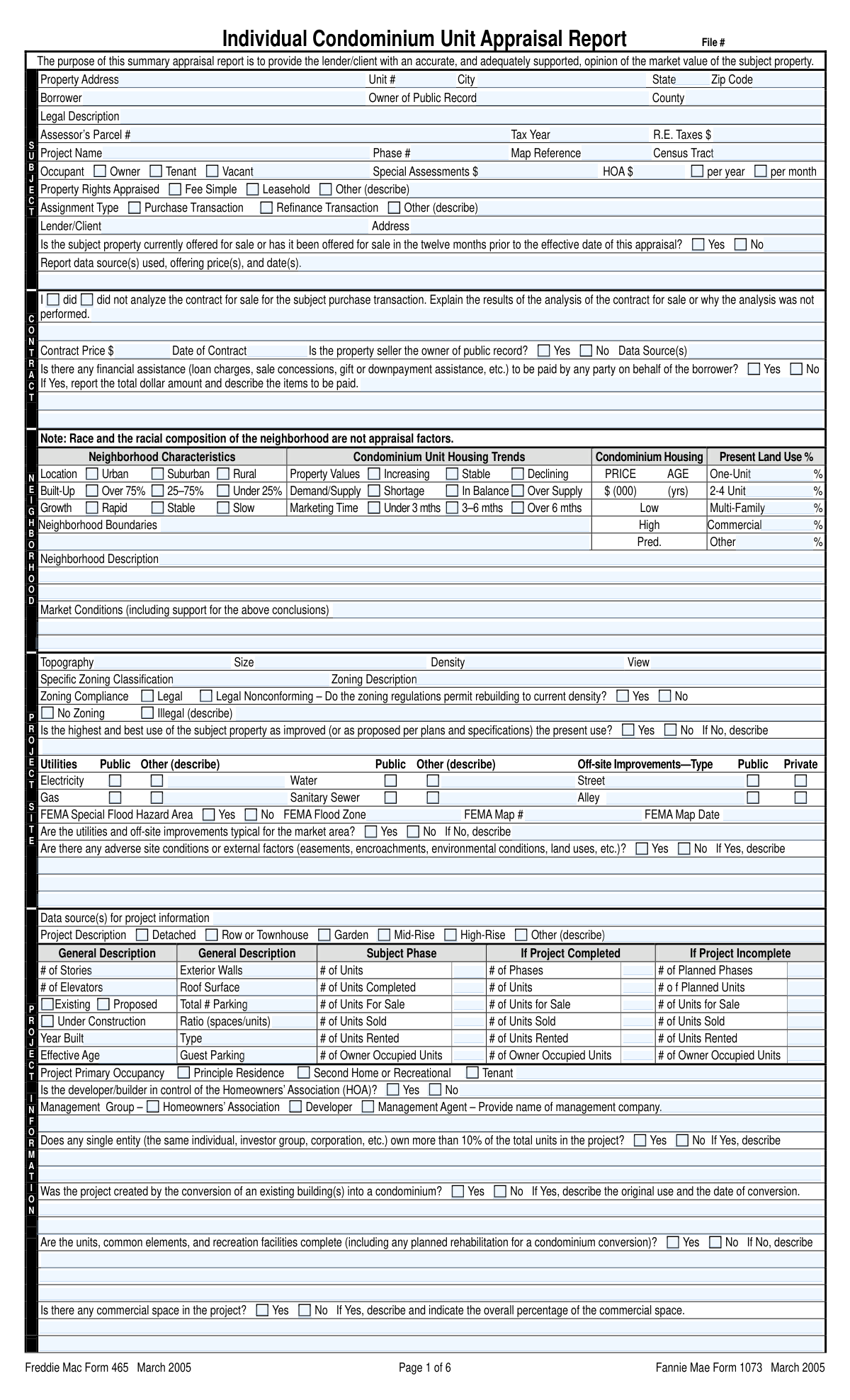
| 1. | Fannie Mae Form 1073 / Freddie Mac Form 465, Individual Condominium Unit Appraisal Report | 7 | Very Complex 86 |
| 2. | Form DE 4, Employee’s Withholding Allowance Certificate (Rev. 56) | 4 | Moderate 46 |
| 3. | Uniform Residential Appraisal Report (Fannie Mae Form 1004 / Freddie Mac Form 70) | 6 | Very Complex 82 |
| 4. | Uniform Residential Loan Application (Fannie Mae Form 1003 / Freddie Mac Form 65) | 3 | Moderate 46 |
| 5. | Uniform Residential Loan Application, Fannie Mae Form 1003 / Freddie Mac Form 65 | 9 | Very Complex 97 |
| 6. | Uniform Residential Loan Application (Freddie Mac Form 65 / Fannie Mae Form 1003) | 9 | Very Complex 92 |
| 7. | Uniform Residential Loan Application (Freddie Mac Form 65 / Fannie Mae Form 1003) | 1 | Complex 64 |
| 8. | Uniform Underwriting and Transmittal Summary (Fannie Mae Form 1008 / Freddie Mac Form 1077) | 1 | Complex 68 |
- Enterprise-grade security & data encryption
- 99%+ accuracy powered by AI
- 1,000+ forms from all industries
- Complete forms in under 60 seconds
How to Choose the Right Form
Navigating California state payroll requirements and residential mortgage documentation involves distinct sets of paperwork. Whether you are an employee starting a new job or a borrower seeking a home loan, choosing the correct form is essential for compliance and financial accuracy.
California State Tax & Payroll
If you are an employee working in California, you likely need Form DE 4, the Employee’s Withholding Allowance Certificate. While the federal W-4 handles national taxes, the Form DE 4 is specifically for the California Employment Development Department (EDD). Use this form to calculate and authorize the correct amount of state income tax to be withheld from your wages to avoid underpayment penalties.
Applying for a Residential Mortgage
For individuals seeking to purchase or refinance a home, the Uniform Residential Loan Application (Fannie Mae Form 1003 / Freddie Mac Form 65) is the primary document. This comprehensive application is used by almost all U.S. lenders to gather your identity, employment history, assets, and debts. It is the industry standard for assessing a borrower's creditworthiness for a residential mortgage.
Professional Mortgage & Appraisal Forms
If you are a real estate professional or working within the lending industry, you will require specialized reporting and summary tools:
- Uniform Residential Appraisal Report (Fannie Mae Form 1004): This is the standard document used by professional appraisers to provide a detailed analysis and opinion of a property's market value for a lender.
- Uniform Underwriting and Transmittal Summary (Fannie Mae Form 1008 / Freddie Mac Form 1077): This form is used by lenders to consolidate and summarize critical loan data, qualifying ratios, and risk assessments into a single package for secondary market delivery.
By identifying whether your task is related to California state payroll or a real estate transaction, you can quickly select the appropriate document from this list and use our AI tools to fill it out accurately.
Form Comparison
| Form | Purpose | Primary User | Key Information |
|---|---|---|---|
| Form DE 4, Employee’s Withholding Allowance Certificate | Determines California state income tax withholding amounts from employee paychecks. | Employees working in California. | Filing status, number of allowances, and additional withholding amounts. |
| Uniform Residential Appraisal Report (Fannie Mae Form 1004 / Freddie Mac Form 70) | Provides a detailed analysis and opinion of a property's market value. | Licensed real estate appraisers. | Property condition, neighborhood analysis, and comparison with recent similar sales. |
| Uniform Residential Loan Application (Fannie Mae Form 1003 / Freddie Mac Form 65) | Standardized application used by borrowers to apply for a mortgage loan. | Mortgage loan applicants. | Borrower assets, liabilities, employment history, income, and property details. |
| Uniform Residential Loan Application (Freddie Mac Form 65 / Fannie Mae Form 1003) | Collects comprehensive financial data to evaluate creditworthiness for residential mortgages. | Homebuyers and refinancing homeowners. | Identity verification, debt-to-income ratios, and loan-specific declarations. |
| Uniform Underwriting and Transmittal Summary (Fannie Mae Form 1008 / Freddie Mac Form 1077) | Consolidates critical loan data for delivery to the secondary mortgage market. | Mortgage lenders and underwriters. | Risk assessment findings, qualifying ratios, and borrower income summaries. |
Tips for EDD forms
Always ensure you are using Form DE 4 specifically for California state tax withholding rather than relying solely on the federal W-4. California has unique allowance calculations and tax rates that must be documented separately to ensure the correct amount of state tax is withheld from your paycheck.
The most frequent cause for processing delays in EDD and payroll forms is a transposed digit in a Social Security Number or Employer Account Number. Verify these identifiers against official documents before submission to avoid administrative errors or potential underpayment penalties.
Managing multiple state tax or loan application forms can be time-consuming, but AI-powered tools like Instafill.ai can complete these forms in under 30 seconds with high accuracy. Your data stays secure during the process, providing a practical and fast solution for anyone dealing with high volumes of paperwork.
For employers, it is critical that the data on an employee's DE 4 matches your internal payroll system exactly. Discrepancies between the allowances an employee claims and what is reported to the EDD can lead to reconciliation errors during your quarterly state tax filings.
California payroll and withholding forms should be retained for several years to comply with standard record-keeping practices. Store digital copies of all completed forms in an organized, encrypted folder to ensure you are prepared for future audits or financial reviews.
Personal financial situations, such as a change in dependents or homeownership status, can impact your tax liability. Reviewing and updating your withholding forms at the start of each year helps ensure your employer is withholding the correct amount, preventing unexpected tax bills.
Frequently Asked Questions
EDD forms are used by the California Employment Development Department to manage state-level payroll taxes, disability insurance, and unemployment benefits. These documents ensure that employers and employees comply with state labor laws and that the correct amount of tax is withheld from paychecks.
While the federal W-4 determines federal income tax withholding, the DE 4 is specific to California state income tax. Because state tax laws and allowances often differ from federal regulations, the DE 4 ensures your employer deducts the correct amount for California's specific tax brackets.
Yes, AI tools like Instafill.ai can fill out EDD forms and other payroll documents in under 30 seconds. The AI accurately extracts data from your source documents and places it into the correct fields, ensuring high accuracy and saving time on manual data entry.
Most individuals working in California must complete these forms when they begin a new job or when their personal financial situation changes. Employers use this information to calculate state tax withholdings, which are then reported to the Employment Development Department.
Manually filling out complex payroll or loan forms can take 20 minutes or more, but using an AI-powered service reduces this time significantly. These tools can process and populate a standard form in less than a minute by automatically identifying where information like income and assets should be placed.
It is best practice to update your withholding forms whenever you experience a major life event, such as a change in marital status or the addition of a dependent. You may also want to file a new form if you find that you are consistently owing money or receiving a large refund at the end of the tax year.
In most cases, these forms are submitted directly to your employer's human resources or payroll department rather than being sent to a government agency. Your employer is responsible for maintaining these records and using the data to process your state tax withholdings correctly.
Standardized mortgage forms like the Uniform Residential Loan Application (1003) are used by lenders to assess a borrower's creditworthiness and financial stability. They are often grouped with payroll forms because both require detailed verification of income and employment status to satisfy regulatory requirements.
While many official websites provide these forms as static documents, online platforms can convert them into interactive fillable PDFs. This allows you to type directly into the fields on your computer or mobile device, eliminating the need for printing and handwriting.
A loan application generally requires a comprehensive look at your financial life, including current employment details, monthly income, a list of assets, and a summary of your outstanding debts. Having these documents organized allows automated tools to quickly and accurately transfer the data into the official application form.
Glossary
- Form Complexity Index
- Instafill’s 0–100 measure of how much effort a form takes to complete, calculated deterministically from the form’s own structure rather than estimated. It combines the number of fillable fields (the largest factor), how difficult those fields are to complete based on their type, the number of pages that contain fields, the amount of conditional “fill-only-if” logic, and how many sections the form is divided into, then adds modifiers for tables and repeating lists, bundled instruction pages, and dense page layouts. A higher score means the form is harder to fill out by hand. The forms in this category have a median Form Complexity Index of 82/100 (Very Complex). See exactly how it is calculated.
- EDD (Employment Development Department)
- The California state agency responsible for managing unemployment insurance, disability insurance, and the collection of payroll taxes.
- Withholding Allowance
- A value used on state tax forms to calculate the specific amount of income tax an employer should deduct from an employee's paycheck.
- PIT (Personal Income Tax)
- A California state tax withheld by employers from employee wages based on the information provided on the DE 4 form.
- DE 4
- The California Employee’s Withholding Allowance Certificate used to ensure state-specific tax withholdings are accurate, separate from the federal W-4.
- URLA (Uniform Residential Loan Application)
- The industry-standard document, also known as Form 1003, used by lenders to collect financial and employment information from mortgage applicants.
- Underwriting
- The process where a lender reviews a borrower's financial profile and the property's value to determine the risk of providing a mortgage.
- SDI (State Disability Insurance)
- A state-mandated program in California that provides partial wage replacement to workers who are unable to work due to non-work-related illness or injury.
- ETT (Employment Training Tax)
- An employer-paid tax in California intended to fund training programs that improve the skills of the state's workforce.