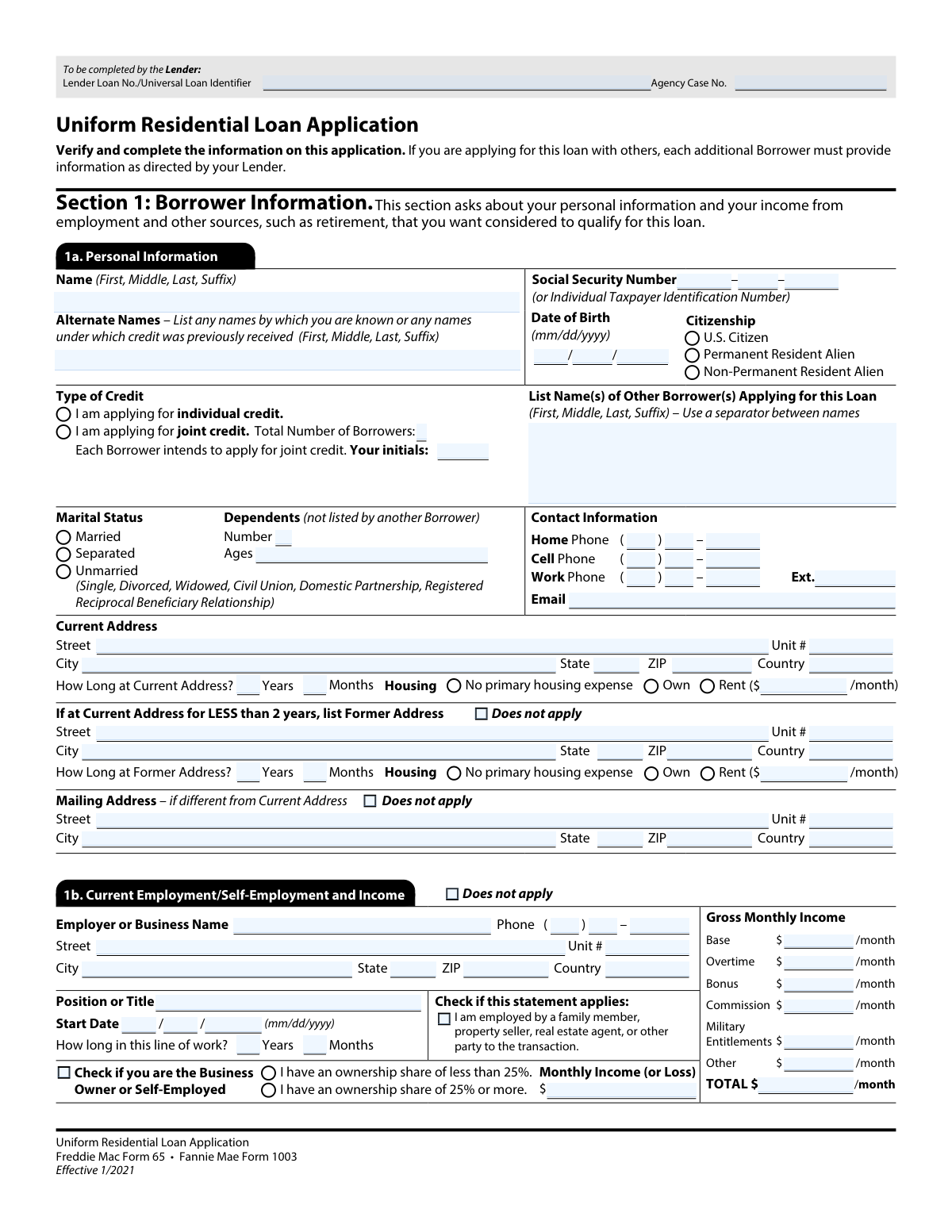
Yes! You can use AI to fill out Uniform Residential Loan Application, Fannie Mae Form 1003 / Freddie Mac Form 65
The Uniform Residential Loan Application (URLA), Fannie Mae Form 1003, is the industry-standard document used by nearly all mortgage lenders in the United States when a borrower applies for a home loan. It collects detailed information about the borrower's finances, including income, assets, liabilities, and credit history, which lenders use to assess creditworthiness and make an underwriting decision. Today, this extensive form can be filled out quickly and accurately using AI-powered services like Instafill.ai, which can also convert non-fillable PDF versions into interactive fillable forms.
Form 1003 / Form 65 is part of the
Fannie Mae forms, Freddie Mac forms, loan application forms, loan forms and EDD forms categories on Instafill.
Our AI automatically handles information lookup, data retrieval, formatting, and form filling.
It takes less than a minute to fill out Form 1003 / Form 65 using our AI form filling.
Securely upload your data. Information is encrypted in transit and deleted immediately after the form is filled out.
Form specifications
| Form name: | Uniform Residential Loan Application, Fannie Mae Form 1003 / Freddie Mac Form 65 |
| Number of fields: | 473 |
| Number of pages: | 9 |
| Language: | English |
More forms in Fannie Mae forms
Instafill Demo: How to fill out PDF forms in seconds with AI
How to Fill Out Form 1003 / Form 65 Online for Free in 2026
Are you looking to fill out a FORM 1003 / FORM 65 form online quickly and accurately? Instafill.ai offers the #1 AI-powered PDF filling software of 2026, allowing you to complete your FORM 1003 / FORM 65 form in just 37 seconds or less.
Follow these steps to fill out your FORM 1003 / FORM 65 form online using Instafill.ai:
- 1 Navigate to Instafill.ai and upload or select the Uniform Residential Loan Application (Form 1003).
- 2 Use the AI assistant to complete Section 1 with your personal details, contact information, and current employment and income history.
- 3 Fill out Section 2 by providing a complete picture of your financial assets (bank accounts, investments) and liabilities (debts, credit cards).
- 4 In Section 3, list all real estate properties you currently own, including details about their value and any existing mortgages.
- 5 Complete Section 4 with information about the new loan you are requesting and the property you intend to purchase or refinance.
- 6 Carefully answer all declaration questions in Section 5 regarding your finances and the property, then read the acknowledgments and agreements in Section 6.
- 7 Provide military service and demographic information in Sections 7 and 8, then review the entire application for accuracy before electronically signing.
Our AI-powered system ensures each field is filled out correctly, reducing errors and saving you time.
Why Choose Instafill.ai for Your Fillable Form 1003 / Form 65 Form?
Speed
Complete your Form 1003 / Form 65 in as little as 37 seconds.
Up-to-Date
Always use the latest 2026 Form 1003 / Form 65 form version.
Cost-effective
No need to hire expensive lawyers.
Accuracy
Our AI performs 10 compliance checks to ensure your form is error-free.
Security
Your personal information is protected with bank-level encryption.
Frequently Asked Questions About Form Form 1003 / Form 65
This is the standard application used by lenders when you apply for a mortgage to purchase or refinance a home. It collects your personal, financial, and employment information for the lender to determine if you qualify for the loan.
Anyone applying for a residential mortgage loan needs to complete this form. If you are applying with a co-borrower, each person will need to provide their information as directed by your lender.
You will need personal details like your Social Security Number and two years of address history. You'll also need financial documents for your income, assets like bank and retirement accounts, and liabilities like credit cards and other loans.
You will complete one application package, but each borrower must provide their own personal and financial information. The form has sections for a primary borrower and allows for information from additional borrowers to be included.
The form requires at least two years of current and previous employment and income history. You should list your current employer in section 1b and any previous employers needed to cover that two-year period in section 1d.
No, you are not required to disclose income from alimony, child support, or separate maintenance. You should only include this income if you want the lender to consider it when evaluating your loan qualification.
If you are refinancing, you should list the property you are refinancing first in Section 3a. Any other properties you own should be listed in the subsequent sections.
You should report this in Section 4d, 'Gifts or Grants You Have Been Given or Will Receive for this Loan'. You will need to specify the source, the amount, and whether the funds have already been deposited into your account.
Lenders ask about past events like bankruptcy or foreclosure to assess your credit history and risk as a borrower. These events can impact your eligibility for certain loan programs for a period of time, so honest disclosure is crucial.
No, providing this demographic information is voluntary, and you can select 'I do not wish to provide this information.' Federal law requires lenders to ask for it to monitor compliance with fair lending laws, and it will not be used to discriminate against you.
After you submit the application, your lender will review all the information, verify your income and assets, and pull your credit report. They will then begin the underwriting process to determine if your loan is approved.
Yes, services like Instafill.ai use AI to help you fill out complex forms like the Uniform Residential Loan Application. It can auto-fill fields accurately based on your information, which saves significant time and reduces errors.
You can use a service like Instafill.ai to easily complete the form online. Simply upload the PDF, and the platform will make it an interactive, fillable form that you can complete from any device.
If you have a non-fillable or 'flat' PDF, you can use a tool like Instafill.ai to convert it into an interactive, fillable form. This allows you to type your information directly into the fields instead of printing and filling it out by hand.
Compliance Form 1003 / Form 65
Validation Checks by Instafill.ai
1
Validates Social Security Number Format
This check ensures the Social Security Number (SSN) or Individual Taxpayer Identification Number (ITIN) in Section 1a is entered in the standard 9-digit format (XXX-XX-XXXX). This is critical for credit reporting, identity verification, and fraud prevention. If the format is incorrect, the system should reject the entry and prompt the user to correct it before proceeding, as an invalid number will cause downstream processing failures.
2
Verifies Minimum Age of Borrower
This validation checks that the borrower's Date of Birth in Section 1a indicates they are of legal age to enter into a contract, typically 18 years or older. The system calculates the age based on the application date and flags any applicant who does not meet the minimum age requirement. This is a fundamental legal and compliance check, and failure to pass will prevent the application from being submitted.
3
Ensures Two-Year Residential History
This check enforces the requirement for a complete two-year address history. It verifies that if the 'Time at Current Address' in Section 1a is less than 24 months, the 'Former Address' section must be completed. This is crucial for lenders to assess borrower stability and to meet underwriting guidelines. If the history is incomplete, the application will be flagged as missing required information.
4
Validates Joint Credit Application Completeness
This check ensures that if an applicant selects 'I am applying for joint credit' in Section 1a, all related fields are completed. The 'Total Number of Borrowers' must be greater than one, and the names of the other borrowers must be listed. This ensures the application accurately reflects all parties to the loan, which is essential for credit checks and legal documentation. An incomplete joint application will be rejected until all borrower information is provided.
5
Confirms Two-Year Employment History
This validation cross-references Sections 1b, 1c, and 1d to ensure a continuous employment history of at least two years is provided, as instructed on the form. Lenders require this history to verify income stability and the borrower's capacity to repay the loan. If the combined duration of all listed employment does not meet the two-year minimum, the system will issue a warning or error, requesting additional previous employment information.
6
Verifies Gross Monthly Income Calculation
This check validates the 'TOTAL' Gross Monthly Income field in Section 1b by summing the individual income components (Base, Overtime, Bonus, Commission, etc.). This ensures the total income figure used for qualification is accurate and free of manual calculation errors. If the sum of the parts does not equal the provided total, the system will flag the discrepancy for correction, preventing underwriting with incorrect data.
7
Validates Asset and Liability Type Selections
This check ensures that for every asset or liability entered in Sections 2a, 2b, 2c, and 2d, the 'Account Type' or 'Source' field contains a value from the specific, pre-approved list provided in the form's instructions. This standardization is vital for automated underwriting systems to correctly categorize and analyze the borrower's financial position. Any entry that does not match the list will be rejected, requiring the user to select a valid option.
8
Ensures Asset Total Calculation Accuracy
This validation confirms that the 'Provide TOTAL Amount Here' fields in Sections 2a and 2b accurately reflect the sum of all 'Cash or Market Value' amounts listed in that section. This automated check prevents mathematical errors in summarizing the borrower's assets, which is a critical input for determining their net worth and down payment capacity. If the total is incorrect, the system will recalculate it or prompt for a correction.
9
Checks for Conditional Real Estate Ownership Data
This check enforces a logical rule in Section 3: if the applicant checks the 'I do not own any real estate' box, the system must prevent or invalidate any data entered in the subsequent property detail sections (3a, 3b, 3c). This prevents contradictory information from being submitted, ensuring data integrity. If the box is checked and property data exists, the user will be prompted to resolve the conflict.
10
Validates Conditional Declaration Responses
This check ensures that when a 'YES' answer is given to a primary question in Section 5 (Declarations), the required follow-up information is provided. For example, if the borrower answers 'YES' to having declared bankruptcy (Question M), they must then select the type of bankruptcy. This ensures the application is complete for underwriting review, as these details are material to the loan decision. Failure to provide the follow-up information will result in an incomplete application error.
11
Requires Specification for 'Other' Loan Purpose
This validation rule applies to Section 4a, 'Loan and Property Information'. If the borrower selects 'Other' as the 'Loan Purpose', this check ensures that the adjacent text field to specify the purpose is not left blank. This information is required for compliance and to determine the correct loan program and terms. An application with 'Other' selected but no explanation will be considered incomplete.
12
Enforces Military Service Status Specification
This check validates the Military Service section (Section 7). If the borrower answers 'YES' to having served in the Armed Forces, the system requires that at least one of the subsequent checkboxes (e.g., 'Currently serving', 'Currently retired', etc.) is also selected. This detail is necessary to determine eligibility for certain loan programs, like VA loans. The application will be flagged as incomplete if the specific service status is missing after a 'YES' response.
13
Validates Logical Employment Dates
This check examines the employment dates in Section 1d (Previous Employment). It ensures that the 'End Date' is chronologically after the 'Start Date' for any single entry. Furthermore, it can cross-reference that the 'End Date' of a previous job is before the 'Start Date' of current employment. This maintains a logical and credible timeline for the borrower's work history, which is essential for income verification.
14
Requires Dependent Ages if Dependents are Listed
This validation applies to the 'Dependents' section (1a). If the 'Number of Dependents' field is populated with a value greater than zero, this check ensures the 'Ages' field is also filled in. This information is used by lenders to understand the borrower's financial obligations and household structure. An application listing dependents without their ages would be flagged as incomplete.
Common Mistakes in Completing Form 1003 / Form 65
Applicants often mistakenly enter their net (take-home) pay instead of their gross monthly income. This happens because people are more familiar with their net pay. This error significantly understates their qualifying income, which can lead to an incorrect initial assessment or even an unnecessary denial. To avoid this, always use the pre-tax income figure from your pay stubs and be careful when converting annual, weekly, or bi-weekly pay to a monthly figure.
A very serious mistake is omitting debts from Section 2c, such as student loans (especially if in deferment), store credit cards, personal loans, or co-signed loans. Applicants may think that if a payment isn't currently due or if the debt is small, it doesn't need to be listed. However, lenders will discover all debts during the credit check, and the discrepancy can lead to significant delays, a re-evaluation of your debt-to-income ratio, and a potential loan denial due to the lack of transparency.
The loan application requires a continuous two-year history of employment. Applicants with recent job changes, multiple part-time jobs, or employment gaps often fail to list all employers and date ranges required to meet this two-year threshold in Sections 1b, 1c, and 1d. This forces the lender to halt processing and request additional information, delaying the underwriting process. Before starting, gather employment details for the last 24 months to ensure the history is complete and accurate.
Section 5 contains critical 'Yes/No' questions about your finances and the property that have significant legal implications. Applicants may rush through this section and check 'No' to everything without reading carefully. Answering incorrectly about being a party to a lawsuit, having outstanding judgments, or having a prior foreclosure can be considered a material misrepresentation or mortgage fraud, resulting in immediate loan rejection and potential legal action. Read every question in this section slowly and answer with complete honesty.
In Section 3, applicants are required to list all properties they *currently own*. A common error is for a first-time homebuyer to list the property they are trying to purchase in this section, or for a refinancer to list other properties before the one being refinanced. This creates confusion for the underwriter and requires clarification, delaying the application. This section should only be filled out with details of properties already in your name.
Similar to employment history, lenders require a full two-year residency history to verify your identity and credit history. Applicants who have moved within the last two years often forget to complete the 'Former Address' section (1a) after filling out their current address. An incomplete history is a red flag that halts the verification process. To prevent delays, have the full street addresses, dates of residency, and rent/own status for the last 24 months ready before you begin.
If you are receiving a gift or grant to help with the down payment, it must be declared accurately in Section 4d. Mistakes include failing to disclose the gift, not specifying the source (e.g., 'Relative'), or incorrectly stating whether the funds have been deposited. Lenders must verify the source of all funds used for closing, and an undisclosed gift can stop the entire loan process until a proper gift letter and fund verification are completed.
In Section 2a, applicants often make errors like forgetting to list certain accounts (e.g., a 401k or a small savings account), providing incomplete account numbers, or guessing at the market value instead of using the value from a recent statement. These inaccuracies can cause delays when the lender attempts to verify your assets. This can become a critical issue if the stated assets are needed to qualify for the loan or cover closing costs.
After filling out dozens of fields, it is surprisingly easy to miss a signature line, an initial box (like for joint credit in Section 1a), or a date field in Section 6. An unsigned or undated application is invalid and cannot be processed, causing it to be immediately returned. This simple oversight will delay your loan application from the very start. If the form is a non-fillable PDF, it's even easier to miss these spots; AI-powered tools like Instafill.ai can convert such documents into fillable versions to help ensure all required fields are completed.
When applying for joint credit, every section that collects personal, employment, and financial data must be completed for each borrower. It is a frequent mistake for the primary applicant to fill out their information but forget to provide all the corresponding details for the co-borrower. This results in an incomplete application that cannot be underwritten. To avoid this, both borrowers should review the entire application to ensure their respective information is present and accurate before submission.
Saved over 80 hours a year
“I was never sure if my IRS forms like W-9 were filled correctly. Now, I can complete the forms accurately without any external help.”
Kevin Martin Green
Your data stays secure with advanced protection from Instafill and our subprocessors

Robust compliance program
Transparent business model
You’re not the product. You always know where your data is and what it is processed for.
ISO 27001, HIPAA, and GDPR
Our subprocesses adhere to multiple compliance standards, including but not limited to ISO 27001, HIPAA, and GDPR.
Security & privacy by design
We consider security and privacy from the initial design phase of any new service or functionality. It’s not an afterthought, it’s built-in, including support for two-factor authentication (2FA) to further protect your account.
Fill out Form 1003 / Form 65 with Instafill.ai
Worried about filling PDFs wrong? Instafill securely fills uniform-residential-loan-application-fannie-mae-form-1003-freddie-mac-form-65-1 forms, ensuring each field is accurate.