Fill out outpatient forms
with AI.
Outpatient forms are a critical component of the modern healthcare system, serving as the primary bridge between medical providers and insurance carriers. These documents ensure that specific treatments, diagnostic tests, and behavioral health services are medically necessary and eligible for coverage before a patient receives care. By standardizing the flow of clinical data, these healthcare forms help prevent claim denials and reduce the financial risk for both patients and healthcare facilities. Whether it is a request for specialized behavioral therapy or a high-tech imaging procedure, accurate documentation is essential for maintaining a seamless continuum of care.
By continuing, you acknowledge Instafill's Privacy Policy and agree to get occasional product update and promotional emails.
About outpatient forms
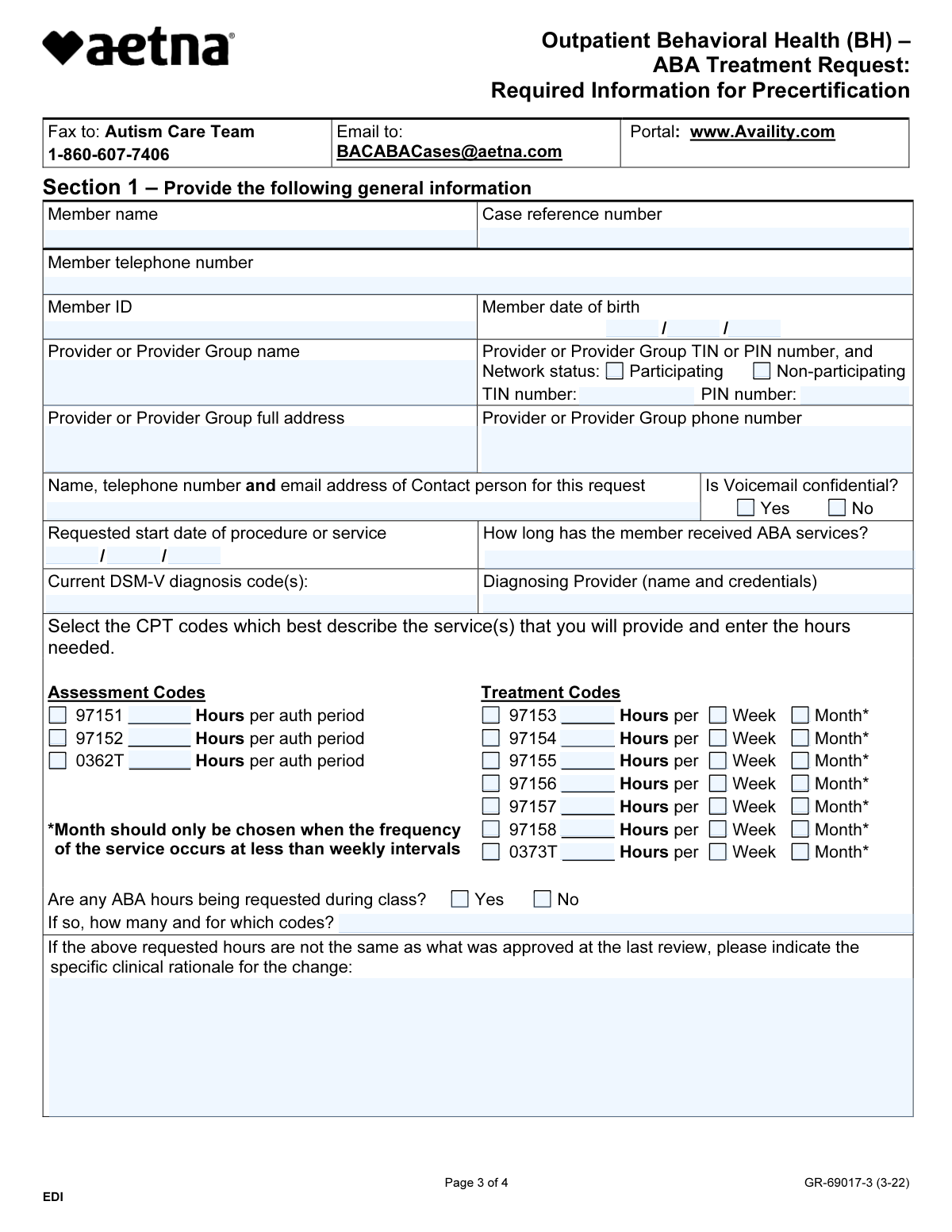
Typically, these forms are managed by clinical providers, medical billing specialists, and administrative staff who must navigate complex requirements from various insurance networks. Common examples include ABA Treatment Requests for behavioral health services or Prior Authorization forms for outpatient imaging like MRIs and CT scans. Because these documents require precise clinical details—ranging from diagnostic codes to specific treatment hours—they can be incredibly time-consuming to complete manually. Tools like Instafill.ai use AI to fill these insurance authorization forms in under 30 seconds, ensuring data is handled accurately and securely to speed up the adjudication process.
Every form on this page can be completed without typing. Instafill is form filling software that reads a PDF and fills it for you — including flat and scanned documents that carry no fillable fields at all.
Forms in This Category
The forms in this category have a median Form Complexity Index of 52/100 (Moderate), measured across 3 forms by field count, input difficulty, length, conditional logic and structure. See how it is calculated.
| Form Name | Pages | FCI | |
|---|---|---|---|
| 1. | Form BHVH, Outpatient Behavioral Health – ABA Treatment Request | 4 | Moderate 58 |
| 2. | Outpatient Behavioral Health (BH) – ABA Treatment Request: Required Information for Precertification (GR-69017-4) | 6 | Moderate 52 |
| 3. | Outpatient Imaging Prior Authorization Request Form | 1 | Moderate 51 |
- Enterprise-grade security & data encryption
- 99%+ accuracy powered by AI
- 1,000+ forms from all industries
- Complete forms in under 60 seconds
Frequently Asked Questions
These forms are primarily used by healthcare providers to request prior authorization or precertification from insurance companies before a patient receives specific services. This process ensures that treatments like ABA therapy or advanced imaging scans are medically necessary and covered under the patient's specific health plan.
While these forms concern the patient's coverage, they are almost always completed and submitted by the attending healthcare provider or their clinical staff. The provider must supply detailed clinical data, such as CPT codes and diagnostic information, which is necessary for the insurance company's medical review team.
The choice depends on the specific insurance carrier and the date of service. For instance, Aetna and its affiliates like Innovation Health require the GR-69017-4 form for ABA precertification starting in 2026, while other plans may use the BHVH form for general outpatient behavioral health requests.
Providers must generally provide the patient's demographic details, the specific type of scan requested (such as an MRI or CT scan), and the relevant ICD-10 diagnosis codes. Additionally, most forms require clinical notes or a history of previous treatments to justify why the imaging is necessary for the patient's care.
Yes, AI tools like Instafill.ai can be used to fill out complex outpatient and healthcare forms in under 30 seconds. These tools accurately extract and place data from source clinical documents directly into the form fields, significantly reducing the time spent on manual data entry.
Manually completing detailed medical authorization forms can take 15 to 20 minutes depending on the complexity of the clinical history required. Using AI-powered automation, the process is streamlined, allowing providers to generate a completed and accurate form in less than a minute.
These forms should be submitted well before the scheduled procedure or the start of a treatment cycle. Submitting the request early allows time for the insurance company to review the clinical documentation and issue an approval, preventing the patient from facing unexpected costs or appointment cancellations.
Incomplete forms are often pended or denied by the insurance carrier, which can delay patient treatment. Ensuring that all required fields, such as provider NPI numbers and specific CPT codes, are filled accurately is essential for a smooth adjudication process.
Once the form is filled and signed, it is typically submitted to the insurance company via their secure provider portal or by fax. The specific submission instructions, including the correct department's fax number, are usually listed on the form's header or footer.
Not all procedures require prior authorization, but high-cost services like behavioral health therapy and advanced diagnostic imaging almost always do. Providers should check the specific requirements of the patient's insurance plan to determine if a form from this category is necessary before proceeding with care.
Aetna uses specific forms like the GR-69017-4 to capture essential quality care elements and detailed clinical diagnostic information for Autism Spectrum Disorder. These specialized forms help the insurer evaluate the medical necessity of Applied Behavior Analysis (ABA) therapy more effectively than a generic healthcare form.
Glossary
- Form Complexity Index
- Instafill’s 0–100 measure of how much effort a form takes to complete, calculated deterministically from the form’s own structure rather than estimated. It combines the number of fillable fields (the largest factor), how difficult those fields are to complete based on their type, the number of pages that contain fields, the amount of conditional “fill-only-if” logic, and how many sections the form is divided into, then adds modifiers for tables and repeating lists, bundled instruction pages, and dense page layouts. A higher score means the form is harder to fill out by hand. The forms in this category have a median Form Complexity Index of 52/100 (Moderate). See exactly how it is calculated.