Fill out plaintiff forms
with AI.
Plaintiff forms are the essential first step for anyone looking to seek justice through the small claims court system. These documents serve as the formal notification to both the court and the defendant that a legal dispute exists and a resolution is being sought. Whether you are dealing with a landlord-tenant dispute, a breach of contract, or property damage, these forms ensure that your case is documented correctly and that all necessary details—such as the amount owed and the legal basis for the claim—are clearly presented to the court.
By continuing, you acknowledge Instafill's Privacy Policy and agree to get occasional product update and promotional emails.
About plaintiff forms
Typically, these forms are utilized by individuals, small business owners, or representatives of public entities who wish to resolve disputes without the high costs of hiring an attorney. Because small claims court is designed to be accessible to the general public, the paperwork is structured to be straightforward but requires precision to avoid procedural delays. For instance, the SC-100 is the primary document used to initiate a claim, while supplemental forms like the SC-100A are used when multiple parties are involved in the suit. Accuracy is critical, as these documents establish the foundation for the entire legal proceeding and determine how the court sets hearing dates.
Tools like Instafill.ai use AI to fill these forms in under 30 seconds, ensuring your data is handled accurately and securely while streamlining the preparation of your legal documents.
Every form on this page can be completed without typing. Instafill is form filling software that reads a PDF and fills it for you — including flat and scanned documents that carry no fillable fields at all.
Forms in This Category
The forms in this category have a median Form Complexity Index of 60/100 (Moderate), measured across 5 forms by field count, input difficulty, length, conditional logic and structure. See how it is calculated.
| Form Name | Pages | FCI | |
|---|---|---|---|
| 1. | Form SC-100, Plaintiff’s Claim and ORDER to Go to Small Claims Court | 6 | Complex 65 |
| 2. | Form SC-100A, Other Plaintiffs or Defendants (Attachment to Plaintiff's Claim and ORDER to Go to Small Claims Court) | 1 | Moderate 60 |
| 3. | Form UD-101, Plaintiff's Mandatory Cover Sheet and Supplemental Allegations—Unlawful Detainer | 2 | Moderate 48 |
| 4. | Plaintiff's Claim and ORDER to Go to Small Claims Court (SC-100) | 6 | Moderate 56 |
| 5. | Form SC-100, Plaintiff's Claim and ORDER to Go to Small Claims Court | 6 | Complex 65 |
- Enterprise-grade security & data encryption
- 99%+ accuracy powered by AI
- 1,000+ forms from all industries
- Complete forms in under 60 seconds
How to Choose the Right Form
Initiating Your Small Claims Case
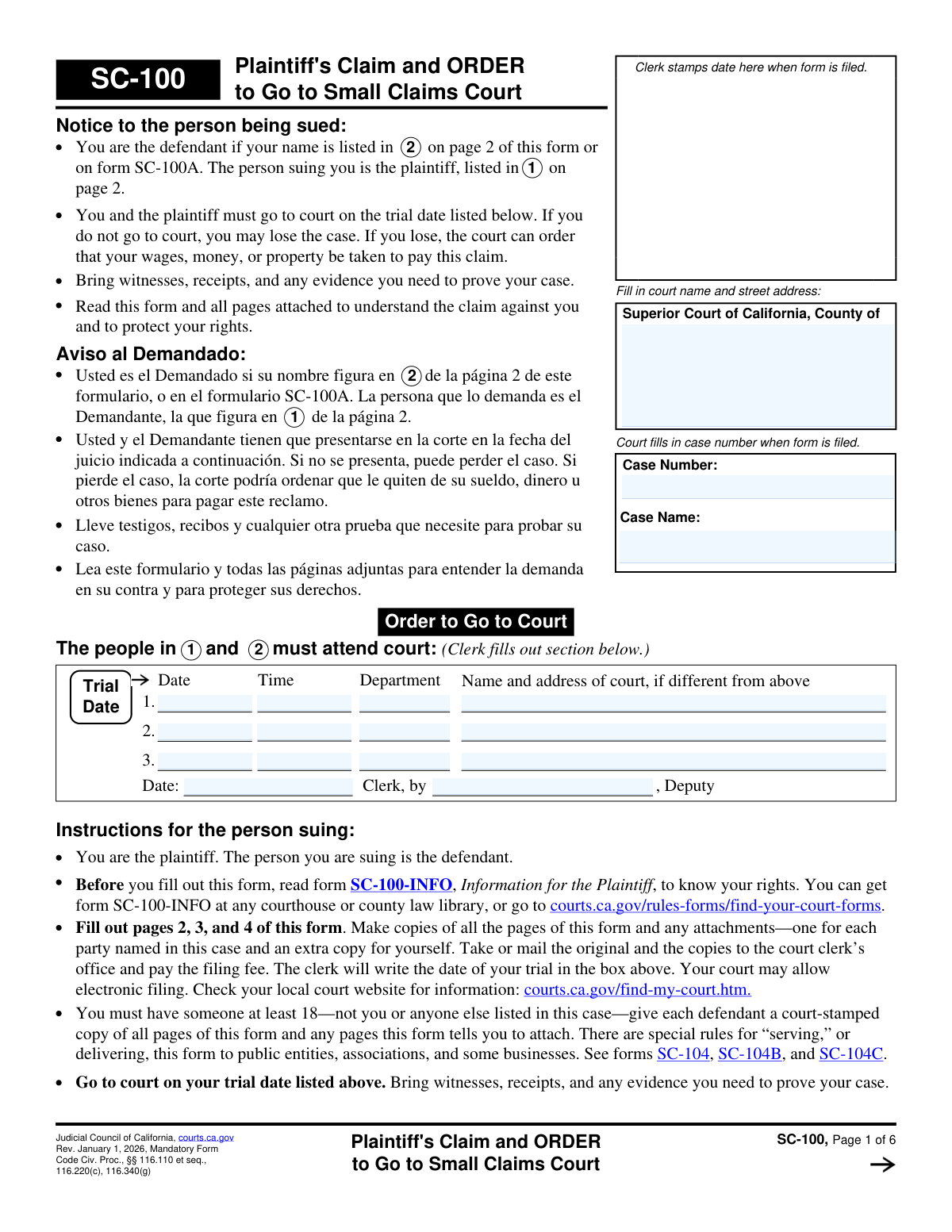
If you are the person or business filing a lawsuit in California, your primary document is Form SC-100, Plaintiff's Claim and ORDER to Go to Small Claims Court. This is the foundational form required to start any small claims action. You should select this form if:
- You are an individual suing for an amount up to $12,500.
- You are a corporation or business suing for an amount up to $6,250.
- You need to set a court date and provide the defendant with official notice of the claim.
Form SC-100 captures essential details, including the parties' contact information, the amount of money owed, and the legal reason for the lawsuit. It also acts as the official court order requiring the defendant to appear at the hearing.
Handling Multiple Parties
The standard SC-100 form has limited space for listing names. If your legal situation involves more than two people suing or more than two people being sued, you must use an additional attachment:
- Form SC-100A, Other Plaintiffs or Defendants: This is not a standalone form; it is an attachment to Form SC-100. Use it to ensure all parties are properly identified for the court record so that the judgment applies to everyone involved.
Choosing the Right Version
While the list contains multiple entries for the Plaintiff's Claim and ORDER to Go to Small Claims Court (SC-100), they all refer to the same mandatory California Judicial Council document. When selecting a version, look for those optimized for digital filling. Using Instafill’s AI-powered tools helps you accurately complete section-specific requirements, such as venue checkboxes (why you are suing in a specific location) and declarations regarding public entity claims. These details are critical for preventing your case from being dismissed on procedural grounds, and our interactive versions help ensure every field is addressed correctly before you file.
Form Comparison
| Form | Primary Purpose | Claim Limit | When to Use |
|---|---|---|---|
| Form SC-100, Plaintiff's Claim and ORDER to Go to Small Claims Court | Initiates a small claims lawsuit and requests an official hearing date. | Up to $12,500 for individuals or $6,250 for businesses and corporations. | Starting a new legal case in the California small claims court system. |
| Form SC-100, Plaintiff’s Claim and ORDER to Go to Small Claims Court | Captures case details, party information, and the legal reason for the claim. | Standard California jurisdictional limits for individuals, businesses, and public entities. | Providing the court with essential data to set and issue trial orders. |
| Plaintiff's Claim and ORDER to Go to Small Claims Court (SC-100) | Serves as the official summons notifying the defendant of the trial date. | Individuals may sue for $12,500; public entities are limited to $6,250. | Filing a simplified legal action without the requirement of hiring an attorney. |
| Form SC-100A, Other Plaintiffs or Defendants (Attachment to Plaintiff's Claim and ORDER to Go to Small Claims Court) | Provides additional space for naming all parties involved in the lawsuit. | Not applicable; this form is a supplemental attachment for party identification. | The small claims case involves more than two plaintiffs or two defendants. |
Tips for plaintiff forms
Always confirm the exact legal name of the person or entity you are suing by checking business licenses or official records. If the name on your SC-100 form is incorrect, you may face significant hurdles when trying to collect your judgment later.
If your lawsuit involves more than two plaintiffs or two defendants, ensure you include Form SC-100A. This attachment is essential for providing the court with a complete record of every party involved in the dispute.
In the section regarding why the defendant owes you money, be concise and stick to the facts, such as dates and specific damages. Avoid long narratives and focus on the breach of contract or incident that led to the financial loss.
AI-powered tools like Instafill.ai can complete these plaintiff forms in under 30 seconds with high accuracy. This technology ensures your data stays secure during the process, making it an ideal time-saver for those managing multiple legal documents.
Small claims cases must be filed in the correct court location, usually where the defendant resides or where the dispute took place. Carefully review the venue checkboxes on your form to confirm you are filing in the proper jurisdiction.
Before filling out the form, calculate the exact amount you are seeking, including any interest or specific costs. Having a clear, itemized total ready helps you complete the financial sections of the plaintiff forms without second-guessing.
Frequently Asked Questions
Plaintiff forms are the initial legal documents filed by an individual or business to start a lawsuit. In California, these forms, specifically the SC-100 series, provide the court with details about who is being sued, why they are being sued, and the specific amount of money being requested.
Any individual, business, or public entity can file a plaintiff's claim if they believe someone owes them money and the amount is within the court's jurisdictional limits. Generally, individuals can sue for larger amounts than corporations or other business entities in this specific court setting.
In California small claims court, individuals can typically file claims for up to $12,500. For corporations, public entities, and other businesses, the filing limit is usually lower, often capped at $6,250 per claim.
Form SC-100A is used as an attachment when there are more than two plaintiffs or more than two defendants involved in the case. It ensures that the court has a complete record of every party participating in the lawsuit when the standard SC-100 form runs out of space.
Yes, AI-powered tools like Instafill.ai allow you to fill out plaintiff forms by extracting data directly from your source documents. These tools can accurately place information into the correct fields, ensuring the forms are completed professionally and are ready for filing.
Using modern AI technology, you can complete complex plaintiff forms in under 30 seconds. Services like Instafill.ai automate the data entry process, which significantly reduces the time spent manually typing in names, addresses, and claim details.
Once the forms are filled out, they must be filed with the clerk of the small claims court in the appropriate county. Usually, this is the county where the defendant lives, where the contract was signed, or where the incident that caused the dispute occurred.
Small claims court is specifically designed to be accessible without the need for a lawyer. In many jurisdictions, attorneys are generally not allowed to represent parties during the actual small claims hearing, though you may consult one for advice before filing.
You will need the exact legal name and address of the person or business you are suing, the specific dollar amount of your claim, and a brief explanation of why the money is owed. You should also be prepared to state whether you have already asked the defendant to pay.
After the court clerk processes your forms and assigns a hearing date, you must 'serve' the defendant with a copy of the papers. This is typically done through a process server, a sheriff, or a neutral third party, as the law usually prohibits you from serving the papers yourself.
Glossary
- Form Complexity Index
- Instafill’s 0–100 measure of how much effort a form takes to complete, calculated deterministically from the form’s own structure rather than estimated. It combines the number of fillable fields (the largest factor), how difficult those fields are to complete based on their type, the number of pages that contain fields, the amount of conditional “fill-only-if” logic, and how many sections the form is divided into, then adds modifiers for tables and repeating lists, bundled instruction pages, and dense page layouts. A higher score means the form is harder to fill out by hand. The forms in this category have a median Form Complexity Index of 60/100 (Moderate). See exactly how it is calculated.
- Plaintiff
- The individual, group, or business entity that initiates a lawsuit by filing a claim against another party.
- Defendant
- The person or entity being sued in a court case who must respond to the plaintiff's claims.
- Venue
- The specific geographic location or courthouse where it is legally appropriate to hear a case, usually determined by where the defendant lives or where the incident occurred.
- Jurisdictional Limit
- The maximum dollar amount that a court is authorized to award, such as the $12,500 limit for individuals in California small claims cases.
- Service of Process
- The formal delivery of legal documents, such as the SC-100 form, to the defendant to ensure they are legally notified of the lawsuit.
- Judicial Council Forms
- Standardized legal documents adopted for mandatory or optional use in all California courts to ensure legal procedures are followed correctly.
- Public Entity
- A government-related body, such as a city, county, or state agency, which may have specific rules and shorter time limits for filing a claim.
- Attachment
- A supplemental document, like Form SC-100A, used when there is not enough space on the primary form to list all parties involved in the case.