Fill out required minimum distribution forms
with AI.
Required Minimum Distribution (RMD) forms are essential documents used by retirement account holders to satisfy IRS mandates for annual withdrawals. Once you reach a specific age—currently 73 for most individuals—the law requires you to begin taking distributions from tax-deferred accounts like Traditional IRAs, SEP IRAs, and employer-sponsored plans. These forms ensure that the government eventually collects taxes on the income that has been growing tax-deferred for decades. Failing to file these documents and withdraw the correct amount can result in significant tax penalties, making timely and accurate completion a priority for every retiree.
By continuing, you acknowledge Instafill's Privacy Policy and agree to get occasional product update and promotional emails.
About required minimum distribution forms
This category includes a variety of forms tailored to specific financial institutions and account types. Whether you are an original account owner looking to set up recurring payments through TIAA or a beneficiary managing an inherited account with Vanguard or Fidelity, these documents help you calculate and authorize the necessary transfers. These retirement forms are typically used annually or when first establishing a distribution schedule. They also allow you to manage tax withholdings and specify whether you want your distributions sent via check or direct deposit.
Completing these ira distribution forms can be complex, especially when calculating specific amounts or navigating non-fillable PDF formats. Tools like Instafill.ai use AI to fill these forms in under 30 seconds, ensuring data is handled accurately and securely to help you meet IRS deadlines without the manual hassle. This streamlined approach allows you to focus on your retirement planning rather than paperwork.
Every form on this page can be completed without typing. Instafill is form filling software that reads a PDF and fills it for you — including flat and scanned documents that carry no fillable fields at all.
Forms in This Category
The forms in this category have a median Form Complexity Index of 36/100 (Basic), measured across 10 forms by field count, input difficulty, length, conditional logic and structure. See how it is calculated.
- Enterprise-grade security & data encryption
- 99%+ accuracy powered by AI
- 1,000+ forms from all industries
- Complete forms in under 60 seconds
How to Choose the Right Form
Navigating IRS requirements for Required Minimum Distributions (RMDs) can be complex, but choosing the right form depends primarily on where your retirement funds are held and how you want to receive your payments.
Choosing by Financial Institution
Most RMD requests are specific to the custodian of your account. If your retirement plan is managed by a major provider, look for their specific documentation to ensure the funds are processed correctly:
- Vanguard: Use the Vanguard Required Minimum Distribution Service Form if you are the original owner of an institutional or employer plan. This form is used for both initiating new RMDs and updating existing schedules.
- Fidelity Advisor: Choose the Fidelity Advisor IRA Minimum Required Distribution form for Traditional, Rollover, SEP, or SIMPLE IRAs.
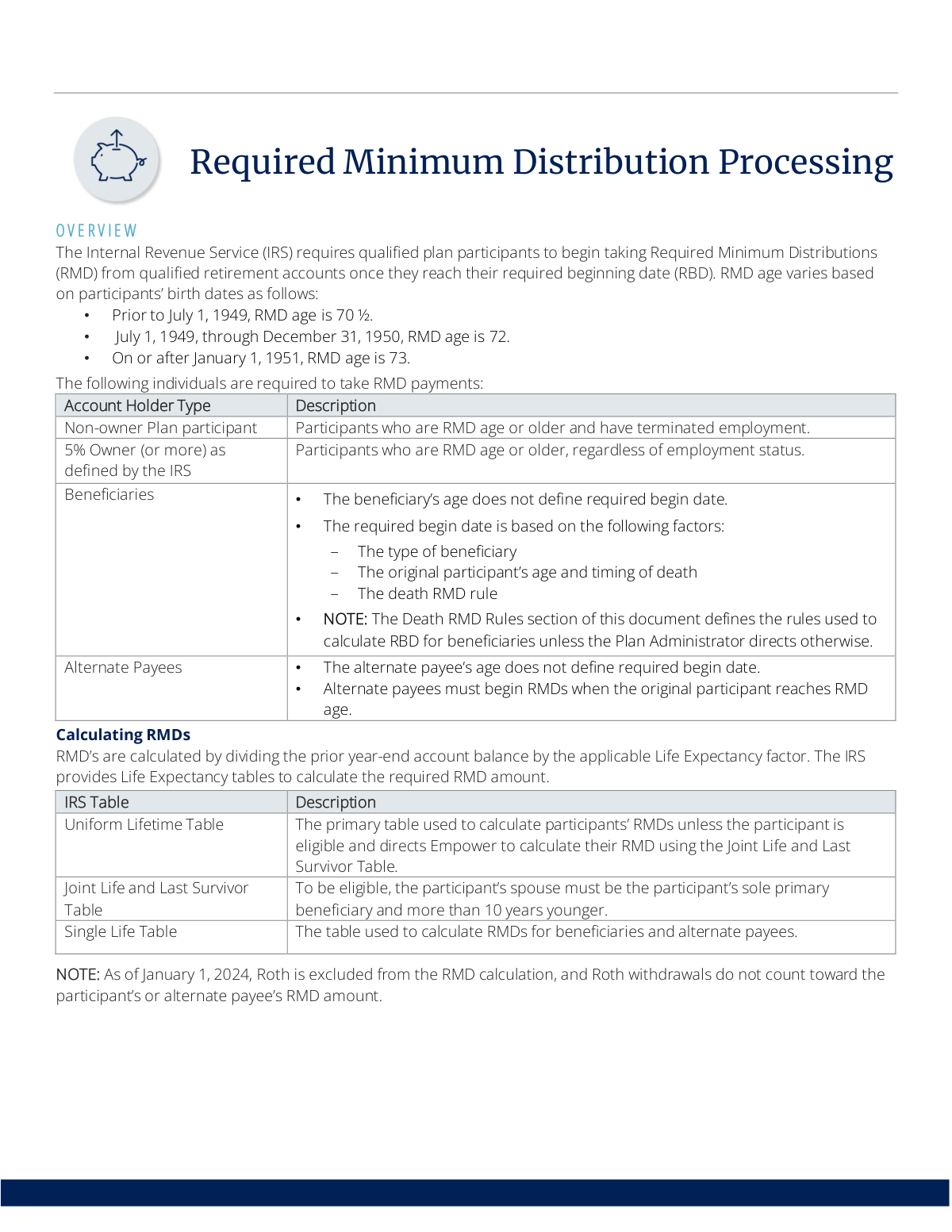
- Empower: The Empower Required Minimum Distribution Request Form is the standard document for participants, beneficiaries, or alternate payees of Empower-managed retirement plans.
Automated vs. One-Time Distributions
If you prefer to set up a "set it and forget it" system to avoid annual paperwork and potential IRS penalties, look for forms that offer recurring options:
- TIAA: Use Form F11489 (Request for Recurring Required Minimum Distributions) to authorize TIAA to automatically calculate and pay out your distributions each year. There is a specific version for Non-ERISA retirement investments as well.
- Fidelity & Guaranty Life: The Request for Required Minimum Distribution (RMD) - IRA Owner/Plan Participant (ADMIN 5275) allows you to establish a specific distribution schedule or formally waive the RMD if you are satisfying the requirement through other qualified funds.
Specialized and State Plans
Certain forms are restricted to specific employment backgrounds or specialized insurance products:
- Florida State University System: Former employees of Florida’s university system must use Form ORP-RMD-1 (SUSORP Application) to request distributions from their Optional Retirement Program.
- Annuity Holders: For those with Fidelity & Guaranty Life annuity contracts (IRA, SEP, or 403b), use the Fidelity & Guaranty Life Required Minimum Distribution (RMD) Form to manage tax withholding preferences and payment methods.
Form Comparison
| Form | Applicable Accounts | Payment Options | Primary Function |
|---|---|---|---|
| Empower Required Minimum Distribution Request Form | Qualified retirement plans managed by Empower | One-time or scheduled annual payments | Facilitates IRS compliance for participants and beneficiaries |
| Fidelity Advisor IRA Minimum Required Distribution | Traditional, Rollover, SIMPLE, SEP, and SARSEP IRAs | Mandatory annual minimum distributions | Helps account holders avoid significant IRS tax penalties |
| Fidelity & Guaranty Life Required Minimum Distribution (RMD) Form for IRA Owner/Plan Participant | IRA, SEP, or 403(b) annuity contracts | Recurring schedules or formal RMD waivers | Allows users to certify distributions from other funds |
| Form F11489, Request for Recurring Required Minimum Distributions From Your Retirement Investments | TIAA retirement investment accounts | Automated recurring annual distribution payments | Authorizes TIAA to calculate and pay RMDs automatically |
| Form F11489, Request for Recurring Required Minimum Distributions From Your Retirement Investments | TIAA retirement investment accounts | Established automated annual payment plans | Simplifies meeting IRS obligations without manual yearly requests |
| Form ORP-RMD-1, State University System Optional Retirement Program (SUSORP) Application for a Required Minimum Distribution | Florida State University System Optional Retirement Program | One-time or recurring mandatory distributions | For terminated employees of Florida University System employers |
| Request for Recurring Required Minimum Distributions From Your Retirement Investments (Non-ERISA) | Non-ERISA TIAA retirement investments | Automated recurring distribution payments | Specifically designed for non-ERISA retirement account compliance |
| Request for Required Minimum Distribution (RMD) - IRA Owner/Plan Participant | Fidelity & Guaranty Life annuity contracts | Update, start, or terminate RMD payments | Includes settings for tax withholding and payment frequency |
| Vanguard Required Minimum Distribution Service Form | Vanguard institutional retirement plans | New or modified payment schedules | Helps original account owners meet mandatory distribution rules |
| Vanguard Required Minimum Distribution Service Form | Vanguard employer-sponsored retirement plans | Automated calculation and distribution services | Prevents 50% tax penalties on distribution shortfalls |
Tips for required minimum distribution forms
Required Minimum Distributions are generally treated as taxable income. When filling out these forms, be sure to clearly indicate how much you want withheld for taxes to avoid a large bill or underpayment penalties when you file your annual return.
Many providers offer a 'recurring' or 'automated' option on their RMD request forms. Selecting this allows the institution to calculate and send your payment every year automatically, ensuring you never miss a deadline or face steep IRS penalties.
These forms require specific identification numbers for your retirement accounts or annuity contracts. Having your recent statements handy will prevent errors and ensure the institution can locate your funds quickly to process the distribution.
While you can often take a total RMD for multiple IRAs from a single account, employer-sponsored plans like 401(k)s or 403(b)s usually require individual forms and distributions for each account. Check the specific requirements for each form to ensure full compliance.
AI-powered tools like Instafill.ai can complete these complex retirement forms in under 30 seconds with high accuracy. This is a massive time-saver for those managing multiple accounts, and your sensitive financial data stays secure throughout the process.
Ensure that your bank routing and account numbers are entered correctly if you choose electronic transfer. Small typos in the payment section are a common cause of significant delays in receiving your retirement funds.
Frequently Asked Questions
These forms allow retirement account holders to withdraw the minimum amount required by the IRS once they reach a specific age. Filing these documents ensures compliance with tax laws and helps avoid significant penalties associated with failing to take distributions.
You should select the form that corresponds to the specific financial institution or plan provider that holds your retirement account. For example, if you have a Vanguard employer plan, you would use the Vanguard-specific service form, whereas a state employee in Florida might use the SUSORP application.
Many providers, such as TIAA and Vanguard, offer specific forms for recurring distributions. These allow you to authorize the institution to calculate and send your required amount automatically each year, reducing the risk of missing a deadline.
While both facilitate mandatory withdrawals, IRA forms are for personal retirement accounts like Traditional, SEP, or SIMPLE IRAs, while employer plan forms are for 401(k), 403(b), or other workplace-sponsored plans. The rules for when you must start distributions may vary slightly between these account types.
Yes, AI tools like Instafill.ai can be used to fill out RMD forms quickly and accurately. The AI can extract data from your source documents and place it into the correct fields, ensuring your personal and account information is transcribed correctly.
Using AI-powered services like Instafill.ai, you can typically complete these forms in under 30 seconds. This significantly speeds up the process compared to manual entry, especially for complex forms involving recurring payment schedules.
Some forms, such as those from Fidelity & Guaranty Life, allow you to formally waive a distribution from a specific annuity contract. This is usually done when you are satisfying your total RMD requirement for the year using funds from other qualified retirement accounts.
Completed forms should be submitted directly to the financial institution or plan administrator that manages the account. Submission methods vary by provider but often include secure online uploads, fax, or physical mail to their benefits or retirement services department.
These forms are generally required for Traditional IRAs, SEP IRAs, SIMPLE IRAs, 401(k) plans, 403(b) plans, and other tax-deferred retirement accounts. Roth IRAs typically do not require distributions during the original owner's lifetime, though inherited Roth IRAs may have different rules.
The IRS imposes steep tax penalties on any portion of a required minimum distribution that is not withdrawn by the annual deadline. Accurately completing the forms ensures the correct amount is calculated and distributed, protecting your retirement savings from unnecessary taxes.
Glossary
- Form Complexity Index
- Instafill’s 0–100 measure of how much effort a form takes to complete, calculated deterministically from the form’s own structure rather than estimated. It combines the number of fillable fields (the largest factor), how difficult those fields are to complete based on their type, the number of pages that contain fields, the amount of conditional “fill-only-if” logic, and how many sections the form is divided into, then adds modifiers for tables and repeating lists, bundled instruction pages, and dense page layouts. A higher score means the form is harder to fill out by hand. The forms in this category have a median Form Complexity Index of 36/100 (Basic). See exactly how it is calculated.
- Required Minimum Distribution (RMD)
- The minimum amount that the IRS requires you to withdraw from your retirement accounts each year once you reach a certain age, typically 72 or 73.
- Traditional IRA
- An individual retirement account where contributions are often tax-deductible and investment growth is tax-deferred until funds are withdrawn.
- Beneficiary
- The person or entity designated by the account owner to receive the assets in a retirement account upon the owner's death.
- Tax Withholding
- The process of setting aside a portion of your distribution to be paid directly to the IRS or state tax authorities to cover your income tax liability.
- Alternate Payee
- A person, such as a spouse or former spouse, who is entitled to receive a portion of a participant's retirement benefits under a Qualified Domestic Relations Order (QDRO).
- ERISA
- The Employee Retirement Income Security Act, a federal law that sets minimum standards for retirement and health plans in private industry to protect participants.
- SEP IRA
- A Simplified Employee Pension plan that allows employers and self-employed individuals to contribute to traditional IRAs set up for employees.
- Qualified Plan
- A retirement plan that meets specific IRS requirements, such as a 401(k) or 403(b), and provides tax benefits to both the employer and the employee.