Fill out retirement withdrawal forms
with AI.
Retirement withdrawal forms are the essential documents required to access funds stored in tax-advantaged accounts like 401(k)s, IRAs, and defined contribution plans. These forms serve as the official authorization for a financial institution to release your savings, and they play a critical role in determining tax withholding, distribution methods, and compliance with IRS regulations. Because retirement accounts are subject to strict legal guidelines, accurately completing these documents is vital to avoid unexpected penalties or delays in receiving your funds.
By continuing, you acknowledge Instafill's Privacy Policy and agree to get occasional product update and promotional emails.
About retirement withdrawal forms
Typically, these forms are needed by individuals transitioning into retirement, those setting up Required Minimum Distributions (RMDs), or participants who need to initiate a rollover to another account. Whether you are managing a recurring income stream through a Fidelity automatic withdrawal plan or requesting a one-time cash distribution from a TIAA account, these documents ensure the transaction is recorded correctly for tax purposes. They are also frequently used by plan trustees and individuals facing specific life events, such as disability or plan termination, that necessitate a payout from their investment portfolio.
Navigating the dense fields and financial jargon on these PDFs can be time-consuming and prone to error. Tools like Instafill.ai use AI to fill these forms in under 30 seconds, handling the data accurately and securely to streamline the entire process. This allows you to focus on your financial planning rather than the administrative burden of manual data entry.
Every form on this page can be completed without typing. Instafill is form filling software that reads a PDF and fills it for you — including flat and scanned documents that carry no fillable fields at all.
Forms in This Category
The forms in this category have a median Form Complexity Index of 53/100 (Moderate), measured across 9 forms by field count, input difficulty, length, conditional logic and structure. See how it is calculated.
| Form Name | Pages | FCI | |
|---|---|---|---|
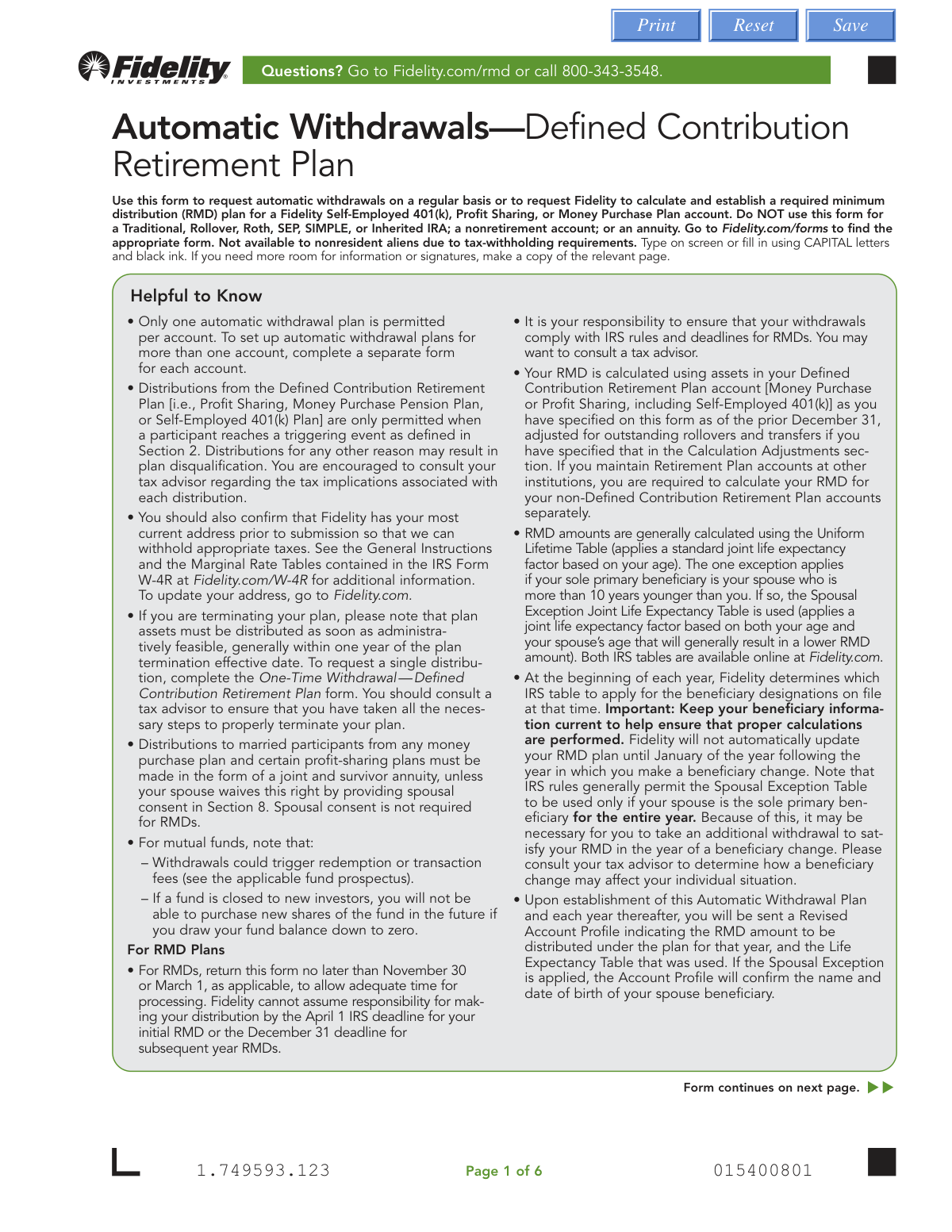
| 1. | Automatic Withdrawals—Defined Contribution Retirement Plan | 1 | Moderate 53 |
| 2. | Empower Retirement Plan Withdrawal Request Form | 1 | – |
| 3. | Fidelity Automatic Withdrawals — Nonretirement | 1 | Basic 45 |
| 4. | Fidelity Automatic Withdrawals — RMD/Life Expectancy | 1 | Moderate 47 |
| 5. | Fidelity One-Time Withdrawal Form — Nonretirement | 1 | Basic 42 |
| 6. | Form F11323, Cash Withdrawal From Your Retirement Investments | 1 | – |
| 7. | Form F11610, Cash Withdrawal from your Retirement Investments for Plans Not Subject to QJSA | 1 | – |
| 8. | One-Time Withdrawal — Defined Contribution Retirement Plan | 1 | Complex 64 |
| 9. | One-Time Withdrawal – Investment-Only (Non-Prototype) Retirement Account | 1 | Moderate 54 |
- Enterprise-grade security & data encryption
- 99%+ accuracy powered by AI
- 1,000+ forms from all industries
- Complete forms in under 60 seconds
How to Choose the Right Form
Selecting the correct retirement withdrawal form depends primarily on your financial institution, the frequency of the distribution, and the specific tax rules governing your account.
Fidelity Retirement and Brokerage Accounts
Fidelity offers specialized forms based on whether you want a single payment or a recurring income stream:
- For Recurring Payments: Use Automatic Withdrawals—Defined Contribution Retirement Plan for Self-Employed 401(k)s or Profit Sharing Plans. If you are managing a personal IRA (Traditional, Roth, or SEP) and need to satisfy IRS rules, use Fidelity Automatic Withdrawals — RMD/Life Expectancy.
- For Single Distributions: Choose the One-Time Withdrawal — Defined Contribution Retirement Plan for immediate 401(k) payouts or rollovers. If you are a plan trustee managing a specialized account, use the One-Time Withdrawal – Investment-Only (Non-Prototype) Retirement Account form.
- For Non-Retirement Accounts: If you are accessing funds from a standard brokerage account, use Fidelity One-Time Withdrawal Form — Nonretirement or Fidelity Automatic Withdrawals — Nonretirement for scheduled transfers.
TIAA and Empower Distributions
If your funds are held with TIAA or Empower, your choice depends on the specific plan regulations regarding spousal consent and payment structure:
- TIAA Participants: Use Form F11323, Cash Withdrawal From Your Retirement Investments for standard requests. However, if your specific plan is not subject to Qualified Joint and Survivor Annuity (QJSA) requirements, you should use Form F11610 instead.
- Empower Participants: Use the Empower Retirement Plan Withdrawal Request Form to handle lump-sum distributions, installments, and tax withholding preferences for your Empower-managed savings.
Key Considerations for Your Choice
- Frequency: Decide if you need a one-time lump sum for an emergency or a recurring "paycheck" for retirement living expenses.
- Tax Compliance: Ensure you select RMD-specific forms, such as the Fidelity RMD/Life Expectancy form, if you are reaching the age where the IRS requires mandatory distributions to avoid heavy penalties.
Form Comparison
| Form | Primary Purpose | Applicable Account Type | Withdrawal Frequency | Key Feature |
|---|---|---|---|---|
| Automatic Withdrawals—Defined Contribution Retirement Plan | Establish or modify recurring payments from a retirement plan | Self-Employed 401(k) or Profit Sharing plans | Ongoing Automatic | Helps comply with IRS Required Minimum Distribution rules |
| Empower Retirement Plan Withdrawal Request Form | General request to access retirement savings and distributions | Empower Retirement Plan accounts | Lump Sum or Installments | Details payout method and specific tax withholding preferences |
| Fidelity Automatic Withdrawals — Nonretirement | Manage recurring distributions from non-retirement investment accounts | Fidelity Brokerage or Mutual Fund accounts | Ongoing Automatic | Not for use with retirement, ABLE, or 529 accounts |
| Fidelity Automatic Withdrawals — RMD/Life Expectancy | Automate withdrawals based on RMD or life expectancy | Traditional, Roth, SEP, or SIMPLE IRAs | Ongoing Automatic | Simplifies compliance with IRS annual withdrawal mandates |
| Fidelity One-Time Withdrawal Form — Nonretirement | Request a single cash distribution for specific needs | Fidelity Brokerage or Mutual Fund accounts | Single One-Time | Accesses funds without setting up a recurring plan |
| Form F11323, Cash Withdrawal From Your Retirement Investments | Standard request for accessing funds from retirement plans | TIAA Retirement Investment accounts | Single One-Time | Allows users to specify exactly how funds are sourced |
| Form F11610, Cash Withdrawal from your Retirement Investments for Plans Not Subject to QJSA | Withdrawal request for plans exempt from QJSA rules | TIAA Retirement accounts (non-QJSA) | Single One-Time | Used specifically for plans without joint survivor requirements |
| One-Time Withdrawal — Defined Contribution Retirement Plan | Request an immediate distribution, rollover, or Roth conversion | Fidelity Self-Employed 401(k) or Profit Sharing | Single One-Time | Supports distributions for retirement, disability, or plan termination |
| One-Time Withdrawal – Investment-Only (Non-Prototype) Retirement Account | Authorizes a single distribution from specialized investment accounts | Investment-Only (Non-Prototype) Retirement accounts | Single One-Time | Requires authorization from the designated plan trustee |
Tips for retirement withdrawal forms
Retirement plans like 401(k)s, IRAs, and Profit Sharing Plans often have distinct withdrawal forms. Using the wrong form for your specific account type can lead to immediate rejection by the financial institution, significantly delaying your access to funds.
Most retirement withdrawals are subject to federal and state income taxes. Ensure you clearly indicate whether you want taxes withheld at the time of distribution or if you prefer to handle them separately to avoid unexpected liabilities during tax season.
AI-powered tools like Instafill.ai can complete these complex retirement forms in under 30 seconds with high accuracy. Your sensitive financial data stays secure during the process, making it a highly efficient way to handle multiple withdrawal or rollover requests.
If you are requesting an electronic transfer to a bank account, a single digit error can cause significant delays or misdirected funds. Always cross-reference your bank's routing number and your personal account number with an official statement before submitting the form.
Many employer-sponsored retirement plans require a spouse's signature, sometimes even notarized, before a withdrawal can be processed. Review the authorization section early to ensure you have all necessary parties available to sign the document.
Ensure you are using the correct form for your specific intent, whether it is a single cash distribution or a scheduled recurring payment like an RMD. Attempting to set up a recurring plan on a one-time withdrawal form is a common mistake that necessitates a full resubmission.
If you are withdrawing funds for specific reasons like a rollover or a qualified hardship, keep all related account statements or invoices organized. Having this documentation ready ensures you can provide proof quickly if the plan administrator or the IRS requests verification.
Frequently Asked Questions
These forms are used to request funds from your retirement accounts, such as a 401(k), IRA, or Profit Sharing Plan. They allow you to specify the amount, frequency (one-time or recurring), and the method of payment for your distribution, ensuring the transaction complies with both plan rules and IRS regulations.
A one-time withdrawal form is intended for a single, immediate request for funds, often used for specific financial needs or rollovers. Automatic withdrawal forms are designed to set up recurring payments, such as monthly retirement income or meeting annual Required Minimum Distribution (RMD) obligations.
These forms are generally required by account holders who have reached retirement age, individuals facing financial hardships, or those who need to move funds to another plan. In some cases, such as with Investment-Only accounts, a plan trustee may be required to fill out and authorize the form on behalf of the account.
Retirement withdrawal forms are governed by strict IRS tax rules and age requirements, often involving specific tax withholding and reporting. Non-retirement forms are used for standard brokerage or mutual fund accounts where distributions do not carry the same retirement-specific tax penalties or age-based restrictions.
Yes, you can use AI tools like Instafill.ai to fill out these forms in under 30 seconds. The AI accurately extracts and places data from your source documents directly into the form fields, ensuring high accuracy and saving significant time compared to manual entry.
Manually filling out complex financial forms can take 15 to 20 minutes of careful data entry. However, using an AI-powered service like Instafill.ai allows you to complete the entire process in less than 30 seconds by automating the data mapping and entry steps.
These are specialized forms used by account holders who have reached the age where the IRS mandates annual withdrawals from traditional retirement accounts. These forms help automate the calculation and distribution of the required amount to help you avoid heavy tax penalties for under-withdrawal.
Each financial institution has its own proprietary account structures, internal processing systems, and specific plan requirements. To ensure your request is processed without delay, you must use the specific form provided by the company that currently manages your assets.
Yes, most retirement withdrawal forms will ask you to specify how much federal and state income tax should be withheld from your distribution. If you do not provide this information, the financial institution is often required by law to withhold a default percentage, which may not align with your actual tax liability.
Completed forms should be submitted directly to the financial institution managing your retirement plan, usually via their secure online portal, fax, or mail. You should check the 'Submission' section of the specific form to find the correct address or digital upload link.
Glossary
- Form Complexity Index
- Instafill’s 0–100 measure of how much effort a form takes to complete, calculated deterministically from the form’s own structure rather than estimated. It combines the number of fillable fields (the largest factor), how difficult those fields are to complete based on their type, the number of pages that contain fields, the amount of conditional “fill-only-if” logic, and how many sections the form is divided into, then adds modifiers for tables and repeating lists, bundled instruction pages, and dense page layouts. A higher score means the form is harder to fill out by hand. The forms in this category have a median Form Complexity Index of 53/100 (Moderate). See exactly how it is calculated.
- Required Minimum Distribution (RMD)
- The minimum amount that the IRS requires you to withdraw from your retirement accounts annually once you reach a specific age, usually 72 or 73.
- Defined Contribution Plan
- A retirement plan, such as a 401(k) or profit-sharing plan, where the final benefit depends on the amount contributed and the performance of the chosen investments.
- Tax Withholding
- The portion of a withdrawal that is sent directly to the IRS or state tax authorities to cover your income tax obligations on the distribution.
- Direct Rollover
- A distribution of assets from a retirement plan directly to another eligible retirement plan or IRA, which avoids immediate taxes and penalties.
- Qualified Joint and Survivor Annuity (QJSA)
- A retirement plan payment structure that provides a lifetime income to the participant and a survivor benefit to their spouse, unless waived by both parties.
- Non-Prototype Account
- A specialized retirement account where the plan trustee or employer, rather than the financial institution, is responsible for maintaining the legal plan documents.
- Profit Sharing Plan
- A type of defined contribution plan that gives employees a share in the profits of a company, with contributions often varying based on the company's annual earnings.
- Custodian
- The financial institution, such as Fidelity or TIAA, that is responsible for holding the assets within your retirement account and processing transactions.