Fill out Roth conversion forms
with AI.
Roth conversion forms are essential tools for individuals looking to manage their retirement savings more effectively. These documents facilitate the process of moving funds from a traditional, pre-tax retirement account—such as a 401(k) or traditional IRA—into a Roth account. The primary motivation for using these forms is the strategic tax advantage: by paying taxes on the converted amount now, investors can benefit from tax-free growth and tax-free withdrawals during retirement. This is particularly valuable for those who anticipate being in a higher tax bracket later in life or who want to avoid future required minimum distributions (RMDs) on their Roth assets.
By continuing, you acknowledge Instafill's Privacy Policy and agree to get occasional product update and promotional emails.
About Roth conversion forms
Financial planners, insurance policyholders, and retirement plan participants typically encounter these forms during major financial shifts or year-end tax planning. Whether you are managing an In-Plan Roth Conversion within a corporate retirement plan or transferring assets between individual accounts, accurate documentation is critical to avoid costly IRS penalties or processing delays. For example, specific insurance forms like those from Principal Life Insurance Company are used to document these elections and ensure compliance with specific plan rules. Because these forms involve sensitive financial data and complex tax elections, precision is paramount to ensuring your long-term financial strategy is executed correctly.
Handling these complex insurance and retirement documents manually can be time-consuming and prone to errors. Tools like Instafill.ai use AI to fill these forms in under 30 seconds, ensuring that data is handled accurately and securely while saving you the hassle of manual entry. This allows you to focus on your financial goals rather than the administrative burden of paperwork.
Every form on this page can be completed without typing. Instafill is form filling software that reads a PDF and fills it for you — including flat and scanned documents that carry no fillable fields at all.
Forms in This Category
The forms in this category have a median Form Complexity Index of 39/100 (Basic), measured across 7 forms by field count, input difficulty, length, conditional logic and structure. See how it is calculated.
| Form Name | Pages | FCI | |
|---|---|---|---|
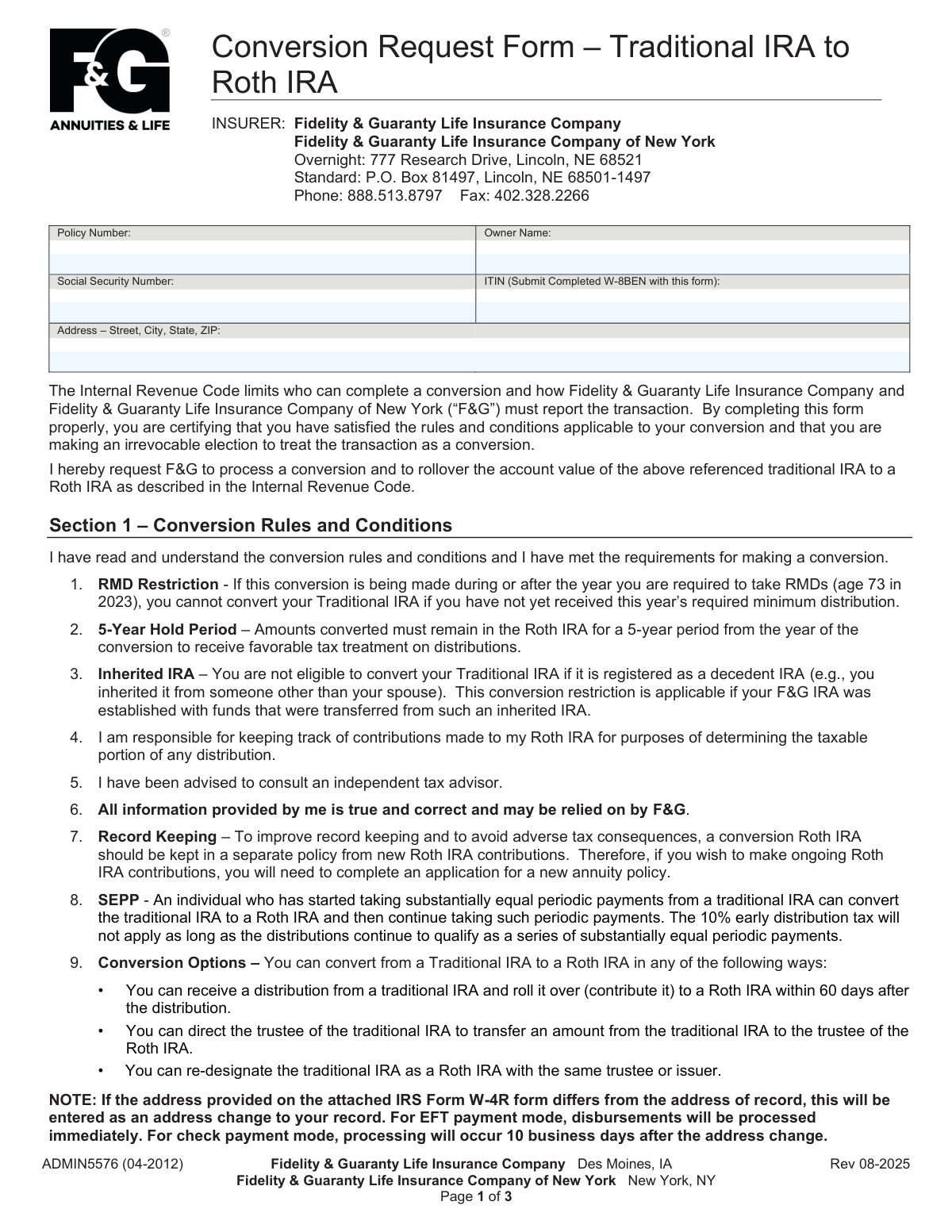
| 1. | Conversion Request Form – Traditional IRA to Roth IRA | 1 | Basic 31 |
| 2. | Fidelity Advisor IRA Roth Conversion | 1 | Moderate 49 |
| 3. | Fidelity Roth IRA Conversion Form | 1 | Basic 39 |
| 4. | Merrill Lynch IRA/IRRA® to Roth IRA Conversion Form | 1 | Basic 39 |
| 5. | Premiere Select Roth IRA Conversion | 1 | Complex 71 |
| 6. | Premiere Select Roth IRA Conversion 1.747921.112 | 1 | Basic 39 |
| 7. | Principal Life Insurance Company Form PG4701, In-Plan Roth Conversion – No Spousal Consent Needed | 1 | – |
- Enterprise-grade security & data encryption
- 99%+ accuracy powered by AI
- 1,000+ forms from all industries
- Complete forms in under 60 seconds
How to Choose the Right Form
Deciding how to transition your retirement savings into a tax-advantaged future requires the right paperwork. While Roth conversions are a powerful wealth-building tool, the forms required depend heavily on your plan provider and your marital status.
Verify Your Plan Administrator
The primary form in this category is the Principal Life Insurance Company Form PG4701, In-Plan Roth Conversion. This document is specifically designed for individuals whose retirement plans are managed by Principal Life Insurance Company. If your employer-sponsored plan or individual annuity is held with a different provider, you will likely need a different form specific to that institution.
Understanding "In-Plan" Conversions
Form PG4701 is used specifically for an In-Plan Roth Conversion. This means you are moving funds from a pre-tax account (such as pre-tax contributions or previous rollovers) into a Roth account within the *same* retirement plan. You should choose this form if:
- You intend to pay taxes on your contributions now to enjoy tax-free qualified distributions later.
- You are maintaining your balance within your current employer's plan rather than moving it to an outside brokerage.
- You are converting existing non-Roth funds to a Roth sub-account.
Spousal Consent Considerations
A unique feature of Form PG4701 is its designation: "No Spousal Consent Needed." In many retirement plans, significant changes to the character of funds require a spouse's signature to protect potential survivor benefits. However, this specific version of the form is used when those requirements are either not applicable or the plan rules allow for conversions without additional spousal authorization. If your specific plan requires a notarized spousal waiver, you may need to look for an alternative version of the Principal conversion paperwork.
Streamlining the Filing Process
Retirement and insurance forms often involve complex tax implications. Using Instafill.ai to complete Form PG4701 ensures that your data is entered accurately into the PDF, helping you avoid administrative errors that could delay your conversion and impact your tax planning for the year.
Form Comparison
| Form | Primary Purpose | Who Files It | Consent Requirement | Tax Impact |
|---|---|---|---|---|
| Principal Life Insurance Company Form PG4701, In-Plan Roth Conversion – No Spousal Consent Needed | Converts pre-tax or rollover funds into a Roth account within the same plan. | Retirement plan participants holding accounts with Principal Life Insurance Company. | Specifically designed for situations where spousal consent is not required. | Creates immediate taxable income in exchange for future tax-free qualified distributions. |
Tips for Roth conversion forms
A Roth conversion is a taxable event where you pay income tax on the converted amount now to enjoy tax-free growth later. Ensure you have the funds available outside of the retirement account to cover the resulting tax bill to maximize the conversion's long-term benefits.
AI-powered tools like Instafill.ai can complete these complex retirement forms in under 30 seconds with high accuracy. Your sensitive financial data stays secure during the process, making it a reliable way to handle multiple documents without manual entry errors.
While form PG4701 covers conversions without spousal consent, individual employer plans may have unique restrictions on when and how often you can convert. Review your Summary Plan Description (SPD) to ensure you meet all eligibility requirements before submitting the paperwork.
Errors in account numbers or distribution codes can lead to rejected applications or incorrect tax reporting. Carefully verify your current contract or policy number against your most recent statement to ensure the funds are moved from the correct source.
Once the conversion is processed, you will likely receive a Form 1099-R for the tax year the conversion occurred. Store a copy of your completed conversion form alongside your annual statements to simplify filing IRS Form 8606 during tax season.
A Roth conversion is an excellent time to review and update your beneficiary designations for the new Roth portion of your account. Ensure that your designations on file with the insurance company align with your current estate planning goals.
Frequently Asked Questions
These forms are used to request the transfer of pre-tax retirement assets into a Roth account within the same plan or a different retirement vehicle. This process allows the account holder to pay income taxes on the converted amount now so that future qualified distributions can be taken tax-free.
Retirement plan participants who want to shift their existing non-Roth funds, such as pre-tax contributions or rollovers, into a Roth sub-account within their current employer-sponsored plan use these forms. It is a common strategy for individuals who expect to be in a higher tax bracket during retirement.
Yes, converting funds to a Roth account is generally a taxable event. The amount converted is added to your gross taxable income for the year, so it is highly recommended to consult with a tax professional to understand the impact on your specific tax liability.
Many participants choose to submit these forms when they anticipate their annual income will be lower or when market values have decreased. To count for a specific tax year, the conversion must typically be processed and completed by the end of that calendar year.
Once the form is filled out, it is usually submitted directly to the insurance company or financial institution that manages the retirement plan, such as Principal Life Insurance Company. Submission instructions, including mailing addresses or digital upload portals, are typically found on the form's instructional pages.
Spousal consent requirements depend on the specific rules of your retirement plan and the type of form being used. Some forms are specifically designed for situations where spousal consent is not required, but you should always verify your plan’s summary description before proceeding.
You will typically need your plan number, personal identification details, and the specific dollar amount or percentage you wish to convert. Having your latest account statement nearby is helpful for ensuring that account numbers and fund details are entered accurately.
Yes, AI tools like Instafill.ai can fill out these complex retirement forms in under 30 seconds. The AI accurately extracts data from your source documents and places it directly into the required fields of the PDF, reducing the risk of manual entry errors.
Processing times vary by the financial institution, but it often takes several business days for the funds to be moved into the new Roth account. Ensuring the form is completed accurately using digital tools can help prevent common administrative delays.
Under current tax laws, Roth conversions are generally permanent and cannot be reversed or 'recharacterized' once they are finalized. Because of this, it is crucial to ensure all information on the form is correct before the transaction is executed.
AI-powered services accurately extract and place data from source documents directly into the form fields. This automated process ensures that sensitive information, such as social security numbers and plan identifiers, is handled consistently and correctly.
Glossary
- Form Complexity Index
- Instafill’s 0–100 measure of how much effort a form takes to complete, calculated deterministically from the form’s own structure rather than estimated. It combines the number of fillable fields (the largest factor), how difficult those fields are to complete based on their type, the number of pages that contain fields, the amount of conditional “fill-only-if” logic, and how many sections the form is divided into, then adds modifiers for tables and repeating lists, bundled instruction pages, and dense page layouts. A higher score means the form is harder to fill out by hand. The forms in this category have a median Form Complexity Index of 39/100 (Basic). See exactly how it is calculated.
- In-Plan Roth Conversion
- A transaction that allows a retirement plan participant to move non-Roth funds, such as pre-tax savings, into a Roth account within the same employer-sponsored plan.
- Pre-tax Contributions
- Retirement savings taken from your paycheck before income taxes are calculated, which reduces your current taxable income but makes the funds taxable upon withdrawal or conversion.
- Taxable Event
- An action that triggers a tax liability, such as a Roth conversion, where the converted amount is treated as ordinary income for the year the transfer occurs.
- Qualified Distribution
- A withdrawal from a Roth account that is both tax-free and penalty-free, usually occurring after the account has been open for five years and the owner is at least 59½.
- Spousal Consent
- A legal requirement in many retirement plans where a spouse must provide a signed and notarized agreement before the participant can make certain changes to their account or distributions.
- After-tax Contributions
- Funds contributed to a retirement plan from income that has already been taxed; these can often be converted to a Roth account with little to no additional tax cost.
- Cost Basis
- The total amount of money in your retirement account that has already been taxed, which is not subject to further income tax during a conversion.
- Rollover
- The process of moving retirement funds from one eligible account or plan to another, which may be required before a conversion can be initiated.