Yes! You can use AI to fill out Fidelity Advisor IRA Roth Conversion

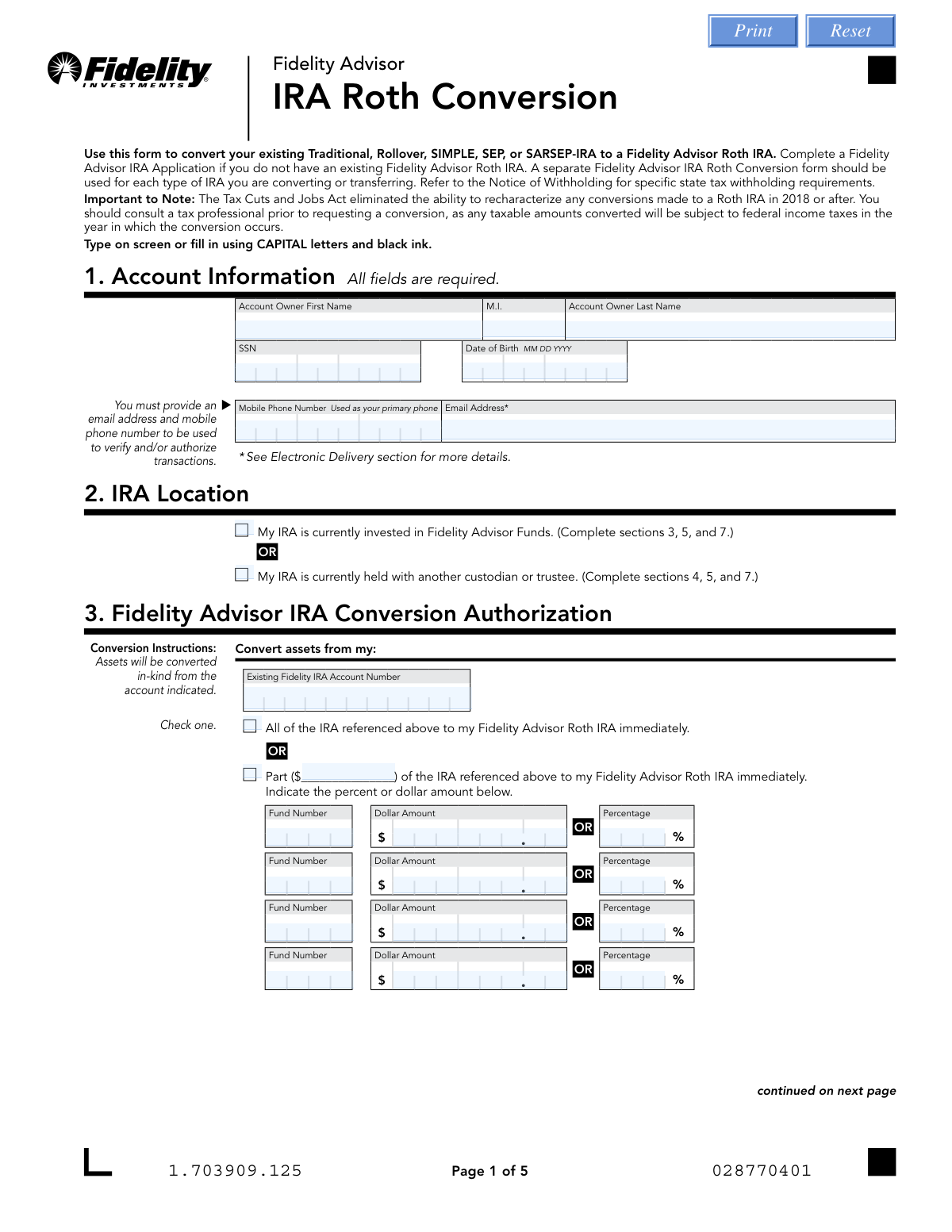
The Fidelity Advisor IRA Roth Conversion form is a financial document used to formally request the conversion of funds from a pre-tax retirement account (like a Traditional, Rollover, SIMPLE, or SEP-IRA) into a post-tax Fidelity Advisor Roth IRA. This process is a taxable event, and the form is crucial for providing Fidelity with the necessary authorization, asset details, and tax withholding instructions. Today, this form can be filled out quickly and accurately using AI-powered services like Instafill.ai, which can also convert non-fillable PDF versions into interactive fillable forms.
Our AI automatically handles information lookup, data retrieval, formatting, and form filling.
It takes less than a minute to fill out Fidelity IRA Roth Conversion using our AI form filling.
Securely upload your data. Information is encrypted in transit and deleted immediately after the form is filled out.

Form specifications

Form name: Fidelity Advisor IRA Roth Conversion
Number of pages: 1
Language: English
Categories: IRA forms, Fidelity forms, Roth conversion forms
main-image

Instafill Demo: How to fill out PDF forms in seconds with AI

How to Fill Out Fidelity IRA Roth Conversion Online for Free in 2026

Are you looking to fill out a FIDELITY IRA ROTH CONVERSION form online quickly and accurately? Instafill.ai offers the #1 AI-powered PDF filling software of 2026, allowing you to complete your FIDELITY IRA ROTH CONVERSION form in just 37 seconds or less.
Follow these steps to fill out your FIDELITY IRA ROTH CONVERSION form online using Instafill.ai:
  1. 1 Navigate to Instafill.ai and upload or select the Fidelity IRA Roth Conversion form to begin.
  2. 2 Provide your personal account information in Section 1, including your full name, Social Security Number, date of birth, and contact details.
  3. 3 In Section 2, indicate the current location of the IRA you wish to convert, whether it's already with Fidelity or held by another custodian.
  4. 4 Complete the appropriate conversion authorization section (Section 3 for Fidelity IRAs or Section 4 for external IRAs), specifying the accounts and the amount (full or partial) to be converted.
  5. 5 Make your federal and state income tax withholding elections in Section 5. A Roth conversion is a taxable event, so this step is critical for managing your tax liability.
  6. 6 Carefully review all the information you've provided, then proceed to Section 7 to electronically sign and date the form, certifying your instructions and authorizing the conversion.

Our AI-powered system ensures each field is filled out correctly, reducing errors and saving you time.

Why Choose Instafill.ai for Your Fillable Fidelity IRA Roth Conversion Form?

Speed

Complete your Fidelity IRA Roth Conversion in as little as 37 seconds.

Up-to-Date

Always use the latest 2026 Fidelity IRA Roth Conversion form version.

Cost-effective

No need to hire expensive lawyers.

Accuracy

Our AI performs 10 compliance checks to ensure your form is error-free.

Security

Your personal information is protected with bank-level encryption.

Frequently Asked Questions About Form Fidelity IRA Roth Conversion

This form is used to convert an existing Traditional, Rollover, SIMPLE, SEP, or SARSEP-IRA into a Fidelity Advisor Roth IRA. It facilitates moving your retirement assets from a pre-tax account to a post-tax Roth account.

You should fill out this form if you have an eligible pre-tax IRA and wish to convert all or part of it to a Fidelity Advisor Roth IRA. If you don't already have a Fidelity Advisor Roth IRA, you must also complete a Fidelity Advisor IRA Application.

You should complete Section 3 if your IRA is already with Fidelity Advisor. Complete Section 4 if your IRA is currently held at a different financial institution (another custodian or trustee).

If you are converting an IRA from another custodian (Section 4), you must attach a copy of your most recent account statement for that IRA. No other documents are explicitly required unless a signature guarantee is needed.

Yes, a conversion from a traditional IRA to a Roth IRA is a taxable event. The amount you convert is generally considered taxable income for the year in which the conversion occurs, so you should consult a tax professional.

No, the Tax Cuts and Jobs Act eliminated the ability to recharacterize Roth conversions made in 2018 or later. Once you convert the funds, the action cannot be undone.

In Section 5, you can elect to have federal and state income taxes withheld. If you do nothing, Fidelity is required to withhold 10% for federal taxes, but you can choose a different rate (from 0% to 100%) or elect no withholding at all.

Yes, you cannot convert a SIMPLE IRA to a Roth IRA until two years have passed since the first contribution was deposited into the account. You must provide the date contributions were first made in Section 4.

You can submit the form by uploading it online via the Fidelity website, faxing it to 888-321-7349, or mailing it. If your form requires an original signature guarantee, you must send it by mail.

A signature guarantee is a stamp from an eligible financial institution (like a bank or credit union) that verifies your identity and signature to protect against fraud. Unlike a notary, which only verifies identity, a signature guarantee also insures the transaction.

Yes, services like Instafill.ai use AI to accurately auto-fill form fields with your information, which can save you time and help prevent errors.

You can use a service like Instafill.ai to easily complete the form online. Simply upload the PDF, and the AI will make all the fields fillable so you can type your information, sign, and download the completed document.

If you have a non-fillable or 'flat' PDF, you can use a tool like Instafill.ai to convert it into an interactive, fillable form. This allows you to easily type your information directly into the fields from your computer or mobile device.

If you are converting from another custodian and do not specify investment instructions, the form states that if a share class is not indicated, Class A shares will be purchased. If percentages don't total 100%, the first fund listed will be adjusted to make the total 100%.

Compliance Fidelity IRA Roth Conversion
Validation Checks by Instafill.ai

1
Ensures All Required Account Information is Provided
This check verifies that all fields in Section 1 (Account Information) are completed, including First Name, Last Name, SSN, Date of Birth, Mobile Phone Number, and Email Address. These fields are critical for identifying the account owner and processing the conversion request accurately. A failure would prevent form submission until all required fields are filled.
2
Validates Social Security Number (SSN) Format
This validation ensures the Social Security Number entered in Section 1 consists of exactly nine digits, and may enforce a XXX-XX-XXXX format. An accurate SSN is legally required for tax reporting purposes related to the conversion. An invalid format will trigger an error message prompting the user to correct the entry before proceeding.
3
Verifies Valid Date of Birth
This check confirms that the Date of Birth in Section 1 is a valid calendar date in MM DD YYYY format and that the account owner meets the minimum age requirement (e.g., 18 years old) to enter into this agreement. This is important for legal and compliance reasons. If the date is invalid or the individual is underage, the form cannot be processed.
4
Conditional Section Completion Based on IRA Location
This check enforces the logic selected in Section 2 (IRA Location). If the user indicates their IRA is with Fidelity, Section 3 must be completed and Section 4 must be blank. Conversely, if the IRA is with another custodian, Section 4 must be completed and Section 3 must be blank. This prevents ambiguity and ensures the correct conversion workflow is initiated.
5
SIMPLE IRA Two-Year Holding Period Rule
If 'SIMPLE IRA' is selected in Section 4, this validation checks that the 'Date Contributions Were First Made' is at least two years prior to the current date. This is a mandatory IRS rule for converting a SIMPLE IRA to a Roth IRA. A failure to meet this requirement will block the conversion and inform the user that they are not yet eligible.
6
Fidelity Account Number Existence and Ownership
When a user provides an 'Existing Fidelity IRA Account Number' in Section 3, this check validates that the account number is a valid, active account within Fidelity's systems. It should also verify that the account is registered to the same individual identified in Section 1. This prevents unauthorized or erroneous conversions from the wrong account.
7
Partial Conversion Specification Logic
In Section 3, if the user selects to convert a 'Part' of their IRA, this check ensures that at least one fund line item is completed with either a dollar amount or a percentage. It also validates that for any given line, only one of the two fields (Dollar Amount or Percentage) is filled, not both. This ensures clear and executable instructions for the partial conversion.
8
Trustee-to-Trustee Investment Allocation Total
For conversions from another custodian (Section 4), this check verifies that the 'Whole Percentage' allocations for the new investments sum to exactly 100%. While the form notes an automatic adjustment, a proper validation should flag any total other than 100% to the user for correction. This ensures the user's investment intentions are captured accurately without system defaults.
9
Mutually Exclusive Federal Tax Withholding Election
This validation ensures that in Section 5, the user selects only one of the two primary federal tax withholding options: either 'I elect NOT to have' or 'I want Fidelity to withhold'. Selecting both options is contradictory and would result in an error. This check guarantees a clear, unambiguous instruction for tax withholding.
10
Federal Withholding Percentage Range
If the user elects to have federal taxes withheld in Section 5, this check validates that the specified percentage is a whole number between 1 and 100. The form text specifies this range for user-defined withholding. This prevents invalid entries and ensures compliance with the available withholding options.
11
State-Specific Tax Withholding Logic
Based on the account owner's state of residence on file, this check applies the rules outlined in the 'Notice of Withholding'. For example, it would prevent a user from a 'Not Allowed' state (like FL or TX) from electing state withholding. It would also enforce mandatory withholding for states like MI or CT, flagging an error if the user tries to opt out incorrectly.
12
CD Maturity Date Submission Window
If the asset being converted is a CD (Section 4), this validation checks if the form submission date is within the recommended window, which is between two and four weeks prior to the CD's maturity date. This is important for timely processing without incurring penalties. The system should issue a warning if the submission is outside this optimal timeframe.
13
Signature and Date Presence
This is a critical final check to ensure that the 'Account Owner or Authorized Signer Signature' and the 'Date' fields in Section 7 are not empty. A signature is legally required to authorize the transaction and certify the statements on the form. The form cannot be processed without a valid signature and date.
14
Valid Email Address Format
This check verifies that the email address provided in Section 1 follows a standard format (e.g., '[email protected]'). A valid email is required for electronic delivery of account communications and transaction authorizations as stated in the form. An invalid format would prevent the user from receiving critical information and completing the consent process.

Common Mistakes in Completing Fidelity IRA Roth Conversion

Forgetting to Attach the Required Custodian Statement

When converting an IRA from another institution, Section 4 explicitly requires attaching a copy of the most recent account statement. People often overlook this instruction, assuming the account number alone is sufficient. Without the statement, Fidelity cannot verify the assets to be transferred, leading to the form's rejection and significant delays in the conversion process. To avoid this, always double-check for required attachments before submitting; AI-powered tools like Instafill.ai can highlight these requirements to ensure you don't miss critical steps.

Attempting an Ineligible SIMPLE IRA Conversion

The form and IRS rules state that a SIMPLE IRA can only be converted to a Roth IRA two years after the first contribution was made. Filers may be unaware of this rule or misremember the date, leading them to request an ineligible conversion. This will result in the rejection of the request, forcing the user to wait and resubmit the form later. It's crucial to verify the exact date of the first contribution before filling out Section 4.

Misunderstanding Tax Withholding Elections

A Roth conversion is a taxable event, making Section 5 critical. Many people either forget to make an election or don't understand the consequences, not realizing that Fidelity is required to withhold a default 10% for federal taxes if no choice is made. Furthermore, state withholding rules are complex and vary; making an invalid choice for one's state of residence will cause processing errors. It is vital to consult the 'Notice of Withholding' and a tax professional to make an informed decision.

Selecting the Incorrect IRA Location

In Section 2, the filer must choose between an existing Fidelity IRA or an IRA at another custodian, which determines whether they fill out Section 3 or Section 4. Selecting the wrong option causes the user to provide information in the wrong section, making the application invalid. This fundamental error results in immediate rejection and requires the user to start over with a new form. Carefully read Section 2 to ensure you complete the correct part of the application.

Forgetting to Sign and Date the Form

This is one of the most common reasons for form rejection across the board. Filers often complete all the complex financial details but forget the final, crucial step of signing and dating in Section 7. An unsigned or undated form is legally invalid and cannot be processed, causing the entire submission to be returned and restarting the process from the beginning. Always perform a final check for a signature and correctly formatted date before submission.

Failing to Include a New Roth IRA Application When Needed

This form is for converting assets *to* a Roth IRA. If the account owner does not already have an existing Fidelity Advisor Roth IRA, they must submit a separate 'Fidelity Advisor IRA Application' along with this conversion form. Many people miss this requirement, assuming this form alone will create the new account. This omission will halt the entire process until the separate application is received, significantly delaying the conversion.

Ambiguous Partial Conversion Instructions

In Section 3, when converting only part of an IRA, users must specify the exact dollar amount or percentage for each fund. People often provide vague instructions, list incorrect fund numbers, or enter amounts that don't match their holdings. This ambiguity forces Fidelity to halt the process and contact the owner for clarification, delaying the conversion. To avoid this, use a current statement to get the correct fund numbers and decide on precise dollar amounts or percentages for each.

Incorrect Investment Allocation Percentages

In Section 4, when specifying how to invest the converted funds into a new Fidelity Roth IRA, the percentages must add up to exactly 100%. Filers can easily make a calculation error when allocating across multiple funds. While the form notes that Fidelity will adjust the first fund to correct the total, this may not reflect the filer's true investment intent, potentially leading to an undesirable asset allocation. To prevent this, carefully double-check that all specified percentages sum to 100% before signing.

Incomplete or Inaccurate Custodian Information

When transferring from another institution (Section 4), all fields for the current custodian—including name, address, phone number, and account number—are required. People may leave fields blank if the information isn't readily available, or they might provide an incorrect account number. Incomplete or inaccurate data prevents Fidelity from contacting the other institution to initiate the transfer, causing significant delays. Using a tool like Instafill.ai, which can make this non-fillable PDF interactive, helps ensure all required fields are completed before submission.

Confusing a Notary with a Signature Guarantee

The form explicitly states that a notary public cannot provide a signature guarantee, which may be required for certain transactions. Users unfamiliar with this distinction may obtain a notary stamp, believing it to be sufficient. Submitting a form with a notary stamp when a signature guarantee is needed will lead to rejection and require the filer to visit an eligible financial institution (like a bank or credit union) to get the correct stamp and then re-mail the form.
Saved over 80 hours a year

“I was never sure if my IRS forms like W-9 were filled correctly. Now, I can complete the forms accurately without any external help.”

Kevin Martin Green

Your data stays secure with advanced protection from Instafill and our subprocessors

Robust compliance program

Transparent business model

You’re not the product. You always know where your data is and what it is processed for.

ISO 27001, HIPAA, and GDPR

Our subprocesses adhere to multiple compliance standards, including but not limited to ISO 27001, HIPAA, and GDPR.

Security & privacy by design

We consider security and privacy from the initial design phase of any new service or functionality. It’s not an afterthought, it’s built-in, including support for two-factor authentication (2FA) to further protect your account.

Fill out Fidelity IRA Roth Conversion with Instafill.ai

Worried about filling PDFs wrong? Instafill securely fills fidelity-advisor-ira-roth-conversion forms, ensuring each field is accurate.