Fill out Roth IRA forms
with AI.
Roth IRA forms are a critical component of retirement planning, facilitating the movement and management of post-tax retirement funds. These documents are necessary for a variety of financial actions, from establishing a new account to executing complex tax strategies. Because Roth IRAs offer the unique benefit of tax-free growth and withdrawals, maintaining accurate documentation is vital for ensuring your contributions and conversions comply with IRS guidelines and specific financial institution policies.
By continuing, you acknowledge Instafill's Privacy Policy and agree to get occasional product update and promotional emails.
About Roth IRA forms
These forms are typically required by individual investors, beneficiaries, and account holders at major institutions like Merrill Lynch or Fidelity. You might need them when performing a Roth conversion to lock in future tax savings, or when managing a beneficiary distribution from an inherited account. They are also used for specialized transactions, such as rolling over funds from a 529 college savings plan or a 401(k) into a Roth account. Ensuring that details like tax withholding elections and beneficiary designations are correct is essential for avoiding unintended tax liabilities.
Navigating these administrative requirements can be time-consuming, but tools like Instafill.ai use AI to fill these forms in under 30 seconds while ensuring data is handled accurately and securely. This allows you to focus on your long-term financial strategy rather than the complexities of the paperwork.
Every form on this page can be completed without typing. Instafill is form filling software that reads a PDF and fills it for you — including flat and scanned documents that carry no fillable fields at all.
Forms in This Category
The forms in this category have a median Form Complexity Index of 45/100 (Basic), measured across 15 forms by field count, input difficulty, length, conditional logic and structure. See how it is calculated.
- Enterprise-grade security & data encryption
- 99%+ accuracy powered by AI
- 1,000+ forms from all industries
- Complete forms in under 60 seconds
How to Choose the Right Form
Converting to a Roth IRA
If you are moving pre-tax funds from a Traditional, SEP, or SIMPLE IRA into a post-tax Roth account, you will need a conversion form. These are taxable events, so selecting the correct custodian-specific form is vital:
- Fidelity Users: Choose the Fidelity Roth IRA Conversion Form for standard accounts or the Fidelity Advisor IRA Roth Conversion if working with a financial advisor.
- Merrill Lynch Users: Use the Merrill Lynch IRA/IRRA® to Roth IRA Conversion Form to transition your assets.
- Premiere Select Users: Opt for the Premiere Select Roth IRA Conversion form to authorize the transfer.
Managing Distributions and Withdrawals
Accessing your funds requires specific documentation based on how you want to receive the money, particularly for Merrill Lynch accounts:
- One-Time Requests: Use the Merrill IRA/IRRA®/Roth IRA/SEP/SRA One Time Distribution Form for a single withdrawal.
- Recurring Payments: The IRA/IRRA®/Roth IRA/SEP/SRA Distribution Form For Standing Letters is best for setting up automatic, scheduled distributions.
- Divorce Transfers: To move assets to a former spouse’s account without triggering unnecessary taxes, use the IRA/IRRA®/Roth IRA/SEP/SRA Divorce Transfer Instruction Form.
Inherited Accounts and Beneficiaries
If you are the beneficiary of a deceased account holder, you must use specific forms to claim or distribute the assets. The IRA/IRRA®/ROTH IRA/SEP/SRA Beneficiary Distribution Form allows you to specify payout amounts and tax withholding elections for inherited Merrill accounts.
Rollovers from 401(k)s and 529 Plans
Moving funds from other types of savings plans into a Roth IRA involves unique IRS regulations:
- From a 401(k): Use the Transamerica Distribution Request (Distribution of Traditional 401(k) to Roth IRA) for employer-sponsored plan rollovers.
- From a 529 Plan: The Vanguard 529 College Savings Plan Direct Rollover Out to Roth IRA Form is specifically for transferring unused education savings into a Roth IRA.
- From State Plans: Use the New York State Deferred Compensation Plan Direct Rollover to a Roth IRA for state-specific deferred comp accounts.
Opening a New Account
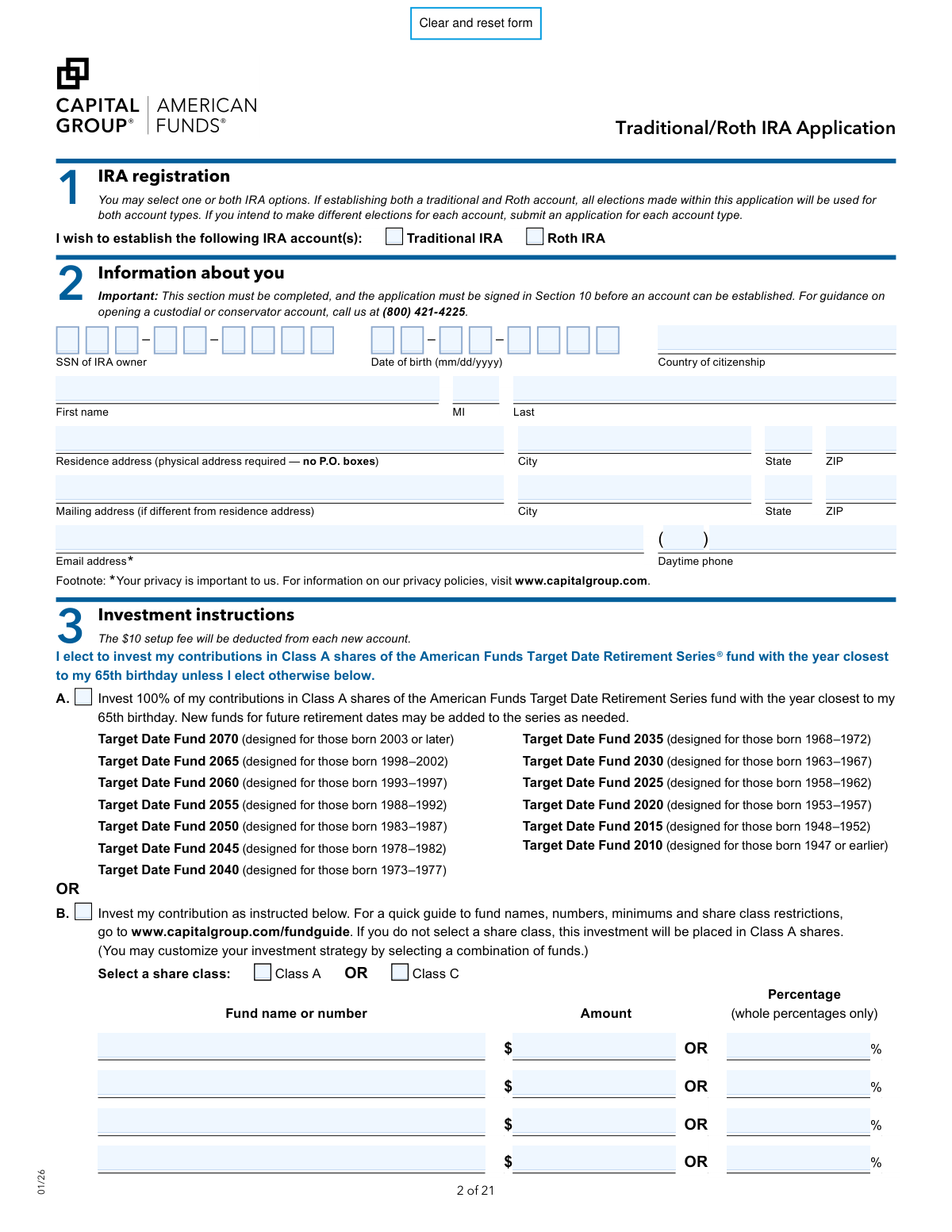
If you are establishing a brand new retirement account, the Voya Investment Management Traditional, Roth, Rollover, and SEP Individual Retirement Account (IRA) Application and Adoption Agreement provides the full package needed to set up your account and designate beneficiaries from the start.
Tips for Roth IRA forms
When filling out Roth conversion or distribution forms, you must decide whether to have federal and state taxes withheld immediately. Choosing the wrong amount can lead to an unexpected tax bill or underpayment penalties at year-end, so consult your current tax bracket before checking these boxes.
Forms for beneficiary distributions require precise information about the original account owner and the beneficiary's legal relationship to them. Ensure names and Social Security numbers match the financial institution's existing records exactly to avoid having your distribution request rejected.
Because converting a Traditional IRA to a Roth IRA is an irrevocable and taxable event, always save a copy of your completed forms for your permanent tax records. This documentation is vital for proving the tax-paid status of your funds during future tax-free withdrawals.
Managing complex Roth IRA forms, such as those from Merrill Lynch or Fidelity, can be time-consuming and prone to manual errors. AI-powered tools like Instafill.ai can complete these forms in under 30 seconds with high accuracy, and your sensitive financial data stays secure throughout the process.
If you are using specialized forms to transfer IRA assets to a former spouse, have the relevant sections of your divorce decree or settlement agreement ready for reference. These forms must be filed correctly to ensure the transfer is treated as a non-taxable event under IRS Section 408(d)(6).
When rolling over funds from a 529 plan or a 401(k) to a Roth IRA, the names on both the sending and receiving accounts should match exactly. Discrepancies in naming conventions between different institutions can cause significant delays or the rejection of your rollover request.
Frequently Asked Questions
A Roth IRA conversion form is used to move assets from a pre-tax retirement account, such as a Traditional IRA, SEP, or SIMPLE IRA, into a post-tax Roth IRA. This process allows your investments to grow tax-free, though the amount converted is generally treated as taxable income in the year the move occurs.
You should use a distribution form if you intend to withdraw funds from your account for personal use or to move them to a non-retirement bank account. Use a conversion form specifically when you are moving funds between retirement accounts to change their tax status from pre-tax to post-tax.
Yes, you can use AI tools like Instafill.ai to fill out these forms accurately and efficiently. The AI can extract data from your source documents and place it into the correct fields on the PDF, ensuring all information is captured correctly without manual typing.
Using AI-powered services like Instafill.ai, most Roth IRA and Merrill Lynch forms can be completed in under 30 seconds. This is significantly faster than manual entry and helps reduce errors in critical sections like account numbers and tax withholding elections.
When completing a beneficiary distribution form for an inherited Roth IRA, you typically need the deceased account holder's information and your own Social Security number or tax ID. Financial institutions like Merrill Lynch may also require a certified copy of the death certificate to process the request.
Yes, specific forms like the Vanguard 529 Direct Rollover Out to Roth IRA Form facilitate this transfer under SECURE 2.0 Act rules. There are strict requirements, including a lifetime limit on the rollover amount and a requirement that the 529 account must have been open for at least 15 years.
You should use a specialized Divorce Transfer Instruction Form, such as the one provided by Merrill Lynch. This form ensures the asset transfer is treated as a non-taxable event under IRC Section 408(d)(6), preventing unnecessary penalties for either spouse during the asset division.
Most Roth IRA distribution and conversion forms allow you to choose whether to have federal and state income taxes withheld from the amount being moved. Because conversions and certain distributions are taxable events, these elections are crucial for managing your year-end tax liability.
Once completed and signed, these forms should be submitted directly to the custodian of the account, such as Merrill Lynch or Fidelity. Many institutions accept submissions through their secure online portals, while others may require the form to be mailed or faxed to a specific processing center.
Anyone with an existing pre-tax retirement account, such as a Traditional IRA or a 401(k), can typically use a conversion form. There are no longer income limits for performing a Roth conversion, though you should consult a tax professional to understand how the added income will affect your tax bracket.
Glossary
- Form Complexity Index
- Instafill’s 0–100 measure of how much effort a form takes to complete, calculated deterministically from the form’s own structure rather than estimated. It combines the number of fillable fields (the largest factor), how difficult those fields are to complete based on their type, the number of pages that contain fields, the amount of conditional “fill-only-if” logic, and how many sections the form is divided into, then adds modifiers for tables and repeating lists, bundled instruction pages, and dense page layouts. A higher score means the form is harder to fill out by hand. The forms in this category have a median Form Complexity Index of 45/100 (Basic). See exactly how it is calculated.
- Roth Conversion
- The process of moving assets from a pre-tax retirement account, such as a Traditional IRA or 401(k), into a post-tax Roth IRA, which typically triggers a taxable event.
- Tax Withholding Election
- A choice made by the account holder to have a specific percentage of a distribution or conversion amount sent directly to the IRS to cover potential income taxes.
- Beneficiary Distribution
- A withdrawal of funds from a retirement account by a person who inherited the account after the original owner's death.
- Direct Rollover
- The movement of retirement funds directly from one plan provider or custodian to another, ensuring the money is not treated as a taxable distribution to the owner.
- IRRA®
- An Individual Retirement Rollover Account, a term used by institutions like Merrill Lynch to categorize IRAs specifically funded by assets moved from employer-sponsored plans.
- SEP IRA
- Simplified Employee Pension Plan; a type of traditional IRA for small business owners and self-employed individuals that can be converted to a Roth IRA via these forms.
- Custodian
- The financial institution, such as Fidelity or Merrill Lynch, that is responsible for holding the assets and maintaining the legal compliance of the IRA.
- Standing Instructions
- Pre-authorized, permanent directions given to a financial institution to execute future transactions, such as recurring monthly distributions, without requiring a new form each time.