Fill out trust certification forms
with AI.
Trust certification forms, often referred to as a "Certificate of Trust," are essential legal documents used to verify the existence and terms of a trust without disclosing the private details of the entire trust agreement. These forms serve as a formal summary for financial institutions, confirming key information such as the trust's legal name, the date it was established, the identity of the grantors, and the specific powers granted to the trustees. By using these certifications, trustees can conduct business on behalf of the trust while maintaining the confidentiality of the beneficiaries and the specific distribution instructions contained within the full trust document.
By continuing, you acknowledge Instafill's Privacy Policy and agree to get occasional product update and promotional emails.
About trust certification forms
These forms are typically required by trustees when opening new brokerage accounts, managing life insurance policies, or updating account records following the addition or removal of a trustee. For instance, financial institutions like Fidelity and Vanguard require specific certification forms—such as the Fidelity Certification of Trust or the Vanguard 529 Trustee Certification—to authorize transactions or to identify beneficial ownership in compliance with federal regulations. Whether you are managing a college savings plan or handling a Transamerica life insurance policy, providing an accurate certification ensures that the institution recognizes your legal authority to act.
Completing these documents accurately is vital for maintaining legal compliance and ensuring smooth fiduciary management. Tools like Instafill.ai use AI to fill these trust certification forms in under 30 seconds, handling complex data accurately and securely to streamline your administrative tasks.
Every form on this page can be completed without typing. Instafill is form filling software that reads a PDF and fills it for you — including flat and scanned documents that carry no fillable fields at all.
Forms in This Category
The forms in this category have a median Form Complexity Index of 50/100 (Moderate), measured across 6 forms by field count, input difficulty, length, conditional logic and structure. See how it is calculated.
| Form Name | Pages | FCI | |
|---|---|---|---|
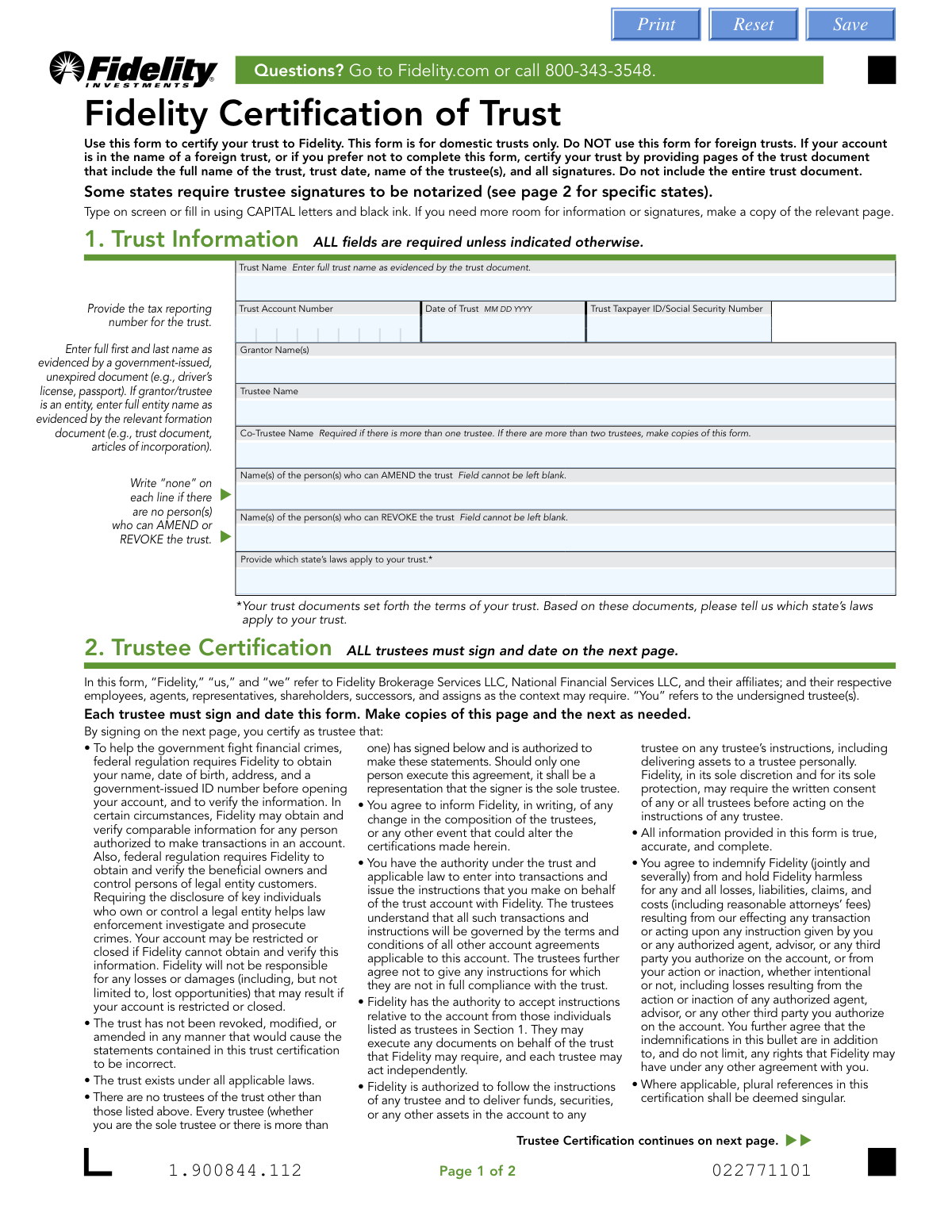
| 1. | Fidelity Certification of Trust | 1 | Simple 28 |
| 2. | Fidelity Trustee Certification — Adding or Removing Trustees | 1 | Moderate 58 |
| 3. | Form 529TCF, The Vanguard 529 College Savings Plan, Trustee Certification | 1 | Moderate 46 |
| 4. | Legal Entity Beneficial Ownership/Trust Certification Form | 1 | Moderate 58 |
| 5. | Trust Certification | 2 | Moderate 50 |
| 6. | Trust Certification and Trustee Powers | 1 | – |
- Enterprise-grade security & data encryption
- 99%+ accuracy powered by AI
- 1,000+ forms from all industries
- Complete forms in under 60 seconds
How to Choose the Right Form
Choosing the right trust certification form depends primarily on the financial institution you are working with and whether you are establishing a new account or updating an existing one. These forms allow you to certify trust details without providing the entire private trust document.
For Fidelity Investments Accounts
If your trust assets are held with Fidelity, you will likely need one of two documents:
- Fidelity Certification of Trust: Use this for standard account setups. It provides Fidelity with essential details such as the trust's name, date, and the authority of the trustees to act.
- Fidelity Trustee Certification — Adding or Removing Trustees: Choose this specific form if you are performing maintenance on an existing account. It is required to formally update records when a trustee is added or removed to ensure legal compliance.
For Vanguard Accounts and 529 Plans
Vanguard requires different certifications based on the type of account or the legal nature of the trust:
- Form 529TCF, The Vanguard 529 College Savings Plan, Trustee Certification: This is the correct choice specifically for trust accounts established within a college savings plan. Use it to certify trustee identity when setting up the plan or changing authorized individuals.
- Legal Entity Beneficial Ownership/Trust Certification Form: Use this if you are opening a new account for a legal entity (like an LLC or a Trust) and need to comply with federal regulations regarding who ultimately owns or controls the entity.
For Insurance and General Transactions
If you are managing a life insurance policy or need to verify specific fiduciary authorities:
- Trust Certification and Trustee Powers: This Transamerica form is used to confirm that proposed transactions are within the powers granted by the trust agreement. It is essential for verifying the trust's tax ID, grantors, and the specific permissions given to trustees regarding financial actions.
Form Comparison
| Form | Primary Purpose | Financial Institution | Key Requirement |
|---|---|---|---|
| Fidelity Certification of Trust | Verifies trust existence and trustee authority for general investment accounts. | Fidelity Investments | Provides summary details without requiring the full trust document. |
| Fidelity Trustee Certification — Adding or Removing Trustees | Updates account records when there is a change in trustees. | Fidelity Investments | Formally identifies individuals being added to or removed from management. |
| Form 529TCF, The Vanguard 529 College Savings Plan, Trustee Certification | Certifies trustee identity specifically for education savings plan accounts. | Vanguard 529 Plan | Required for setting up or updating 529 trust-owned accounts. |
| Legal Entity Beneficial Ownership/Trust Certification Form | Complies with federal regulations to identify individuals controlling legal entities. | Vanguard (Legal Entities) | Focuses on beneficial ownership and anti-money laundering compliance. |
| Trust Certification and Trustee Powers | Confirms that requested transactions are permitted by the trust agreement. | Transamerica | Validates trustee powers regarding life insurance or financial policies. |
Tips for trust certification forms
A Trust Certification form is specifically designed to provide financial institutions with necessary details without revealing private family or distribution information. Instead of sending the entire trust deed, use these forms to summarize only the essential legal authorities and trustee identities.
Before signing, verify that the trust agreement explicitly grants the trustees the power to perform the specific actions requested, such as trading securities or withdrawing funds. Financial institutions require these certifications to ensure all transactions are legally authorized by the trust's governing language.
Whether your trust uses a Social Security Number or a dedicated Employer Identification Number (EIN), having this information at your fingertips will speed up the process. Most certification forms, including those for 529 plans, require this data to verify the trust’s tax status and reporting requirements.
Managing complex trust documents can be time-consuming, but AI-powered tools like Instafill.ai can complete these forms in under 30 seconds with high accuracy. Your sensitive trust data stays secure during the process, making it a reliable way to handle multiple certifications for different financial accounts.
Whenever a trustee is added or removed, you must submit an updated certification form immediately to maintain account access. Keeping these records current ensures that only authorized individuals can manage assets and prevents administrative delays during critical financial transactions.
Ensure that the names and signatures on the certification form exactly match the names listed in the original trust agreement. Inconsistencies in names or titles can lead to the form being rejected by a compliance department, requiring a full resubmission.
Frequently Asked Questions
A trust certification form is a legal document that provides a summary of essential trust information to financial institutions without requiring the disclosure of the entire trust agreement. It protects the privacy of the trust's grantors and beneficiaries while proving that the trustees have the legal authority to manage assets and conduct transactions.
This specific form is required whenever there is a change in the individuals responsible for managing a Fidelity trust account. You must file it to formally update account records following the resignation, death, or new appointment of a trustee to ensure only authorized individuals can access the funds.
Vanguard requires this form to comply with federal regulations aimed at preventing financial crimes such as money laundering and fraud. It identifies the 'beneficial owners'—the individuals who ultimately own or control the trust or legal entity—providing the transparency required by law for financial institutions.
Generally, all currently acting trustees must sign the certification form to attest to its accuracy. Depending on the specific requirements of the institution (like Fidelity or Transamerica) and the terms of the trust itself, signatures may need to be witnessed by a notary public to be legally binding.
Yes, you can use AI tools like Instafill.ai to complete trust certification forms quickly and accurately. These tools can extract relevant data from your original trust documents and automatically populate the corresponding fields on the required PDF form.
Using AI-powered services like Instafill.ai, most trust certification forms can be completed in under 30 seconds. The AI accurately identifies and places data from your source documents, significantly reducing the time spent on manual data entry.
Yes, if a trust is the owner of a Vanguard 529 plan, you must submit Form 529TCF. This form certifies the identity of the trustees and their authority to make decisions regarding the college savings account, such as requesting distributions or changing beneficiaries.
Most trust certifications require the full legal name of the trust, the date it was executed, the Taxpayer Identification Number (TIN), and the names and addresses of all current trustees. You may also need to specify if the trust is revocable or irrevocable and describe the specific powers granted to the trustees.
Transamerica uses this form to confirm that the trustees have the specific legal power to manage life insurance policies or other financial products. It ensures that any requested actions, such as taking a loan against a policy or changing a death benefit, are permitted under the terms of the trust agreement.
In most cases, no. These certification forms are designed to act as a substitute for the full trust document to maintain your privacy. However, the financial institution reserves the right to request specific pages of the trust agreement if the certification form does not provide sufficient clarity.
Failing to update the certification can lead to significant delays in account management or the freezing of assets. Financial institutions like Fidelity or Vanguard will not permit a new trustee to act on the account until their authority has been formally certified through the appropriate paperwork.
Glossary
- Form Complexity Index
- Instafill’s 0–100 measure of how much effort a form takes to complete, calculated deterministically from the form’s own structure rather than estimated. It combines the number of fillable fields (the largest factor), how difficult those fields are to complete based on their type, the number of pages that contain fields, the amount of conditional “fill-only-if” logic, and how many sections the form is divided into, then adds modifiers for tables and repeating lists, bundled instruction pages, and dense page layouts. A higher score means the form is harder to fill out by hand. The forms in this category have a median Form Complexity Index of 50/100 (Moderate). See exactly how it is calculated.
- Certification of Trust
- A legal document that summarizes the essential details of a trust agreement, allowing a trustee to prove their authority to a financial institution without revealing private details like asset values or specific beneficiaries.
- Trustee
- The person or entity designated in a trust agreement to hold legal title to the trust's property and manage its assets for the benefit of others.
- Grantor
- Also known as a settlor or trustor, this is the individual who creates the trust and transfers their assets into it. Their name and information are typically required to verify the trust's validity.
- Beneficial Owner
- An individual who ultimately owns or controls a legal entity, such as a trust. Federal regulations require financial institutions to identify these individuals to prevent money laundering and other financial crimes.
- Successor Trustee
- A person named in the trust document who is authorized to take over management of the trust if the original trustee dies, resigns, or becomes incapacitated.
- Revocable Trust
- A trust that can be modified, amended, or terminated by the grantor during their lifetime. This is the most common type of trust identified on certification forms.
- Fiduciary
- A person who has the legal obligation to act in the best interest of another party. Trustees have a fiduciary duty to the trust's beneficiaries, meaning they must manage trust assets responsibly and ethically.
- Tax Identification Number (TIN)
- A unique number, often an Employer Identification Number (EIN), used by the IRS to identify the trust for tax reporting purposes. Most trust accounts require a TIN rather than a personal Social Security Number.